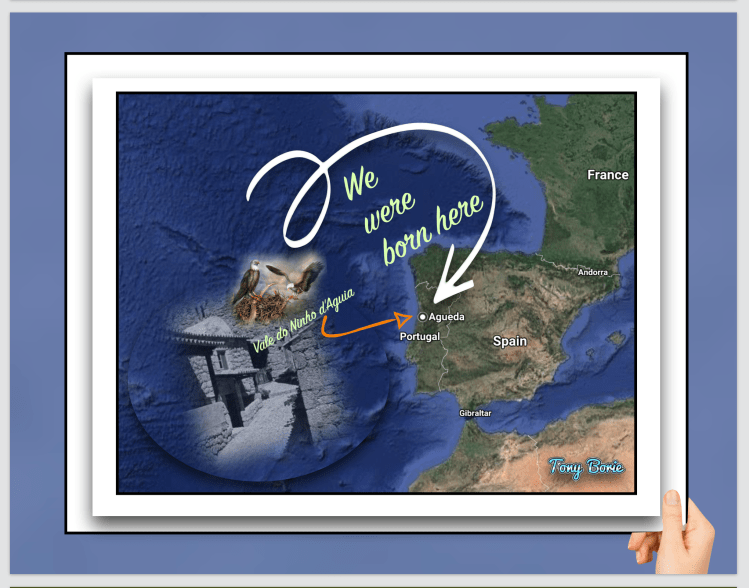
…nascemos lá!. (…we were born there)!.

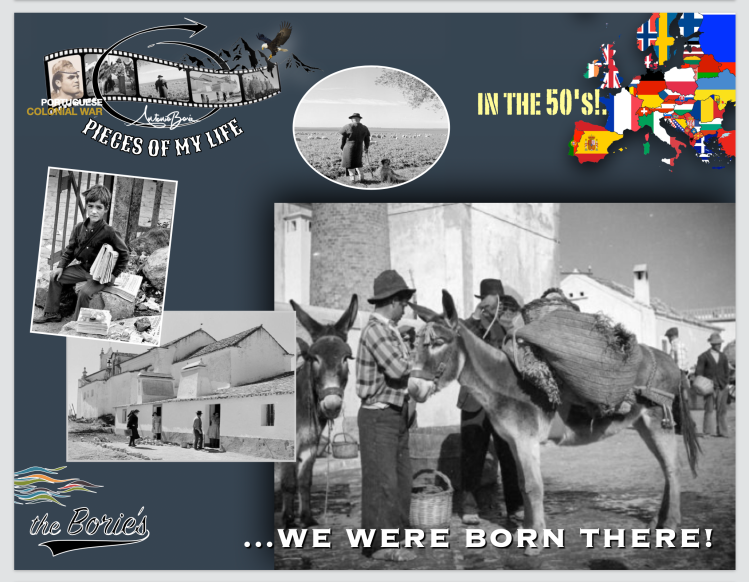
…nas décadas de quarenta e cinquenta do século passado, logo após a segunda guerra mundial, pelo menos no sul da Europa de onde somos oriundos, as experiências das famílias diferiam com base na sua localização, estatuto económico e em algumas circunstâncias individuais, cobriam uma paisagem grande e variada, sempre com base na agricultura!.

…in the forties and fifties of the last century, right after the second world war, at least in southern Europe where we come from, the experiences of families differed based on their location, economic status and in some individual circumstances, covering a large and varied landscape, always based on agriculture!.

…havia crenças, tradições e estilos de vida que vinham dos seus antepassados e, pelo menos nas aldeias e vilas não variavam muito de outros centros urbanos, fossem eles do interior de montanha ou das terras da beira mar, onde as famílias continuaram aspectos de cultura que incluíam práticas agrícolas e técnicas culinárias, para sobreviver!. 

…there were beliefs, traditions and lifestyles that came from their ancestors and, at least in the villages and towns, they did not vary much from other urban centers, whether in the interior of the mountains or in the lands by the sea, where families continued aspects of culture which included agricultural practices and culinary techniques, to survive!.

…não importava que fosse agricultor, pescador, ferreiro, carpinteiro, criança, esposa ou mãe, a jornada de trabalho normalmente começava antes do amanhecer e durava até ao pôr do sol, onde ao longo do dia, todos se dedicavam às tarefas essenciais pela sobrevivência e bem de toda a família!. 

…it didn’t matter if you were a farmer, fisherman, blacksmith, carpenter, child, wife or mother, the workday normally began before dawn and lasted until sunset, where throughout the day, everyone dedicated themselves to essential tasks for survival and good luck to the whole family!.

…a manhã começava com um modesto desjejum de pão de milho, leite de cabra ou ovelha, chicória, (uma mistura parecida com café), sopa de cebola e batata antes do início do trabalho, dependendo da época do ano, do clima e da estação, e esse sustento era muito necessário, porque uma jornada de trabalho típica poderia durar até 12 horas, praticada seis dias por semana!. 

…the morning began with a modest breakfast of cornbread, goat’s or sheep’s milk, chicory, (a coffee-like mixture), onion and potato soup before starting work, depending on the time of year, the weather and the season, and this support was very necessary, because a typical workday could last up to 12 hours, carried out six days a week!.

…as mulheres, quando necessário também ajudavam nas tarefas da agricultura, da pesca ou qualquer outro trabalho, mas normalmente trabalhavam em casa administrando todos os aspectos da casa e dos cuidados com os filhos, incluindo a preparação das refeições e a educação básica dos filhos, como tal, os filhos adoravam a mãe, que sempre lembravam ao longo de toda a sua vida!. 

…women, when necessary, also helped with farming, fishing or any other work, but they normally worked at home managing all aspects of the home and childcare, including preparing meals and providing basic education for their children, As such, the children adored their mother, whom they always remembered throughout their lives!.
…além disso, as mulheres casadas de famílias não agrícolas muitas vezes trabalhavam ao lado dos maridos em lojas, comércios ou tavernas, e as mulheres solteiras ou viúvas trabalhavam como costureiras, parteiras ou taberneiras e as crianças muitas vezes ajudavam os pais no seu trabalho, aprendendo competências valiosas para o seu futuro!.

…in addition, married women from non-agricultural families often worked alongside their husbands in shops, businesses or taverns, and single women or widows worked as seamstresses, midwives or innkeepers and children often helped their parents with their work, learning valuable skills for your future!.

…naquela época, o almoço era chamado de “jantar” e era a maior e mais farta refeição do dia à base de sopa de batatas e outros vegetais da estação, como milho ou couves, onde também podia entrar alguma carne salgada de porco ou mesmo aves, seguindo-se um curto período de descanso, onde às vezes se permitia que as famílias se conectassem com os vizinhos e fortalecessem os laços sociais!. 

…at that time, lunch was called “dinner” and was the biggest and most filling meal of the day, based on potato soup and other seasonal vegetables, such as corn or cabbage, which could also include some salted pork or even birds, followed by a short period of rest, where families were sometimes allowed to connect with neighbors and strengthen social ties!.

…também havia algumas excepções, como por exemplo durante os períodos de pico agrícola, como o plantio na primavera e a colheita no outono, a jornada de trabalho das famílias era ampliada, pois todos os membros da família se dedicavam às tarefas essenciais, onde as mulheres preparavam a comida de madrugada a que chamavam “o farnel” e era levada e comida nos campos agrícolas, porque a natureza era mais exigente nestas épocas exigindo mais horas para garantir uma colheita bem-sucedida!.

…there were also some exceptions, for example during peak agricultural periods, such as planting in spring and harvesting in autumn, families working hours were extended, as all family members dedicated themselves to essential tasks, where the Women prepared the food early in the morning, which they called “farnel” and it was taken and eaten in the agricultural fields, because nature was more demanding at these times, requiring more hours to guarantee a successful harvest!.

…por outro lado, nos meses de inverno ou durante condições climáticas adversas, quando as atividades ao ar livre eram mais limitadas, a jornada de trabalho poderia ser mais curta, onde as famílias se concentravam  nas tarefas internas e domésticas, como preparar alimentos para armazenamento ou tecer e remendar roupas!. 

…conversely, in the winter months or during adverse weather conditions when outdoor activities were more limited, the workday could be shorter where families focused on indoor and domestic tasks such as preparing food for storage or weave and mend clothes!.

…continuando…, as roupas eram geralmente feitas de materiais de origem local, especialmente lã de ovelha e algodão e linho cultivados, e as famílias produziam os seus próprios têxteis através da fiação e da tecelagem!. As roupas do dia a dia eram modestas e simples, refletindo as necessidades práticas da vida diária!. Os homens normalmente usavam tamancos, camisas, coletes e calças, enquanto as mulheres vestiam vestidos com saias rodadas cobertas por longos aventais!. 

…continuing…, clothes were generally made from locally sourced materials, especially sheep’s wool and cultivated cotton and linen, and families produced their own textiles through spinning and weaving!. Everyday clothes were modest and simple, reflecting the practical needs of daily life!. Men typically wore clogs, shirts, vests and pants, while women wore dresses with full skirts covered by long aprons!.

…e para terminar…,  as famílias à noite retiravam-se para as suas camas, que eram feitas e recheadas com colchões de palha, e como havia poucos móveis na casa, raramente havia dormitórios designados, em vez disso, as pessoas dormiam em áreas de convivência com vários membros da família compartilhando o mesmo quarto, onde as crianças mais velhas dormiam numa cama e os bebés e as crianças muito pequenas dormiam ao lado da mãe e…, com o ritmo natural da luz do dia e a iluminação artificial muito limitada, as horas de dormir eram cedo, porque havia a necessidade de preparação para os longos dias de trabalho físico!.

…and to finish…, families at night retired to their beds, which were made and stuffed with straw mattresses, and as there was little furniture in the house, there were rarely designated bedrooms, instead, people slept in areas of coexistence with several family members sharing the same room, where older children slept in one bed and babies and very young children slept next to their mother and…, with the natural rhythm of daylight and very limited artificial lighting, bedtimes were early, because there was a need to prepare for long days of physical work!.

Tony Borie, Século XXI. (Tony Borie, 21st Century).
…coisas da vida!. (…things in life)!.

…alguém lá esteve e entendeu que era uma oportunidade fotográfica e reuniu os monarcas para esta imagem histórica, e nós…, um dia destes encontrámo-la!. Claro, não resistimos a falar dela!. Está lá a realeza Europeia, e foi tirada em Londres no ano de 1910 e mostra os nove monarcas reinantes que estiveram presentes durante o enterro do rei Eduardo VII!. Possivelmente é a única fotografia de todos os nove reis existentes e também lá está um do país onde nascemos, que era o Rei Manuel II de Portugal e Algarve!.

…someone was there and understood that it was a photographic opportunity and brought together the monarchs for this historic image, and we…, one of these days we found it!. Of course, we couldn’t resist talking about her! European royalty is there, and was taken in London in 1910 and shows the nine reigning monarchs who were present during the burial of King Edward VII!. It is possibly the only photograph of all nine existing kings and there is also one from the country where we were born, who was King Manuel II of Portugal and Algarve!.

…e, companheiros de jornada, lá para o ano de três mil e tal os livros de história que ainda existirem, vão lembrar que havia os reis de bigodes e barbas encaracoladas que eram senhores de muitas terras e tinham escravos a quem chamavam servos e passavam a vida entre outras coisas…, talvez na companhia das moças bonitas que por lá existiam ao redor, ou a fazer guerras e…, quando batiam com o pé no chão faziam tremer todo o palácio!.

…and, companions on the journey, back in the year three thousand or so, the history books that still exist will remember that there were kings with mustaches and curly beards who were masters of many lands and had slaves whom they called servants and passed life among other things…, perhaps in the company of the beautiful girls that were around, or fighting wars and…, when they stamped their feet on the ground they made the entire palace shake!.

…mas ninguém se vai lembrar do Zé Magro que passou a vida a plantar couves na terra arrendada ao senhor dono da aldeia, ou…, da minha saudosa e virtuosa avó Agar que tirou um retrato descalça, com uma saia feita de “borel” amarrada com uma cinta escura de linho e uma camisa do mesmo linho, mas de cor quase branca, sentada num banco de três pernas, junto de um caneco de barro com flores silvestres apanhadas na beira do caminho!. 

…but no one will remember Zé Magro who spent his life planting cabbages on the land rented from the owner of the village, or…, my late and virtuous grandmother Agar who took a portrait barefoot, with a skirt made of “borel” tied with a dark linen belt and a shirt made of the same linen, but almost white in color, sitting on a three-legged stool, next to a clay mug with wild flowers picked on the side of the path!.

..porquê?. Porque eram pobres, pessoas de muitos bons sentimentos, ajudavam todas as pessoas em desgraça e nunca maltrataram ou feriram alguém!.

..why?. Because they were poor, people with many good feelings, they helped everyone in misfortune and never mistreated or hurt anyone!

Tony Borie, Século XXI. (Tony Borie, 21st Century).

…apanhados pelo clima!. (caught by the climate!.)

…quando da nossa participação forçada na maldita Guerra Colonial Portuguesa em África, na então província da Guiné, talvez sem o notar, fomos “apanhados pelo clima” porque os elementos eram duros, havia um calor sufocante, havia o vírus e outras doenças, as picadas de insetos a podridão da selva pantanosa que nos infectava e…, a temperatura caía consideravelmente à noite e fazia frio, era a estação das monções, onde chovia constantemente, no entanto o nosso jovem corpo Europeu, foi-se acostumando a tudo isto!.

…when we participated forcedly in the cursed Portuguese Colonial War in Africa, in the then province of Guinea, perhaps without noticing it, we were “caught by the climate” because the elements were harsh, there was suffocating heat, there were viruses and other diseases, the insect bites, the rot of the swampy jungle that infected us and…, the temperature dropped considerably at night and it was cold, it was the monsoon season, where it rained constantly, however our young European body got used to all this! .

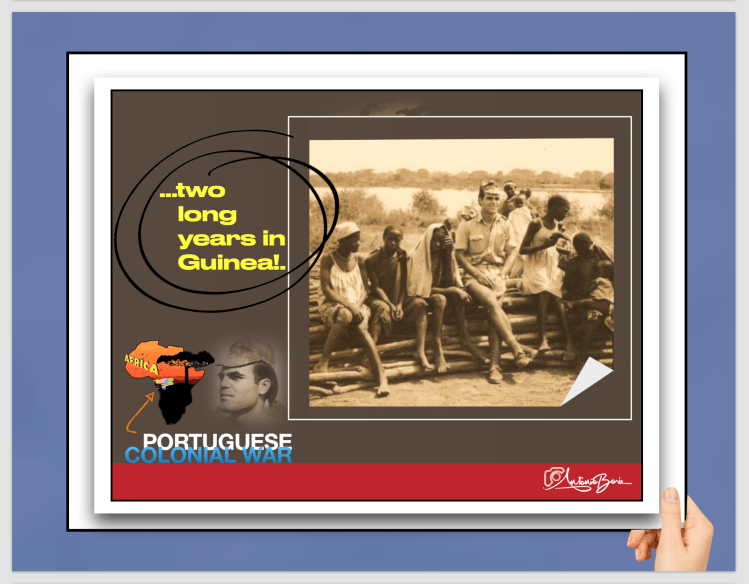
…no “posto avançado” onde estivemos pelo período de dois longos anos, não havia paz!. No silêncio da noite ou em qualquer outro infeliz momento, “de repente o inferno explodia” e não sabíamos se iríamos ser o próximo a ser embrulhado no nosso próprio camuflado sujo com o nosso próprio sangue, como tal, não sabemos as vezes que estivemos perto de morrer, e nesses momentos, éramos forçados a aprender a valorizar a nossa vida e…, éramos uns jovens de 20 anos!. Às vezes pensando nisto, sentimos a pele a arrepiar-se!. 

…in the “outpost” where we were for two long years, there was no peace! In the silence of the night or in any other unfortunate moment, “all of a sudden all hell broke loose” and we didn’t know if we would be the next one to be wrapped in our own camouflage dirty with our own blood, as such, we don’t know how many times we were close to die, and in those moments, we were forced to learn to value our life and…, we were young people in our 20s!. Sometimes thinking about this makes our skin crawl!

…e tal como muitos veteranos de guerra que voltaram de África, a princípio não tínhamos muito a dizer, no entanto, passado alguns anos, começámos a escrever as coisas que testemunhámos como histórias e as escrevemos num pequeno diário que uma madrinha de guerra nos tinha enviado!. 

…and like many war veterans who returned from Africa, at first we didn’t have much to say, however, after a few years, we began to write down the things we witnessed as stories and wrote them down in a small diary that a war godmother had for us sent!.

…assim, pretendíamos mostrar tudo isto sobretudo aos jovens, como um aviso para quando fossem forçados a ingressar nas forças armadas, já que nós mesmos não tínhamos a menor ideia ao sermos forçados a nelas ingressar, sendo naquela época, pouco mais que crianças!. No entanto, enquanto crianças que cresciam naquela sociedade, assumimos que os adultos que eram os “líderes” do nosso país que era Portugal, então com regime colonial…, sabiam o que estavam a fazer!.

…thus, we intended to show all this especially to young people, as a warning for when they were forced to join the armed forces, since we ourselves had no idea when we were forced to join them, being at that time, little more than children!. However, as children growing up in that society, we assumed that the adults who were the “leaders” of our country, which was Portugal,then under colonial rule…, knew what they were doing!

Tony Borie, Século XXI. (Tony Borie, 21st Century). 
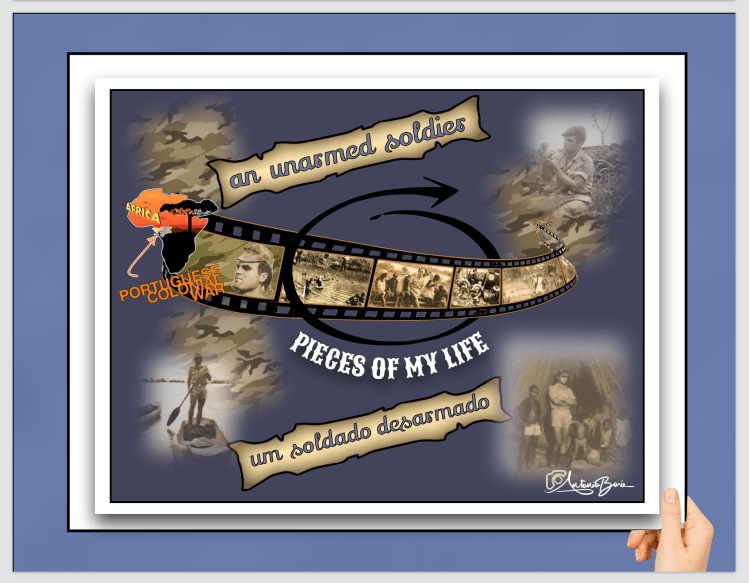
…entrámos na vida de adulto feridos e incuráveis!. (…we entered adult life wounded and incurable)!.

…nós, uma criança da época de quarenta do século passado que nasceu e vivia numa aldeia de montanha, mas perto do mar…, num país da Europa com regime então colonial que, quase a entrar na idade de adulto, foi “arrancado” do lugar onde nasceu, mobilizado, recebido à pressa treino de guerra de guerrilha num campo de treino improvisado e…, obrigado a entrar e navegar para sul, no porão dum navio de carga com destino aos pântanos do Golfo da Guiné, em África, para lutar contra guerrilheiros que queriam a independência dos seus territórios e que…, nunca tinha visto antes e também nada tinha em contra!.

…we, a child from the 40s of the last century who was born and lived in a mountain village, but close to the sea…, in a European country with a colonial regime that, almost reaching adulthood, was “ripped away” from place where he was born, mobilized, hastily received guerrilla warfare training in an improvised training camp and…, forced to enter and sail south, in the hold of a cargo ship bound for the swamps of the Gulf of Guinea, in Africa, to fight against guerrillas who wanted the independence of their territories and who… I had never seen before and had nothing against them either!.

…e, ao fim de dois longos anos…, quando regressámos à Europa vindos dessa maldita Guerra Colonial em África, a família e os vizinhos viam, sabiam, notavam que estávamos diferentes e ainda aterrorizados e algo agressivos…, para nos refugiar do medo que ainda sentíamos…, afastando-nos das pessoas e, sem acreditar que ainda existíamos, perguntávamos a nós mesmos,“que mal fizemos para nunca mais descansar, mesmo quando nos afastamos para um cantinho mais escondido”!.

…and, after two long years…, when we returned to Europe from that damned Colonial War in Africa, our family and neighbors saw, knew, noticed that we were different and still terrified and somewhat aggressive…, to take refuge from the fear that We still felt…, moving away from people and, without believing that we still existed, we asked ourselves, “what wrong did we do to never rest again, even when we moved away to a more hidden corner”!.

…e, pela vida fora o medo que sempre sentimos, principalmente quando nos encontramos entre alguns adultos é doloroso e…, quebrou muito do potencial que sempre nos revestiu até aos dias de hoje e…, nesta já avançada idade continuamos a construir memórias que nos atormentam, no entanto, vamos sobrevivendo e resistindo, embora em alguns momentos sentindo ser “um zero”, principalmente quando recebemos algumas “cagadelas de alguns pássaros predadores, jovens e até adultos, que infelizmente voam e governam no país onde nascemos e por quem cuja bandeira combatemos, que dá pelo nome de Portugal”!.

…and, throughout life, the fear that we have always felt, especially when we find ourselves among some adults, is painful and…, it has broken much of the potential that has always possessed us until today and…, at this advanced age we continue to build memories that give us torment, however, we survive and resist, although at times we feel like we are “a zero”, especially when we receive some “shits” from some predatory birds, young and even adults, who unfortunately fly and govern in the country where we were born and by whom whose flag we fight, which is called Portugal”!

…poderíamos escrever uma centena de frases com a temática do medo, de momentos intensos da Guerra Colonial, marcados a fogo nas entranhas da nossa memória, pegando-se à pele como se uma segunda pele se tratasse, e não era só os ataques mortíferos dos guerrilheiros que nos combatiam, eram também as ferradelas daqueles mosquitos selvagens dos pântanos africanos do golfo da Guiné, onde vinham aos milhares, talvez aos milhões, zumbindo ao redor, mordendo-nos, fazendo-nos sofrer ainda mais, porque vinham às montanhas mais altas que as do Himalaia, todos para cima de nós, parecendo que só nós existíamos por ali!.  

…we could write a hundred sentences with the theme of fear, of intense moments of the Colonial War, burned into the depths of our memory, clinging to the skin as if it were a second skin, and it wasn’t just the deadly attacks of the guerrillas who fought us, were also the stingers of those wild mosquitoes from the African swamps of the Gulf of Guinea, where they came in thousands, perhaps in millions, buzzing around, biting us, making us suffer even more, because they came to the highest mountains than those in the Himalayas, all on top of us, looking like we were the only ones there!.

…todos temos a nossa historia de que vamos deixando marcas no caminho e…, os outros também sofrem, só que para alguns a vida é um autêntico naufrágio e…, pelo meio aparecem aqueles que nos falam na defesa das fronteiras e da terra que dizem ser deles…, como se a terra pertencesse a alguém!. Esses são “uns verdadeiros mausoléus da estupidez”, que continuam a defender as tais fronteiras e os pedaços de terra que não são de ninguém, mas…, infelizmente os homens através dos séculos amaram sempre ser estúpidos!.

…we all have our story that we leave marks along the way and…, others also suffer, but for some life is a real shipwreck and…, in between appear those who speak to us in defense of the borders and the land that they say be theirs…, as if the land belonged to someone! These are “true mausoleums of stupidity”, which continue to defend such borders and pieces of land that belong to no one, but…, unfortunately, men over the centuries have always loved to be stupid!

…e o pior…, é que ainda hoje nos continuamos a refugiar no nosso medo, perguntando ao nosso Deus, que mal fizemos para nunca mais poder descansar, e tal como acima mencionamos, mesmo quando nos afastamos para o nosso cantinho mais escondido, porque os nossos medos continuam a construir a grande travessia da qual somos um sobrevivente duma história muito longa e que a todo o momento nos fazem lembrar as tais “cagadelas de alguns pássaros  predadores, jovens e até adultos, que infelizmente voam e governam no país onde nascemos e por quem cuja bandeira combatemos, que dá pelo nome de Portugal”!.

…and the worst thing…, is that even today we continue to take refuge in our fear, asking our God, what wrong did we do to never be able to rest again, and as we mentioned above, even when we move away to our most hidden corner, because our fears continue to build the great crossing of which we are a survivor of a very long history and which at all times remind us of the “shits” of some predatory birds, young and even adults, that unfortunately fly and govern in the country where we were born and for those whose flag we fight, who goes by the name of Portugal”!.

Tony Borie, Século XXI. (Tony Borie, 21st Century).