…estávamos em Red Lodge, Montana e chovia!. Era nossa intenção, mais uma vez tentar viajar pela Highway 212, que é a panorâmica Beartooth Highway, no entanto, parte dela estava interdita porque o temporal causou algumas inundações mas, vagarosamente íamos prosseguindo parando aqui e ali, onde outros viajantes que se cruzavam com nós também paravam e trocávamos informação de como a estrada estava e até onde se podia chegar!.
…we were in Red Lodge, Montana and it was raining!. It was our intention, once again, to try to travel along Highway 212, which is the scenic Beartooth Highway, however, part of it was closed because the storm caused some flooding, but we slowly continued stopping here and there, where other travelers who crossed paths with We also stopped and exchanged information on how the road was and how far we could get!.
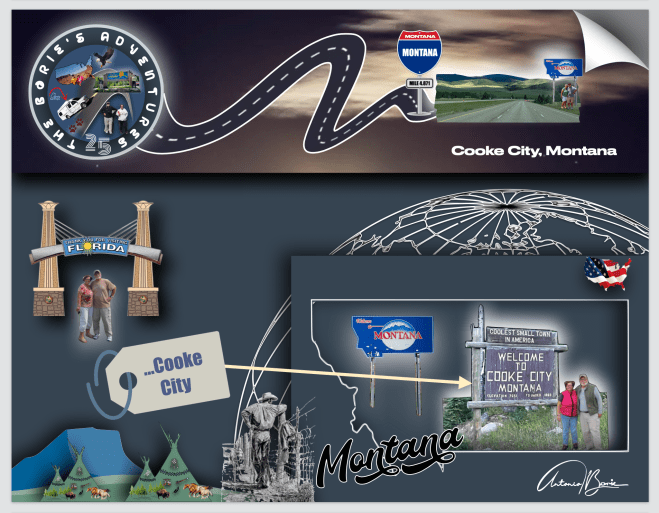
…era a famosa e panorâmica Beartooth Highway, que entra ao norte do estado de Wyoming, como tal havia que tentar prosseguir porque o cenário, mesmo com um tempo de chuva era deslumbrante!. Prosseguimos, já tínhamos entrado no estado de Wyoming e quase todos os viajantes com quem nos cruzávamos nos diziam que conseguiram chegaram até à comunidade de Cooke City, em Montana, mas daí para diante a estrada estava mesmo interdita, portanto voltavam!.
…it was the famous and panoramic Beartooth Highway, which enters the north of the state of Wyoming, so we had to try to continue because the scenery, even in rainy weather, was stunning! We continued, we had already entered the state of Wyoming and almost all the travelers we met told us that they had managed to reach the community of Cooke City, in Montana, but from then on the road was closed, so they returned!
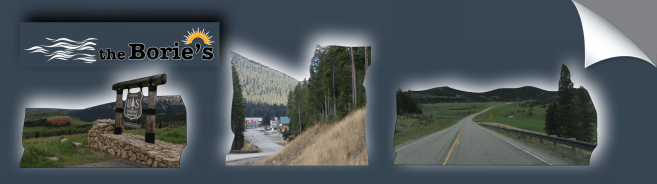
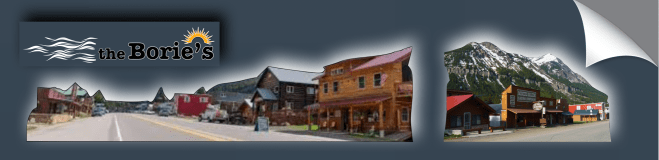
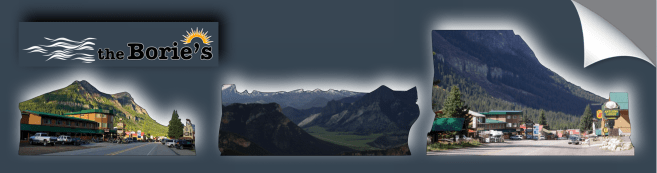
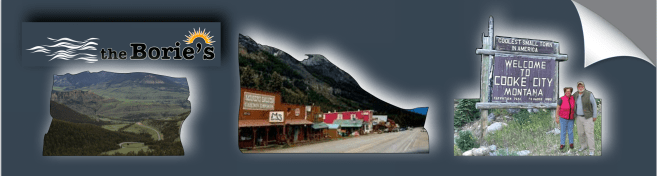
…nós tentámos fazer o mesmo, como tal prosseguimos, seguindo para oeste/norte entrando de novo em Montana, chegando à já mencionada comunidade de Cooke City, que nos pareceu um local muito pitoresco e o cenário desta estrada que serpenteia pela Floresta Nacional Shoshone e pelas montanhas, também tem história porque em algumas partes segue a rota seguida pelo “Chefe Joseph” para fora do hoje Parque Nacional de Yellowstone e para Montana, no ano de 1877, durante a sua tentativa de fugir da Cavalaria dos EUA e escapar para o Canadá!.
…we tried to do the same, so we continued, heading west/north back into Montana, arriving at the aforementioned community of Cooke City, which seemed like a very picturesque place and the setting for this road that winds through the Shoshone National Forest and through the mountains, it also has history because in some parts it follows the route taken by “Chief Joseph” out of what is now Yellowstone National Park and into Montana in 1877, during his attempt to escape the US Cavalry and escape to Canada!.
…toda esta área era relativamente desconhecida para os homens brancos até o final da década de 1860, quando garimpeiros rondavam a área em busca de ouro, no entanto hoje, a principal indústria da comunidade de Cooke City, é o turismo, que durante o inverno inclui esqui e snowmobile!. A famosa e panorâmica Beartooth Highway, passa pelo seu centro, levando a sudoeste até o Parque Nacional de Yellowstone, numa rota panorâmica que sobe a 10.947 pés (3.337 m) de altitude através das montanhas e do Planalto Beartooth!, para continuar a sudeste de volta ao Wyoming no vale do rio Clarks Fork Yellowstone!.
…this entire area was relatively unknown to white men until the late 1860s, when prospectors prowled the area in search of gold, however today, the Cooke City community’s main industry is tourism, which during the winter includes skiing and snowmobiling!. The famous and scenic Beartooth Highway passes through its center, leading southwest to Yellowstone National Park on a scenic route that climbs 10,947 feet (3,337 m) in elevation through the mountains and Beartooth Plateau!, to continue southeast of back to Wyoming in the Clarks Fork Yellowstone River Valley!.
…a sua localização geográfica é remota, por estar cercada por altos picos e passagens de montanhas e o único acesso rodoviário durante todo o ano é a partir da localidade de Gardiner, Montana, que está localizada na entrada nordeste do Parque Nacional Yellowstone!. Todavia, também tem acesso rodoviário a partir de Red Lodge, Montana, (que foi seguido por nós), mas é sazonal, abrindo no final da primavera e fechando bem no início do inverno!.
…its geographical location is remote, as it is surrounded by high peaks and mountain passes and the only year-round road access is from the town of Gardiner, Montana, which is located at the northeast entrance of Yellowstone National Park!. However, it also has road access from Red Lodge, Montana, (which we followed), but it is seasonal, opening in late spring and closing at the very beginning of winter!.
…a despovoação em alguns territórios no ocidente era normal, porque as possíveis minas de ouro estavam geralmente localizadas em locais remotos e como tal despovoados, no entanto foi a mineração que alimentou os motores da colonização e da “civilização” no ocidente!. Assim, Cooke City era remota, ficava a muitos dias de dolorosas caminhadas em trilhas difíceis do assentamento mais próximo, que era a hoje cidade de Bozeman, Montana!.
…depopulation in some territories in the West was normal, because possible gold mines were generally located in remote and therefore unpopulated locations, however it was mining that fueled the engines of colonization and “civilization” in the West!. Thus, Cooke City was remote, it was many days of painful hiking on difficult trails from the nearest settlement, which was today the city of Bozeman, Montana!.
…só por volta de 1869-70, os primeiros mineiros começaram a descobrir ouro na área e no início desta comunidade, os lotes de terreno de esquina foram vendidos inicialmente por 20 dolares e os lotes internos por 10 dolares e por aqui havia cerca de 35 homens e uma mulher nesta nova comunidade de Cooke City, onde começaram a construir casas de toras de madeira…, onde o que hoje é a rua principal!.
…it wasn’t until around 1869-70 that the first miners began to discover gold in the area and in the early days of this community, corner lots were initially sold for $20 and interior lots for $10 and around here there were about 35 men and a woman in this new community of Cooke City, where they began to build log homes…, where what is now Main Street!.
…e depois de por algum tempo permanecermos por aqui, voltamos pela mesma rota em direcção ao local de onde saímos pela manhã…, que era Red Lodge, Montana, onde continuava a chover!.
…and after staying here for some time, we returned along the same route towards the place where we left in the morning…, which was Red Lodge, Montana, where it continued to rain!.
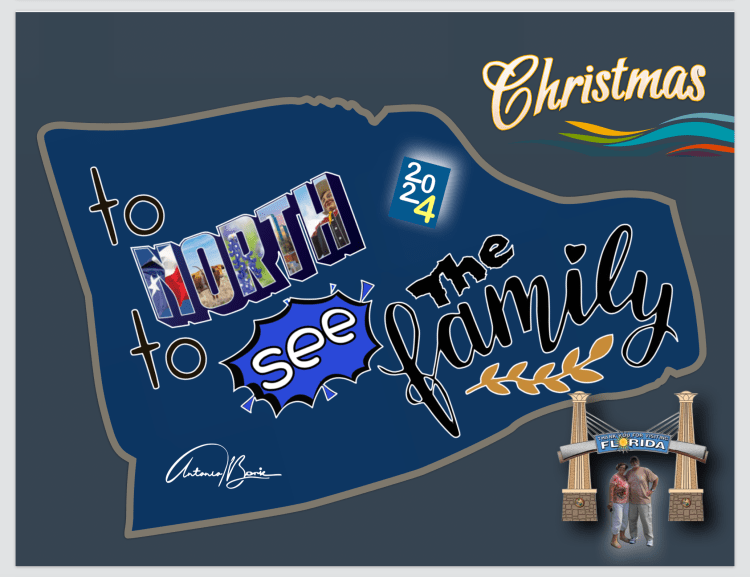
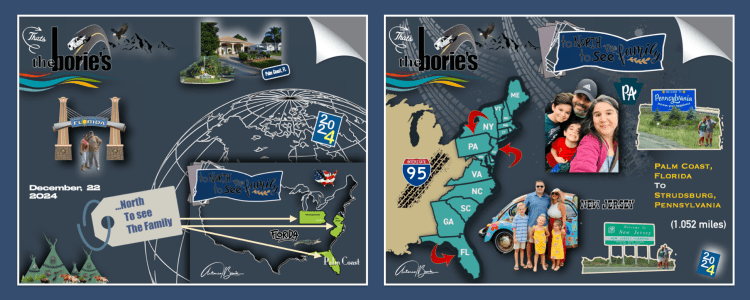
…fomos ao norte, porque às vezes é necessário retornar à infância, ao seio da família, o único porto de abrigo e…, caminhámos na neve das montanhas de Pennsylvania, porque a experiência de vida diz-nos que nada vive para sempre, só talvez as montanhas e os rios que correm para o mar vivem até o sol se apagar…, depois tudo ficará escuro e já não haverá olhos para ver!.
…we went to the north, because sometimes it is necessary to return to childhood, to the heart of the family, the only haven of shelter and…, we walked in the snow of the mountains of Pennsylvania, because life experience tells us that nothing lives forever, only Maybe the mountains and the rivers that flow to the sea live until the sun goes out…, then everything will be dark and there will be no more eyes to see!.
…depois dum confortável e aconchegante convívio com parte da família nessas montanhas, descemos para o gelo das planícies deNova Jersey, recebendo de novo o calor da outra parte da família, porque infelizmente o ser humano vivendo fechado ao egoísmo, só se preocupa com o seu interior, querendo fazer valer a sua vontade ao resto do mundo, não se lembrando que o calor da família, ainda é quase tudo na vida!.
…after a comfortable and cozy get-together with part of the family in these mountains, we descended to the ice of the New Jersey plains, once again receiving the warmth of the other part of the family, because unfortunately the human being, living closed to selfishness, only cares about the your inner self, wanting to assert your will to the rest of the world, not remembering that the warmth of family is still almost everything in life!.
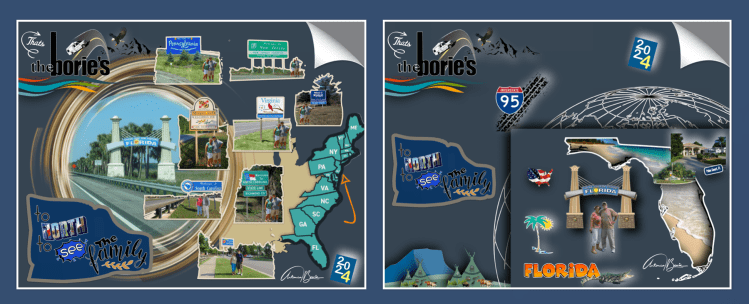
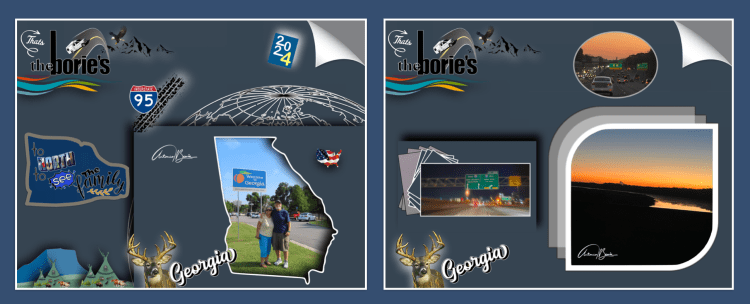
…num breve resumo desta viajem das “Christmas de 2024 ao norte”, para lá, passámos pelo estado de Georgia, que se situa a norte do estado da Florida onde presentemente vivemos e a leste do Oceano Atlântico, ainda era madrugada, com um tráfico moderado, o que valeu à nossa dedicada esposa Isaura tirar algumas fotos ao nascer do sol!.
…in a brief summary of this “Christmas 2024 trip to the north”, there, we passed through the state of Georgia, which is located north of the state of Florida where we currently live and east of the Atlantic Ocean, it was still dawn, with traffic moderate, which meant our dedicated wife Isaura took some photos at sunrise!.
…entrando e de seguida entrámos no estado da Carolina do Sul, que no século passado experimentou um desenvolvimento económico significativo e onde a Interstate 95 segue por uma distância de aproximadamente 200 milhas e em algumas áreas perto ou com acesso ao Oceano Atlântico!.
…entering and then entering the state of South Carolina, which in the last century has experienced significant economic development and where Interstate 95 runs for a distance of approximately 200 miles and in some areas close to or with access to the Atlantic Ocean!.
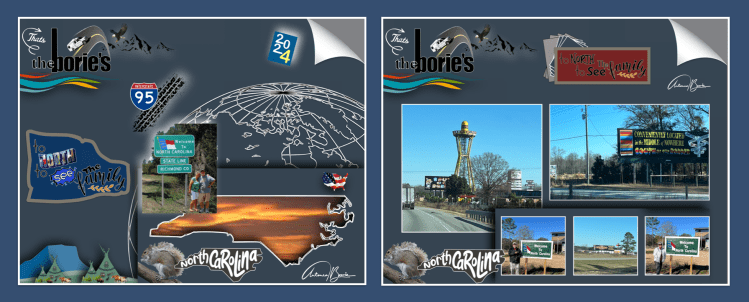
…de seguida surge-nos a torre do ”South of the Border”, que é uma atração na Interstate 95,anunciando que entramos no estado de Carolina do Norte, onde a sua primeira evidência de ocupação humana remonta a 10.000 anos!. No entanto hoje, principalmente nas suas áreas metropolitanas, experimentou um aumento constante no crescimento populacional, criando assim um grande desenvolvimento, principalmente nos setores financeiro, bancário e de tecnologia!.
…then we see the “South of the Border” tower, which is an attraction on Interstate 95, announcing that we have entered the state of North Carolina, where the first evidence of human occupation dates back 10,000 years!. However today, especially in its metropolitan areas, it has experienced a constant increase in population growth, thus creating great development, mainly in the financial, banking and technology sectors!.
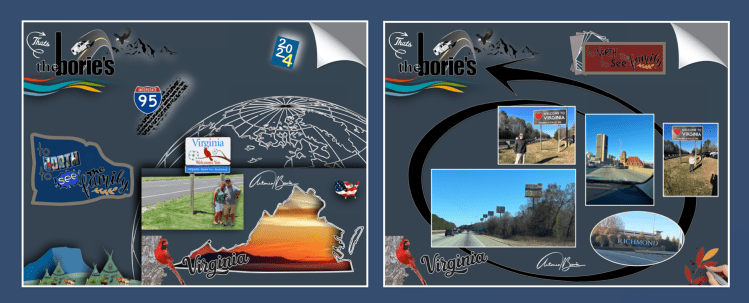
…e já era no final da tarde quando entrámos no estado da Virgínia onde pernoitámos!. Este estado, faz parte da Planície Atlântica e a Península Média forma a foz da Baía de Chesapeake, tal como a região do sopé das montanhas Blue Ridge, que atravessam as partes oeste e sudoeste do estado!. No fértil Vale do Shenandoah promove os condados agrícolas mais produtivos do estado, enquanto a economia é impulsionada por empresas de tecnologia e agências governamentais federais dos EUA e, temos também de lembrar a Hampton Roads que abriga o principal porto marítimo da região e a Estação Naval de Norfolk, a maior base naval do mundo!.
…and it was already late afternoon when we entered the state of Virginia where we spent the night!. This state is part of the Atlantic Plain and the Middle Peninsula forms the mouth of the Chesapeake Bay, as does the foothills of the Blue Ridge Mountains, which run through the western and southwestern parts of the state!. The fertile Shenandoah Valley boasts the most productive agricultural counties in the state, while the economy is driven by technology companies and US federal government agencies, and we also have to remember Hampton Roads, which is home to the region’s main seaport and Naval Station of Norfolk, the largest naval base in the world!.
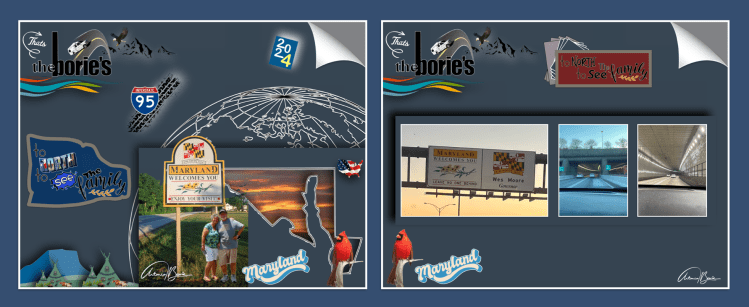
…ao outro dia, pela madrugada, atravessando a cidade de Washington, entrámos no estado de Maryland, que é um estado do Meio Atlântico definido por seus abundantes cursos de água e costas na Baía de Chesapeake e no Oceano Atlântico!. A sua maior cidade é Baltimore, (que atravessámos), tem uma longa história como importante porto marítimo!. Fort McHenry, local de nascimento do hino nacional dos EUA, fica na foz do Inner Harbor de Baltimore, onde fica o Aquário Nacional e o Centro de Ciências de Maryland!.
…the other day, at dawn, crossing the city of Washington, we entered the state of Maryland, which is a Mid-Atlantic state defined by its abundant waterways and coasts in the Chesapeake Bay and the Atlantic Ocean!. Its largest city is Baltimore, (which we passed through), it has a long history as an important seaport!. Fort McHenry, birthplace of the US national anthem, is at the mouth of Baltimore’s Inner Harbor, home to the National Aquarium and the Maryland Science Center!.
…esta é a primeira parte deste resumo e ficamos por aqui, no entanto siga a segunda parte que será publicada dentro de dias!. Obrigado pela atenção!.
…this is the first part of this summary and we stop here, however follow the second part which will be published within a few days!. Thank you for your attention!.
…sentimo-nos uns previlegiados!. Porquê?. Porque uns anos atrás, já tivemos a felicidade de percorrer o completo percurso da hoje famosa e lendária “Route 66” e…, admirar todo o seu cenário desde a Rua Adams na cidade de Chicago, Illinois, até ao Cais de Santa Mónica na cidade de Los Angeles, California!. Depois…, alguns pequenos trechos desta famosa e lendária estrada, sempre que a oportunidade nos surge, viajamos por eles, porque o cenário continua maravilhoso!.
…we feel privileged! Why?. Because a few years ago, we had the happiness of traveling the entire route of the now famous and legendary “Route 66” and…, admiring its entire scenery from Adams Street in the city of Chicago, Illinois, to the Santa Monica Pier in the city from Los Angeles, California!. Afterwards…, some small sections of this famous and legendary road, whenever the opportunity arises, we travel along them, because the scenery is still wonderful!.
…porque viajar pelo que resta desta hoje famosa e lendária estrada e deste “grande corredor de néon”, talvez seja como dar um passo atrás para um tempo mais simples, que nos faz recordar como por exemplo, aquela família que nos anos trinta do século passado, para se prepararem para a sua viagem até à Califórnia, meteram tudo da sua quinta num calhambeque de 50 dólares, matando os seus dois últimos porcos para fazer um barril de carne de porco salgada, para alimentar as 14 pessoas a bordo do seu calhambeque!.
…because traveling along what remains of this now famous and legendary road and this “great neon corridor”, perhaps it is like taking a step back to a simpler time, which makes us remember, for example, that family that in the 1930s In the past, to prepare for their trip to California, they packed everything from their farm into a $50 jalopy, killing their last two pigs to make a barrel of salted pork to feed the 14 people aboard their jalopy!.
…a “Route 66”, para nós incorpora a cultura da aventura, vai nos mostrando o cenário dos espaços abertos oferecidos pelo oeste americano, numa rota que serpenteia através das partes mais românticas e célebres desse mesmo oeste, conectando as pequenas vilas e aldeias do centro/oeste com as da Costa do Oceano Pacífico!.
…the “Route 66”, for us embodies the culture of adventure, shows us the scenery of open spaces offered by the American West, on a route that winds through the most romantic and famous parts of that same West, connecting the small towns and villages of the center/west with those of the Pacific Ocean Coast!.
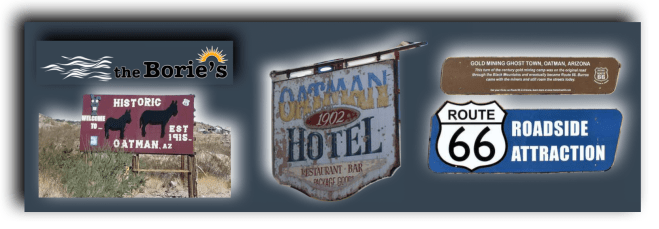
…deu esperança aos migrantes que iam a caminho do oeste, para encontrar uma nova vida, definindo uma geração em busca de aventura e liberdade, como por exemplo um pequeno alinhamento entre Kingman, Arizona, e Needles, Califórnia, que nos leva a atravessar as montanhas negras de Mohave, no estado de Arizona, onde se encontra a pequena aldeia de Oatman, localizada a uma altitude de 2.700 pés (896m), e que é uma paragem muito interessante!.
…gave hope to migrants heading west to find a new life, defining a generation in search of adventure and freedom, such as a small alignment between Kingman, Arizona, and Needles, California, which takes us across the Black Mountains of Mohave, in the state of Arizona, where the small village of Oatman is located, located at an altitude of 2,700 feet (896m), and which is a very interesting stop!.
…porquê?. Porque começou como um acampamento de barracas, logo depois que dois prospectores encontraram um achado de ouro de $10 milhões por volta do ano de 1915 e…, num período de pouco anos já ostentava dois bancos, sete hotéis, vinte bares e dez lojas, com mais de 10.000 pessoas por ali morando, estimando-se que 36 milhões de dólares em ouro foram extraídos em torno da área de Oatman!.
…why?. Because it started as a tent camp, shortly after two prospectors found a $10 million gold find around 1915 and…, within a few years it already boasted two banks, seven hotels, twenty bars and ten stores, with More than 10,000 people live there, and it is estimated that 36 million dollars worth of gold was mined around the Oatman area!.
…e claro, como em tantas outras histórias de acampamentos de barracas, originalmente alguns prospectores vieram para a área como mineiros, no entanto, logo perceberam que o ouro real poderia ser encontrado, todavia ao mesmo tempo iam atendendo os viajantes desta hoje famosa e histórica “Route 66” e…, o negócio era tão bom que nunca conseguiam tempo para construir um prédio apropriado, simplesmente construíam um telhado para fornecer alguma medida de proteção contra o sol quente do deserto!.
…and of course, as in so many other tent camp stories, originally some prospectors came to the area as miners, however, they soon realized that real gold could be found, yet at the same time they were serving travelers from this now famous and historic “Route 66” and…, business was so good that they could never find time to build a proper building, they simply built a roof to provide some measure of protection from the hot desert sun!.
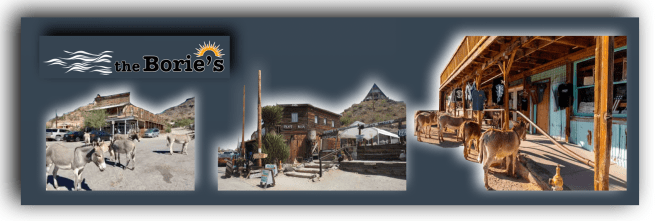
…hoje a aldeia de Oatman, tem inúmeras lojas de presentes e pequenos restaurantes e continua parte importante da rota desta famosa e lendária estrada, onde os “Burros Selvagens” vagam pelas ruas de Oatman e que são os descendentes de burros trazidos para aqui pelos primeiros mineiros de ouro nos anos de 1800 e, quando os mineiros desanimados com a sua prospecção, deixaram a aldeia, foram soltos!.
…today the village of Oatman, has numerous gift shops and small restaurants and remains an important part of the route of this famous and legendary road, where the “Wild Donkeys” roam the streets of Oatman and are the descendants of donkeys brought here by the first gold miners in the 1800s and, when the miners, discouraged with their prospecting, left the village, they were released!.
…e nós, no regresso fomos descendo a montanha, deixando para trás as “Casas das Minas de Ouro, os Burros Selvagens e a lenda dos Pistoleiros do Oeste”, numa estrada muito estreita, sem acostamentos, curvas extremamente estreitas e muitos declives acentuados, com temperaturas altas, entre 100 e 110 graus, mas o tráfico era pouco, onde tudo está quase seco na beira da estrada, sendo também um pouco difícil viajar nesta zona, mas o cenário compensa e para nós, viajantes do mundo…, uma jornada é melhor medida em cenário do que em milhas!.
…and we, on the way back, went down the mountain, leaving behind the “Casas das Minas de Ouro, the Wild Donkeys and the legend of the Pistoleiros do Oeste”, on a very narrow road, without shoulders, extremely narrow curves and many steep slopes, with high temperatures, between 100 and 110 degrees, but there was little traffic, where everything is almost dry on the side of the road, and it is also a little difficult to travel in this area, but the scenery makes up for it and for us, travelers in the world…, a journey is better measured in scenery than in miles!.
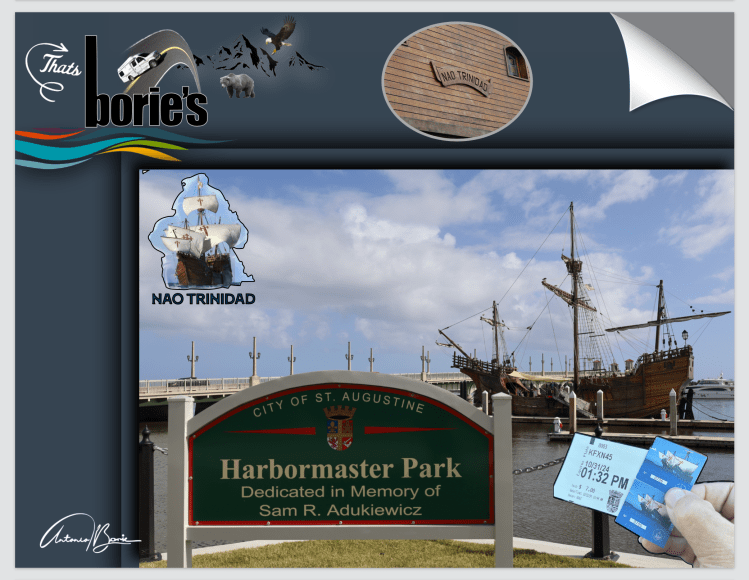
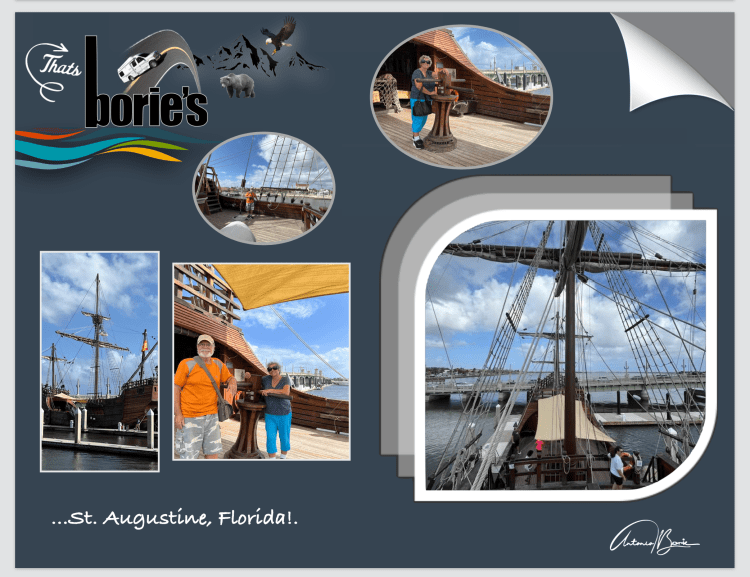
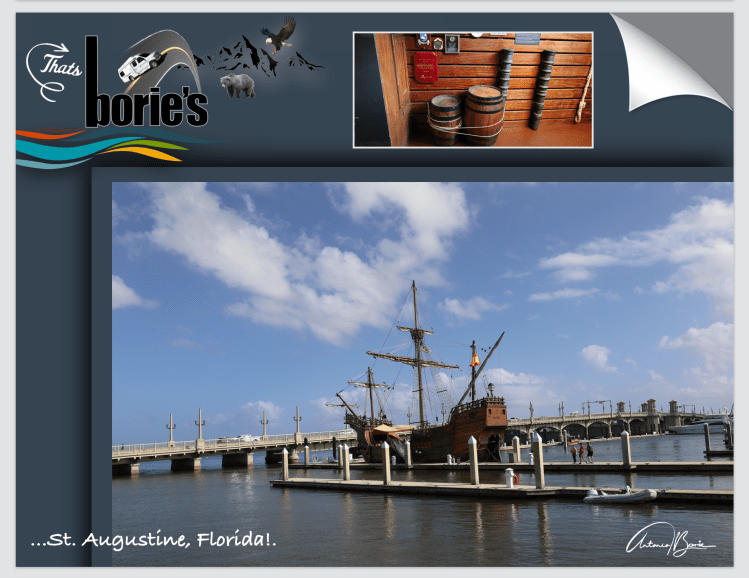
…uma réplica da “Nau Trinidade” voltou a St. Augustine!.(…a replica of the “Nao Trinidad” returned to St. Augustine)!.
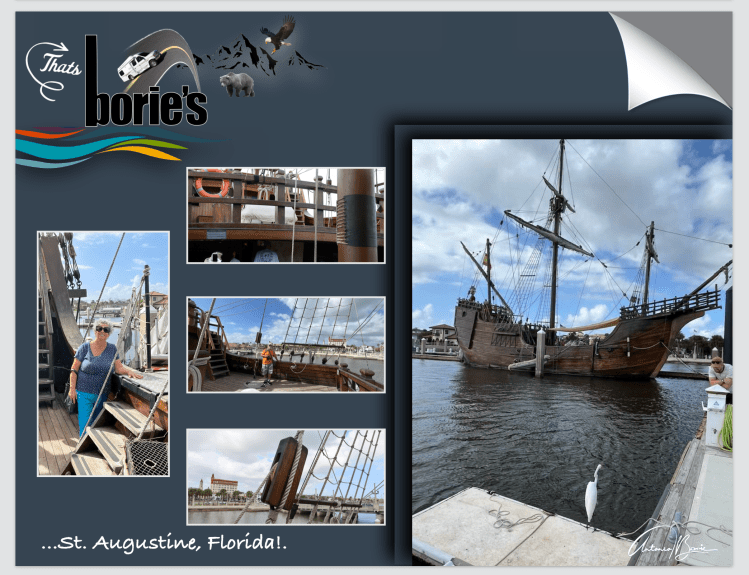
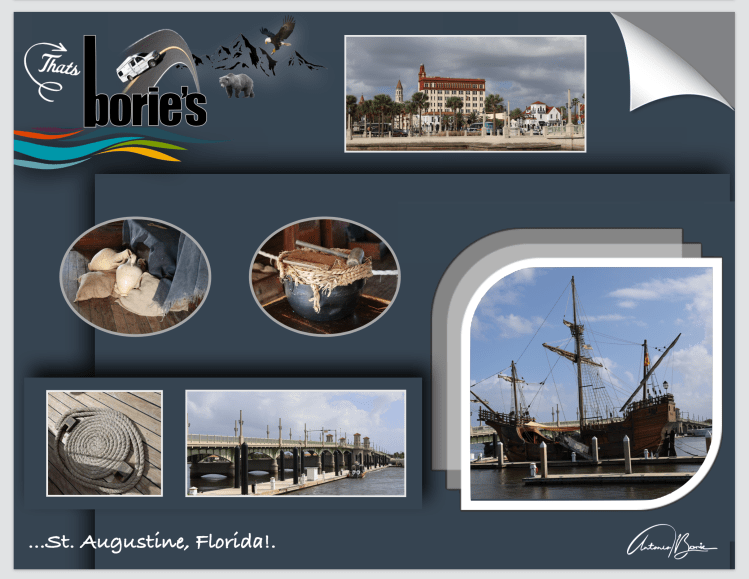
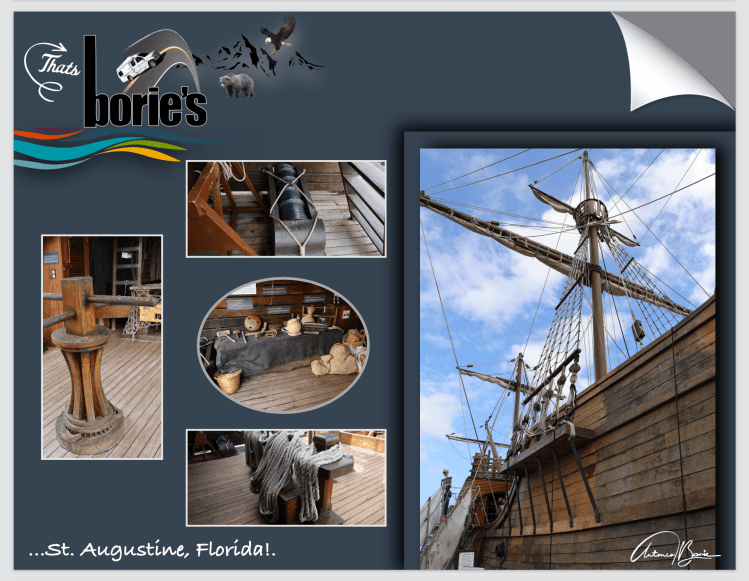
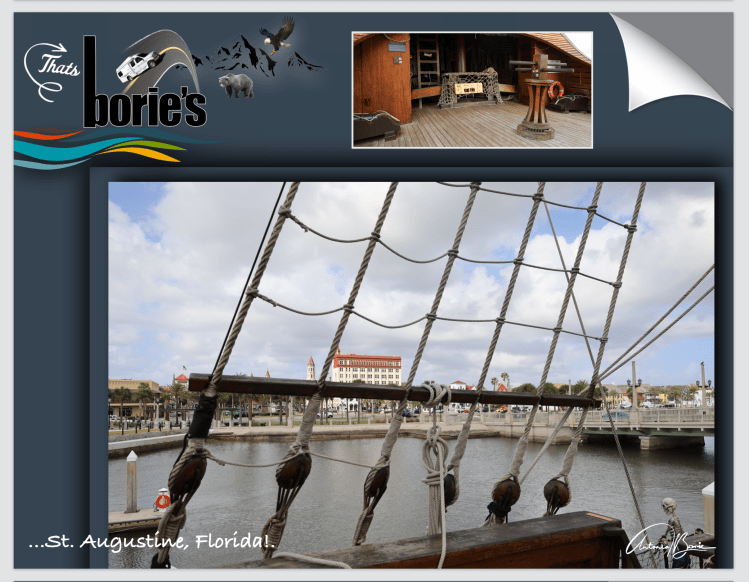
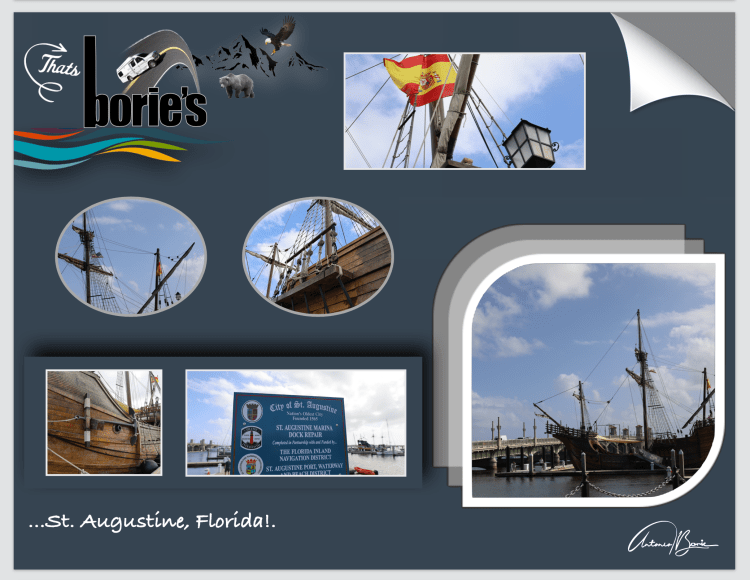
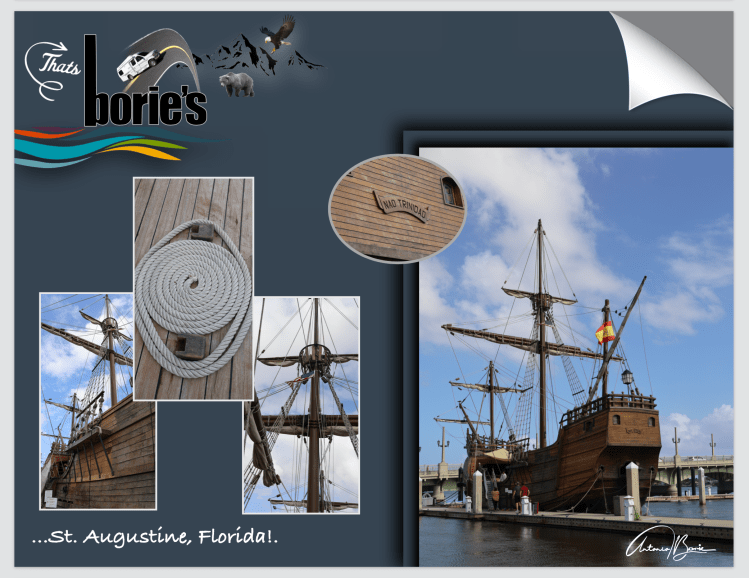
…fizemos um completo “tour” a esta réplica do histórico veleiro “Nau Trinidade” que está presentemente ancorado no cais, próximo à Ponte dos Leões, no porto da Marina Municipal, podendo ser visto diariamente das 10h00 às 19h00, até domingo 17 de Novembro de 2024!.
…we took a complete “tour” of this replica of the historic sailboat “Nao Trinidad” which is currently anchored at the pier, close to Ponte dos Leões, in the Municipal Marina port, and can be seen daily from 10:00 am to 7:00 pm, until Sunday, November 17th 2024!.
…este atual veleiro é uma réplica da “Nau Trinidade” e foi construído em fibra de vidro e madeira em Espanha, no ano de 2018!. Pesa 200 toneladas brutas, tem três mastros e um gurupés, atingindo mais de 25 metros desde a linha d’água até o topo do mastro principal!.
…this current sailboat is a replica of the “Nao Trinidad” and was built in fiberglass and wood in Spain, in 2018!. It weighs 200 gross tons, has three masts and a bowsprit, reaching more than 25 meters from the waterline to the top of the main mast!.
…andámos por lá, subimos a bordo, e vimos, o que consideramos um museu flutuante, incluindo os quatro conveses do navio, completos com painéis informativos que relatam a história do navio e a experiência dos marinheiros espanhóis há mais de 500 anos!.
…we walked around, got on board, and saw what we considered to be a floating museum, including the ship’s four decks, complete with information panels that recount the history of the ship and the experience of Spanish sailors over 500 years ago!.
…esta Nau original foi o navio-chefe da ”Expedição Magalhães-Elcano” que deixou a Espanha em 1519 com outros quatro navios, que cruzaram o Atlântico e descobriram o “Estreito de Magalhães” passando até o Oceano Pacífico, numa viagem que levou à descoberta de novas rotas para os europeus, e claro, de novas terras, à medida que tocavam o Brasil, a Argentina, as Ilhas Marianas, as Filipinas, a Indonésia e as Molucas, tudo “Ilhas das Especiarias”!.
…this original ship was the flagship of the “Magellan-Elcano Expedition” that left Spain in 1519 with four other ships, which crossed the Atlantic and discovered the “Strait of Magellan” passing to the Pacific Ocean, on a journey that led to the discovery of new routes for Europeans, and of course, new lands, as they touched Brazil, Argentina, the Mariana Islands, the Philippines, Indonesia and the Moluccas, all “Spice Islands”!
…no entanto, apenas dois navios sobreviveram para chegar às Molucas, que foram, a “Nau Trinidade e a Nau Victoria”!. Depois…, só a “Nau Victoria” finalmente completou a primeira circunavegação mundial e…, com estaprimeira viagem ao redor do mundo entre 1519 e 1522, o que foi o maior feito marítimo da história, ficou confirmado pela primeira vez que a Terra era redonda!.
…however, only two ships survived to reach the Moluccas, which were the “Nao Trinidad and the Nao Victoria”!. After…, only the “Nao Victoria” finally completed the first world circumnavigation and…, with this first trip around the world between 1519 and 1522, which was the greatest maritime feat in history, it was confirmed for the first time that the Earth was round!
…no entanto, a “Nau Trinidade”, tentou, mas não conseguiu navegar para leste através do Pacífico porque teve um vazamento, que foi consertado, mas nunca mais voltou para a Espanha!.
…however, the “Nao Trinidad” tried, but was unable to sail east across the Pacific because it had a leak, which was repaired, but never returned to Spain!.
…e o que aconteceu à “Nau Trinidade”?.
…com a sua tripulação original, ambos os navios tentaram partir carregados com 50 toneladas de “cravo”, mas a “Nau Trinidade” quase imediatamente começou a vazar muito e, devido a este problema, entretanto foi acordado que a “Nau Victoria” partiria para a Espanha e a “Nau Trinidade” permaneceria para reparos!.
…and what happened to the “Nao Trinidad”?
…with their original crew, both ships tried to leave loaded with 50 tons of “cravo”, but the “Nao Trinidad” almost immediately began to leak a lot and, due to this problem, it was agreed that the “Nao Victoria” would leave to Spain and the “Nao Trinidad” would remain for repairs!.
…reparada, fez-se de novo ao mar e um tempo depois, atracou numa das Marianas, onde três homens desertaram!. Depois rumou para nordeste na tentativa de chegar aos ventos de oeste, mas não os encontrou, provavelmente por causa das monções de verão e…, entretanto o “escorbuto” (doença mortal) instalou-se a bordo matando 30 homens e deixando apenas 17 para navegar no navio e…, finalmente chegou às Molucas!.
…repaired, it set sail again and a while later, it docked in one of the Marianas, where three men deserted!. Then he headed northeast in an attempt to reach the westerly winds, but he did not find them, probably because of the summer monsoons and…, in the meantime “scurvy” (deadly disease) took hold on board, killing 30 men and leaving only 17 for sail the ship and…, finally arrived at the Moluccas!.
…onde os esperava uma frota de sete navios portugueses que ao se confrontar com a “Nau Trinidade”, encontraram apenas um navio à beira de se afundar e uma tripulação à beira da morte!. Ali, a carga, as suas velas e cordame foram removidos e o navio foi pegado por uma tempestade que o despedaçou!..
…where a fleet of seven Portuguese ships awaited them. When confronted with the “Nao Trinidad”, they found only one ship on the verge of sinking and a crew on the verge of death!. There, the cargo, its sails and rigging were removed and the ship was caught in a storm that tore it apart!
…resumindo, após seis meses de sofrimento e luta contra o mar, com apenas 17 sobreviventes, desistindo…, o navio regressou às Molucas!. Lá, os portugueses esperavam por eles e, capturaram a tripulação e abandonaram o navio agredido naquelas águas, onde, exausto e danificado, encontrou o seu fim!.
…in short, after six months of suffering and fighting against the sea, with only 17 survivors, giving up…, the ship returned to the Moluccas!. There, the Portuguese were waiting for them and captured the crew and abandoned the battered ship in those waters, where, exhausted and damaged, it met its end!.
…desde que forçados pelo governo Português de então, participámos na maldita Guerra Colonial Portuguesa na também então colónia da Guiné, quase todos os dias sentimos um certo tipo de “arrepio” a picar-nos a pele!.
…since being forced by the Portuguese government at the time, we participated in the cursed Portuguese Colonial War in the then colony of Guinea, almost every day we felt a certain type of “goosebumps” pricking our skin!.
…porque é impossível esquecer situações num cenário de combate, onde a lama dos rios e pântanos lá na Guiné eram constantes, onde as condições para se tentar recuperar um qualquer morto ou ferido eram quase impossíveis, pois as vítimas, deviam ser puxados para algum tipo de posição onde houvesse alguma segurança e…, levar um homem ferido ou morto, requer até quatro homens como portadores, o que logo enfraquecia uma unidade militar num momento crítico, portanto, esses infelizes militares quando eram atingidos, alguns deles, por lá ficaram para sempre!.
…because it is impossible to forget situations in a combat scenario, where the mud of the rivers and swamps there in Guinea were constant, where the conditions for trying to recover any dead or injured person were almost impossible, as the victims had to be pulled into some kind of position where there was some security and…, carrying a wounded or dead man, requires up to four men as carriers, which soon weakened a military unit at a critical moment, therefore, these unfortunate soldiers, when they were hit, some of them, stayed there to always!.
…e também porque muitas vezes, as tropas Portuguesas encontravam-se na pior posição para avançar e identificar com precisão a sua localização no terreno, onde ou existia selva cerrada, pântanos ou canais, com água, lama e tarrafo, algumas vezes até animais perigosos, como por exemplo giboias ou crocodilos, onde em algumas situações o inimigo, tirando alguma vantagem, surgia de todos os lados, atacando, disparando, sem dar qualquer oportunidade para que se recuperasse os nossos mortos ou feridos!.
…and also because Portuguese troops often found themselves in the worst position to advance and accurately identify their location on the ground, where there was either dense jungle, swamps or canals, with water, mud and tarrafo, sometimes even dangerous animals, such as gibbons or crocodiles, where in some situations the enemy, taking some advantage, appeared from all sides, attacking, shooting, without giving any opportunity to recover our dead or wounded!.
…exemplo disto foi que homens como o “Bóia”, (como carinhosamente o chamava-mos) e que foi morto por uma maldita carga explosiva numa ponte improvisada, que existia para os lados da aldeia de Porto Gole e…, que despedaçou o seu corpo quase totalmente e…, infelizmente parte dele por lá ficou!.
…an example of this was that men like “Bóia”, (as we affectionately called him) and who was killed by a cursed explosive charge on an improvised bridge, which existed on the sides of the village of Porto Gole and…, which shattered his body almost completely and…, unfortunately part of it remained there!.
…lembramos aquele tempo escuro que mesmo depois da guerra continuou a invadir-nos o nosso pensamento, parecendo mesmo que a nossa alma foi baleada em pedaços, pelas coisas que vimos, pelas coisas que cheirámos, pelo isolamento forçado e angustioso, pelas coisas que fizemos e…, pelas coisas que nunca tivemos oportunidade de fazer, mas que deviam ser feitas, naquela idade tão jovem!. Lembramo-nos de como a vida se tornava de alguma forma menor, à medida que nos isolávamos sistematicamente, daqueles que nós amávamos e deixávamos em Portugal!.
…we remember that dark time that, even after the war, continued to invade our thoughts, even feeling as if our soul had been shot into pieces, by the things we saw, by the things we smelled, by the forced and anguished isolation, by the things we did and…, for the things that we never had the opportunity to do, but that should be done, at that young age!. We remember how life became somehow smaller, as we systematically isolated ourselves from those we loved and left in Portugal!.
…nesta já avançada idade, tornou-se claro que o custo de uma guerra é ainda maior do que nós possamos imaginar, porque a guerra tem um apetite insaciável pela morte, e infelizmente, ainda hoje continua a matar pessoas, continua a fazer vítimas, não só em quem participou activamente na mesma, pois as pessoas começam com sentimentos de confusão, depois move-as um longo pensamento de raiva e, finalmente vem a indiferença, mas aquele esgotamento escuro e emocional ainda se encontra de pé, mesmo à beira de um abismo, convidando-nos a saltar, pensando que com essa estúpida atitude, todos os sentimentos vão acabar, mas infelizmente não, cada vez estão mais presentes!.
…at this advanced age, it has become clear that the cost of war is even greater than we can imagine, because war has an insatiable appetite for death, and unfortunately, even today it continues to kill people, continues to claim victims, not only in those who actively participated in it, as people start with feelings of confusion, then a long thought of anger moves them and, finally, indifference comes, but that dark and emotional exhaustion is still there, even on the verge of an abyss, inviting us to jump, thinking that with this stupid attitude, all feelings will end, but unfortunately no, they are increasingly present!.
…ainda hoje não sabemos e talvez nunca saberemos porque a idade já vai longa, quem foram os verdadeiros heróis, se foram os que por lá ficaram enterrados em valas comuns junto do nosso “posto avançado” naquela selva pantanosa, ou aqueles que eram apelidados de activistas e vistos como simpatizantes antipatrióticos e…, ainda em Portugal diziam: “claro que não, não iremos para a Guerra Colonial em África, vamos fugir para França”, o que era muito vulgar naquela época!.
…still today we don’t know, and perhaps we never will because the age is already long, who the real heroes were, whether they were those who were buried there in mass graves next to our “outpost” in that swampy jungle, or those who were nicknamed activists and seen as unpatriotic sympathizers and…, even in Portugal they said: “of course not, we will not go to the Colonial War in Africa, we will flee to France”, which was very common at that time!.
…o que hoje vamos contar, é um episódio que nos anda “atravessado” há dezenas de anos, e quando nos sentamos ao computador, escrevemos umas tantas linhas e…, paramos!. Porquê?. Porque a emoção toma conta de nós, é mais forte, o som do “catra-pum-pum-pum”, começa a zumbir nos nossos ouvidos, parece que vamos a fugir para o nosso abrigo preferido!.
…what we are going to tell you today is an episode that has been “crossing our minds” for dozens of years, and when we sat down at the computer, we wrote a few lines and…, we stopped!. Why?. Because the emotion takes over us, it is stronger, the sound of “catra-pum-pum-pum”, starts to buzz in our ears, it seems like we are going to flee to our favorite shelter!.
…no nosso pensamento aparece o “Zé Pesca”, que era um soldado páraquedista, do mesmo grupo de combate do nosso companheiro de infância de que já aqui falamos por diversas vezes, cujo nome de guerra era “Zargo”!.
…in our thoughts appears “Zé Pesca”, who was a parachutist soldier, from the same combat group as our childhood companion that we have already talked about here several times, whose nom de guerre was “Zargo”!.
…continuando, o “Zé Pesca”, era um jovem amigo da farra, lutador, combatente, com a boina verde sempre de lado, corpo de atleta, cujos pais eram agricultores no Ribatejo e às vezes…, dizia que não gostava da Guiné, “porque não havia cavalos”!.
…continuing, “Zé Pesca”, was a young party friend, fighter, combatant, with the green beret always on his side, the body of an athlete, whose parents were farmers in Ribatejo and sometimes…, he said he didn’t like Guinea, “because there were no horses”!.
…infelizmente o “Zé Pesca” morreu!. Morreu crivado de balas daquela perigosa arma a que nós chamávamos “costureirinha”, que era uma arma metralhadora, que o inimigo usava em cima de um tripé com duas rodas em ferro, que a ajudava a transportar para a zona de combate e normalmente era usada em emboscadas onde havia capim, fazendo fogo muito rasteiro, com cadência de tiro e som que a identificava e…, quase sempre no fim da emboscada os guerrilheiros, talvez desesperados, às vezes abandonavam-na, ou pelo menos abandonavam o tripé, preocupando-se com os seus feridos!.
…unfortunately “Zé Pesca” died! He died riddled with bullets from that dangerous weapon that we called “seamstress”, which was a machine gun, which the enemy used on top of a tripod with two iron wheels, which helped to transport it to the combat zone and was normally used in ambushes where there was grass, making fire very low, with a rate of fire and sound that identified it and…, almost always at the end of the ambush the guerrillas, perhaps desperate, sometimes abandoned it, or at least abandoned the tripod, worrying about it. with their wounded!
…dias depois de tudo isto acontecer, o “Zargo”, explicou-nos alguns pormenores da morte do “Zé Pesca”, onde estavam já a algumas horas, esperando, numa “operação de destruição de um acampamento inimigo”, cobertos com a típica capa camuflada impermeável, (já com muitos buracos), portanto molhados “até aos ossos”, por uma chuva miudinha e…, já era noite quando sairam do “posto avançado” onde também nós estávamos acantonados!.
…days after all this happened, “Zargo”, explained to us some details of the death of “Zé Pesca”, where they had been waiting for a few hours, in an “operation to destroy an enemy camp”, covered with the typical Waterproof camouflage cover, (already with many holes), therefore wet “to the bone”, by a light rain and…, it was already night when they left the “outpost” where we were also camped!.
…todos tinham bebido muito café, não sabiam se estavam sobre influência, mas estavam nervosos e queriam acção!. Passou um grupo de guerrilheiros perto, onde não deviam intervir, pois em caso de fogo toda a operação que estava a ser desenvolvida, seria denunciada!. O “Zé Pesca” já aí queria intervir, todavia, os companheiros seguraram-no!. Foram avançando e já próximo do objectivo, ele, o “Zé Pesca”, não esperou por nada, avançou quase sozinho na frente, gritando, disparando, talvez amaldiçoando a sua própria alma, onde os companheiros surpresos, ouviram a tal “costureirinha”, fazendo suar o seu maldito som, do “catra-pum-pum-pum-pum”, que crivou o “Zé Pesca”, fazendo o seu corpo, rodopiar em zig-zague, caindo uns metros à frente, encolhido, crivado de balas!.
…everyone had drunk a lot of coffee, they didn’t know if they were under the influence, but they were nervous and wanted action!. A group of guerrillas passed nearby, where they were not supposed to intervene, because in case of fire the entire operation that was being carried out would be reported!. “Zé Pesca” already wanted to intervene, however, his companions held him back! They advanced and, already close to the objective, he, “Zé Pesca”, did not wait for anything, he advanced almost alone in front, shouting, shooting, perhaps cursing his own soul, where his surprised companions heard the so-called “seamstress”, making his damned sound sweat, of the “catra-pum-pum-pum-pum”, which riddled “Zé Pesca”, making his body spin in a zig-zag, falling a few meters ahead, curled up, riddled with bullets!.
…a operação continuou!. Capturaram algum material de guerra e o pequeno acampamento inimigo foi destruído!. No regresso, transportando o corpo do “Zé Pesca”, trazendo também algumas mulheres guerrilheiras transportadoras de material de guerra, que depois de feitas prisioneiras acompanharam os militares, por uma certa distância, para serviam de escudo e compreendia-se, pois enquanto acompanhassem os militares, os guerrilheiros não atacavam e, já a manhã ia alta, perto do local onde deviam ser recolhidos, as libertaram!.
…the operation continued! They captured some war material and the small enemy camp was destroyed! On the way back, transporting the body of “Zé Pesca”, also bringing some guerrilla women carrying war material, who, after being taken prisoner, accompanied the soldiers, for a certain distance, to serve as shields and it was understood, because while they accompanied the military, the guerrillas did not attack and, as the morning approached, close to the place where they were supposed to be collected, they released them!.
…alguns dias depois, os militares do seu grupo de combate, olhavam uns para os outros e diziam: “morreu o “Zé Pesca”, na ilha do Como”!.
…a few days later, the soldiers in his combat group looked at each other and said: “Zé Pesca died on the island of Como”!
…todavia, enquanto o grupo de combate a que pertencia o malogrado “Zé Pesca”, esteve estacionado nesta então província ultramarina, a sua cama nunca foi utilizada, estava lá, feita com roupa limpa, ao lado dos seus companheiros, que antes de se deitarem, lhes davam as boas noites!.
…however, while the combat group to which the ill-fated “Zé Pesca” belonged was stationed in this then overseas province, his bed was never used, it was there, made with clean clothes, next to his companions, who before leaving When they went to bed, they said goodnight!
…oxalá o País Portugal respeitasse os seus combatentes, como estes militares de acção respeitavam o seu companheiro morto em combate, pois é dos livros, que, “Nação que não respeita o passado, não pode ter bom futuro”!.
…I wish the country of Portugal respected its fighters, as these active soldiers respected their comrade killed in combat, as it is from the books, that, “A nation that does not respect the past, cannot have a good future”!.
…nós antigos combatentes, defendemos a bandeira, fomos passado, de um País que se chama Portugal!.
…we former combatants, defend the flag, we were the past, of a country called Portugal!.
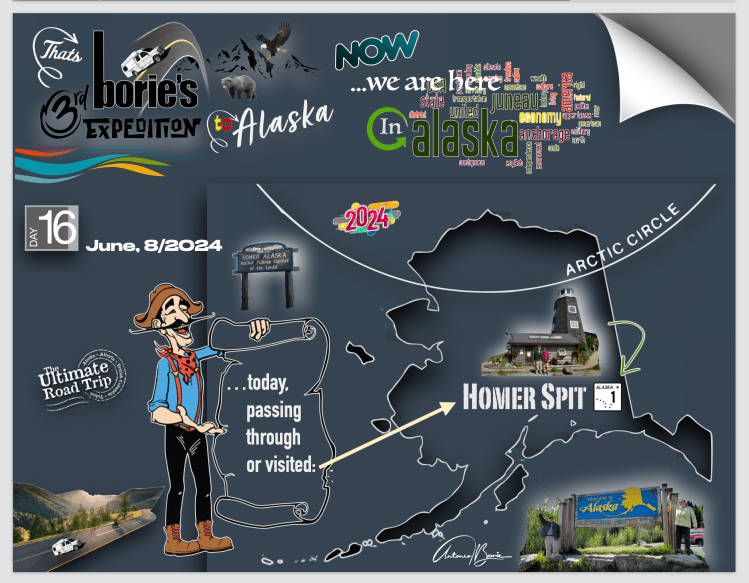
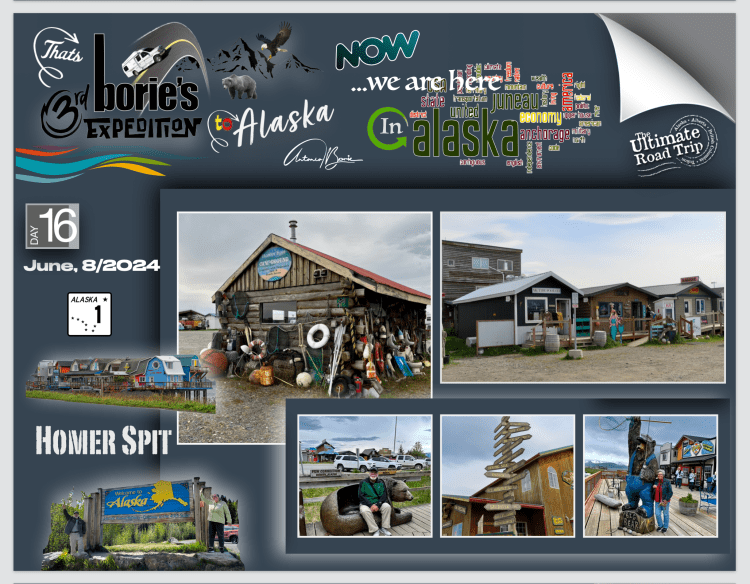
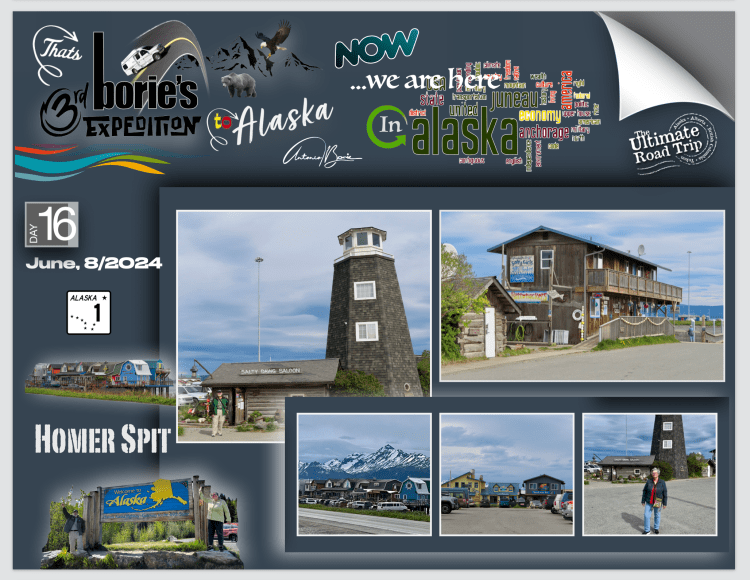
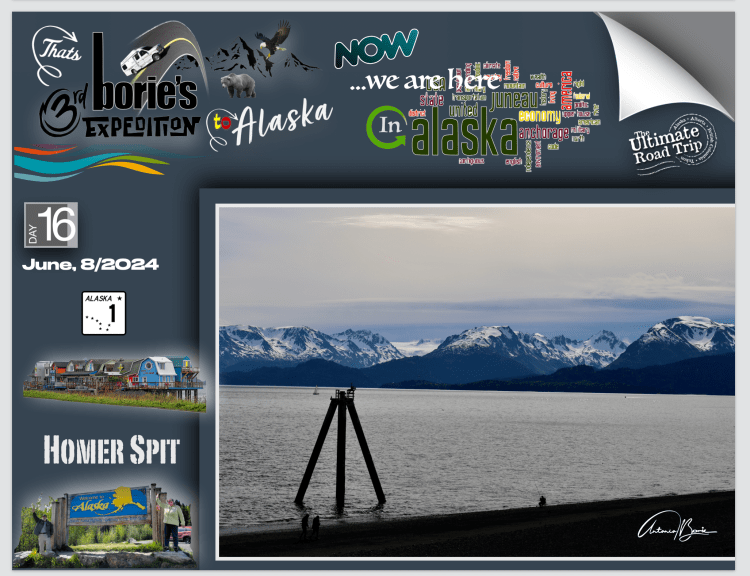
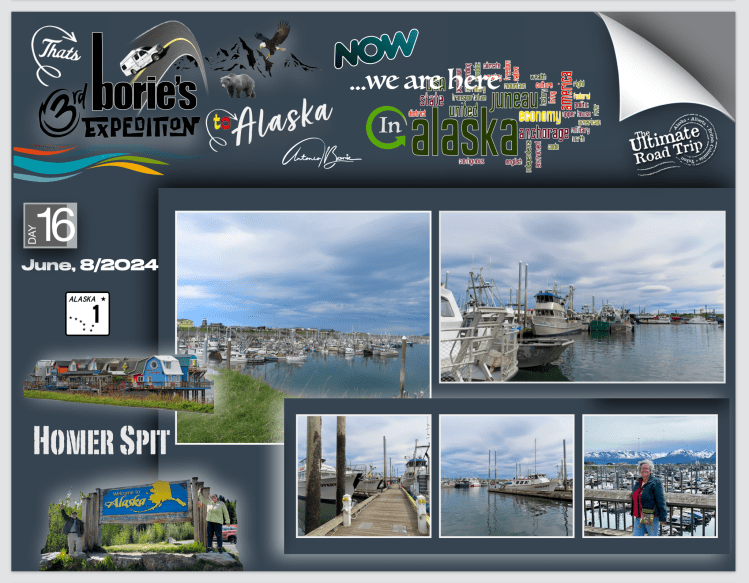
…depois de deixar o norte do Alaska para trás, chegámos ao lugar mais pitoresco do sul, deste ainda um pouco selvagem estado e…, que dá pelo nome de ”Homer Spit”!.
…after leaving the north of Alaska behind, we arrived at the most picturesque place in the south, of this still somewhat wild state and…, which goes by the name of ”Homer Spit”!.
…as forças da natureza que construíram o “Homer Spit”, que entra pela Baía de Kachemak, poderiam tê-lo feito desaparecer anos e anos atrás, se os humanos não tivessem intervindo, pois as tempestades de inverno, que rugem para o noroeste tentam separar esta faixa de 4,5 milhas de areia e cascalho do continente quase todos os anos, mas as paredes de pedra e a perseverança humana, mantêm-na intacta!.
…the forces of nature that built the “Homer Spit,” which enters Kachemak Bay, could have made it disappear years and years ago if humans had not intervened, as winter storms, which roar into the northwest try to separate this 4.5 mile strip of sand and gravel from the mainland almost every year, but the stone walls and human perseverance keep it intact!.
…a teoria predominante para a origem do “Spit” (cuspo), é que são os restos de uma antiga, talvez aldeia ou povoado glacial, constantemente remodelada pelas correntes oceânicas!. Alguns achados arqueológicos, revelam que o “Spit” foi usado por humanos muito antes da história escrita, onde rochas e conchas rachadas pelo fogo indicam que, esses humanos, passando ou vivendo aqui, reuniram amêijoas e mexilhões, cozinhando-as em fogueiras!.
…the predominant theory for the origin of the “Spit” is that it is the remains of an ancient, perhaps glacial village or settlement, constantly remodeled by ocean currents!. Some archaeological finds reveal that the “Spit” was used by humans long before written history, where rocks and shells cracked by fire indicate that these humans, passing through or living here, gathered clams and mussels, cooking them over open fires!.
…os Esquimós do Pacífico são conhecidos por terem vivido nestas margens há milhares de anos e os índios Dena’ina Athabascan mudaram-se para esta área há cerca de 1.000 anos atrás!. Muitos anos depois, talvez no final da década de 1700, os exploradores, caçadores e comerciantes russos chegaram, também acrescentando um pouco da sua cultura!.
…the Pacific Eskimos are known to have lived on these shores thousands of years ago and the Dena’ina Athabascan Indians moved into this area about 1,000 years ago!. Many years later, perhaps in the late 1700s, Russian explorers, hunters and traders arrived, also adding some of their culture!.
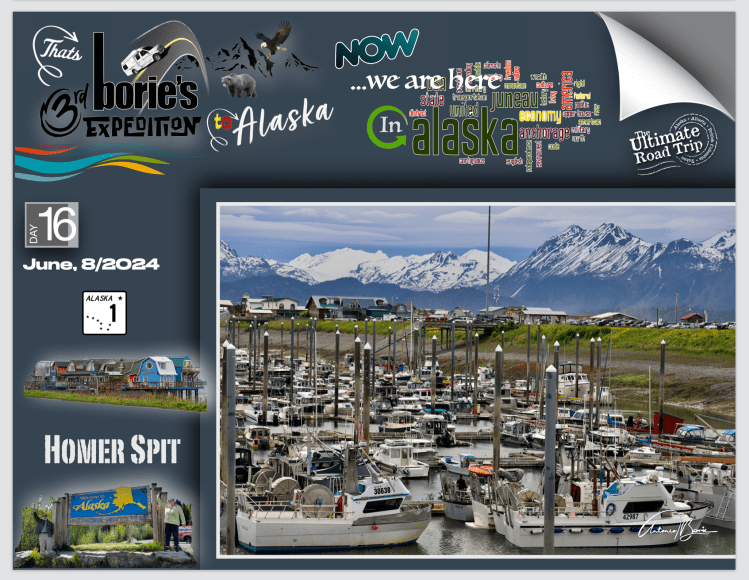
…de uma maneira ou de outra…, é um dos nossos lugares preferidos, pois é a quarta vez que visitamos “Homer Spit” e por aqui ficamos alguns dias, dizendo sempre, que na próxima oportunidade cá estaremos de novo!. Porquê?. Porque, aqui encontramos um maravilhoso cenário de docas com águas profundas e rasas, as cores das mais 1.500 embarcações comerciais e de lazer, atracções adicionais, como por exemplo, o “The Nick Dudiak Fishing Lagoon”, que é um “buraco de pesca” artificial, acampamentos, hotéis e restaurantes e o Salty Dawg Saloon, construído a partir de vários edifícios históricos!.
…one way or another…, it is one of our favorite places, as it is the fourth time we have visited “Homer Spit” and we stayed here for a few days, always saying that next time we will be here again!. Why?. Because here we find a wonderful scenery of docks with deep and shallow waters, the colors of over 1,500 commercial and leisure vessels, additional attractions, such as “The Nick Dudiak Fishing Lagoon”, which is a “fishing hole” artificial, campgrounds, hotels and restaurants and the Salty Dawg Saloon, built from several historic buildings!.
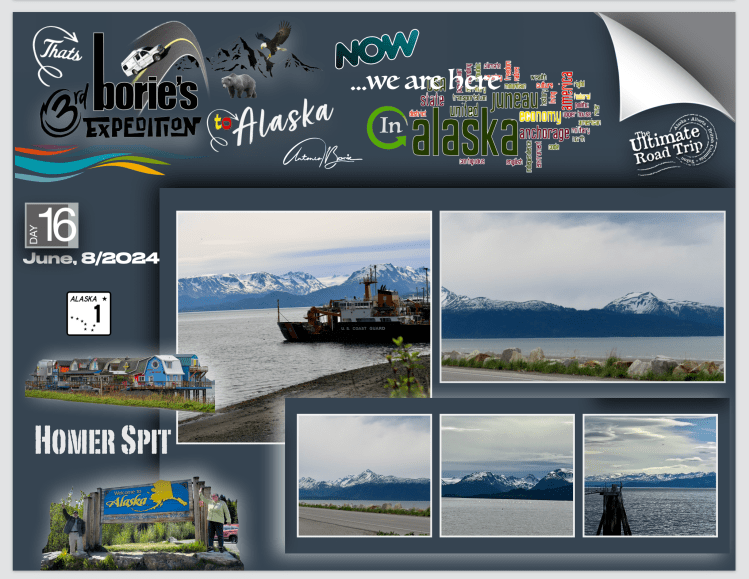
…e nós, ao chegar perto do final desta ponta de terra, entrámos no parque de RV, quase em frente ao Memorial do Marinheiro, onde dezenas de pessoas que perderam a vida no mar e que são homenageadas!. Estacionámos no lugar que nos foi previamente reservado e…, começámos a caminhar neste local que tem longas distâncias de praia rochosa, onde observamos navios de cruzeiro ou navios de pesca, grandes ou pequenos, indo e vindo do mar!.
…and we, upon arriving near the end of this point of land, entered the RV park, almost in front of the Sailor’s Memorial, where dozens of people who lost their lives at sea are honored!. We parked in the place that was previously reserved for us and…, we started walking in this place that has long distances of rocky beach, where we observed cruise ships or fishing vessels, large or small, coming and going from the sea!.
…quase no início da caminhada passamos por um dos aglomerados de lojas e restaurantes que margeiam a região e onde não existem problemas para encontrar uma lembrança ou até bons frutos do mar e…, já um pouco convencidos de que o “Homer Spit” não era apenas um lugar para turistas, continuámos caminhando e explorando, pois esta costa é ladeada por centenas de barcos…, todos prontos para o seu trabalho!.
…almost at the beginning of the walk we passed by one of the clusters of shops and restaurants that border the region and where there are no problems finding a souvenir or even good seafood and…, already a little convinced that the “Homer Spit” was not just a place for tourists, we continued walking and exploring, as this coast is lined with hundreds of boats…, all ready for their work!.
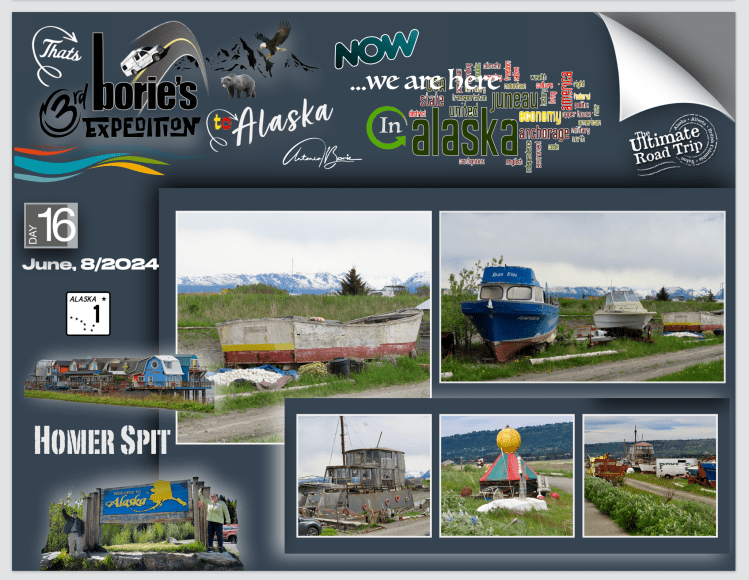
…por aqui também existem empresas que estão ocupadas embalando frutos do mar para o resto do mundo desfrutar!. É um ótimo lugar para avistar águias e…, elas voam por aqui às dúzia, todas num só lugar ao longo da costa, e também as vimos!. Continuando a caminhar, mais à frente encontrámos um “cemitério” de barcos antigos, cordas, redes de pesca, bóias de sinalização no mar e outros utensílios de pesca no mar, que se prestaram a inúmeras oportunidades fotográficas!.
…there are also companies here that are busy packaging seafood for the rest of the world to enjoy! It’s a great place to spot eagles and…, they fly here by the dozen, all in one place along the coast, and we saw them too!. Continuing walking, further ahead we found a “cemetery” of old boats, ropes, fishing nets, sea signal buoys and other fishing utensils at sea, which lent themselves to countless photographic opportunities!).
…a tarde já ia longa quando parámos no já acima mencionado Salty Dawg Sallon, que hoje funciona como um bar típico do Alaska, como era no princípio do século passado, com o chão térreo e serradura no chão, onde se pode falar de tudo, mesmo dizendo asneiras, cuspir no chão, para onde também vão as cascas dos amendoins, e claro, fazendo tudo o que nos der na real gana, como é normal dizer-se, claro sem insultar ou provocar alguém, e beber cerveja local à temperatura da casa, por canecas muito grandes, algumas de barro ou porcelana!.
…the afternoon was already long when we stopped at the aforementioned Salty Dawg Sallon, which today operates as a typical Alaskan bar, as it was at the beginning of the last century, with a ground floor and sawdust on the floor, where you can talk about everything, even saying stupid things, spitting on the ground, where the peanut shells also end up, and of course, doing everything we really want, as is normal to say, of course without insulting or provoking anyone, and drinking local beer at room temperature. of the house, for very large mugs, some made of clay or porcelain!.
…outra curiosidade é que a maré neste local é das mais diferentes do mundo, podendo ter uma diferença entre a maré baixa e alta de aproximadamente 0 a 15 metros, como tal, na maré baixa alguns barcos estão em terreno seco reparando-se e esperando a maré alta para navegar de novo!.
…another curiosity is that the tide in this place is one of the most different in the world, with a difference between low and high tide of approximately 0 to 15 meters, as such, at low tide some boats are on dry ground repairing themselves and waiting the high tide to sail again!.
…e no final de cada dia, sempre proporciona um espectáculo apetecível e único, quando os barcos regressam ao cais, alguns com muito peixe, começando a exibição dos peixes mais grandes para as fotografias, logo seguido da limpeza do peixe, por pessoas habilitadas, que manejam uma faca com muita habilidade!.
…and at the end of each day, it always provides an attractive and unique spectacle, when the boats return to the pier, some with lots of fish, starting to display the largest fish for photographs, followed by the cleaning of the fish, by qualified people, who wield a knife with great skill!
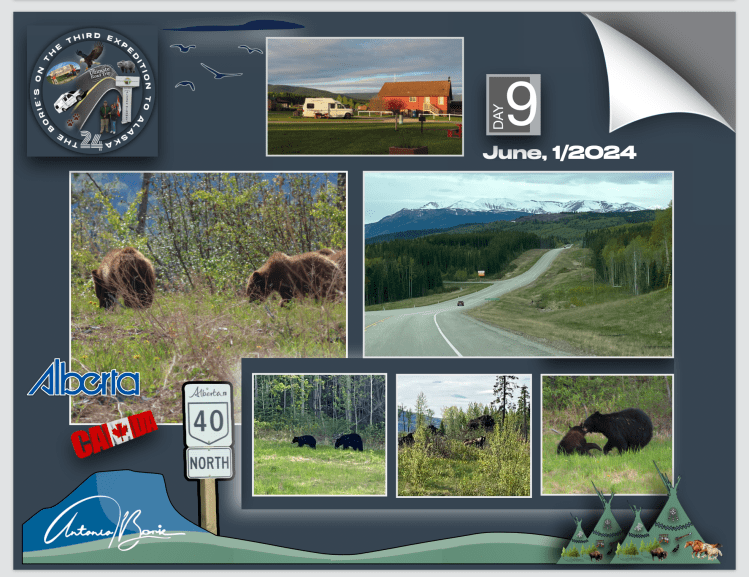
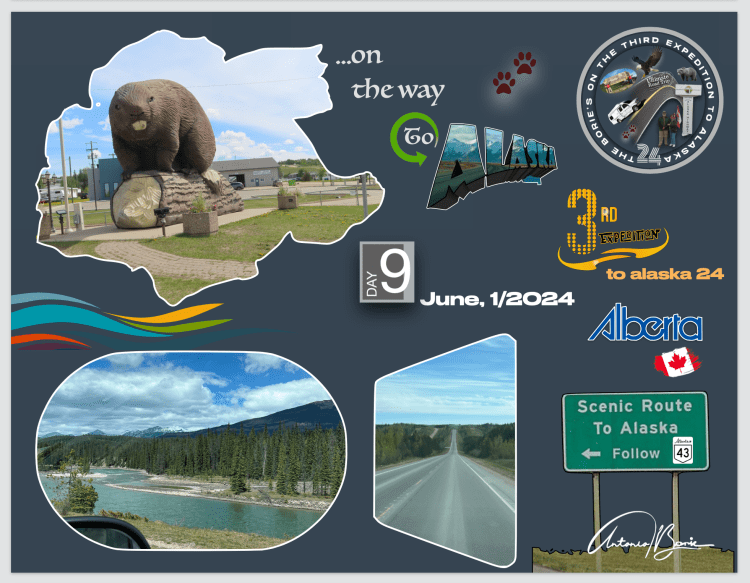
…já tínhamos passado o paralelo 48º, os dias eram muito maiores com 18, próximo das 20 horas com luz, e era no começo dessa luz quando saímos da pequena cidade de Hinton, Alberta, entrámos na estrada #40 rumo ao norte, onde na sua entrada havia uma placa anunciando “que havia cenário e vida selvagem”!. Perfeito!.
…we had already passed the 48th parallel, the days were much longer with 18, close to 20 hours with light, and it was at the beginning of that light when we left the small town of Hinton, Alberta, we entered highway #40 heading north, where in At the entrance there was a sign announcing “there was scenery and wildlife”! Perfect!.
…e era verdade!. Entre outros animais e parando a nossa “White Fox” na berma da estrada deserta, saímos a fotografar uma família de “ursos grizzly”, que ao ver-nos procuraram esconder-se na floresta!. Pouco depois eram alguns “ursos pretos” que se alimentavam na berma da estrada, e esses não fugiam…, levantavam a cabeça e olhavam-nos!.
…and it was true! Among other animals and stopping our “White Fox” on the side of the deserted road, we went out to photograph a family of “grizzly bears”, who, upon seeing us, tried to hide in the forest)! Shortly afterwards, some “black bears” were feeding on the side of the road, and they didn’t run away…, they raised their heads and looked at us!
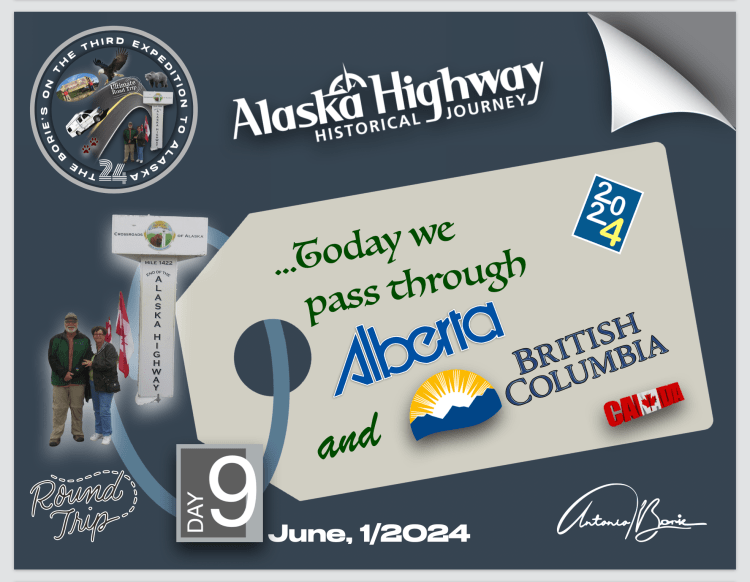
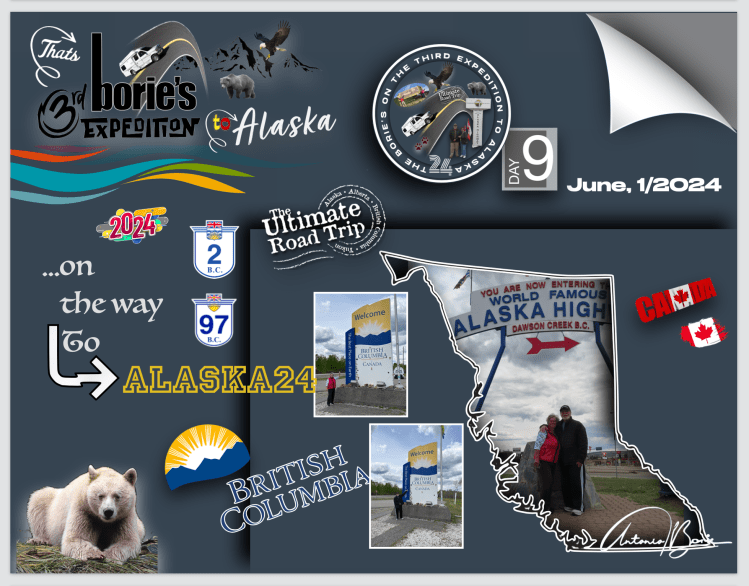
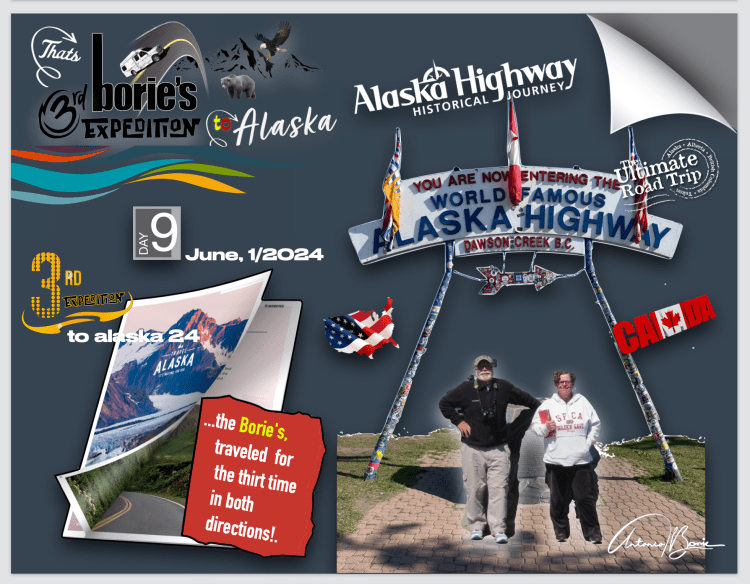
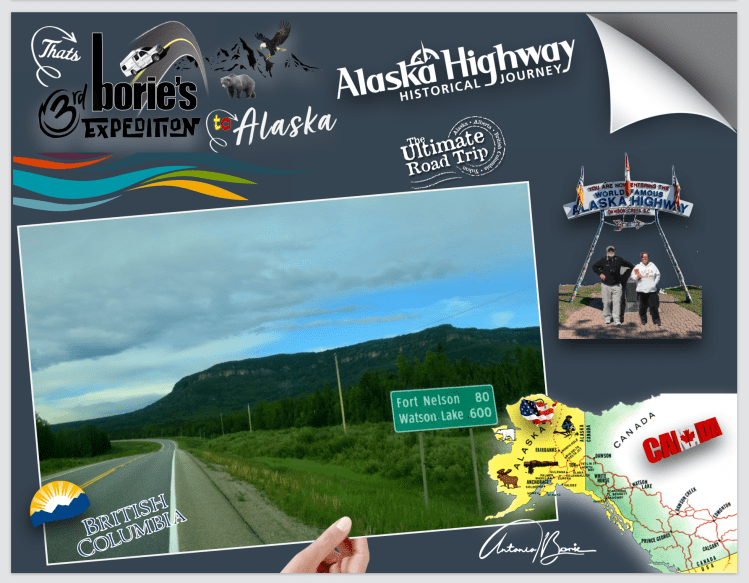
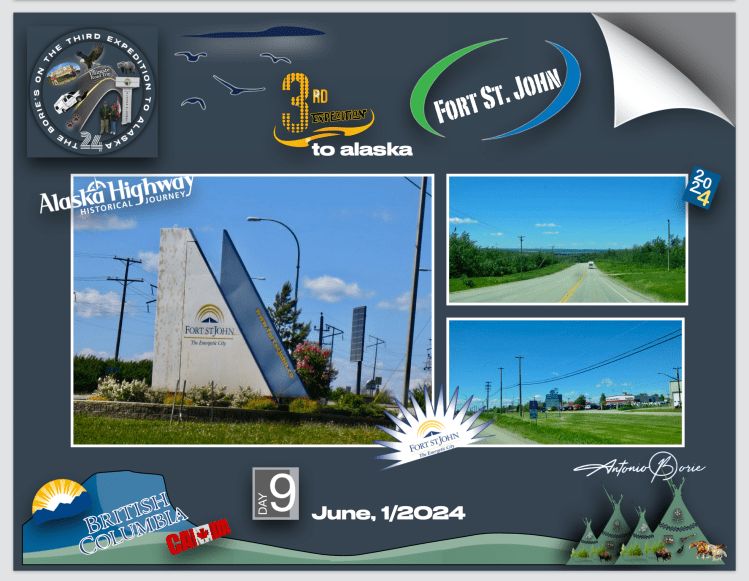
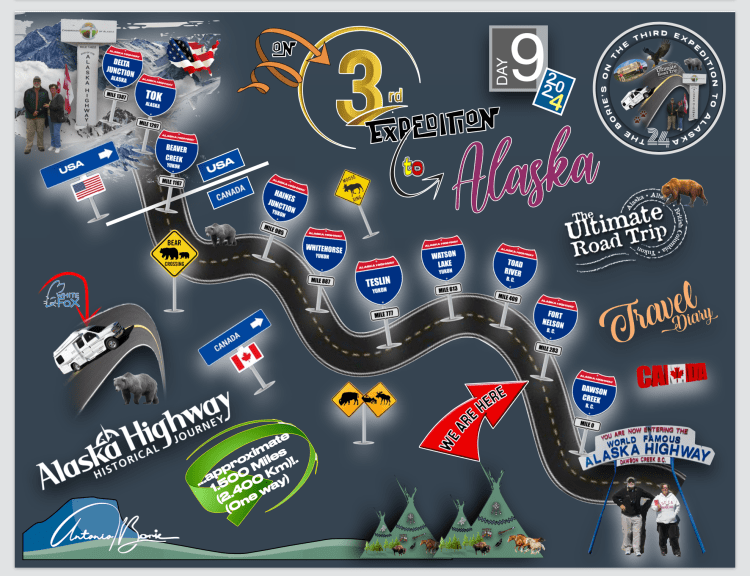
…até que chegámos à cidade de Grande Prairie, Alberta, onde procurámos uma oficina especializada para um pequeno diagnóstico à nossa “White Fox” (caravana), e mudar o óleo ao motor, porque já estávamos próximo do limite de milhas percorridas e íamos entrar na província da Columbia Britânica, onde se situa a pequena cidade de Dawson Creek,“Milha 0”, que é o começo do hoje lendário e “Histórico Alaska Highway”!.
…until we arrived in the city of Grande Prairie, Alberta, where we looked for a specialized workshop for a small diagnosis of our “White Fox” (caravan), and to change the engine oil, because we were already close to the mileage limit and were going to enter in the province of British Columbia, where the small town of Dawson Creek is located, “Mile 0”, which is the beginning of the now legendary and “Historic Alaska Highway”!.
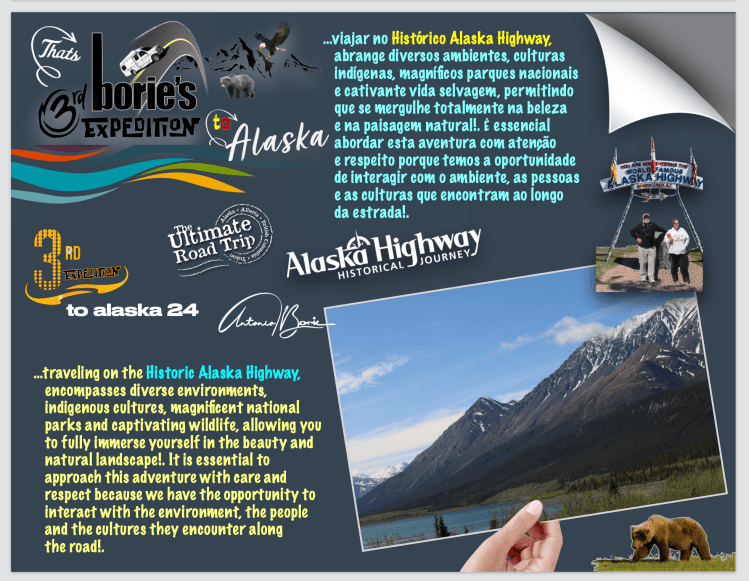
…e, entrando no lendário e “Histórico Alaska Highway”, entre outras coisas, estávamos a ficar mais perto do Oceano Ártico e do “sol da meia-noite”, como tal, a aventura pendurada numa corda ao lado duma montanha, dum rio selvagem ou num longo trecho de uma estrada deserta, dentro de uma tempestade de chuva constante ou de neve branca e gelada, que possivelmente iríamos encontrar já nos afligia muito menos, porque já nos considerávamos veteranos ao viajar por esta lendária estrada, e sabíamos das dificuldades e de possíveis reparações, que são quase impossíveis!.
…and, entering the legendary and “Historic Alaska Highway”, among other things, we were getting closer to the Arctic Ocean and the “midnight sun”, as such, the adventure hanging from a rope on the side of a mountain, a river wilderness or on a long stretch of deserted road, in a storm of constant rain or icy white snow, which we were likely to encounter already distressed us much less, because we already considered ourselves veterans when traveling this legendary road, and we knew the difficulties and possible repairs, which are almost impossible!.
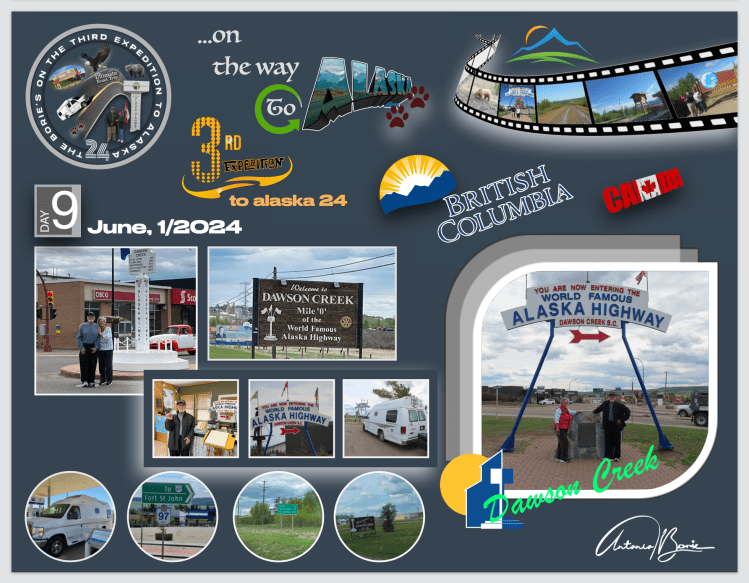
…entretanto chegámos à cidade de Dawson Creek!. É uma típica cidade cujo nome deriva dum riacho que por aqui passa com o mesmo nome, que por sua vez o recebeu de um tal George Mercer Dawson, que era um membro de uma equipe de pesquisa de terras, que talvez tal como nós, também por aqui passou no longínquo ano de 1879!.
…in the meantime we arrived in the city of Dawson Creek!. It is a typical town whose name derives from a stream that passes through here with the same name, which in turn received it from a certain George Mercer Dawson, who was a member of a land survey team, who perhaps like us, also He passed through here in the distant year of 1879!
…e foi aqui, quando ainda era uma pequena comunidade agrícola, que se tornou num centro regional, após o terminal ocidental da “Northern Alberta Railways”, ser estendido até aqui, no ano de 1932, crescendo rapidamente quando por volta do ano de 1942, o Exército dos EUA usou este terminal ferroviário como um ponto de transbordo, durante a construção do hoje lendário e “Histórico Alaska Highway”!. Passou então a ser chamada de “Capital da Paz”, também conhecida como a “Milha 0”, referindo-se à sua localização no extremo sul desta já referida estrada!.
…and it was here, when it was still a small agricultural community, that it became a regional center, after the western terminus of the “Northern Alberta Railways”, was extended here in 1932, growing rapidly when around 1942 , the US Army used this rail terminal as a transfer point during the construction of the now legendary and “Historic Alaska Highway”!. It then came to be called the “Capital of Peace”, also known as “Mile 0”, referring to its location at the southern end of this aforementioned road!.
…a construção do hoje lendário e “Histórico Alaska Highway” começou por volta do ano de 1942, pois o ataque do Japão à baía de Pearl Harbor, no Hawaii, começou um teatro de guerra no oceano Pacífico, com o Japão a querer avançar para ocupar a costa oeste dos USA, incluindo as “Aleutian Islands”, que se situam na parte oeste do Alaska!.
…the construction of the now legendary and “Historic Alaska Highway” began around 1942, as Japan’s attack on Pearl Harbor Bay, Hawaii, began a theater of war in the Pacific Ocean, with Japan wanting to advance to occupy the west coast of the USA, including the “Aleutian Islands”, which are located in the western part of Alaska!.
…assim, com o propósito de haver uma via de comunicação terrestre entre o continente dos USA e o estado do Alaska, claro, passando pelo território do Canadá, em Fevereiro do ano de 1942, o Congresso dos USA, aprovou a sua construção e, o então presidente Franklin D. Roosevelt, mandou começar as obras uns dias depois!. O governo do Canadá concordou, com a condição de a construção ser financiada pelos USA e no final, a estrada e todas as facilidades dela proveniente, ficassem propriedade do governo do Canadá!.
…so, with the purpose of having a land communication route between the USA continent and the state of Alaska, of course, passing through the territory of Canada, in February 1942, the USA Congress approved its construction and, The then president Franklin D. Roosevelt ordered construction to begin a few days later! The government of Canada agreed, on the condition that the construction would be financed by the USA and in the end, the road and all the facilities arising from it would remain the property of the government of Canada!.
…foi construída em tempo de guerra e com muito trabalho físico, onde era usada a pá, picareta e a vagoneta, por pessoas dedicadas, trabalhando muitas horas seguidas, nas mínimas condições de segurança, cumprindo um período de tempo para que se propuseram…, pois em Outubro do mesmo ano, esta estrada estava completa!.
…it was built in wartime and with a lot of physical work, where shovels, picks and carts were used, by dedicated people, working many hours in a row, under the minimum safety conditions, fulfilling a period of time for which they set out …, because in October of the same year, this road was complete!.
…mencionando algumas curiosidades, não existe em todo o seu percurso um único túnel, tudo foi feito à pressa, à luz do dia, sempre improvisando, com os recursos que naquela ocasião existiam, fazendo todas as curvas, que o acidentado do terreno mostrava!. Em algumas zonas, não sendo possível seguir, rasgavam o lado das montanhas, de onde tiravam terra, cascalho ou pedra, para colocar em alguns terrenos mais baixos, que eram alagadiços!. Outra curiosidade, foi que durante a sua construção foi chamada de “Estrada das latas de óleo”, dado o grande número de latões vazios de óleo ou outro combustível, que iam ficando para trás, marcando o progresso da estrada!.
…mentioning some curiosities, there is not a single tunnel along its entire route, everything was done in a hurry, in daylight, always improvising, with the resources that existed at that time, making all the curves, which the rugged terrain showed! In some areas, when it was not possible to follow, they tore up the side of the mountains, where they took earth, gravel or stone, to place in some lower terrain, which was swampy)!. Another curiosity was that during its construction it was called the “Road of Oil Cans”, given the large number of empty cans of oil or other fuel, which were left behind, marking the progress of the road!.
…foi construída em apenas oito meses, descrita como um dos maiores feitos de engenharia da história, através de um território completamente desconhecido, atravessando zonas extremamente frias, compostas por florestas, planícies, montanhas com neve acumulada em milhares, talvez milhões de anos, rochas, povoadas por animais e aves selvagens, lagos, rios revoltosos, alguns de água quente, lama, áreas infestadas de mosquitos, que juntou por terra o continente dos EUA ao estado do Alaska, permitindo que, principalmente os americanos, transportassem aviões até ao território da Rússia, no intuito de combater os alemães, por meio de uma cadeia de aeródromos e aeroportos remotos!.
…was built in just eight months, described as one of the greatest engineering feats in history, through completely unknown territory, crossing extremely cold areas, composed of forests, plains, mountains with snow accumulated over thousands, perhaps millions of years, rocks , populated by wild animals and birds, lakes, wild rivers, some with hot water, mud, areas infested with mosquitoes, which joined the continent of the USA to the state of Alaska by land, allowing, mainly Americans, to transport planes to the territory of Russia, in order to combat the Germans, through a chain of airfields and remote airports!.
…a sua distância era maior nas ocasiões anteriores que por cá passámos, pois constantemente está em reparação, pelo menos na época de verão e, quando acontece uma avalanche por acumulação de neve nas montanhas, ou qualquer inundação junto dos diversos riachos e rios que ela atravessa, próprias do clima de inverno, na sua reconstrução, tentam sempre encurtar a sua distância, o que nos leva a crer que daqui a alguns anos já será uma estrada rápida, perdendo parte do seu encanto!.
…its distance was greater on the previous occasions we passed by, as it is constantly under repair, at least in the summer season and, when an avalanche occurs due to the accumulation of snow in the mountains, or any flood near the various streams and rivers which it crosses, due to the winter climate, in its reconstruction, they always try to shorten its distance, which leads us to believe that in a few years it will already be a fast road, losing part of its charm!.
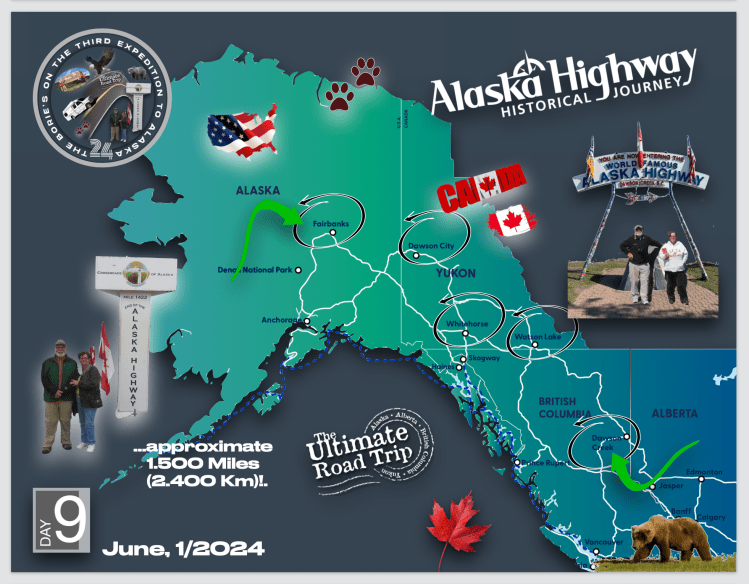
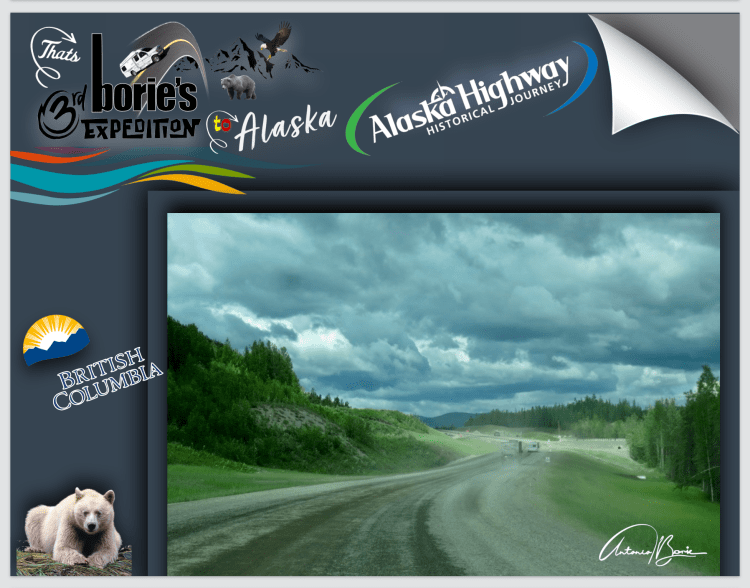
…é uma estrada especialmente para pessoas com gosto pela aventura, onde o GPS, tal como o telefone, em algumas zonas não recebe sinal de satélite, a gasolina existe em alguns locais estratégicos, com as suas aproximadamente 1.500 milhas, onde existe partes com muita terra, lama, pedra miúda, algum alcatrão com buracos constantes, riachos, pontes em reparação, onde passa só um veículo de cada vez, entre outras coisas, a espera pelo “Carro Piloto”, que nos guia por uma determinada distância, onde não temos autorização de nos desviar da rota do referido carro!.
…it is a road especially for people with a taste for adventure, where the GPS, like the telephone, in some areas does not receive a satellite signal, gasoline exists in some strategic locations, with its approximately 1,500 miles, where there are parts with a lot of dirt, mud, small stones, some tar with constant holes, streams, bridges under repair, where only one vehicle passes at a time, among other things, waiting for the “Pilot Car”, which guides us for a certain distance, where we are not allowed to deviate from the route of said car!.
…depois deste breve relato e continuando, andámos um pouco pela cidade de Dawson Creek, parando no local onde se inicia esta hoje lendária estrada, para uma foto no marco histórico na “Milha 0”, todavia já lá estavam algumas caravanas, motos e outros veículos, alguns vindos da Europa!.
…after this brief report and continuing, we walked a little through the city of Dawson Creek, stopping at the place where this now legendary road begins, for a photo at the historical marker at “Mile 0”, however there were already some caravans, motorbikes and others there vehicles, some coming from Europe!.
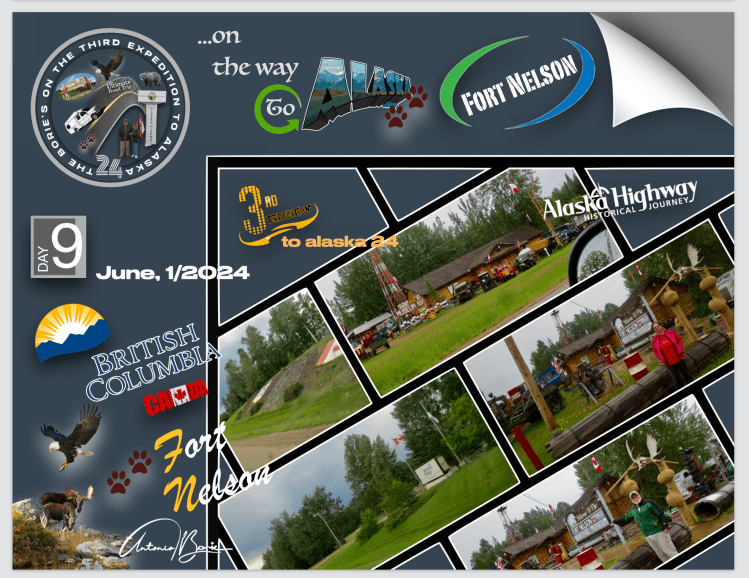
…iniciámos a nossa jornada passando por diversas comunidades, apreciando em algumas áreas uma natureza intocada e uma vida selvagem indígena, pernoitámos num parque RV na cidade de Fort Nelson, historicamente concentrada nas indústrias de energia e turismo, cercada de parte da floresta boreal do Canadá, situada na margem sudoeste do campo de petróleo e gás da Grande Serra, e tem história, com o seu aeroporto a ser um bem valioso para as forças militares aliadas na Segunda Guerra Mundial, pois serviu como base aérea para a Força Aérea dos Estados Unidos e para a Royal Air Force!.
…we began our journey passing through several communities, enjoying in some areas pristine nature and indigenous wildlife, we spent the night in an RV park in the city of Fort Nelson, historically concentrated in the energy and tourism industries, surrounded by part of Canada’s boreal forest , located on the southwestern edge of the Grande Serra oil and gas field, and has history, with its airport being a valuable asset to the Allied military forces in World War II, as it served as an air base for the United States Air Force and for the Royal Air Force!.
…na aldeia onde nascemos, lá naquela encosta de uma montanha na Europa, onde toda a gente era pobre…, com excepção de uma pequenina parte da população, que eram os ricos!. Na vila mais próxima, havia uma rua onde também havia uma mercearia, uma loja de fazendas e pano crú e…, uma taberna!.
…in the village where we were born, there on that mountainside in Europe, where everyone was poor…, with the exception of a tiny part of the population, who were the rich!. In the nearest village, there was a street where there was also a grocery store, a farm and raw cloth store and…, a tavern!.
…a mercearia vendia açúcar, arroz, sal e farinha, às vezes bacalhau, e.., era tudo fiado, onde os clientes pagavam os géneros a prestações ou por ocasião das colheitas, quando faziam algum dinheiro da sua agricultura de subsistência, onde normalmente criavam algumas aves de capoeira e matavam um porco uma vez por ano!. Bifes, peixe fino, café ou pão de trigo com manteiga…, eram um luxo!.
…the grocery store sold sugar, rice, salt and flour, sometimes cod, and…, it was all on credit, where customers paid for the items in installments or during the harvest, when they made some money from their subsistence farming, where they normally They raised some poultry and killed a pig once a year!. Steaks, fine fish, coffee or wheat bread with butter… they were a luxury!
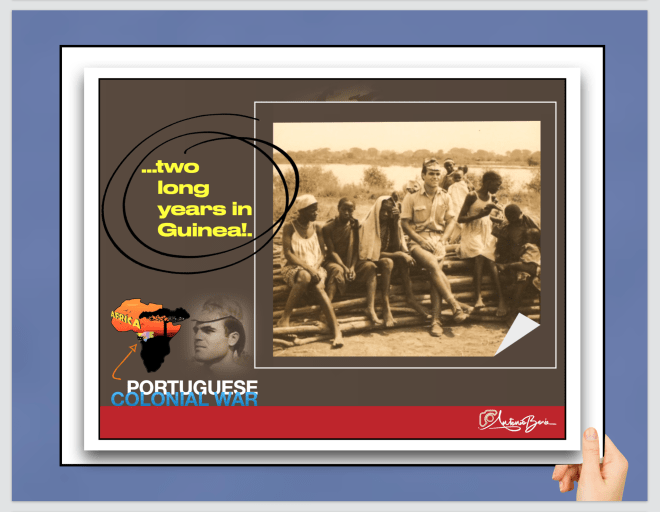
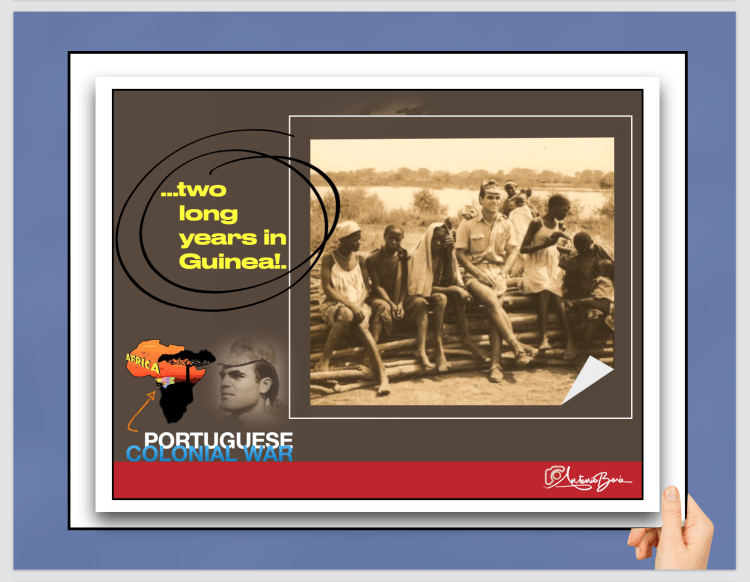
…depois de quase crianças, ser-mos recrutados, mobilizados, treinados à pressa para a Guerra Colonial, “encaixotados” no porão de um navio de carga, navegando no mar do Atlântico, rumo ao sul com destino à costa africana, para combater pessoas que lutavam pela liberdade dos seus territórios, e que nunca antes tínhamos visto e nada tínhamos em contra e…, ao final de dois longos anos, vivendo num cenário de medo e angustia nos pântanos e florestas da então Província Colonial da Guiné, quando regressámos de novo à Europa, decidimos fugir…, ou seja, imigrar!.
…after we were almost children, we were recruited, mobilized, trained in a hurry for the Colonial War, “boxed” in the hold of a cargo ship, sailing in the Atlantic sea, heading south towards the African coast, to fight people who were fighting for the freedom of their territories, and which we had never seen before and had nothing against and…, at the end of two long years, living in a scenario of fear and anguish in the swamps and forests of the then Colonial Province of Guinea, when we returned from new to Europe, we decided to escape…, that is, to immigrate!.
…escolhemos este continente do lado de cá do Atlântico, vindo viver para este país que nos recebeu de “braços abertos”!. Como tal, apesar de termos jurado a cidadania, possuir-mos passaporte deste grande país e termos dado o nosso contributo possível para com a ajuda da nossa dedicada esposa Isaura, criarmos e educarmos uma família com princípios honestos, que por sua vez, já criaram as suas próprias famílias…, continuamos a ser imigrantes, descendentes da Europa!.
…we chose this continent on this side of the Atlantic, coming to live in this country that welcomed us with “open arms”!. As such, despite having sworn citizenship, holding a passport from this great country and having given our possible contribution to, with the help of our dedicated wife Isaura, creating and educating a family with honest principles, which in turn, have already created their own families…, we continue to be immigrants, descendants of Europe!.
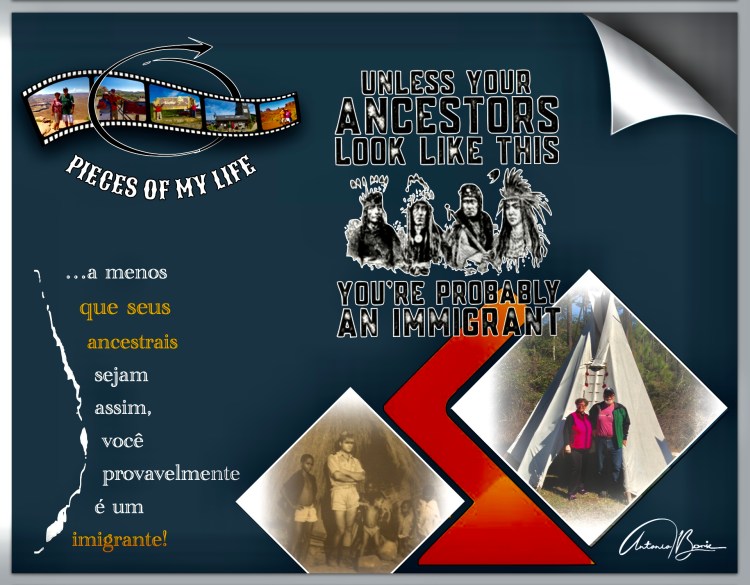
…e, talvez, pelo sotaque da voz ou qualquer outra qualquer anomalia, é frequente perguntarem-nos: é imigrante, de que país veio?. E a resposta para estas perguntas podem ler-se neste cartaz, que completámos com uma bonita foto tirada da internet e da qual não sabemos o nome do autor, mas com muito respeito lhe agradecemos, e que pode dizer-nos: “a menos que seus ancestrais sejam assim, você provavelmente é um imigrante”!.
…and, perhaps, due to the accent of the voice or any other anomaly, we are often asked: are you an immigrant, what country did you come from?. And the answer to these questions can be read on this poster, which we have completed with a beautiful photo taken from the internet and of which we do not know the name of the author, but with great respect we thank him, and who can tell us: “unless your ancestors are like this, you are probably an immigrant”!.
Tony Borie, Século XXI. (Tony Borie, 21st Century).



















 Tony Borie - "Pieces of my life"