…talvez seja da idade já avançada mas…, hoje, sentimos uma manhã fria de autêntico inverno e…, ao acordarmos vemos o mundo onde já não existe lugar para a fuga, porque toneladas de bombas já não são suficientes para satisfazer as mentes diabólicas que infelizmente dirigem as multidões!. Assim…, os noticiários na comunicação social abrem com notícias do oriente ao ocidente, mencionando única e simplesmente destruição, mortes ou famílias com crianças famintas e desalojadas!.
…maybe it’s old age but…, today, we feel a cold morning of true winter and…, when we wake up we see the world where there is no longer any place to escape, because tons of bombs are no longer enough to satisfy the diabolical minds that unfortunately they direct the crowds!. So…, the news in the media opens with news from East to West, mentioning only and simply destruction, deaths or families with hungry and homeless children!.
…às vezes e nos intervalos, também nos mostram as planícies desertas a perder de vista, onde os bisontes vão desaparecendo, as poucas aves de rapina que ainda existem estão enjauladas nos jardins zoológicos, os felinos estão em extinção, toneladas de marfim ditam o fim dos paquidermes, os oceanos são constantemente contaminados, violados e saqueados e…, as grandes geleiras nos polos norte e sul, estão a derreter mais rápido do que o normal e…, o mais importante é que infelizmente, já não nascem tantas crianças!.
…sometimes and at intervals, they also show us the desert plains as far as the eye can see, where bison are disappearing, the few birds of prey that still exist are caged in zoos, felines are becoming extinct, tons of ivory dictate the end of pachyderms, the oceans are constantly contaminated, raped and plundered and…, the large glaciers in the north and south poles, are melting faster than normal and…, the most important thing is that unfortunately, not so many children are born anymore!.
…como tal…, o que nos resta?. Talvez mais rápido do que pensamos…, o exemplo da destruição de Kiev ou de Gaza pintados com sangue humano, (onde os sobreviventes tentam remover dos escombros o que resta dos seus familiares já mortos), poderá vir a aparecer em outras partes do mundo, onde já não existem vidros nas janelas e o gélido vento da impotência vai destruindo a esperança, transformando-nos em seres errantes no meio de uma intensa nuvem do pó explosivo e mortífero das bombas, que nos vai toldando a vista e os sentidos!.
…as such…, what are we left with? Perhaps faster than we think…, the example of the destruction of Kiev or Gaza painted with human blood, (where survivors try to remove what remains of their dead family members from the rubble), could appear in other parts of the world, where there are no longer any glass in the windows and the cold wind of impotence is destroying hope, transforming us into wandering beings in the midst of an intense cloud of explosive and deadly dust from the bombs, which is clouding our vision and senses!.
…infelizmente, foi sempre assim e assim será…, o homem constrói para destruir!.
…unfortunately, it has always been like this and will always be like this…, man builds to destroy!.
Tony Borie, Século XXI. (Tony Borie, 21st Century).
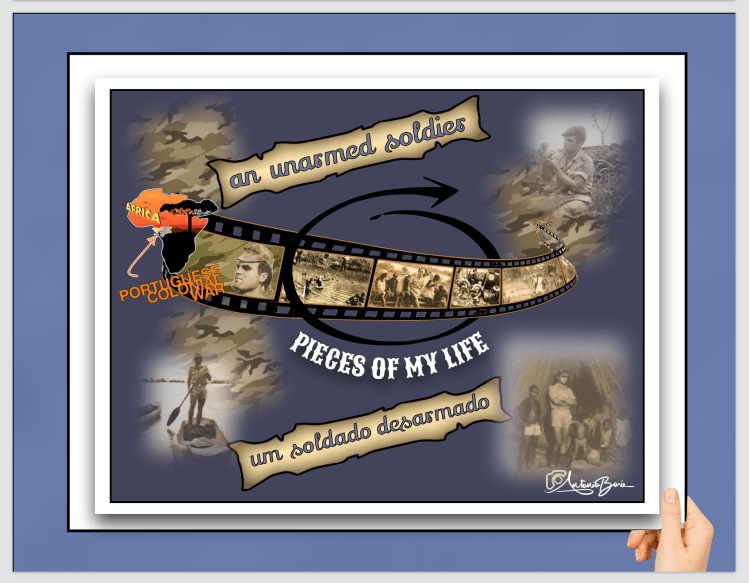
…a nossa experiência diz-nos que, (e não é apenas a continuação de uma história ruim que se arrasta por séculos), qualquer guerra, por mais pequena que seja, “nunca tem um bom final”!. Como tal, hoje somos um antigo “veterano de guerra…, anti-guerra”!. Porquê?.
…our experience tells us that, (and it is not just the continuation of a bad story that has dragged on for centuries), any war, no matter how small, “never has a good ending”! As such, today we are a former “war veteran…, anti-war”!. Why?.
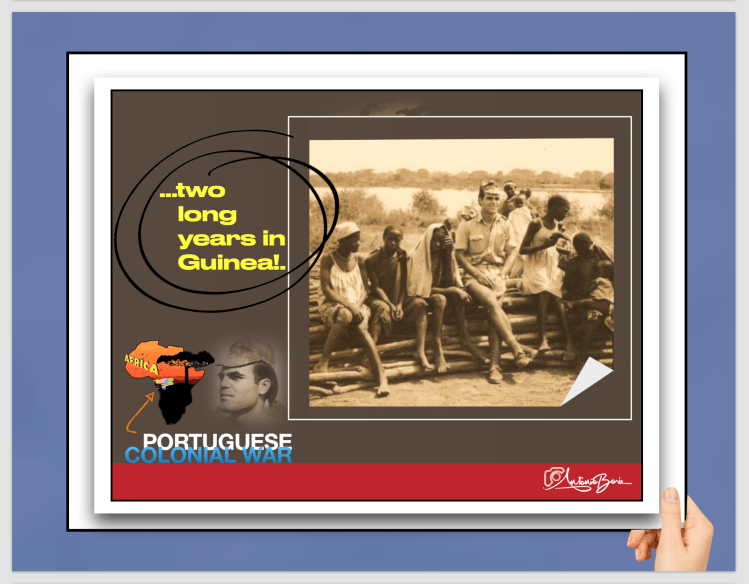
…porque durante os nossos dois longos anos da nossa participação forçada na Guerra Colonial Portuguesa na então província da Guiné, nós soldados combatentes, era-nos proibido e…, não falávamos muito sobre a política da guerra, principalmente porque não sabíamos realmente nenhuma informação relevante sobre este assunto, como tal…, estávamos ali para lutar e morrer!.
…because during our two long years of our forced participation in the Portuguese Colonial War in the then province of Guinea, we combat soldiers were forbidden and…, we didn’t talk much about the politics of the war, mainly because we didn’t really know any relevant information on this subject, as such…, we were there to fight and die!.
…ao regressar-mos à Europa, começámos a pesquisar o início do envolvimento do então governo colonial de Portugal em forçar-nos a navegar no oceano Atlântico rumo ao sul, “empacotados” no porão de um navio de carga, para ir-mos combater os guerrilheiros que lutavam pela independência dos seus territórios, lá naquela parte da África selvagem e pantanosa, com savanas de terra vermelha!.
…when we returned to Europe, we began to research the beginning of the involvement of the then colonial government of Portugal in forcing us to sail in the Atlantic Ocean heading south, “packed” in the hold of a cargo ship, to go fight The guerrillas who fought for the independence of their territories, there in that part of wild and swampy Africa, with red earth savannas!.
…e aí…, devemos dizer que ficámos bastante chocados e furiosos, porque éramos nós jovens soldados combatentes que colocávamos as nossas vidas em risco diariamente e, com muito poucas excepções, servimos fiel e honrosamente, o que é mais do que podemos dizer sobre os políticos e planeadores militares que iniciaram esta maldita guerra!. Então passámos a acreditar que a guerra tinha sido errada a muitos níveis!.
…and then…, we must say that we were quite shocked and furious, because we were young combat soldiers who put our lives at risk daily and, with very few exceptions, we served faithfully and honorably, which is more than we can say about the politicians and military planners who started this damn war!. So we came to believe that the war had been wrong on many levels!
…e todavia, ainda hoje não sabemos e talvez nunca saberemos porque a idade já vai longa, quem foram os verdadeiros heróis, se foram os que por lá ficaram enterrados nas valas comuns junto do nosso “posto avançado” naquela selva pantanosa,ou aqueles que eram apelidados de activistas e vistos como simpatizantes antipatrióticos e…, ainda em Portugal diziam: “claro que não, não iremos para a guerra em África, vamos fugir para França”, o que era muito vulgar naquela época!.
…and yet, even today we do not know and perhaps we will never know because the age is already long, who the real heroes were, whether they were those who were buried there in the mass graves next to our “outpost” in that swampy jungle,or those who they were called activists and seen as unpatriotic sympathizers, and even in Portugal they said: “of course not, we’re not going to war in Africa, we’re going to flee to France”, which was very common at that time!.
…hoje…, consideramos tudo isto fragmentos do tempo…, do tempo que nos resta!.
…today…, we consider all of this fragments of time…, of the time we have left!.
Tony Borie, Século XXI. (Tony Borie, 21st Century).
…o dia estava excelente, a manhã a raiar com algum sol, o céu estava quase azul, a temperatura era de uma primavera semi-tropical, nem parecia que estávamos no norte do Alaska!.
…the day was excellent, the morning dawned with some sun, the sky was almost blue, the temperature was that of a semi-tropical spring, it didn’t even feel like we were in northern Alaska!.
…era um dia especial!. Queríamos completar uma aventura que já se prolongava por alguns anos, que era viajar na famosa “Estrada Dalton”!. No passado já a havíamos tentado, estando no início desta famosa estrada, percorrendo mesmo algumas milhas…, mas a chuva, o nevoeiro, o vento, o frio, a neve e os acidentes que havia pelo percurso, além dos avisos feitos pelas pessoas de uniforme, alguns eram militares, que frequentemente nos apareciam, fizeram com que desanimados, voltasse-mos para trás, desistindo, percorrendo um caminho de regresso, de alguma revolta, jurando que um dia havia-mos de nela viajar, pelo menos até ao “Circulo Polar Ártico”!.
…it was a special day! We wanted to complete an adventure that had been going on for a few years, which was traveling on the famous “Dalton Highway”!. In the past we had already tried it, being at the beginning of this famous road, covering just a few miles…, but the rain, the fog, the wind, the cold, the snow and the accidents along the way, in addition to the warnings given by people from uniform, some were military, who frequently appeared to us, made us discouraged, turned back, giving up, following a path of return, of some revolt, swearing that one day we would travel in it, at least until the “Arctic Circle”!.
…e anos depois, numa segunda tentativa fomos abençoados com ventos suaves e céu limpo!. Aqui e ali ainda nos apareciam…, alguma lama, poeira, pedra miúda ou buracos, mas a tal chuva, neve ou granizo, enormes geadas, buracos e rachaduras na estrada, felizmente não!. Como tal…, perfeitamente nos adaptámos!.
…and years later, on a second attempt we were blessed with gentle winds and clear skies!. Here and there we still saw some mud, dust, small stones or holes, but not so much rain, snow or hail, huge frosts, holes and cracks in the road, fortunately not! As such… we adapted perfectly!
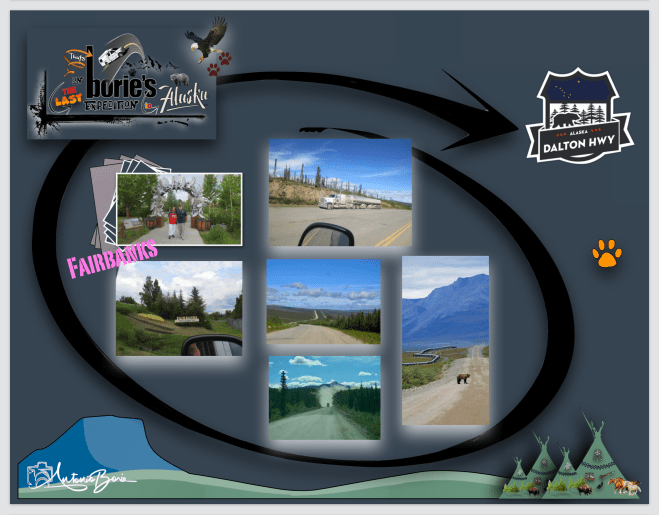
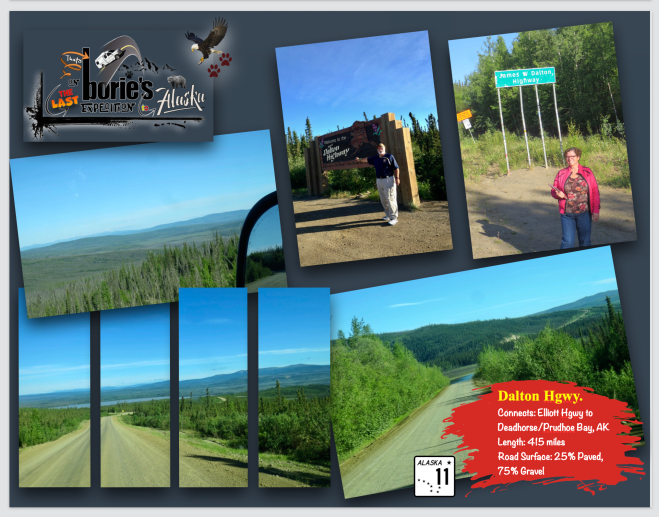
…a ”EstradaDalton” é uma estrada de 414 milhas (666 km) que começa na“Estrada Elliott, ao norte da cidade de Fairbanks e termina em Deadhorse, uma comunidade da Baía de Prudhoe, perto do Oceano Ártico e dos Campos Petrolíferos da Baía de Prudhoe!. Hoje chama-se “Estrada Dalton”, em homenagem ao engenheiro James W. Dalton, especialista em engenharia do Ártico, actuando como consultor em exploração de petróleo no norte do Alaska, todavia já foi chamada de “North Slope Haul Road”, um nome pelo qual ainda é conhecida às vezes e que, foi construída como uma estrada de suprimento para apoiar o Sistema de Oleodutos Trans-Alaska no ano de 1974!.
…the “Dalton Highway” is a 414-mile (666 km) road that begins at “Elliott Highway”, north of the city of Fairbanks and ends in Deadhorse, a Prudhoe Bay community near the Arctic Ocean and the Oil Fields Prudhoe Bay!. Today it is called “Dalton Highway”, in honor of the engineer James W. Dalton, a specialist in Arctic engineering, acting as a consultant in oil exploration in northern Alaska, however it was once called “North Slope Haul Road”, a name which it is still sometimes known as, was built as a supply road to support the Trans-Alaska Pipeline System in 1974!.
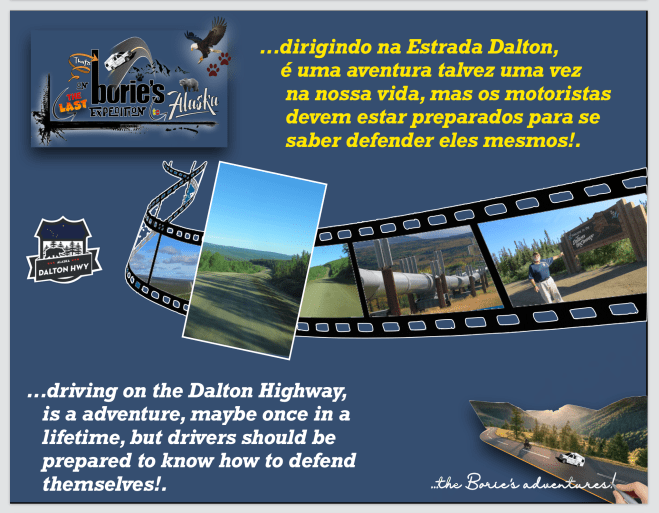
…aqui recomeçou a aventura que frustrados e revoltados, fomos obrigados a desistir uns anos atrás!. O dia estava mesmo a nosso favor, estava um céu limpo e não era necessário esperar por outros aventureiros, como tal fomos em frente, sabendo que o lema era, “conduzir na Estrada Dalton, é uma aventura, talvez uma vez na vida, mas os motoristas devem preparar-se para se saber defender sózinhos”!.
…here the adventure that frustrated and angry, we were forced to give up a few years ago, began again!. The day was really in our favor, it was a clear sky and there was no need to wait for other adventurers, so we went ahead, knowing that the motto was, “driving the Dalton Highway, it’s an adventure, maybe once in a lifetime, but Drivers must prepare themselves to know how to defend themselves”!
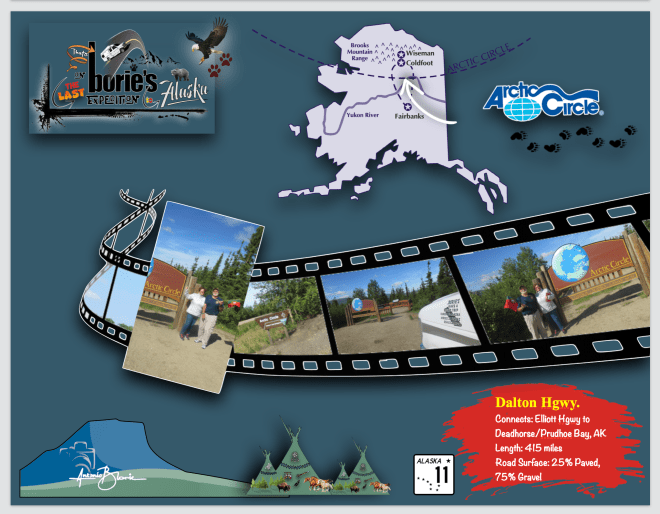
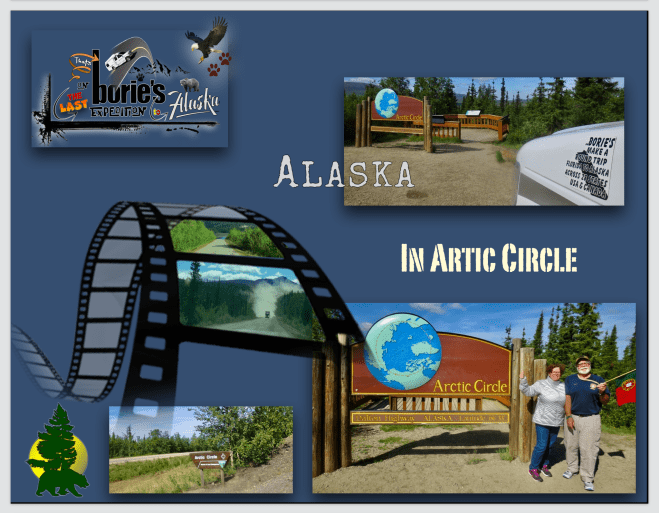
…a “Estrada Dalton” é a única estrada no estado do Alaska que atravessa o “Círculo Polar Ártico”, que é o ponto mais ao norte, dos abstratos ou imaginários principais círculos de latitude, como é mostrado nos mapas da Terra!. Ele marca o ponto mais setentrional no qual o sol do meio-dia é visível no solstício de inverno do norte, e o ponto mais ao sul no qual o sol da meia-noite é visível no solstício de verão do norte!. A região ao norte deste círculo é conhecida como o Ártico, e a zona apenas para o sul é chamada de Zona Temperada Norte!.
…the “Dalton Highway” is the only road in the state of Alaska that crosses the “Arctic Circle”, which is the northernmost point of the abstract or imaginary main circles of latitude, as shown on maps of the Earth! . It marks the northernmost point at which the midday sun is visible on the northern winter solstice, and the southernmost point at which the midnight sun is visible on the northern summer solstice!. The region north of this circle is known as the Arctic, and the zone just to the south is called the North Temperate Zone!
…e nós ao cruzarmos este ponto, ficámos fascinados e algo surpresos por ver este fenómeno, pois ao norte do “Círculo Polar Ártico”, o sol está acima do horizonte por vinte e quatro horas contínuas pelo menos uma vez por ano, portanto, visível à meia-noite e, abaixo do horizonte por vinte e quatro horas contínuas pelo menos uma vez por ano, portanto, não visíveis ao meio dia, isso também é verdade dentro do Círculo Polar equivalente no Hemisfério Sul, o Círculo Antártico. A posição do Círculo Ártico não é fixa, mas o normal é 66º33’46.8 graus ao norte do Equador!.
…and when we crossed this point, we were fascinated and somewhat surprised to see this phenomenon, because north of the “Arctic Circle”, the sun is above the horizon for twenty-four continuous hours at least once a year, therefore visible at midnight and, below the horizon for twenty-four continuous hours at least once a year, therefore not visible at noon, this is also true within the equivalent Polar Circle in the Southern Hemisphere, the Antarctic Circle. The position of the Arctic Circle is not fixed, but the normal is 66º33’46.8 degrees north of the Equator!.
…algumas curiosidades do “Círculo Polar Ártico” é que passa por sete países que possuem uma porção considerável de terra dentro do seu círculo, que são países como os USA, Groenlândia, Canadá, Rússia, Noruega, Suécia ou Finlândia, no entanto, a Islândia tem uma pequena região, menos de um quilómetro quadrado, dentro do mesmo círculo!.
…some interesting facts about the “Arctic Circle” is that it passes through seven countries that have a considerable portion of land within their circle, which are countries such as the USA, Greenland, Canada, Russia, Norway, Sweden or Finland, however, the Iceland has a small region, less than a square kilometer, within the same circle!.
…a sua posição, que como acima explicámos é normalmente localizada a 66º33’46.8 graus ao norte do Equador, no entanto, a sua localização real muda ligeiramente todos os anos e.., este fenómeno deve-se à flutuação da inclinação axial da Terra, que é influenciada pela órbita da Lua e pelas consequentes mudanças nas marés!. A mesma inclinação axial causa as diferentes estações que vivemos na Terra, e actualmente, o círculo está a mover-se para o norte a uma taxa de cerca de 15 metros por ano!.
…its position, which as we explained above is normally located at 66º33’46.8 degrees north of the Equator, however, its actual location changes slightly every year and…, this phenomenon is due to the fluctuation of the Earth’s axial tilt , which is influenced by the Moon’s orbit and the resulting changes in tides!. The same axial tilt causes the different seasons we experience on Earth, and currently, the circle is moving north at a rate of about 15 meters per year!.
…para muitos, o “Círculo Polar Ártico”, ou “Pólo Norte” como é costume dizer-se, e que é frequentemente associado ao “Pai Natal” eàs renas voadoras…, no entanto, o que a maioria das pessoas não sabe é que na verdade existem quatro “Pólos Norte” reconhecidos, que são: O “Pólo Norte Geográfico”, que é o ponto mais setentrional do planeta e onde todas as linhas de longitude da Terra se encontram!.. O “Pólo Norte Magnético”, que é o local onde todas as linhas de força magnética do planeta apontam verticalmente para baixo e o seu ponto atrai a agulha de uma bússola!. O “Pólo Norte Geomagnético”, que é o extremo norte de onde o eixo da magnetosfera, ou seja, o campo magnético que envolve a Terra e se estende pelo espaço e cruza o planeta!. E finalmente, o ”Pólo Norte da Inacessibilidade”, que é o ponto do Oceano Ártico mais distante de qualquer costa!.
…for many, the “Arctic Circle”, or “North Pole” as it is customary to say, and which is often associated with “Santa Claus” and flying reindeer…, however, what most people don’t know is that there are actually four recognized “North Poles”, which are: The “Geographic North Pole”, which is the northernmost point on the planet and where all the Earth’s longitude lines meet!.. The “Magnetic North Pole” , which is the place where all the planet’s magnetic lines of force point vertically downwards and its point attracts the needle of a compass!. The “Geomagnetic North Pole”, which is the extreme north of where the axis of the magnetosphere, that is, the magnetic field that surrounds the Earth and extends through space and crosses the planet!. And finally, the “North Pole of Inaccessibility”, which is the point in the Arctic Ocean furthest from any coast!.
…e, dizem-nos que os maiores predadores terrestres da Terra são exclusivos desta região, que dão pelo nome de Ursos Polares e que são os maiores carnívoros terrestres do mundo, residindo em torno de águas cobertas de gelo e dependendo do gelo marinho para se alimentar, descansar e procriar!..
…and, we are told that the largest land predators on Earth are exclusive to this region, which they call Polar Bears and that they are the largest land carnivores in the world, residing around ice-covered waters and depending on sea ice for food. feed, rest and procreate!
…também dezenas de grupos indígenas prosperam dentro da sua região e, entre a grande população do “Círculo Polar Ártico” residem mais de 40 grupos étnicos diferentes!. Embora variem muito em cultura, língua e história, estes grupos indígenas têm uma forte ligação com as terras árticas que habitam há milhares de anos. Muitos mantêm actividades tradicionais de pesca, pastoreio de renas e caça!.
…dozens of indigenous groups also thrive within its region and, among the large population of the “Arctic Circle” there are more than 40 different ethnic groups!. Although they vary greatly in culture, language and history, these indigenous groups have a strong connection to the Arctic lands they have inhabited for thousands of years. Many maintain traditional fishing, reindeer herding and hunting activities!
…no entanto e infelizmente, os seus meios de subsistência e produtividade estão ameaçados pelas dramáticas mudanças climáticas e pelo desaparecimento do gelo marinho!.
…however, unfortunately, their livelihoods and productivity are threatened by dramatic climate change and the disappearance of sea ice!.
Tony Borie, Século XXI. (Tony Borie, 21st Century).
…é uma excelente caminhada localizada na área da cidade de Daytona Beach, com um comprimento de aproximadamente 2,4 milhas de ida e volta e…, para lá chegar podemos seguir pela estrada US 92 para oeste por uma distância de 4.2 milhas até ao semáforo para Indian Lake Road, onde devemos entrar na faixa da esquerda e observar a sinalização do início da trilha no lado oposto da estrada, usando a próxima curva para entrar nas pistas no sentido leste da estrada US 92 para chegar ao início da trilha!.
…is an excellent hike located in the area of the city of Daytona Beach, with a length of approximately 2.4 miles round trip and…, to get there we can follow US 92 west for a distance of 4.2 miles to the traffic light to Indian Lake Road, where we should enter in the left lane and watch for trailhead signage on the opposite side of the road, using the next turn to enter the eastbound lanes of US 92 to reach the trailhead!.
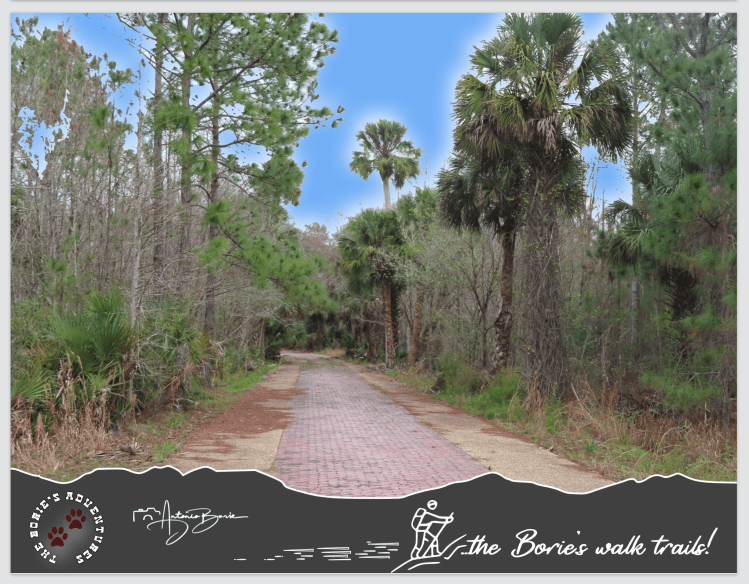
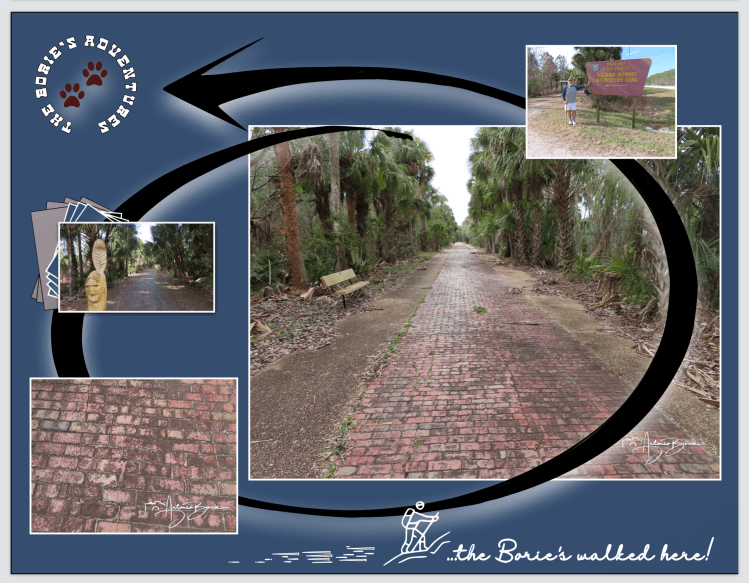
…esta excelente trilha, embora tenha permanecido lá por mais de um século, apenas escondida na floresta ao lado da sua substituta, que é a hoje estrada US 92, no seu início era a Estrada Pershing, que praticamente desapareceu da memória das pessoas e vai abrindo um túnel numa vasta floresta pantanosa, agora protegida como Tiger Bay State Forest, numa faixa de extensão de estrada de tijolos preservados desde o ano de 1917, oferecendo-nos uma visão do início das viagens de automóvel na Flórida!.
…this excellent trail, although it remained there for more than a century, just hidden in the forest next to its replacement, which is today US Highway 92, at its beginning was the Pershing Road, which has practically disappeared from people’s memory and will Tunneling through a vast swamp forest, now protected as Tiger Bay State Forest, on a stretch of brick road preserved since 1917, offering us a glimpse into the beginning of automobile travel in Florida!.
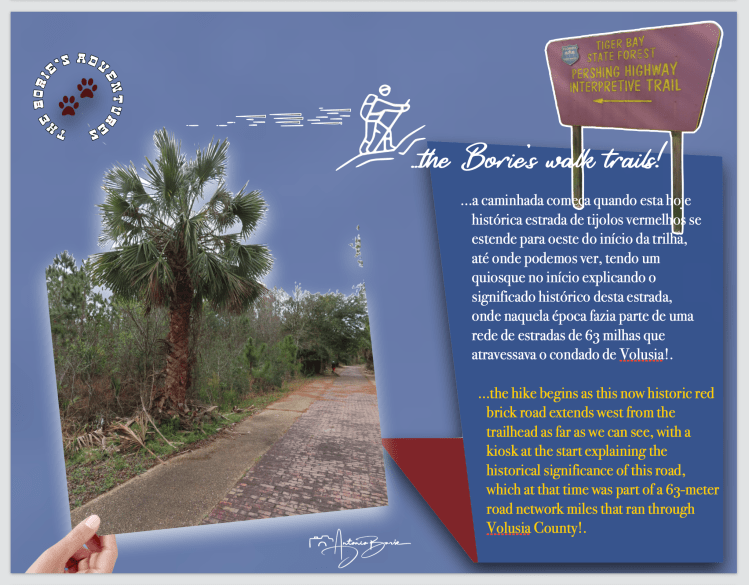
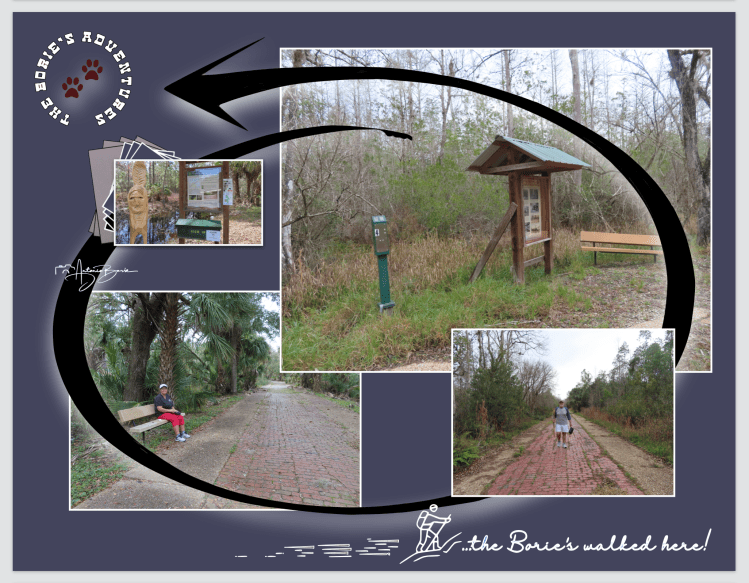
…a caminhada começa quando esta hoje históricaestrada de tijolos vermelhos se estende para oeste do início da trilha, até onde podemos ver, tendo um quiosque no início explicando o significado histórico desta estrada, onde naquela época fazia parte de uma rede de estradas de 63 milhas que atravessava o condado de Volusia!.
…the hike begins as this now historic red brick road extends west from the trailhead as far as we can see, with a kiosk at the start explaining the historical significance of this road, which at that time was part of a 63-meter road network miles that ran through Volusia County!.
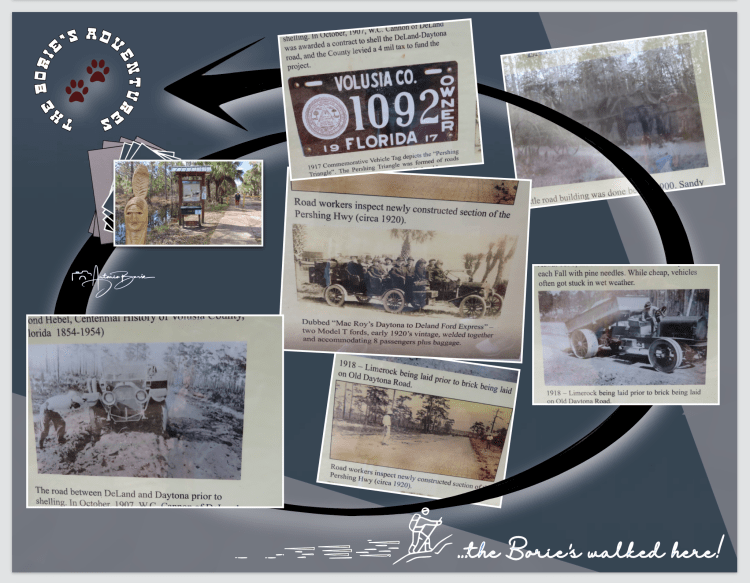
…a história diz-nos que o seu nome foi nomeado em homenagem a um general da Primeira Guerra Mundial com ligações com a área, e claro, a Estrada Pershing depressa atingiu a maioridade, pelo menos para carros na área do Modelo A!. Este segmento específico foi iniciado em 1917 para conectar as cidades de Daytona Beach com DeLand, havendo mesmo outra parte que ia de DeLand a Ormond Beach, conectando-se de volta a Daytona!. Como tal, juntas, elas eram conhecidas como Triângulo de Pershing, uma das primeiras estradas da Flórida, e foram lembradas quando a Tiger Bay State Forest construiu o início desta excelente trilha, que foi também quando esta jóia histórica que estava escondida, finalmente voltou aos holofotes!.
…history tells us that it was named after a World War I general with ties to the area, and of course, the Pershing Road soon came of age, at least for cars in the Model A area! This specific segment was started in 1917 to connect the cities of Daytona Beach with DeLand, there was even another part that went from DeLand to Ormond Beach, connecting back to Daytona!. As such, together they were known as the Pershing Triangle, one of Florida’s first roads, and were remembered when the Tiger Bay State Forest built the beginning of this excellent trail, which was also when this once-hidden historical gem finally returned to the spotlight!.
…naquela época, poucas pessoas possuíam carros!. A estrada tinha apenas a largura da superfície de tijolos, com quase dois metros e meio de largura!. Depois que o trânsito aumentou e os carros precisaram passar uns pelos outros, foi necessário alargar a estrada e assim, flancos de pedra Chattahoochee foram adicionados em ambos os lados!.
…at that time, few people owned cars! The road was only as wide as the brick surface, nearly eight feet wide! After traffic increased and cars needed to pass each other, it was necessary to widen the road and so Chattahoochee stone flanks were added on both sides!.
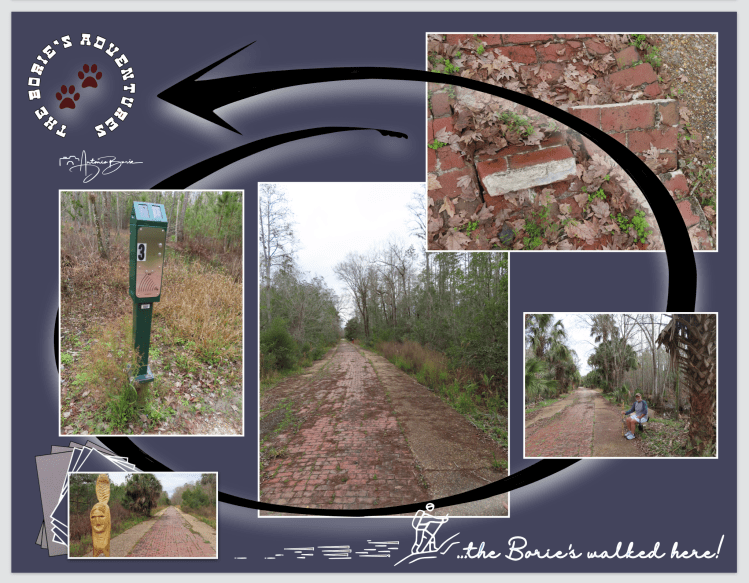
…depois, anos mais tarde quando a US 92 foi inaugurada no ano de 1947, esta estrada desapareceu da vista e da memória das pessoas, no entanto podemos ver com que facilidade a floresta a recuperou e…, só depois dos devastadores incêndios florestais de 1998 é que foi redescoberta!. Em 2011, tropas escoteiras e voluntários de Daytona limparam o mato para permitir que o serviço florestal a abrisse de novo, agora como uma trilha!.
…then, years later when US 92 was opened in 1947, this road disappeared from people’s sight and memory, however we can see how easily the forest recovered it and…, only after the devastating forest fires of 1998 is that it was rediscovered! In 2011, Boy Scout troops and Daytona volunteers cleared the brush to allow the Forest Service to open it again, now as a trail!.
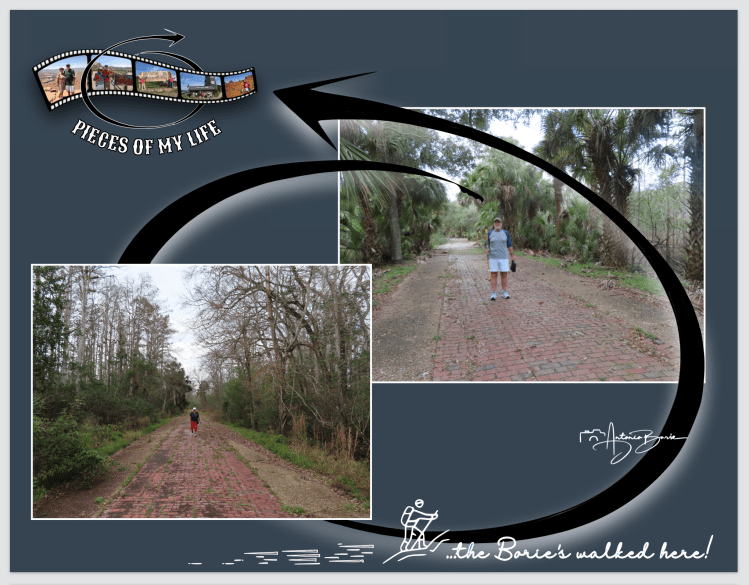
…voltando ao que vimos durante a nossa caminhada, o habitat circundante são florestas de pinheiros, existindo aqui e ali alguns bancos e um marcador de quilometragem que nos aparece após o primeiro quarto de milha e continuam por quarto de milha até o último banco!. A floresta faz a transição para uma planície húmida, com pinheiros e ciprestes e vegetação mista de pântano abaixo!.
…returning to what we saw during our walk, the surrounding habitat is pine forests, with here and there some benches and a mile marker that appears after the first quarter of a mile and continues for a quarter of a mile until the last bench!. The forest transitions to a moist plain, with pine and cypress trees and mixed swamp vegetation below!.
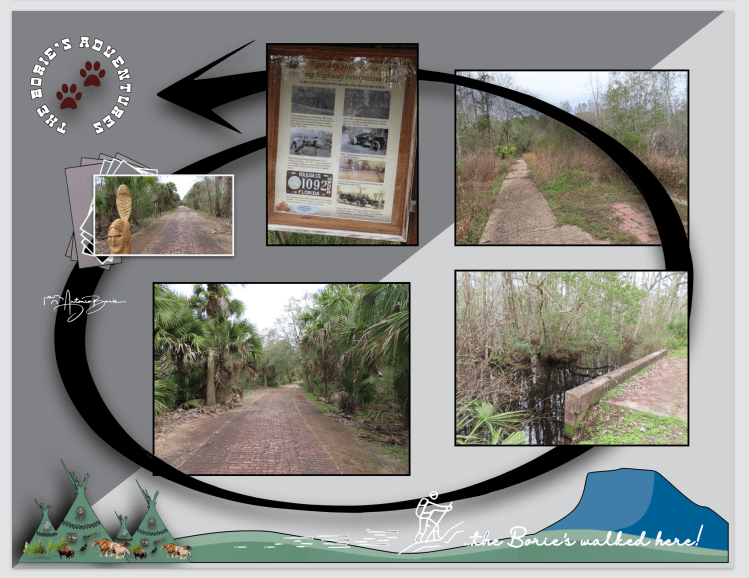
…depois de alguma distância percorrida, existem duas pequenas pontes que permitem que uns riachos escuros ladeados de ciprestes fluam sob a estrada!. Na trilha também existem algumas curvas lentas onde os salgueiros e algumas palmeiras rasteiras formam uma parede densa em frente aos ciprestes e pinheiros mais altos e quanto mais avançamos, mais selvagem a floresta parece, aglomerando-se de ambos os lados!.
…after some distance covered, there are two small bridges that allow dark streams lined with cypress trees to flow under the road!. On the trail there are also some slow curves where the willows and some low-lying palms form a dense wall in front of the taller cypresses and pines and the further we go, the wilder the forest seems, crowding on both sides!.
…a trilha termina oficialmente num quiosque e banco na marca de 1 milha!. Aqui, podemos ler todas as informações, pois elas falam mais detalhadamente sobre o sistema rodoviário do Pershing Triangle!. Os tijolos continuam passando pelo quiosque e a estrada desmorona no pântano que divide esta histórica estrada da US 92!.
…the trail officially ends at a kiosk and bench at the 1 mile mark!. Here, we can read all the information as it talks in more detail about the Pershing Triangle road system!. The bricks continue to pass the kiosk and the road collapses into the swamp that divides this historic road from US 92!.
…ufff…, dizem-nos também que já viram ursos ao longo desta excelente trilha!. Nós, felizmente não vimos nenhum!.
…ufff…, they also tell us that they have seen bears along this excellent trail! We luckily didn’t see any!
Tony Borie, Século XXI. (Tony Borie, 21st Century).







 Tony Borie - "Pieces of my life"