
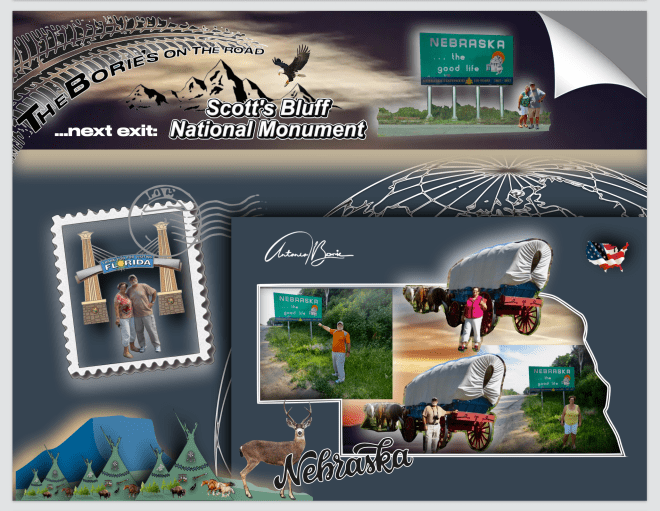
…já lá iam alguns anos que estivemos próximos mas, nunca tivemos a oportunidade de pisar solo do estado do Nebraska!. Era quase um fascínio, até que a nossa curiosidade se satisfez!. Num dia de alguma tempestade, pois existem grandes variações entre as temperaturas de inverno e verão, diminuindo para a região do sul, onde se formam algumas tempestades violentas e tornados, que ocorrem principalmente durante a primavera e o verão, às vezes até no outono, pois os ventos de Chinook tendem a aquecer o estado significativamente no inverno ou no início da primavera!.
…iIt was a few years since we were close but we never had the opportunity to tread ground in the state of Nebraska!. It was almost a fascination, until our curiosity was satisfied!. On a stormy day as there are large variations between winter and summer temperatures, decreasing to the southern region, where some violent and tornado storms occur, occurring mostly during spring and summer, sometimes even in the fall, because the Chinook winds tend to warm the state significantly in winter or early spring!.
…finalmente e, felizmente para nós, entrámos no estado do Nebraska, viajámos pelas suas Grandes Planícies, que se situam no meio-oeste dos USA, atravessámos o rio Missouri, parámos junto ao vale e ao do Rio Platte, tomámos conhecimento com a sua história de pioneiros, que no século XIX, atravessaram estas planícies na procura da sua terra prometida, criando diversas Trilhas históricas de rumo ao oeste, ouvimos histórias e pisámos terras do povo das tribos Lakota Sioux que por aqui viveram milhares de anos, antes da exploração europeia!.
…finally, and fortunately for us, we entered the state of Nebraska, traveled across the Great Plains, which lie in the Midwest of the USA, crossed the Missouri River, stopped along the valley and the Platte River, became acquainted with its history of pioneers, who crossed the plains in search of their promised land in the nineteenth century, creating several historical Trails heading west, heard stories and walked the lands of the people of the Lakota Sioux tribes who lived here for thousands of years before of European exploration!.
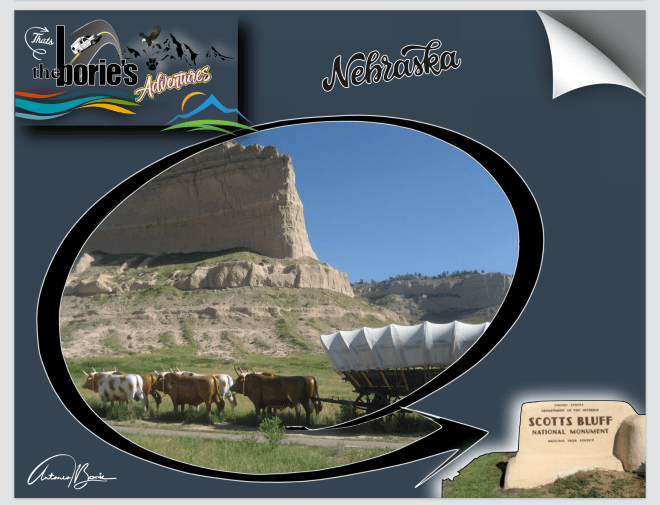
…a nossa “White Fox” (nome de guerra da nossa RV), levou-nos por estas grandes regiões terrestres, como as Grandes Planícies, pela região das colinas ondulantes, pelas pradarias sem árvores, adequadas para pastagem de gado, onde se situa um grande setor agrícola, que faz deste maravilhoso estado, um grande produtor de carne bovina, suína, milho ou soja e, onde vamos lembrar aqui, a história das suas Históricas Trilhas rumo ao oeste, onde os nossos antepassados sobreviviam, por vezes arrastando-se, caindo aqui, levantando-se ali, mas o seu destino era o Oeste, onde lhe diziam que existia a sua terra prometida!. Cá vai a história!.
…our “White Fox” (war name of our RV) led us through these great land regions, such as the Great Plains, through the rolling hills, through the prairies without trees, suitable for grazing cattle, where there is a large agricultural sector that makes this wonderful state a great producer of beef, pork, corn or soybeans and, where we are going to remember here, the history of its Historic Tracks heading west where our ancestors survived sometimes dragging himself, falling here, rising there, but his destiny was the West, where they told him that his promised land existed!. Here goes the story!.
…o presidente Thomas Jefferson, logo após a compra da Louisiana no ano de 1803, encomendou uma expedição para explorar e fazer alguns mapas daquele território recém-adquirido e, encontrar uma rota prática através da metade ocidental do continente, e claro, estabelecer uma presença americana neste território antes da Grã-Bretanha ou outro qualquer país europeu!. Os objetivos secundários da campanha eram científicos e económicos, como por exemplo, estudar as plantas, a vida animal, a geografia da região e estabelecer o comércio com as tribos indígenas americanas locais!.
…President Thomas Jefferson, shortly after the purchase of Louisiana in 1803, commissioned an expedition to explore and make some maps of that newly acquired territory, and find a practical route through the western half of the continent, and of course establish an American presence on this territory before Britain or any other European country!. The secondary objectives of the campaign were scientific and economic, such as for example, studying the plants, animal life, geography of the region and establishing trade with local Native American tribes!.

…esta expedição encomendada pelo presidente Thomas Jefferson, chamava-se Expedição de Lewis e Clark, que durou de Maio de 1804 a Setembro de 1806, também conhecida como Expedição do Corpo de Descoberta!. Foi a primeira expedição norte-americana a atravessar a parte ocidental dos USA começando perto de St. Louis, fazendo o seu caminho para o oeste e passando pela Divisão Continental das Américas, com a intenção de chegar à costa do Pacífico!. Este Corpo de Descoberta, era um grupo selecionado de voluntários do Exército dos USA, sob o comando do capitão Meriwether Lewis e de seu amigo próximo, o segundo-tenente William Clark!.
…this expedition commissioned by President Thomas Jefferson was called the Lewis and Clark Expedition, which lasted from May 1804 to September 1806, also known as the Discovery Corps Expedition!. It was the first North American expedition to cross the western part of the United States, starting near St. Louis, making its way west and past the Continental Division of the Americas, with the intention of reaching the Pacific coast!. This Discovery Corps was a select group of volunteers from the US Army, under the command of Captain Meriwether Lewis and his close friend, Second Lieutenant William Clark!.
…um dos seus objetivos, era encontrar “a comunicação da água mais direta e praticável em todo o continente, para fins de comércio”!. Claro, também dando uma importância especial à declaração da soberania dos USA, sobre a terra ocupada pelas muitas tribos indígenas ao longo do rio Missouri, obtendo uma noção precisa dos recursos da recém-concluída compra da Louisiana!. A expedição fez contribuições notáveis à ciência, embora a pesquisa científica não fosse o objetivo principal desta missão!.
…one of its objectives, was to find “the most direct and practicable communication of water in the whole continent for commercial purposes”!. Of course, also attaching special importance to the declaration of US sovereignty over the land occupied by the many Indian tribes along the Missouri River, getting a precise notion of the resources of the newly completed Louisiana purchase!. The expedition made notable contributions to science, although scientific research was not the primary goal of this mission!.
…o presidente Thomas Jefferson, era uma personagem que, além de outras qualidades era curioso!. Queria saber se o rio mais longo dos USA que é o rio Missouri, era um afluente do rio Mississippi e, que graças a esta expedição, hoje sabemos tem aproximadamente 2.540 milhas de comprimento!. No entanto, também hoje sabemos que, o maior em termos de volume de água é o rio Mississippi e que, o rio mais chegado e desimpedido para se navegar é o rio Yellowstone, que tem 692 milhas de comprimento!. Isto lá no norte, porque no centro, talvez seja o Rio Platte, com as suas 990 milhas de comprimento, e que vem desaguar no Rio Mississippi!.
…President Thomas Jefferson, was a character that, in addition to other qualities was curious!. He wondered if the longest river in the USA, which is the Missouri River, was a tributary of the Mississippi River, and thanks to this expedition, we now know that it is approximately 2,540 miles long!. However, we also know today that the largest in terms of water volume is the Mississippi River, and that the closest and most unimpeded river to navigate is the Yellowstone River, which is 692 miles long!. This in the north, because in the center, perhaps it is the Platte River, with its 990 miles in length, and which flows into the Mississippi River!.
…não só para satisfazer a sua curiosidade, pois disto ia depender o progresso e expansão desta nação, o presidente Thomas Jefferson, queria também saber que, se isso acontecesse, significava que todo o continente norte-americano estava ligado por água, cujas implicações eram surpreendentes!. Isto significava que todo o oeste americano poderia ser aberto ao desenvolvimento, principalmente ao agrícola, com a deslocação de pessoas e bens, onde também alguns produtos manufacturados no leste, poderiam encontrar mercado no profundo e desconhecido interior!.
…not only to satisfy his curiosity, for this was to depend upon the progress and expansion of this nation, President Thomas Jefferson, also wanted to know that, if this happened, it meant that the entire American continent was connected by water, whose Implications were amazing!. This meant that all of the American West could be opened to development, mainly to agricultural, with the displacement of people and goods, where also some manufactured goods in the East, could find market in the deep and inner unknown!.
…esta expedição retornou a St. Louis para relatar as suas descobertas ao presidente Thomas Jefferson, com mapas, esboços e diários em mãos, explicando que existiam rios com água potável, para beber ou para irrigação, alguns podiam ser usados como transporte, outros eram rasos, com diversos tipos de erosão, podendo até formar desfiladeiros e precipícios, como o Grand Canyon, ou até cascatas, como as Cataratas do Niágara!. Também havia, lagos, desertos, pradarias, planícies e montanhas mas, “não havia uma rota de água até ao Oceano Pacífico”!.
…this expedition returned to St. Louis to report its findings to President Thomas Jefferson, with maps, sketches and journals in hand, explaining that rivers existed with drinking water, drinking or irrigation, some could be used as transportation, others were shallow, with various types of erosion, and may even form gorges and precipices, such as the Grand Canyon, or even waterfalls, such as Niagara Falls!. There were also lakes, deserts, prairies, plains and mountains but, “there was no water route to the Pacific Ocean”!.
…por volta do ano de 1818, os USA e a Grã-Bretanha, acabaram por enterrar um machado de 40 anos de guerra intermitente, assinando um tratado que marcava a fronteira entre os USA e o Canadá no paralelo 49!. Este Tratado permitia várias exceções, mais notavelmente a ocupação conjunta do território do Oregon, que é o actual estado de Oregon e Washington!. Não demorou muito para os colonos britânicos e americanos se começarem a empurrar uns aos outros!. Do lado dos britânicos a solução era, acabar com os animais que carregavam peles na região, desencorajando os comerciantes de peles americanos de procurarem as suas fortunas por lá e, a solução americana era mais corajosa, que era inundar o noroeste do Pacífico com colonos americanos!. Óptimo em teoria, mas chegar a esse lugar distante era defacto um problema!.
…around the year 1818, the USA and Britain eventually buried a 40-year-old ax of intermittent warfare, signing a treaty marking the 49-US-Canada border!. This Treaty allowed for several exceptions, most notably the joint occupation of the territory of Oregon, which is the present state of Oregon and Washington!. It did not take long for the British and American settlers to start pushing each other!. On the British side the solution was to do away with the animals that carried skins in the region, discouraging the American fur traders from seeking their fortunes there, and the American solution was more courageous, which was to flood the Pacific Northwest with American settlers!. Great in theory, but getting to this distant place was definitely a problem!.
…sem uma rota fluvial e, querendo povoar o noroeste do Pacífico, pois a atracção poderosa do Oregon, lá mais ao norte, atraía as pessoas!. Se alguma vez a uma terra, chamavam a terra da esperança, era nos vales do Oregon, com um clima fértil e livre de doenças, extensas florestas sem cortes, rios cristalinos repletos de peixes, caça abundante, nativos amigáveis, acesso ao mar e muita terra livre para ser ocupada e cultivada!. Tudo o que esses corajosos colonos precisavam fazer, era chegar lá!.
…without a river route, and wanting to populate the Pacific Northwest, because the powerful attraction of Oregon, further north, drew people! If ever on earth they called the land of hope, it was in the Oregon valleys, with a fertile and disease-free climate, extensive uncrowded forests, crystal clear rivers filled with fish, abundant hunting, friendly natives, access to the sea, and land free to be occupied and cultivated!. All these brave settlers had to do was get there!.
…muitos desses colonos, alguns vindos da europa, a sua teoria era chegar a este lugar distante, onde na procura da esperança na sua terra prometida, tinham praticamente duas escolhas!. Podiam viajar pelo oceano ao longo da costa da América do Sul,em torno do Cabo Horn, subindo a costa oeste, por uma distância de 14.700 milhas, ou tentar viajar por terra, numa jornada cansativa, perigosa, de autêntica sobrevivência, através de 2.000 milhas, com alguns rios, pradarias, desertos e montanhas com difícil acesso e povoadas por perigosos animais ou por um povo que já por lá vivia há milhares de anos e, não viam com bons olhos as suas terras serem ocupadas por estranhos!.
…many of these settlers, some coming from Europe, their theory was to reach this far place, where in search of hope in their promised land, they had practically two choices!. They could travel the ocean along the coast of South America, around Cape Horn, up the west coast, for a distance of 14,700 miles, or try to travel ashore, on a tiresome, dangerous journey of genuine survival, through 2,000 miles, with some rivers, prairies, deserts and mountains with difficult access and populated by dangerous animals or by a people who had lived there for thousands of years and did not see with good eyes their lands being occupied by strangers!.
…aqui, entramos nós na história!. Seguíamos na estrada US 26 no estado de Nebraska, aparecendo aqui e ali anúncios de estrada dizendo que viajávamos nas célebres Trilhas do Oregon, da Califórnia e de Mormon!. Ao lado seguia o Rio Platte que, em grande parte do seu percurso é um riacho sinuoso, tal qual um córrego, serpenteando, que corre por um leito amplo e arenoso, muito raso para flutuar um barco que, se tivesse água até às suas margens, seria uma via navegável muito estimável, mas infelizmente, naquele tempo, raramente isso acontecia!.
…here, we enter the story!. We were on US Highway 26 in the state of Nebraska, here and there road signs saying that we traveled on the celebrated Oregon, California, and Mormon Trails!. Beside it was the Platte River, which, for the most part, is a winding stream, like a winding stream, running through a wide, sandy bed, very shallow to float a boat that, if it had water to its banks , would be a very estimable waterway, but unfortunately, at that time, it rarely happened!.
…todavia, o Rio Platte é uma fonte de água potável, atravessando uma zona quase plana, tornando-se numa artéria ideal ao longo da qual, muitos anos atrás se estabeleceu numa trilha de carroças, dos primeiros colonos e exploradores que se dirigiam para oeste, na procura da sua terra prometida!.
…however, the Platte River is a source of drinking water, crossing an almost flat area, becoming an ideal artery along which many years ago settled on a carriage trail, the first settlers and explorers who went to the west, in search of his promised land!.
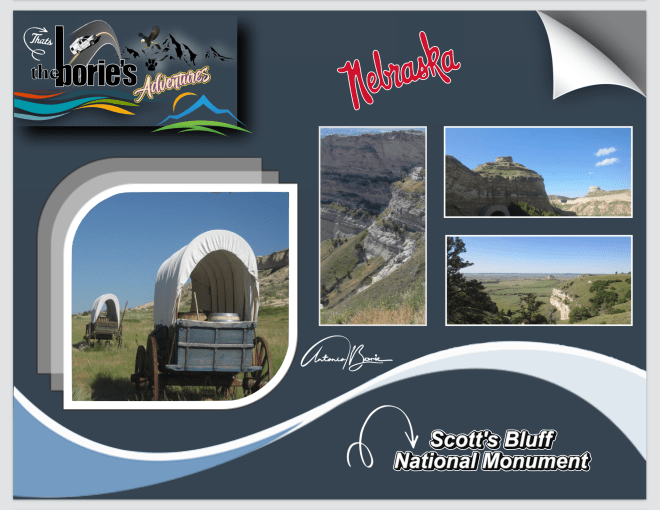
…querendo exemplificar o que era uma carroça de quatro rodas coberta, era básicamente uma longa caixa de madeira sobre rodas, com lados de quase um metro de altura e uma lona chegando a uma altura de cerca de um metro e meio que depois se arqueava sobre vários arcos de madeira de nogueira dobrada!. A tela era impermeabilizada com tinta ou óleo de linhaça para manter o seu espaço seco!. Seguiam em direcção ao oeste, numa longa viajem de corta-mato, carregando muitos dos seus suprimentos, e claro, também funcionavam como abrigo ao longo do caminho, como uma espécie de barraca móvel!.
…wishing to exemplify what a four-wheeled wagon was, was basically a long wooden box on wheels, with sides of almost one meter high and a tarpaulin reaching a height of about a meter and a half that later arched over several arches of bent walnut wood!. The canvas was waterproofed with paint or linseed oil to keep your space dry!. They headed westward on a long cross-country trip, carrying many of their supplies, and of course, they also served as shelters along the way, like some kind of mobile tent!.
…os próprios migrantes pioneiros molhavam-se!. Era comum andarem juntos às suas carroças!. É surpreendente considerar que, ao longo de mais de 2.000 milhas que compunham as trilhas da Califórnia, do Oregon ou Mormon, aqueles migrantes pioneiros caminhavam a maior parte do caminho!. A carroça, puxada por uma equipe de bois, entre quatro e oito animais amarrados a dois, que compunham um par, eram os preferíveis, pois representavam um terço do custo das mulas ou cavalos e, a probabilidade de perder um animal naquelas arrojadas viagens, era muito grande!.
…the pioneer migrants themselves were getting wet!. It was common to ride their wagons together!. It is surprising to note that over the more than 2,000 miles that made up the California, Oregon, or Mormon trails, those pioneer migrants walked most of the way!. The cart, drawn by a team of oxen, between four and eight animals tied to two, which made up a pair, were the preferred ones, representing a third of the cost of mules or horses, and the probability of losing an animal in those daring journeys, it was too big!.
…a caminhada desde a aldeia de Independence, no estado de Missouri até aos vales de Oregon, levava meses, às vezes anos, durante os quais um boi podia morrer de doença, por beber água alcalina, de sede, de fome lenta ou de excesso de trabalho!. A perda de um boi era preocupante, porque a tensão adicional que colocava na equipe restante também os colocava em perigo, a menos que a carga da carroça fosse aliviada, colocando os pioneiros na posição nada invejável de decidir quais suprimentos essenciais deveriam ser deixados para trás naquele caminho que os levava à terra prometida, à terra da esperança!.
…the walk from the village of Independence in the state of Missouri to the Oregon valleys took months, sometimes years, during which an ox could die of disease, drinking alkaline water, thirst, or slow hunger, or of overwork!. The loss of an ox was troubling, because the additional strain it placed on the remaining crew also endangered them unless the cart load was relieved, putting the pioneers in the unenviable position of deciding which essential supplies should be left behind on that path that led them to the promised land, to the land of hope!.

…hoje sabemos que, as trilha da Califórnia, do Oregon e Mormon, eram notoriamente repletas de todo tipo de surpresas desagradáveis, que eram uma evidência das tentativas desesperadas destes migrantes pioneiros aliviarem as suas cargas!. Claro, sob tais circunstâncias, viajar em cima da carroça seria mal aconselhado na melhor das hipóteses!.
…we now know that the California, Oregon, and Mormon tracks were notoriously filled with all sorts of unpleasant surprises, which was evidence of the desperate attempts of these pioneer migrants to lighten their burdens!. Of course, under such circumstances, traveling on top of the wagon would be ill advised at best!.
…para estes corajosos migrantes pioneiros, a morte e o desastre espreitavam por toda parte ao longo destas trilhas!. As rodas e os eixos das carroças, rompiam-se com uma regularidade enlouquecedora, forçando-os a moldar novos no local, com madeira de uma qualquer árvore que pudesse ser derrubada nas imediações!. Muitas vezes, numa zona árida, encontrar uma boa árvore poderia atrasá-los durante algum tempo!. Carregar rodas ou eixos sobressalentes estava fora de questão, pois aumentavam o peso, retardando o seu progresso e, os migrantes pioneiros queriam chegar à sua terra prometida!.
…for these brave pioneer migrants, death and disaster lurked everywhere along these tracks!. The wheels and axles of the carts broke with a maddening regularity, forcing them to mold new ones on the spot, with wood from any tree that could be felled in the vicinity! Often, in an arid zone, finding a good tree could delay them for some time!. Carrying spare wheels or axles was out of the question as they increased their weight, slowing their progress, and the pioneering migrants wanted to reach their promised land!.
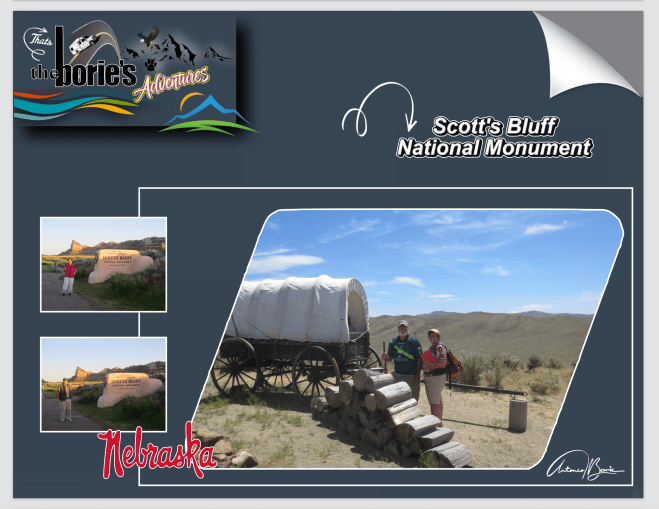
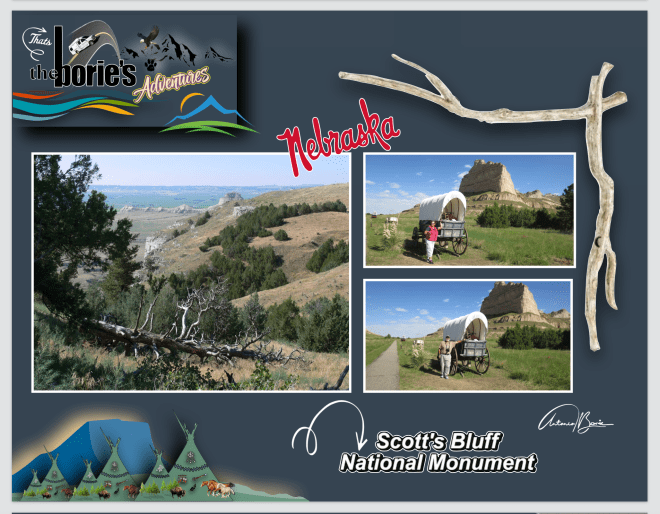
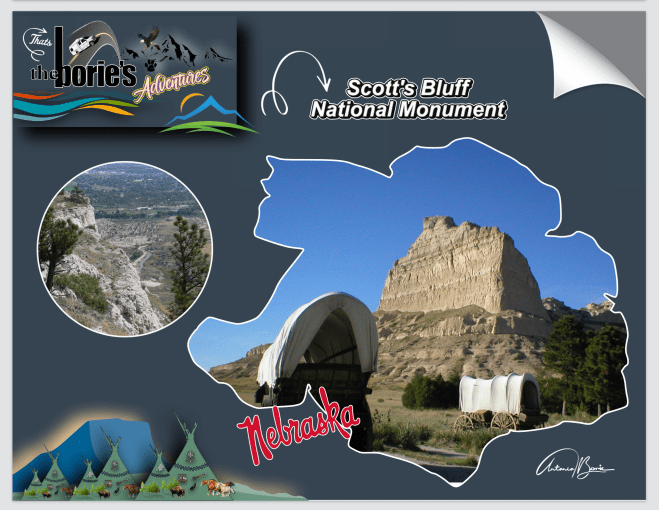
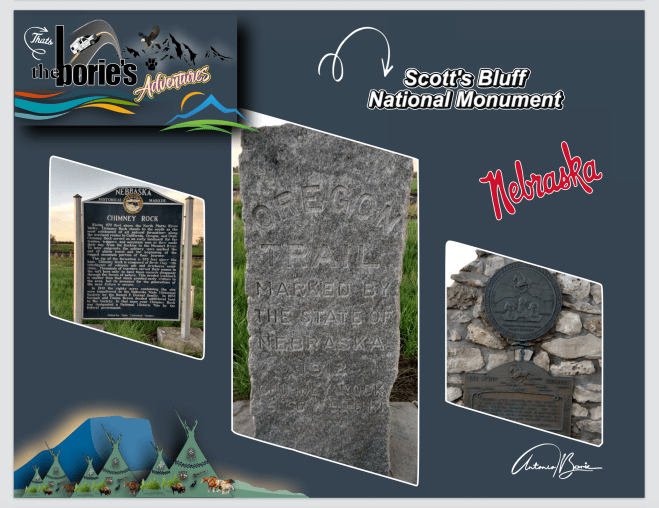
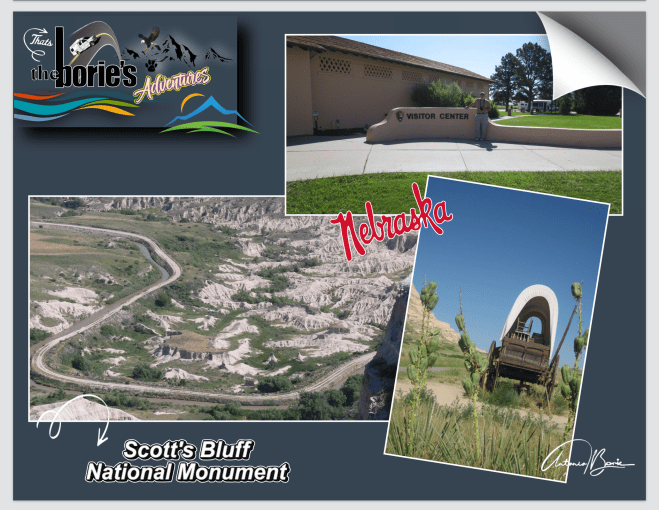
…nós, também íamos avançando naquelas Grandes Planícies!. Um dos nossos outros motivos para visitar este bonito e histórico estado do Nebraska era ver, caminhar, admirar e relembrar a história dos nossos avós a caminho do oeste. Estávamos quase em Scotts Bluff National Monument, no oeste de Nebraska que inclui um importante marco do século XIX no Oregon Trail, Mormon Trail, California Trail e Pony Express Trail!. Este Monumento Nacional contém vários montes íngremes, localizados no lado sul do Rio North Plate, e é mais conhecido por um monte proeminente chamado Scotts Bluff, que se eleva a mais de 800 pés (240 m) acima das planícies, no seu ponto mais alto!. O monumento é composto por cinco montes íngremes, que são, Crown Rock, Dome Rock, Eagle Rock, Saddle Rock e Sentinel Rock!.
…we, too, were advancing on those Great Plains!. One of our other reasons to visit this beautiful and historic state of Nebraska was to see, walk, admire and remember the history of our grandparents on the way to the west. We were almost at Scotts Bluff National Monument in western Nebraska which includes an important 19th-century landmark on the Oregon Trail, Mormon Trail, California Trail and Pony Express Trail!. This National Monument contains several steep hills, located on the south side of the North Plate River, and is best known for a prominent hill called Scotts Bluff, which rises more than 800 feet (240 m) above the plains, at its highest point ! The monument consists of five steep hills, which are, Crown Rock, Dome Rock, Eagle Rock, Saddle Rock and Sentinel Rock!.
…mais de 250.000 emigrantes para o oeste passaram pelo Scotts Bluff, entre 1843 e 1869, sendo o segundo ponto mais mencionado nas trilhas de emigrantes em revistas e diários pioneiros!. Pessoas não-nativas, pela primeira vez, no ano de 1812, numa expedição de comerciantes de peles que viajavam ao longo do rio, observou os penhascos como as primeiras grandes formações rochosas ao longo do rio North Platte, onde as Grandes Planícies começaram a dar lugar ao sopé das Montanhas Rochosas e, a partir desse momento, tomaram estes penhascos como um marco!.
…more than 250,000 emigrants to the west passed through Scotts Bluff, between 1843 and 1869, being the second most mentioned point in the emigrant trails in pioneering magazines and diaries !. Non-native people, for the first time, in the year 1812, on an expedition of fur traders traveling along the river, observed the cliffs as the first large rock formations along the North Platte River, where the Great Plains began to give place at the foot of the Rocky Mountains and, from that moment on, took these cliffs as a landmark!.
…claro, comerciantes de peles, missionários e expedições militares começaram viagens regulares através de Scotts Bluff, durante a década de 1830 e, a partir de 1841, multidões de colonos passaram por Scotts Bluff no seu caminho para o oeste ao longo da Great Platte River Road até Oregon, e depois Califórnia e Utah, onde todos esses grupos usaram estes penhascos como um marco muito importante para a navegação!. Nos fins de semana, os guardas florestais vestem roupas de época e perambulam por várias áreas do parque, oferecendo informações e histórias do passado!.
…of course, fur traders, missionaries, and military expeditions began regular trips through Scotts Bluff during the 1830s, and from 1841, multitudes of settlers passed through Scotts Bluff on their way west along the Great Platte River Road to Oregon, and then California and Utah, where all of these groups used these cliffs as a very important landmark for navigation !. On weekends, rangers wear period clothing and wander around various areas of the park, offering information and stories from the past!.
…voltando à história, relâmpagos e chuva abundante, tal como de uma tempestade se tratasse, foi com que fomos contemplados nesta área em algumas ocasiões, mas tudo passou, pois o nosso pensamento estava nos nossos antepassados, que se dirigiam para oeste, na procura da sua terra prometida!. Geralmente deixavam o Missouri em Maio, esforçando-se por passar pelas Montanhas Rochosas antes de Outubro, pois um qualquer atraso muito longo poderia fazê-los chegar às montanhas quando a neve começasse a cair e, o inverno nas montanhas poderia ser uma sentença de morte, além de os colocar nas Grandes Planícies durante a altura do verão, onde o sol queimava e por vezes a água faltava!.
…going back to history, lightning and abundant rain, like a storm, we were contemplated in this area on some occasions, but everything passed, because our thoughts were on our ancestors, who were heading west, in search of your promised land !. They usually left Missouri in May, struggling to get through the Rockies before October, as any very long delay could get them to the mountains when the snow started to fall, and winter in the mountains could be a death sentence, besides placing them in the Great Plains during the height of summer, where the sun burned and sometimes the water was lacking!.
…carregar muita água, acrescentava um peso extra!. Na bacia do Rio Platte, a água era abundante, no entanto nas Grandes Planícies, encontrar água potável era complicado e beber de qualquer poço ou córrego errado poderia ser mortal!. As travessias de rio eram perigosas, pois alguns rios de fluxo rápido, poderiam esmagar uma carroça ou fazê-la em estilhaços!. Descidas íngremes eram perigosas, as carroças não tinham travões e eram ajudadas a descer por cordas, onde um pequeno deslize tudo podia acabar!.
…carry a lot of water, added an extra weight!. In the Platte River basin, water was plentiful, however on the Great Plains, finding drinking water was tricky and drinking from any well or stream could be deadly!. The river crossings were dangerous, for some fast-flowing rivers could crush a wagon or shatter it!. Steep descents were dangerous, the carts had no brakes and were helped down by ropes, where a small slip could all end!.
…uma carroça danificada, por vezes não se podia reparar e claro, tinha que ser abandonada, ficando alguns migrantes pioneiros à mercê dos seus companheiros!. A fricção que inevitavelmente ocorre em áreas onde as mesmas pessoas estão juntas por longos períodos de tempo e, neste caso com diferentes origens e culturas de vida, pois alguns eram europeus, por vezes geravam brigas!. As brigas por vezes começavam, adicionando outra fonte potencial de lesões e, uma pessoa ferida ou doente era um fardo, pois não só a sua perda necessária para executar o trabalho, mas porque acrescentava peso indesejado à carroça, caso os seus ferimentos fossem tais, que tivesse que ser carregado!.
…a damaged wagon, sometimes it could not be repaired and of course, had to be abandoned, leaving some pioneer migrants at the mercy of their companions!. The friction that inevitably occurs in areas where the same people are together for long periods of time, and in this case with different origins and cultures of life, since some were European, sometimes generated fights!. Fights sometimes began, adding another potential source of injury, and a wounded or sick person was a burden because not only was their loss necessary to do the job, but because it added unwanted weight to the wagon if their injuries were such, that had to be loaded!.
…no entanto, de todas as maravilhas naturais encontradas pelos milhares de migrantes pioneiros que por terra atravessaram o Nebraska até ao Oregon, à Califórnia ou ao Vale do Lago Salgado em meados do século XIX, o Scotts Bluff, foi um dos mais importantes marcos da história na ida dos migrantes pioneiros para oeste!.
…however, of all the natural wonders found by the thousands of pioneer migrants who overland crossed Nebraska to Oregon, California or the Salt Lake Valley in the mid-19th century, Scotts Bluff was one of the most important milestones in the history of the pioneer migrants going west)!.
Tony Borie.
 Tony Borie - "Pieces of my life"