

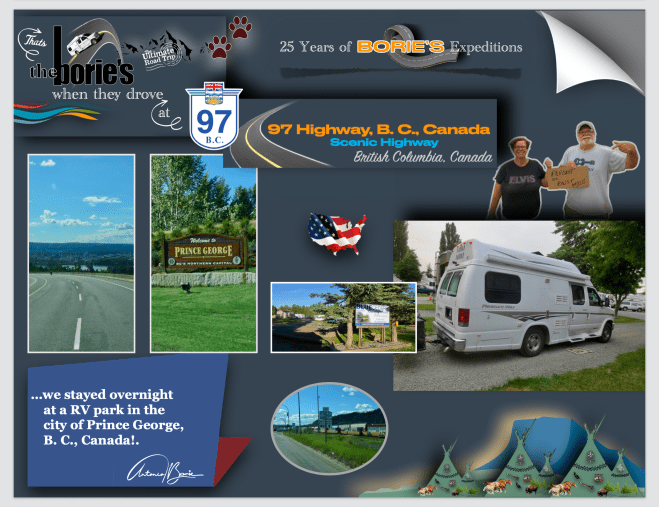
…tínhamos passado a noite num parque de RV na cidade de Prince George, British Columbia, Canada, uma cidade situada junto aos rios Fraser e Nechako, onde as suas origens são referentes a um posto de comércio de peles da North West Company de Fort George, por Simon Fraser, que aqui se estabeleceu por volta do ano de 1807, e o nome foi dado em homenagem ao rei George III!. O posto de comércio de peles, foi centrado na pátria centenária da Primeira Nação Lheidli T’enneh, cujo nome significa “pessoas da confluência dos dois rios”!.
…we had spent the night in an RV park in the city of Prince George, British Columbia, Canada, a city located along the Fraser and Nechako rivers, where its origins refer to a fur trading post of the North West Company of Fort George, by Simon Fraser, who settled here around 1807, and was named in honor of King George III!. The fur trading post was centered on the centuries-old homeland of the Lheidli T’enneh First Nation, whose name means “people of the confluence of the two rivers”!.

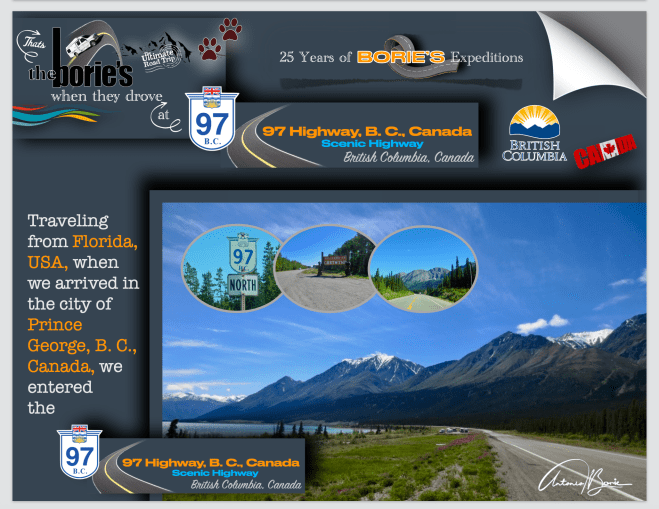
…o nosso destino era o norte!. Como tal, o dia ainda não tinha clareado e já estávamos a viajar no Highway 97, no sentido norte!. Esta estrada é a rota mais longa continuamente na província da Columbia Britânica e a maior estrada provincial em qualquer outra província, contudo nós queríamos chegar apenas até à cidade de Dawson Creek!.
…our destination was the north!. As such, the day had not yet lightened and we were already traveling on Highway 97, heading north!. This road is the longest continuously route in the province of British Columbia and the longest provincial road in any other province, yet we only wanted to get as far as the town of Dawson Creek!

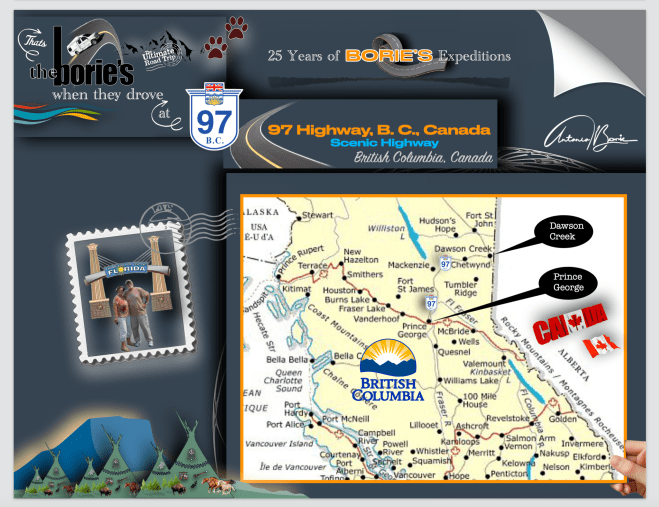
…esta estrada está dividida em diversas seções, e passa através de uma região quase selvagem e em grande parte despovoada, que segue por entre montanhas, planícies e lagos, levando o número da rota 97 dos USA, com a qual se conecta na fronteira internacional, e inicialmente foi designada como “97”, no ano de 1953!.
…this road is divided into several sections, and passes through an almost wild and largely unpopulated region, which runs between mountains, plains and lakes, bearing the number of US route 97, with which it connects at the international border, and was initially designated as “97”, in 1953!.
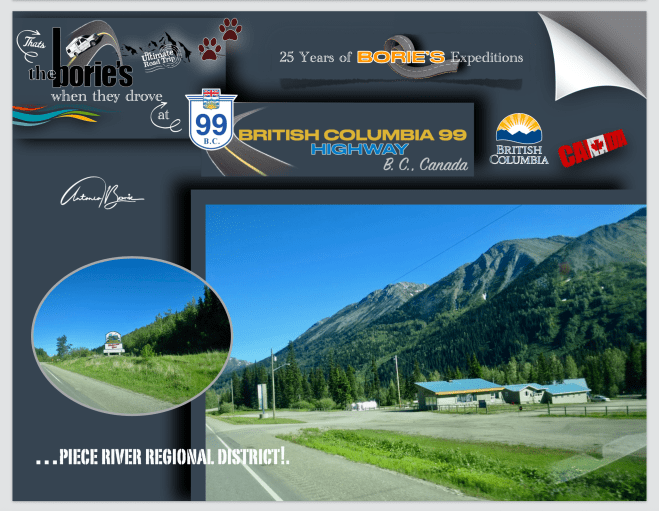
…por exemplo, começámos por viajar na secção John Hart!. Este trecho de aproximadamente 405 km de extensão (252 milhas) da Estrada 97, nome dado pelo ex-primeiro ministro britânico John Hart, que começa em Prince George!.
...for example, we started by traveling in the John Hart! section. This approximately 405 km long (252 miles) stretch of Highway 97, named by former British Prime Minister John Hart, begins in Prince George!.

…depois, viajando por 152 km (94 milhas) ao norte através da pequena aldeia de Summit Lake, que está situado no Continental Divide, bem como através do Parque Provincial Crooked River, Bear Lake e McLeid Lake, até ao seu cruzamento com a Estrada 39!.
…then traveling 152 km (94 miles) north through the small village of Summit Lake, which is situated on the Continental Divide, as well as through Crooked River Provincial Park, Bear Lake and McLeid Lake, to its intersection with Highway 39!.
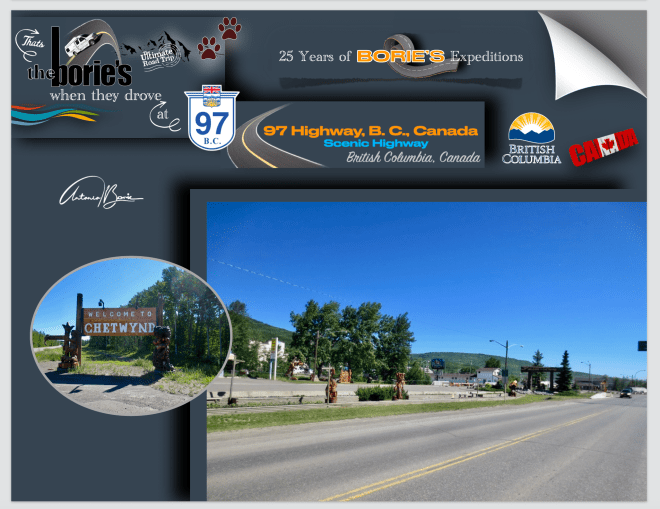
…e continuando a viajar para nordeste mais 150 km (93 mi), através da Continental Divide, em que ponto o fuso horário muda de Hora do Pacífico, para o Tempo da Montanha!.
…and continuing to travel northeast another 150 km (93 mi), across the Continental Divide, at which point the time zone changes from Pacific Time, to Mountain Time!.
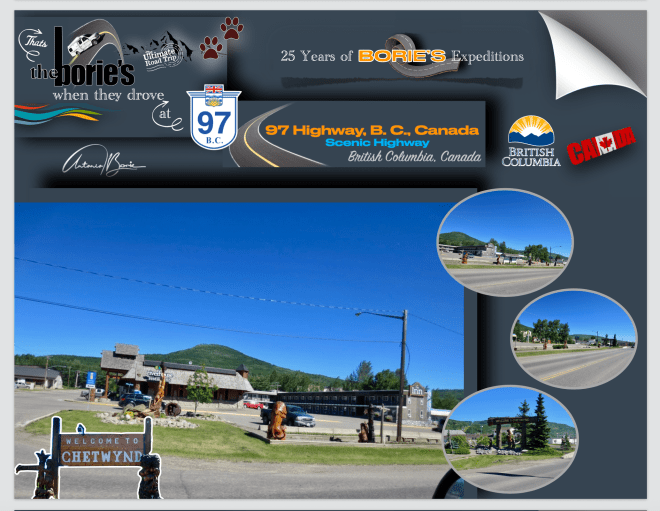
…depois de sair do Pine Pass, e viajando pela Estrada 29, chegamos à cidade de Chetwynd, onde parámos.
…after leaving Pine Pass, and traveling along Route 29, we arrived at the town of Chetwynd, where we stopped!.
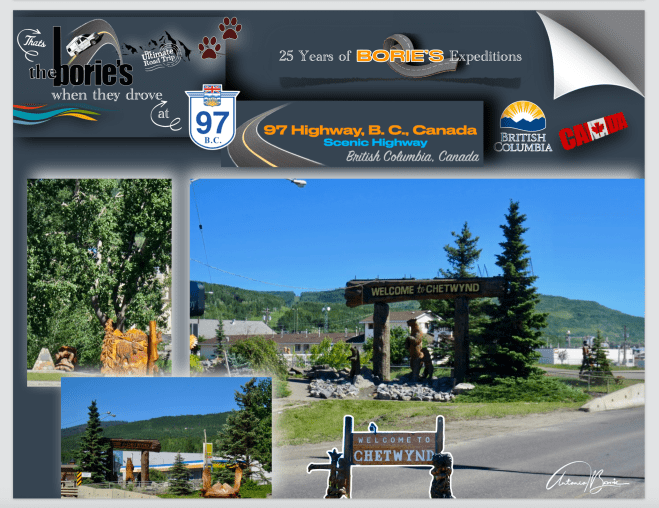
…paramos em Chetwynd por duas razões, a primeira foi apreciar as obras de arte em madeira que se espalham ao longo da Estrada 97, que nos dizem que Chetwynd é a pequena comunidade mais habitável da Columbia Britânica, de acordo com um grupo, a silvicultura, a mineração, o processamento de gás natural, a pecuária, a agricultura e a energia eólica são as principais indústrias!.
…we stopped in Chetwynd for two reasons, the first was to appreciate the wooden artwork that dots along Highway 97, which tells us that Chetwynd is the most livable small community in British Columbia, according to one group, forestry, mining, natural gas processing, ranching, agriculture and wind energy are the main industries!.

…e a segunda razão, foi a mudança de óleo na nossa “White Fox” (caravana),que se queixava que já tinha as milhas suficientes e, necessitava de novo óleo!.
…and the second reason was the oil change in our “White Fox” (caravan), which complained that it already had enough miles and needed new oil!.
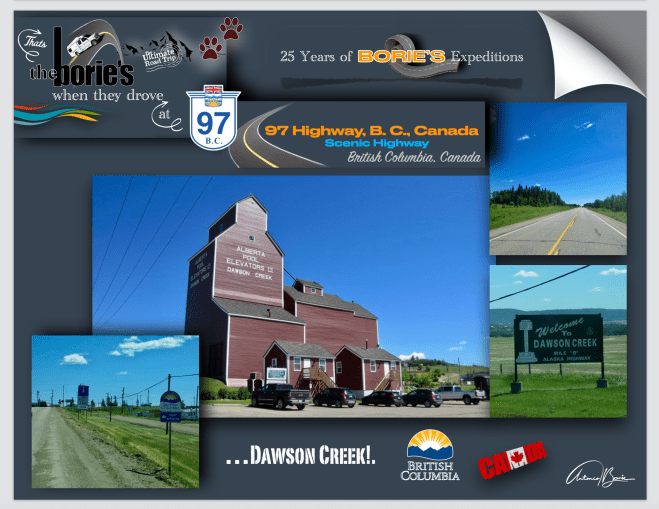
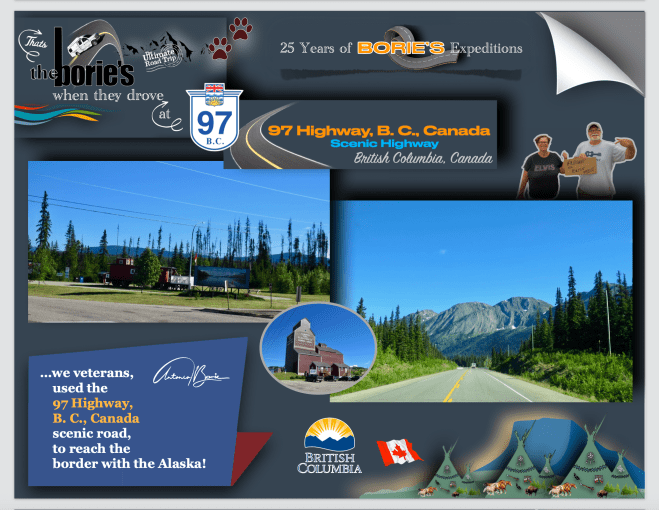
…e após um percurso de outros 97 km (60 mi) para leste, a estrada John Hart, finalmentetermina em Dawson Creek, que é uma típica cidade cujo nome deriva dum riacho que por ali passa com o mesmo nome, que por sua vez o recebeu de um tal George Mercer Dawson, que era um membro de uma equipe de pesquisa de terras, que talvez tal como nós, também por aqui passou no longínquo ano de 1879!.
…and after a journey of another 97 km (60 mi) to the east, the John Hart road finally ends in Dawson Creek, which is a typical town whose name derives from a stream that passes through there with the same name, which in turn received it from a certain George Mercer Dawson, who was a member of a land survey team, who perhaps like us, also passed through here in the distant year of 1879!.
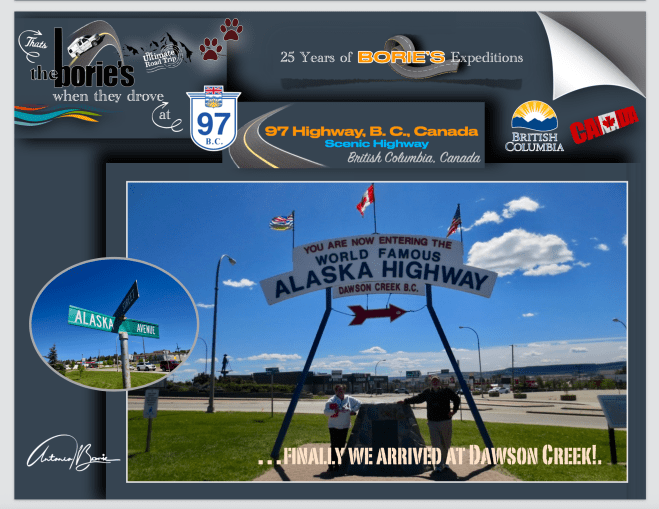
…e foi aqui, quando ainda era uma pequena comunidade agrícola, que se tornou num centro regional, após o terminal ocidental da “Northern Alberta Railways”, ser estendido até aqui, no ano de 1932, crescendo rapidamente quando por volta do ano de 1942, o Exército dos EUA usou este terminal ferroviário como um ponto de transbordo, durante a construção do hoje lendário e “Histórico Alaska Highway”!. Passou então a ser chamada de “Capital da Paz”, também conhecida como a “Milha 0”, referindo-se à sua localização no extremo sul desta já referida estrada!.
…and it was here, when it was still a small agricultural community, that it became a regional center, after the western terminal of the “Northern Alberta Railways”, was extended here in 1932, growing rapidly when around 1942, the US Army used this railway terminal as a transfer point, during the construction of the now legendary and “Historic Alaska Highway”!. It then came to be called the “Capital of Peace”, also known as “Mile 0”, referring to its location at the southern end of this aforementioned road!.
Tony Borie.
 Tony Borie - "Pieces of my life"