…já por diversas vezes escrevemos que às vezes sentimos uma “inveja-invejosa” por quem não recorda!. São seres livres, rebeldes e indomáveis, que quando lhes apetece partir, vão embora sem pesos ou remorsos!. Ao contrário de nós que, por mais que queiramos, não nos desligamos de sotãos e sotãos de relíquias e memórias, colecionando sensações, histórias e lendas!.
(…we have already written several times that we sometimes feel “envious-envious” for those who do not remember!. They are free, rebellious and indomitable beings who, when they feel like leaving, leave without any regrets or regrets!. Unlike us who, as much as we want to, do not disconnect from lofts and lofts of relics and memories, collecting sensations, stories and legends)!.
…a Páscoa já se foi, e o Natal virá!. De uma maneira ou de outra, já quase que não existem, tal como a bondade no coração do homem ou da mulher, é rara ou próxima da extinção!. Também já se foram os usos e costumes do antigamente, a agricultura de subsistência respeitando os ciclos da mãe natureza como a dos nossos avós, que criavam os animais domésticos, plantavam as couves e as batatas para criarem grandes famílias de 8 e 10 filhos!.
(…Easter is already gone, and Christmas will come!. In one way or another, they are almost nonexistent, just as goodness in the heart of man or woman is rare or close to extinction!. The uses and customs of yesteryear are gone, subsistence agriculture respecting the cycles of mother nature like that of our grandparents, who raised domestic animals, planted cabbages and potatoes to create large families of 8 and 10 children)!.
…ao contrário de hoje, onde existe um mundo agitado, com programas de televisão que nos entram pela porta dentro, presenteando-nos com alguma violência e mal dizer, incendiando a sociedade com notícias terríveis e escandalosas, instigando a população à agressividade e à revolta, semeando neste planeta, não a tal agricultura de subsistência respeitando os ciclos da mãe natureza, mas sim angústia e depressão, pelo menos às mentes mais frágeis!.
(…unlike today, where there is an agitated world, with television programs that come through the door, presenting us with some violence and ill saying, igniting society with terrible and scandalous news, instigating the population to aggression and revolt , sowing on this planet, not such subsistence agriculture respecting the cycles of mother nature, but anguish and depression, at least to the most fragile minds)!.
…já chega de blá, blá, blá, vamos à hitória de hoje!.
(…enough of blah, blah, blah, let’s go to today’s story)!.
…quando os pais desejam ensinar valores específicos aos seus filhos, devemos fazê-lo por meio do exemplo, porque o exemplo tem mais significado para uma criança do que podemos pensar!.
(…when parents want to teach their children specific values, we must do it by example, because example has more meaning for a child than we can think)!.
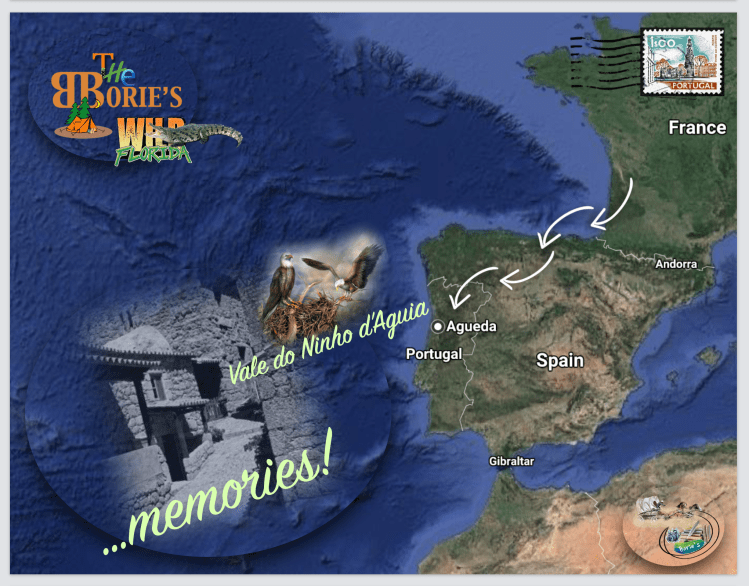
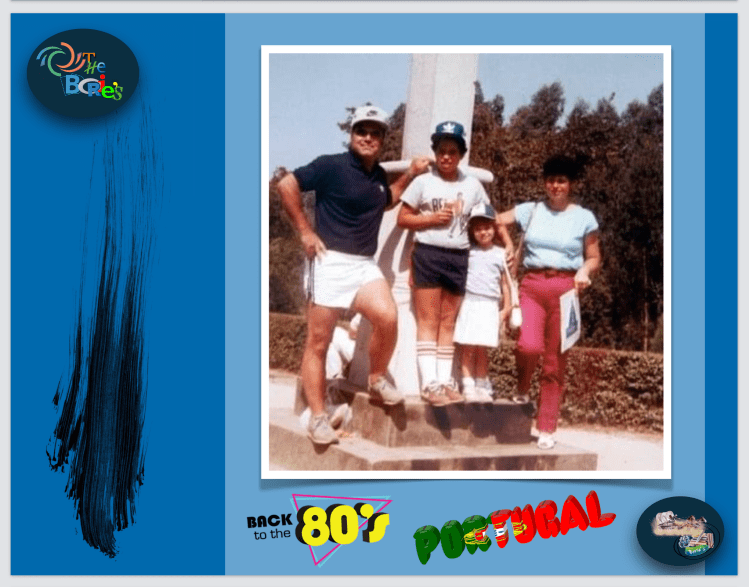
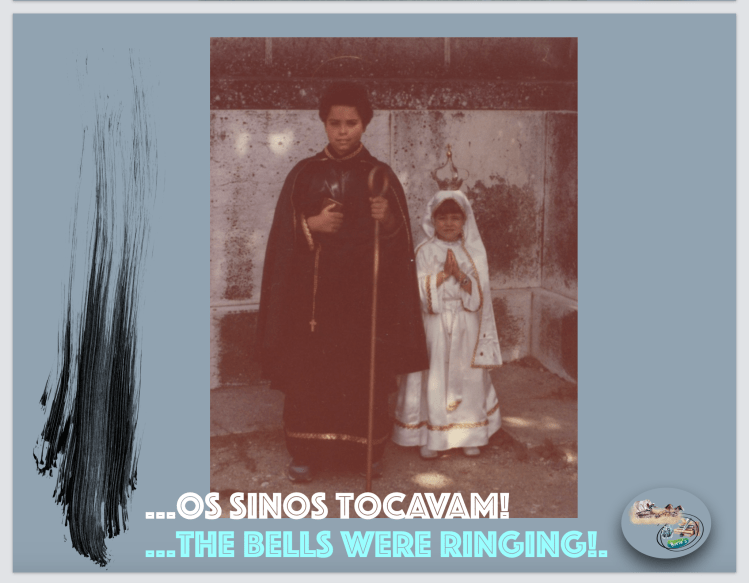
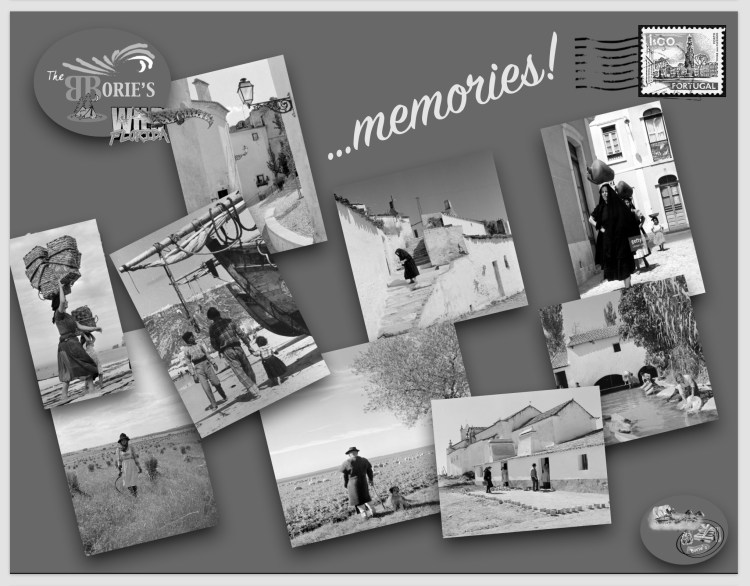
…assim, numa das nossas viajens à Europa, sempre acompanhados da nossa dedicada esposa Isaura e dos nossos filhos ainda crianças, assistimos a uma “procissão” religiosa!. E eles, os nossos filhos ainda crianças, foram protagonistas da já referida “procissão”, onde a sua dedicada mãe Isaura, alugando uns trajos, os vestiu a ambos, imitando uns “santos e santas”, para desfilarem na “procissão”, e nós, claro, fotografámos, e vamos hoje recordar todo este evento, tentando colocar um pouco de “animação” nas palavras para que se torne mais interessante a sua leitura, cá vai:
(…so, on one of our trips to Europe, always accompanied by our dedicated wife Isaura and our children as children, we witnessed a religious “procession”! And they, our children as children, were protagonists of the aforementioned “procession”, where their dedicated mother Isaura, renting some clothes, dressed them both, imitating some “saints” to parade in the “procession”, and we, of course, we took pictures, and today we are going to remember this whole event, trying to put a little “animation” in the words so that it becomes more interesting to read, here it goes):
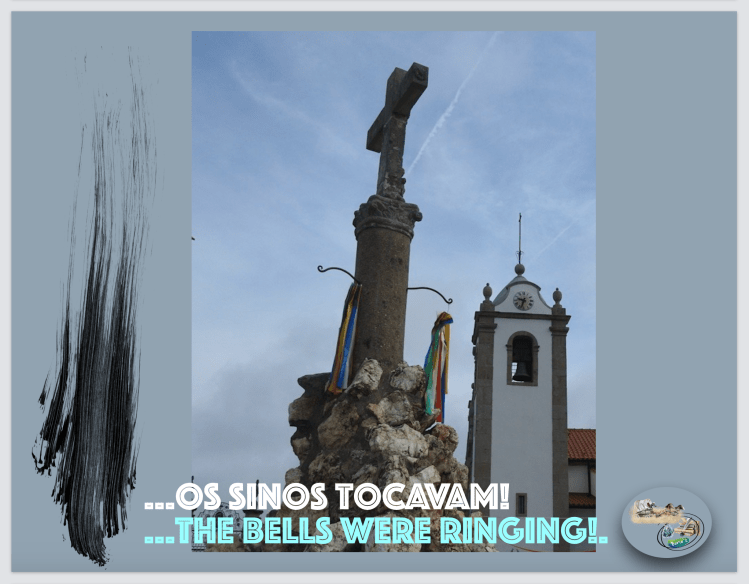
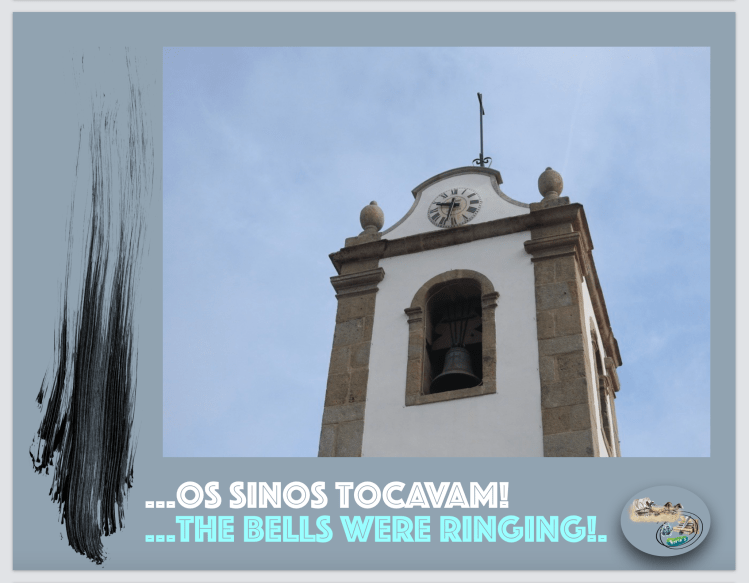
…era uma festa religiosa na aldeia onde nasceu a nossa dedicada esposa Isaura, companheira por mais de cinco décadas!. Algumas pessoas usavam a roupa domingueira, ouviam-se os sinos que tocavam na torre da igreja e havia rosmaninho e alecrim pelo chão, os foguetes estalavam no céu, havia um ambiente de alegria e respeito, abrindo-se fileiras para passar a “procissão” e, ao nosso lado uma mulher vestida de negro, dizia: “saiam da minha frente, porque vivi todo o ano para assistir a este momento“!.
(…it was a religious celebration in the village where our dedicated wife Isaura was born, companion for more than five decades !. Some people wore Sunday clothes, the bells were ringing in the church tower and rosemary and rosemary were on the floor, rockets crackled in the sky, there was an atmosphere of joy and respect, opening lines to pass the procession and, beside us, a woman dressed in black, said: “get out of my way, because I have lived all year to watch this moment”)!.
…mesmo na frente da procissão, vinham os irmãos da confraria, muito solenes nas suas opas vermelhas!. Desfilavam, uns com a ajuda de um grande pau, outros segurando uma linda lanterna!. Agora a mulher vestida de negro, dizia: “nunca pensei que na nossa aldeia houvesse tantos bigodes e tão barrigudos”!. Entretanto, o rosmaninho e o alecrim dificultava o andar dos “anginhos”, onde vinha a nossa filha que desfilava vestida de “Santa Terezinha” e o nosso filho vestido de “Santo António” e, a mulher vestida de negro dizia: “que Deus os proteja”!.
(…right in front of the procession, the brothers of the brotherhood came, very solemn in their red opas, paraded, some with the help of a big stick, others holding a beautiful lantern!. Now the woman dressed in black, said: “I never thought that in our village there were so many mustaches and so big bellies”!. However, rosemary and rosemary made it difficult for “angels” to walk, where our daughter who paraded dressed in “Santa Terezinha” and our son dressed in “Santo António” came, and the woman dressed in black said: “May God protect them”)!.
…de seguida vinha um homem grande segurando a bandeira, com dois meninos vestidos de “anginhos”, um de cada lado segurando uma corda de seda equilibrando a bandeira, e a mulher vestida de negro logo dizia: “Deus é grande, felizmento não está vento”!. Entretanto, um cão tenta atravessar para o outro lado da rua, e a mulher vestida de negro, dizia: “fora daqui, raio de cão”!.
(…next came a big man holding the flag, with two boys dressed as “angels”, one on each side holding a silk rope balancing the flag, and the woman dressed in black immediately said: “God is great, happiness is not wind”!. However, a dog tries to cross over to the other side of the street, and the woman dressed in black, said: “get out of here, damn dog”)!.
…mas voltando atrás, quando os nossos filhos passaram por nós, olharam-no e sorriram, e a mulher vestida de negro, dizia: “ai que bonitos vão estes anginhos, com que cuidado os vestiram, aquele leva uma coroa de espinhos e o mais pequeno perdeu uma asa”!. Continuava a ouvir-se o sino na torre da igreja, o rosmaninho e o alecrim já estavam pisados, eram escorregadios, portanto um pouco perigoso, no entanto a “procissão” ia passando!.
(…but going back, when our children passed us, they looked at him and smiled, and the woman dressed in black, said: “oh how beautiful are these little angels, how carefully did they dress them, the one with a crown of thorns and the little one lost a wing”!. The bell in the church tower continued to be heard, the rosemary and rosemary were already stepped on, they were slippery, so a little dangerous, however the “procession” was passing)!.
…em algumas casas ao lado da rua, estavam pessoas às janelas, com ricas colchas penduradas tornando os rostos das jovens ainda mais bonitos, e a mulher vestida de negro, dizia: “parecem anjos que vieram do céu”!. Fazia calor, o Padre ia aflito debaixo do manto, o povo ajoelhava ao passar o andor, e a mulher vestida de negro, dizia: “não há nesta aldeia nada mais bonito, que estes passeios de Nosso Senhor”!.
(…in some houses beside the street, people were at the windows, with rich quilts hanging making the faces of the young women even more beautiful, and the woman dressed in black, said: “they look like angels that came from heaven”!. It was hot, the Father was afflicted under his cloak, the people knelt when the walk passed, and the woman dressed in black, said: “there is nothing more beautiful in this village than these walks of Our Lord”)!.
…a seguir vinham os músicos, marchando a compasso, com as fardas novas, cremos que tocavam o “solidó”, e quando o regente acenava com o braço, logo o homem do trombone fazia popopóropópó…, o do clarinete fazia pimpimrripimpim…, o dos pratos fazia tamtamtam… e o do tambor fazia pompompom… e, ao nosso lado a mulher vestida de negro dizia: “olha que músicos tão bem alinhados que tocam tão bem”!. E a multidão, alguma cumprindo “promessas”, seguia a procissão até ao adro da igreja!.
(…then came the musicians, marching to the beat, with the new uniforms, we believe they played the “solos”, and when the conductor waved his arm, soon the man with the trombone was doing popopóropópó…, the one with the clarinet was doing pimpimrripimpim… he did tamtamtam… and the drum one made pompompom… and, beside us, the woman dressed in black said: “look at musicians so well aligned that they play so well”!. And the crowd, some of them keeping “promises”, followed the procession to the churchyard)!.
…também lá ia o “Zé Manco” pedindo esmola, coxiando, estendendo o boné aqui e ali, tal como aquela criança descalça, com o dedo na boca e ranho no nariz, que nos olhava com uns olhos humildes a pedir qualquer coisa, talvez carinho, e a mulher vestida de negro dizia: “fora daqui, que raio de gente, só sabem pedir e onde andará a mãe que deixa andar por aqui esta criança”!.
(…there was also “Zé Manco” begging for money, limping, extending his cap here and there, just like that barefoot child, with his finger in his mouth and snot on his nose, who looked at us with humble eyes asking for something, maybe affection, and the woman dressed in black said: “out of here, what the hell, people only know how to ask and where will the mother who lets this child walk here”)!.
…depois, todos fomos festejar, uns para a taverna, outros para casa, onde havia as iguarias de dia de festa e, a mulher vestida de negro lá ia, agora a caminho da igreja, talvez rezar dois Padres-Nossos e Três Avé-Marias, dando graças a Deus por mais um ano que se tinha passado, esperando que o povo saísse da rua, recolhendo o rosmaninho e o alecrim, para fazer a cama aos seus animais ou fertilizar a sua agricultura de subsistência, respeitando os ciclos da mãe natureza!.
(…afterwards, we all went to party, some to the tavern, others to the house, where there were the feast day delicacies and, the woman dressed in black was going there, now on her way to the church, perhaps to pray two Our Fathers and Three Heavens- Marias, giving thanks to God for another year that had passed, waiting for the people to leave the street, collecting rosemary and rosemary, to make the bed for their animals or fertilize their subsistence agriculture, respecting the mother’s cycles nature)!.
…e nós, neste continente do lado de cá do oceano, lembramos com alguma nostralgia os sinos na torre da igreja que continuavam tocando, o cheiro do rosmaninho e do alecrim que ia ficando pisado e perigoso, os foguetes que continuavam estalando no céu, pois a procissão já tinha passado e, a mulher vestida de negro, parece que a ouvimos dizer: “que Deus proteja a nossa aldeia, que tão linda é”!.
(…and we, in this continent on this side of the ocean, remember with some nostralgia the bells in the church tower that kept ringing, the smell of rosemary and rosemary that was getting trampled and dangerous, the rockets that kept popping in the sky, because the procession had already passed and, the woman dressed in black, it seems that we heard her say: “may God protect our village, how beautiful it is”)!.
Tony Borie, Século XXI. (Tony Borie, 21st Century).
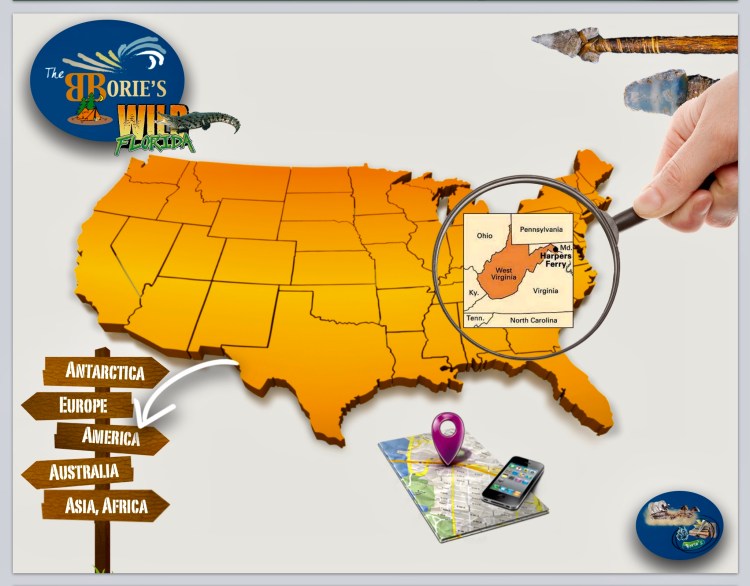
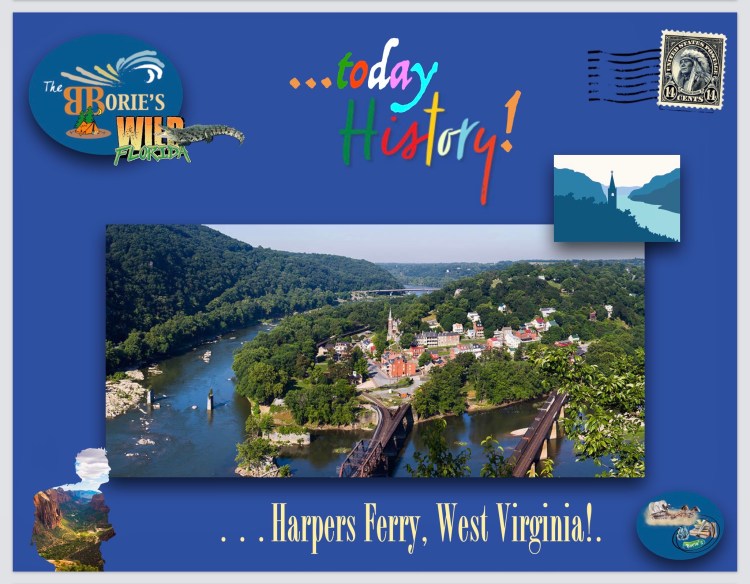
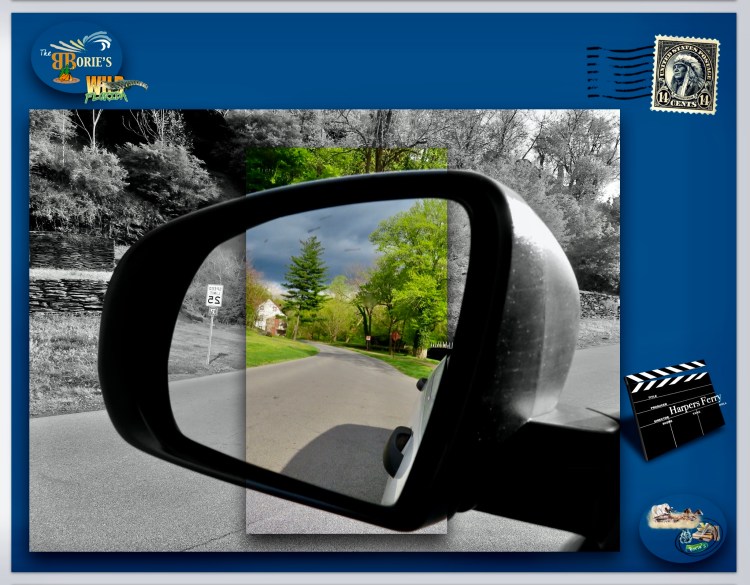
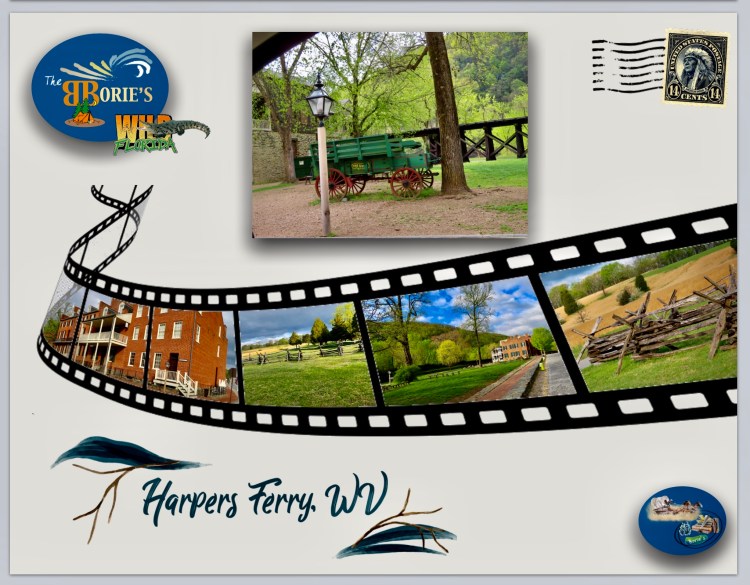
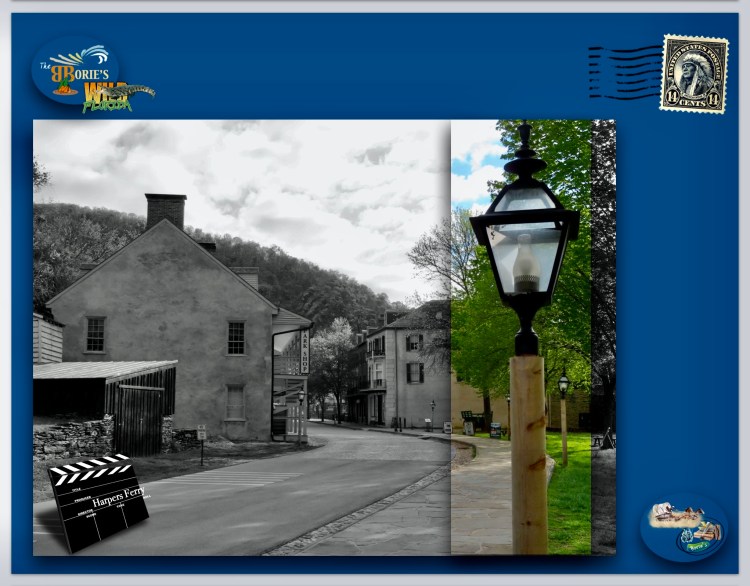
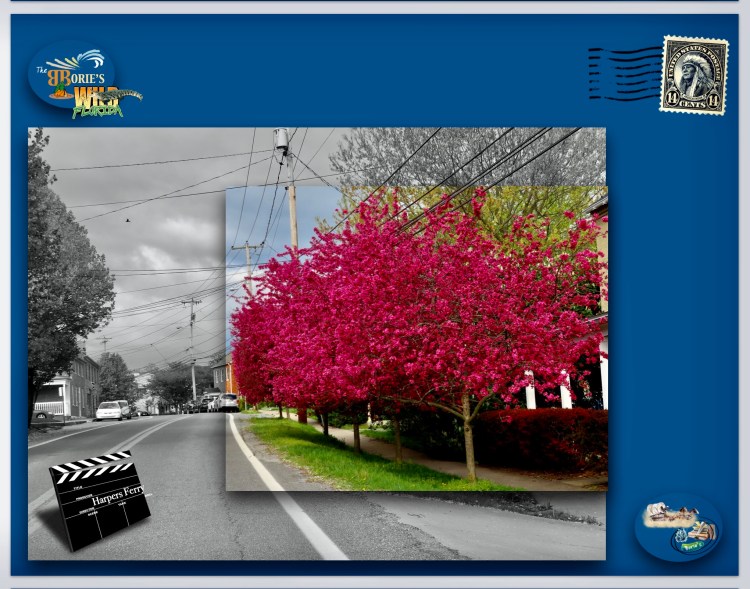
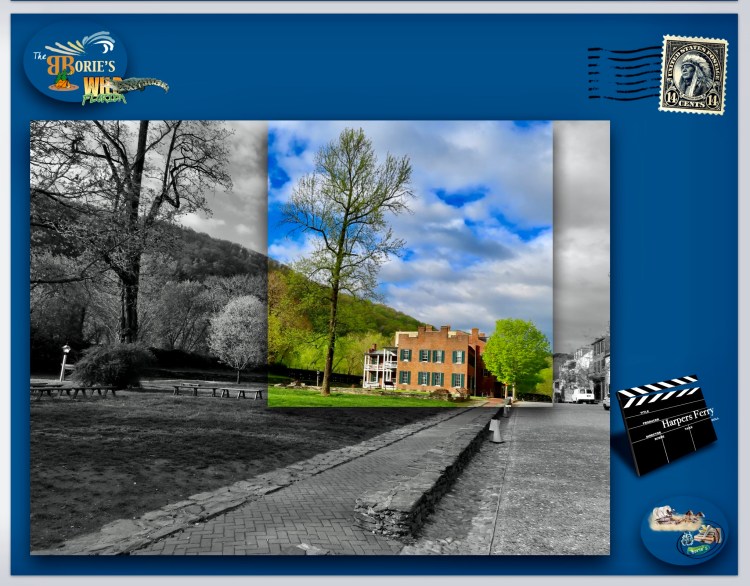
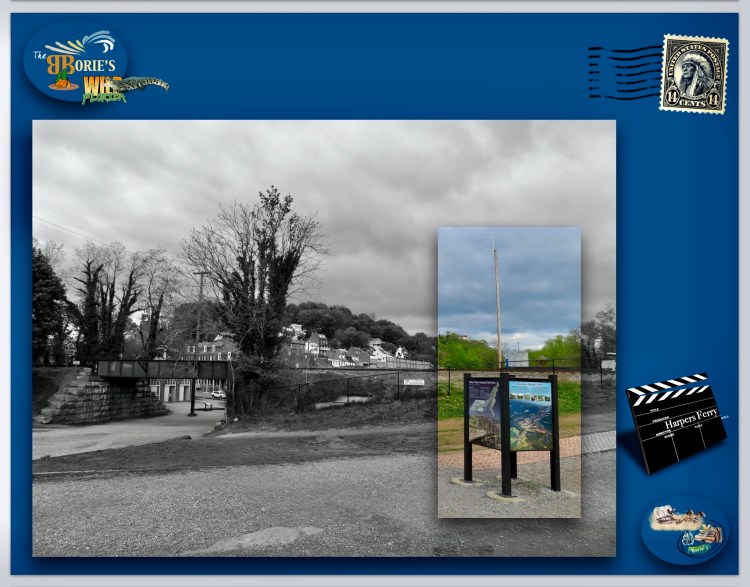
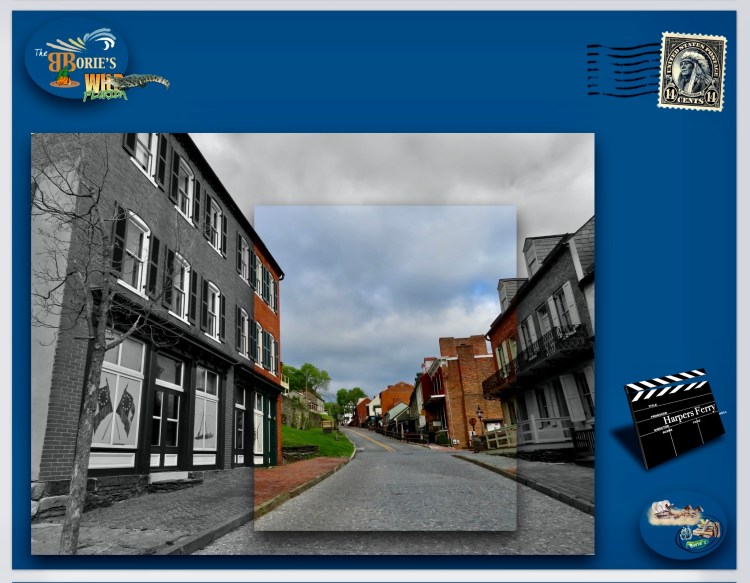
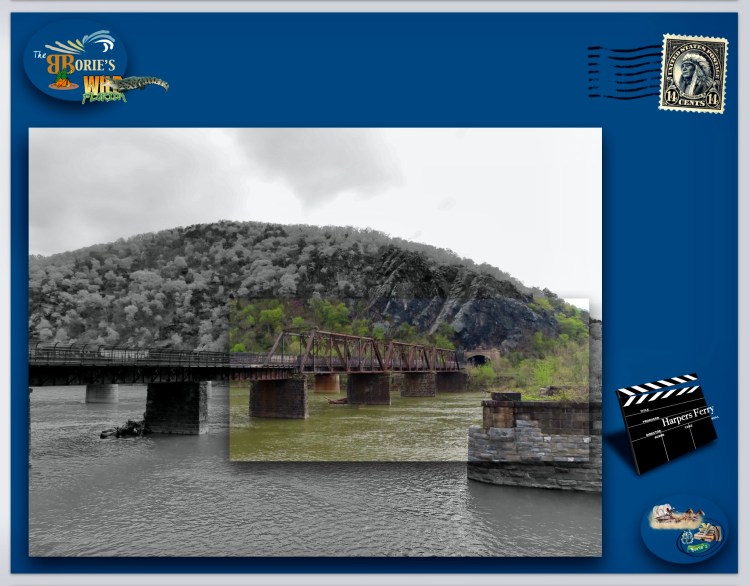
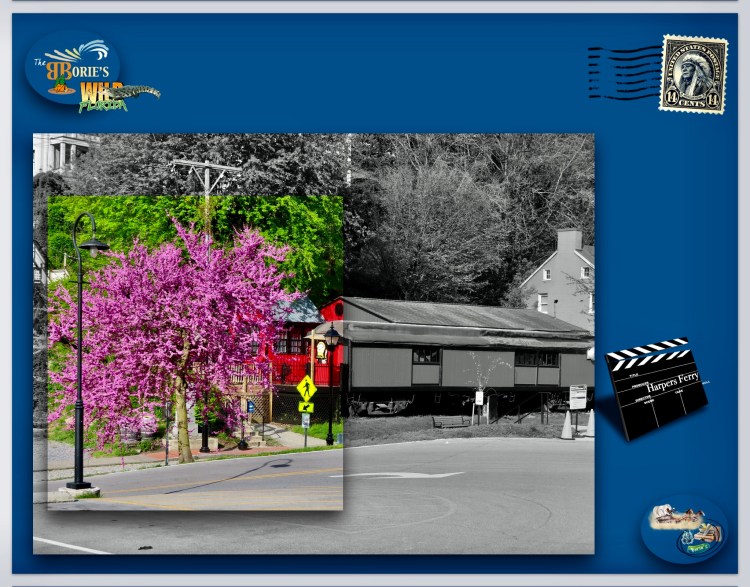
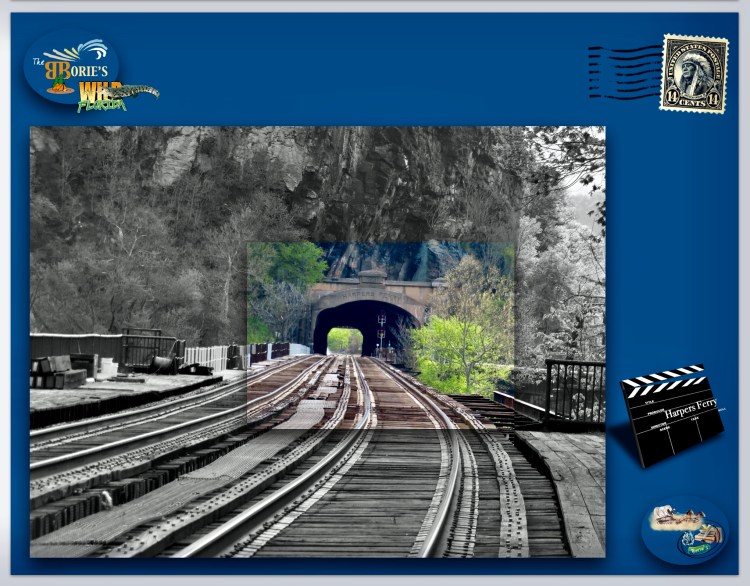
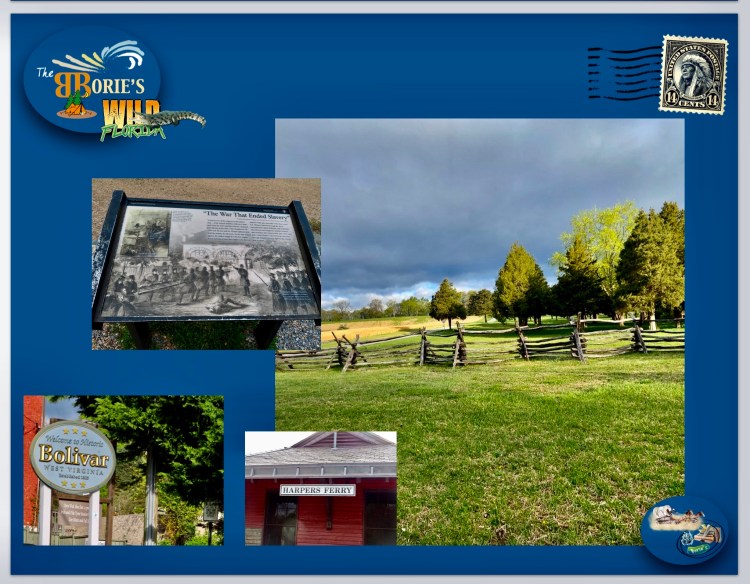
…a tarde já ia avançada, quando chegámos ao vale de Shenandoah na confluência dos rios Potomac e Shenandoah, onde se juntam os estados de Maryland, Virgínia e West Virgínia!. Pernoitámos por ali e, ao outro dia caminhámos pelas ruas calcetadas em pedra, pelas encostas agrestes e pela margem dos rios, parecendo-nos que viajávamos no tempo!.
(…the afternoon was already late, when we arrived in the Shenandoah valley at the confluence of the Potomac and Shenandoah rivers, where the states of Maryland, Virginia and West Virginia join!. We spent the night there and, the other day we walked through the cobbled streets, the rough slopes and the riverside, looking like we were traveling in time)!.
…já lá iam uns anos em que a curiosidade em visitar esta simpática cidade museu crescia em nós!. Porquê? Porque a sua história, pelo menos durante a Guerra Civil Americana, foi considerada o ponto mais ao norte do território controlado pelos confederados, embora um pouco mais a norte, mesmo a muito pouca distância, era unionista, e claro, falando da Guerra Civil, era considerado “o melhor ponto estratégico de todo o Sul”!.
(…there were some years when the curiosity to visit this nice museum city grew in us!. Because? Because its history, at least during the American Civil War, was considered the most northerly point in the territory controlled by the Confederates, although a little further north, even at a very short distance, it was unionist, and of course, speaking of the Civil War, it was considered “the best strategic point in the whole South”)!.
…caminhando por aqui, verificamos que as características geográficas de Harpers Ferry, são as principais razões para sua colonização e eventual desenvolvimento, tornando este local como um centro de transporte natural, situado na encosta de um grande rio, o Shenandoah, que se junta ao Rio Potomac, dando-nos a entender que Harpers Ferry guardava a entrada do grande Vale Shenandoah, na Virgínia, enquanto o rio Potomac proporcionava fácil acesso à capital Washington!.
(…walking here, we find that the geographical characteristics of Harpers Ferry, are the main reasons for its colonization and eventual development, making this place as a center of natural transport, located on the side of a large river, the Shenandoah, which joins the Potomac River, implying that Harpers Ferry guarded the entrance to the great Shenandoah Valley in Virginia, while the Potomac River provided easy access to the capital Washington)!.
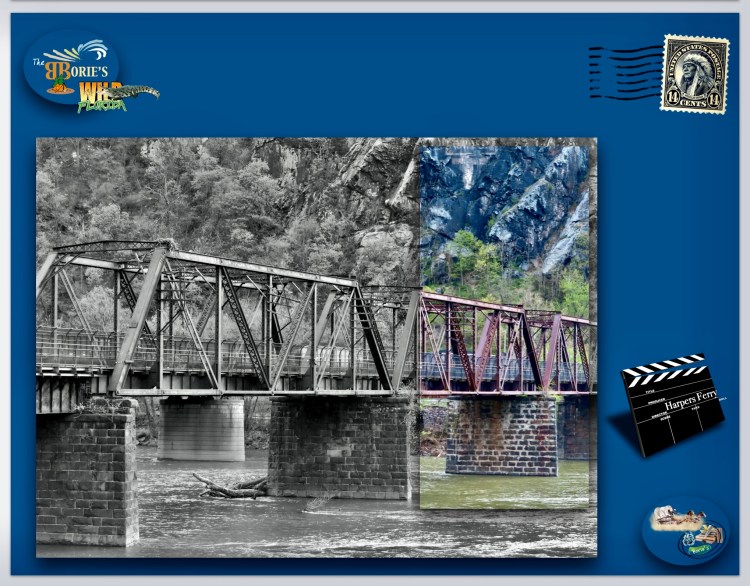
…e mais, os vales dos rios possibilitaram a construção do canal de Chesapeake e Ohio, (que nunca foi concluído), e depois os caminhos de ferro de Baltimore e Ohio, logo seguidos dos caminhos de ferro de Winchester e Potomac, perfazendo assim o primeiro entroncamento ferroviário nos Estados Unidos, sendo a primeira e por muitos anos a única ponte ferroviária sobre o rio Potomac!.
(…and more, the river valleys made it possible to build the Chesapeake and Ohio canal, (which was never completed), and then the Baltimore and Ohio railways, soon followed by the Winchester and Potomac railways, thus making the first rail junction in the United States, being the first and for many years the only railway bridge over the Potomac River)!.
…e claro, seguiram-se as linhas telegráficas e todas as outras componentes de um progresso e, a palavra Ferry (balsa) que dá o nome à cidade, terminou, quando uma ponte rodoviária em madeira coberta foi construída e, nenhuma das pontes de Washington D.C. conectando com a Virgínia, transportava mais tráfego de cavalos, pelo menos até depois da Guerra Civil!.
(…and of course, telegraph lines and all other components of progress followed, and the word Ferry that gives the city its name ended when a covered wooden road bridge was built and none of the bridges Washington DC connecting with Virginia, carried more horse traffic, at least until after the Civil War)!.
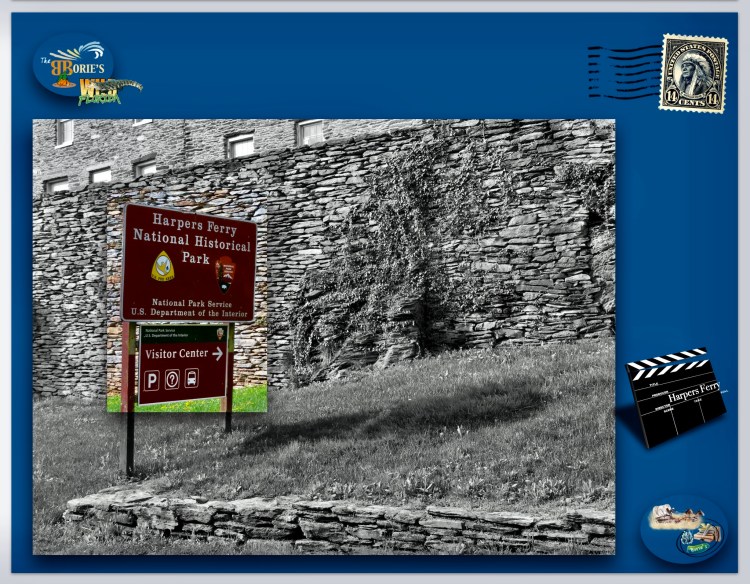
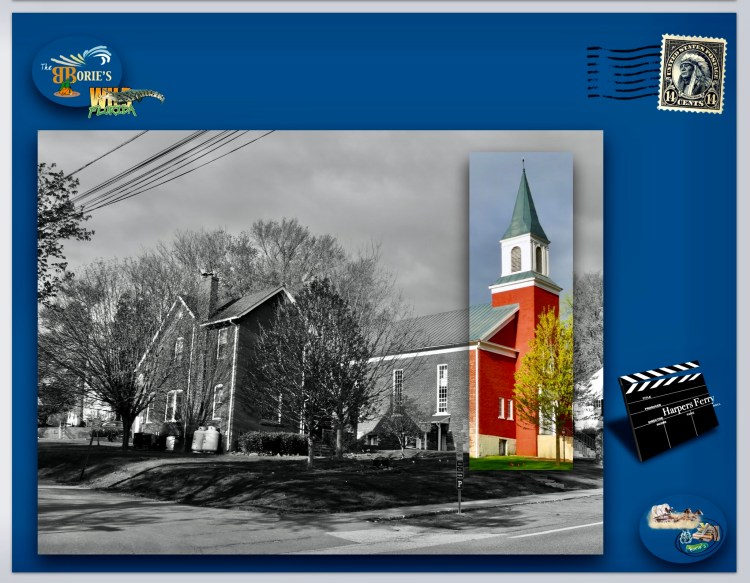
…vale a pena caminhar por aqui, onde a parte inferior e original da cidade se situa numa planície de inundação criada pelos dois rios, cercada por um terreno mais alto, fazendo parte do Parque Histórico Nacional Harpers Ferry, que inclui a área mais populosa, onde está incluído o distrito histórico, fazendo parte do Registro Nacional de Lugares Históricos e, adjacentes à cidade, estão o Baltimore e Ohio Railroad Potomac River Crossing e a Igreja Católica Romana de São Pedro!.
(…it is worth walking here, where the lower and original part of the city is located on a floodplain created by the two rivers, surrounded by higher ground, forming part of the Harpers Ferry National Historical Park, which includes the most populous area, where the historic district is included, forming part of the National Register of Historic Places and, adjacent to the city, are the Baltimore and Ohio Railroad Potomac River Crossing and the Roman Catholic Church of St. Peter)!.
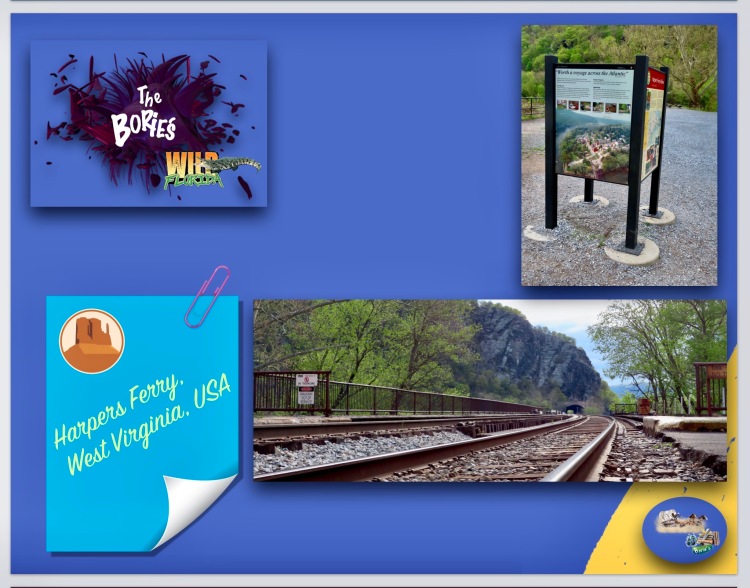
…vários presidentes dos USA visitaram Harpers Ferry e, Thomas Jefferson viu “a passagem do Potomac através do Blue Ridge” de uma rocha que agora leva seu nome!. Esta paragem ocorreu quando Jefferson estava viajando para Filadélfia com a sua filha Patsy, chamando ao local de “talvez uma das cenas mais estupendas da natureza”, afirmando que, “esta cena vale uma viagem através do Atlântico”!.
(…several presidents of the USA visited Harpers Ferry and, Thomas Jefferson saw “the passage of the Potomac through the Blue Ridge” of a rock that now bears his name!. This stop occurred when Jefferson was traveling to Philadelphia with his daughter Patsy, calling it “perhaps one of the most amazing scenes in nature”, stating that, “this scene is worth a trip across the Atlantic”)!.
…e George Washington, viajou para Harpers Ferry durante o verão de 1785 para determinar a necessidade de canais de desvio e, em 1794, a sua familiaridade com a área o levou a propor o local para um novo Arsenal dos Estados Unidos!. Como tal, no ano de 1796, o governo federal comprou um terreno de 125 acres e, três anos depois iniciou a construção do Arsenal dos Estados Unidos em Harpers Ferry!. Esta foi uma das duas únicas instalações nos EUA, sendo a outra Springfield, Massachusetts, onde juntos, produziram a maioria das armas pequenas para o Exército dos EUA!.
(…and George Washington, traveled to Harpers Ferry during the summer of 1785 to determine the need for diversion channels and, in 1794, his familiarity with the area led him to propose the site for a new United States Arsenal!. As such, in the year 1796, the federal government purchased 125 acres of land and, three years later, began building the United States Arsenal on Harpers Ferry!. This was one of only two facilities in the US, the other being Springfield, Massachusetts, where together they produced most of the small arms for the US Army)!.
…assim, a cidade foi transformada num centro industrial entre 1801 e 1861, quando o Arsenal foi destruído para evitar a captura durante a Guerra Civil!. O Arsenal produziu mais de 600.000 mosquetes, rifles e pistolas, onde o capitão inventor John H. Hall foi o pioneiro no uso de peças intercambiáveis em armas de fogo fabricadas nos seus trabalhos de rifle neste Arsenal e, o seu rifle M1819 Hall foi a primeira arma de carregamento por culatra adotada pelo Exército dos EUA!.
(…thus, the city was transformed into an industrial center between 1801 and 1861, when the Arsenal was destroyed to avoid capture during the Civil War!. Arsenal produced more than 600,000 muskets, rifles and pistols, where captain inventor John H. Hall pioneered the use of interchangeable parts in firearms manufactured in his rifle work at this Arsenal, and his M1819 Hall rifle was the first back-loaded weapon adopted by the US Army)!.
…mas, históricamente, Harpers Ferry também é conhecida pelo ataque do abolicionista John Brown, que liderou um grupo de 22 homens numa invasão ao Arsenal!. Cinco dos homens eram negros, sendo três negros livres, um escravo libertado e um escravo fugitivo, trazendo também 1.000 lanças de aço, que foram forjadas em Connecticut por um ferreiro e simpatizante deste abolicionista!. No entanto, as lanças, uma arma que não requer treinamento, nunca foram usadas porque Brown falhou em reunir mais escravos à revolta!.
(…but, historically, Harpers Ferry is also known for the attack by abolitionist John Brown, who led a group of 22 men in an invasion of Arsenal!. Five of the men were black, three of them free blacks, a freed slave and a fugitive slave, also bringing 1,000 steel spears, which were forged in Connecticut by a blacksmith and supporter of this abolitionist!. However, the spears, a weapon that requires no training, were never used because Brown failed to bring more slaves into revolt)!.
…continuando, atacaram e capturam vários edifícios, chegando a manter como refém o sobrinho de George Washington, o coronel Lewis Washington, na esperança de proteger o depósito de armas e armar os escravos, iniciando uma revolta no sul, nas montanhas Blue Ridge de Virginia!.
…continuing, they attacked and captured several buildings, even holding George Washington’s nephew, Colonel Lewis Washington, hostage, hoping to protect the weapons depot and arm slaves, starting a revolt in the south, in the Blue Ridge Mountains of Virginia)!.
…no entanto, os homens de John Brown foram rapidamente imobilizados por cidadãos locais e milícias, e forçados a se refugiar na casa de bombeiros (mais tarde chamada de Forte de John Brown), na entrada do Arsenal!. Uma unidade de fuzileiros navais do Washington Navy Yard, as tropas mais próximas, receberam ordens de levar uma força de 86 fuzileiros para a cidade, onde o tenente-coronel do exército, Robert E. Lee, foi encontrado em licença em sua casa na vizinha Arlington, sendo designado como comandante!.
(…however, John Brown’s men were quickly immobilized by local citizens and militias, and forced to take refuge in the firehouse (later called John Brown Fort), at the entrance to Arsenal!. A marine unit from the Washington Navy Yard, the nearest troops, was ordered to take a force of 86 marines to the city, where army lieutenant colonel Robert E. Lee was found on leave at his neighboring home Arlington, being appointed as commander)!.
…junto com o seu ajudante de campo, Lee liderou a unidade com roupas civis, já que nenhum de seus uniformes estava disponível!. O contingente chegou de combóio e, após o fracasso das negociações, invadiram o corpo de bombeiros e capturaram a maioria dos invasores, matando alguns!.
(…along with his field assistant, Lee led the unit in civilian clothes, as none of his uniforms were available!. The contingent arrived by train and, after the failure of the negotiations, they invaded the fire department and captured the majority of the invaders, killing some)!.
…Brown foi rapidamente julgado em Charles Town, sede do condado de Jefferson, por traição contra a Comunidade da Virgínia, assassinato e fomento de uma insurreição de escravos, sendo condenado por todas as acusações!. Foi enforcado em 2 de dezembro de 1859!. As palavras de John Brown, tanto da sua entrevista com o governador da Virgínia, quanto do seu famoso “último discurso”, “capturaram a atenção da nação como nenhum outro abolicionista ou proprietário de escravos antes ou depois”!.
(…Brown was quickly tried in Charles Town, Jefferson County, for treason against the Commonwealth of Virginia, murder and fomenting a slave uprising, and was convicted on all charges! He was hanged on December 2, 1859!. John Brown’s words, both from his interview with the governor of Virginia, and from his famous “last speech”, “captured the nation’s attention like no other abolitionist or slave owner before or after”)!.
…devido sobretudo à sua localização estratégica, a cidade era “fácil de conquistar mas difícil de segurar”!. Assim a Guerra Civil foi desastrosa para Harpers Ferry, que mudou de mãos oito vezes entre 1861 e 1865, apresentando um quadro bastante sombrio, onde os melhores edifícios foram totalmente destruídos e nada restava, excepto as suas fundações para marcar o local onde eles estiveram!. O Arsenal foi totalmente queimado e aquela parte do prédio onde o velho John Brown fez uma resistência tão fatal, ainda permaneceu como um monumento à sua memória!.
(…due mainly to its strategic location, the city was “easy to conquer but difficult to insure”!. Thus, the Civil War was disastrous for Harpers Ferry, who changed hands eight times between 1861 and 1865, presenting a rather bleak picture, where the best buildings were totally destroyed and there was nothing left, except their foundations to mark the place where they were!. The Arsenal was totally burned and that part of the building where old John Brown made such a fatal resistance, still remained as a monument to your memory)!.
…como acima já mencionámos, por causa da sua localização estratégica e do caminho de ferro da Baltimore & Ohio, no extremo norte do Vale Shenandoah, as tropas da União e dos Confederados deslocavam-se com frequência através da Harpers Ferry e, a guarnição da cidade de 14.000 soldados federais atraiu 1.500 contrabandos (escravos fugidos) que infelizmente foram devolvidos à escravidão quando as forças confederadas tomaram Harpers Ferry por volta do ano de 1862!.
(…as we have already mentioned, because of its strategic location and the Baltimore & Ohio railroad, at the northern end of the Shenandoah Valley, Union and Confederate troops frequently moved through Harpers Ferry and, the garrison of the the city of 14,000 federal soldiers attracted 1,500 smugglers (escaped slaves) who unfortunately were returned to slavery when the Confederate forces seized Harpers Ferry around 1862)!.
…depois, a Guerra Civil prolongou-se, onde de acordo com a história, Harpers Ferry desempenhou um papel fundamental e, em pouco mais de uma semana antes de uma das muitas batalhas, o general Robert E. Lee havia perdido mais da metade de seu exército e, durante o cerco de Petersburgo em Junho de 1864 a abril de 1865, Lee tinha cerca de 60.000 homens famintos e desmoralizados sob seu comando para se opor a mais de 100.000 soldados da União!. Nesse momento observou que para evitar uma destruição desnecessária ao sul, “não havia mais nada a fazer” do que render-se ao tenente-general Ulysses S. Grant, após uma batalha naquela manhã!.
(…then the Civil War went on, where according to history, Harpers Ferry played a key role and, in just over a week before one of the many battles, General Robert E. Lee had lost more than half of his army and, during the siege of Petersburg in June 1864 to April 1865, Lee had about 60,000 hungry and demoralized men under his command to oppose more than 100,000 Union soldiers!. At that moment he observed that to avoid unnecessary destruction to the south, “there was nothing more to be done” than surrender to Lieutenant-General Ulysses S. Grant, after a battle that morning)!.
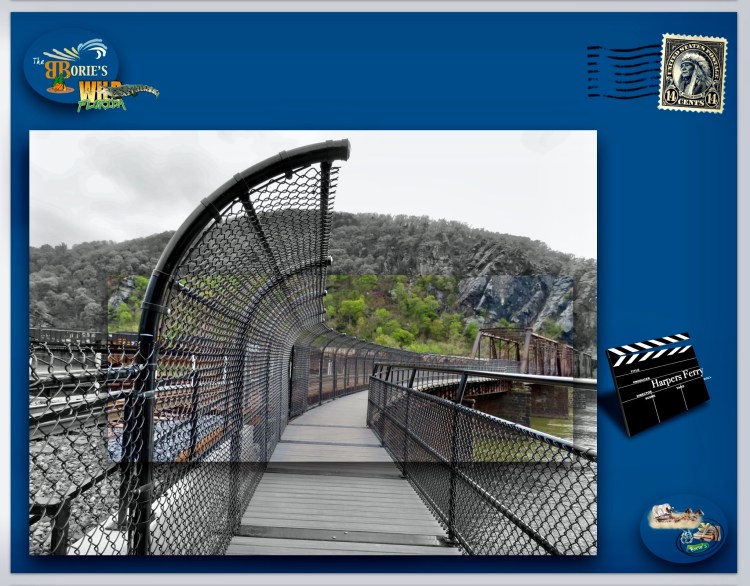
…a cidade também é a sede da Appalachian Trail Conservancy, porque a Trilha dos Apalaches passa diretamente pela cidade, (e nós percorremos parte do seu pequeno percurso), que alguns consideram o ponto médio psicológico desta famosa trilha, embora o ponto médio físico exacto seja mais ao norte, no estado da Pennsilvânia, (que era o nosso destino original), todavia, excepcionalmente, as cidades de Harpers Ferry e Bolivar fizeram parceria com a Appalaches Trail Conservancy, para serem declaradas uma Comunidade unida da Trilha dos Apalaches!.
(…the city is also the headquarters of the Appalachian Trail Conservancy, because the Appalachian Trail passes directly through the city, (and we cover part of its short route), which some consider the psychological midpoint of this famous trail, although the exact physical midpoint be further north, in the state of Pennsilvania, (which was our original destination), however, exceptionally, the cities of Harpers Ferry and Bolivar have partnered with the Appalaches Trail Conservancy, to be declared a united Community of the Appalachian Trail)!.
…e, alguns dos edifícios históricos da cidade, são usados pelo National Park Service para um de seus quatro centros de treinamento nacionais, sendo hoje o National Park Service, o maior empregador da Harpers Ferry do século XXI!.
(…and some of the city’s historic buildings are used by the National Park Service for one of its four national training centers, today being the National Park Service, the largest employer of the 21st century Harpers Ferry)!.
…e nós simples visitantes de Harpers Ferry, continuámos a nossa jornada rumo ao estado de Pennsylvania, lembrando de que a cidade foi reconstruída pelo National Park Service, pois estava em ruínas no final da Guerra Civil e, em parte inundada pelos rios que por lá passam!.
(…and we as simple visitors to Harpers Ferry, we continued our journey towards the state of Pennsylvania, remembering that the city was rebuilt by the National Park Service, because it was in ruins at the end of the Civil War and, in part, flooded by the rivers that there. pass)!.
Tony Borie, Século XXI. (Tony Borie, 21st Century).
…estamos de volta, viajando para sul numa estrada para onde já não queríamos vir!.
(…we’re back, traveling south on a road we didn’t want to come to anymore)!.
…não nos importava a buzina apressada de um qualquer carro ou camião que nos queria passar, o incoveniente de parar e pagar as portagens (pelo menos lá no norte), ou os engarrafamentos causados por alguns acidentes, que nos faziam viajar mais devagar, porque as saudades da família que por lá ficou no norte, tornava o céu da nossa vida perder o azul, e claro, aquela alegria e vontade indomável que tivémos na ida, ia desaparecendo!.
(…we didn’t care about the hurried horn of any car or truck that wanted to pass us, the inconvenience of stopping and paying tolls (at least in the north), or the traffic jams caused by some accidents, which made us travel more slowly, because the longing for the family that stayed there in the north, made the sky of our lives lose the blue, and of course, that joy and indomitable will that we had on the way, was disappearing)!.
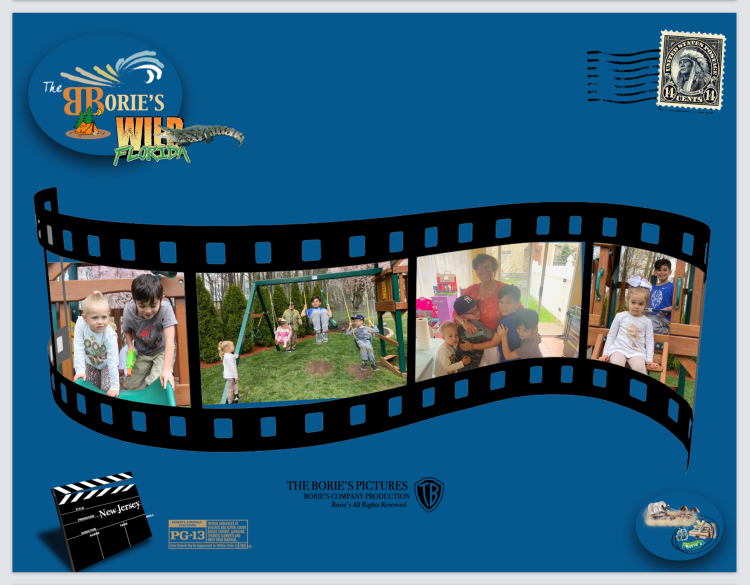
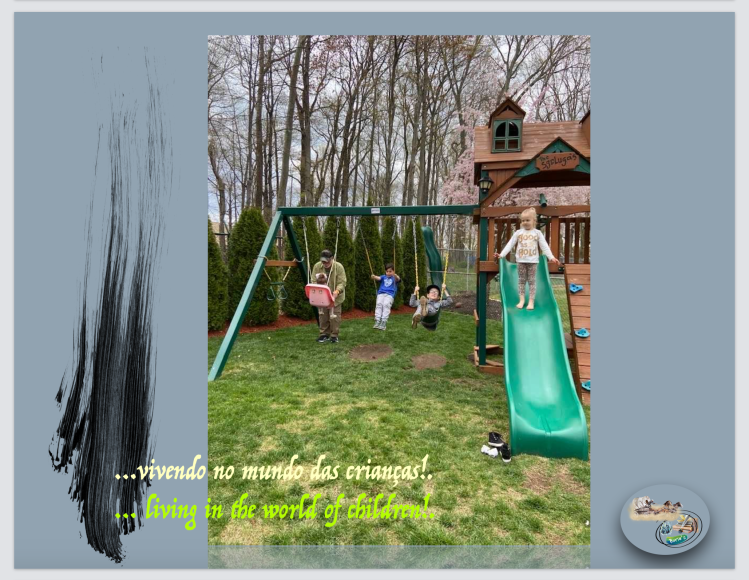
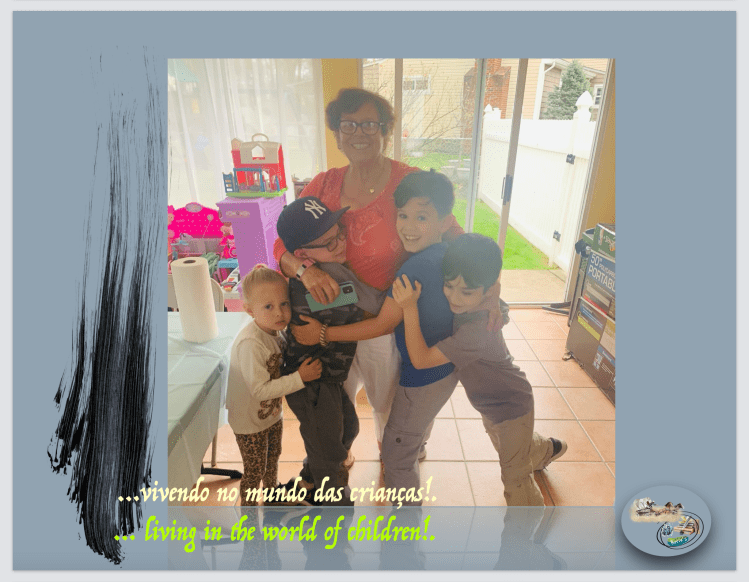
…porquê?. Porque durante uns dias, “EMPANTURÁMO-NOS DE SORRISOS”, vivendo no mundo das crianças, brincando, contando-lhes histórias das coisas da nossa juventude do antigamente, onde tudo era incrível para os dias de hoje!.
(…because?. Because for a few days, “WE SMILE WITH SMILES”, living in the world of children, playing, telling them stories of the things of our youth from the old days, where everything was incredible for today)!.
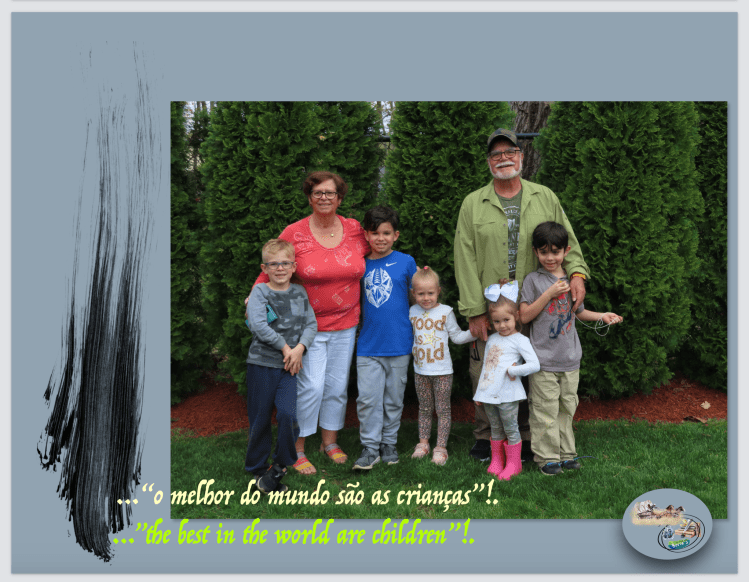
…não existe qualquer dúvida, “o melhor do mundo são as crianças”.
(…there is no doubt, “the best in the world are children”).
…e claro, ouvindo-os nas suas alegres aventuras, onde não faltavam gestos, cantigas e sorrisos inocentes, que só nós, os mais antigos sabemos e compreendemos a riqueza de um sorriso alegre de uma criança, porque nascer nos anos quarenta, numa aldeia perdida na Europa, calcando neve, pedras e lama era difícil e, havia poucos sorrisos!.
(…and of course, listening to them in their joyful adventures, where innocent gestures, songs and smiles were not lacking, that only we, the oldest ones know and understand the richness of a child’s happy smile, because being born in the forties, in a village lost in Europe, treading snow, rocks and mud was difficult and, there were few smiles)!.
…sabemos que a sociedade vive hoje acelarada, basta estar atento às notícias, no entanto, felizmente nestes dias passados no norte, verificámos que o tal fenómeno da falta de comunicação real entre famílias, pelo menos na nossa, “NÃO EXISTE”, continuam a conviver alegremente, juntando períodicamente as crianças que correm e brincam juntas!.
(…we know that society is accelerated today, just be aware of the news, however, fortunately in these days spent in the north, we found that the phenomenon of lack of real communication between families, at least in ours, “DOES NOT EXIST”, continue to live happily, periodically joining children who run and play together)!.
…ao escrever as rotas destes dias por lá passados, emocionamo-nos, mesmo não sabendo se alguém nos lê, até ficando desesperados se alguma frase possa ter outra interpretação ou ferir alguém, mas estes dias para nós, foram dias de uma primavera azul!. Tudo foi “5 estrelas”, o cenário de família, as flores da primavera no norte, o cantar da passarada, o sol aquecia-nos no horizonte, os netos queriam saber coisas de nós, faziam perguntas, rodeávam-nos, o nosso computador era deles, não havia sossego, mas era um agitação encantadora!.
(…when writing the routes of these past days, we were thrilled, even though we did not know if anyone would read us, even getting desperate if any sentence could have another interpretation or hurt someone, but these days for us, were days of a blue spring! . Everything was “5 stars”, the family scene, the spring flowers in the north, the singing of the catwalk, the sun warmed us on the horizon, the grandchildren wanted to know about us, asked questions, surrounded us, our computer it was theirs, there was no rest, but it was a lovely excitement)!.
..e nós, preparando-nos para entrar talvez na última década da vida, que de certeza vai passar num ápice, vergando-nos nesta inevitabilidade vamos murchando aos poucos, contudo, ainda vamos sendo úteis, pelo menos para a família, mesmo sabendo que às vezes errámos, não acertando no centro do alvo, muitas vezes nem no alvo acertávamos, mas felizmente na família, tivémos alguma sorte, fomos bafejados pela benção do criador e, afinal, por mais caos e destruição que haja no mundo ao nosso redor, são a nossa família e as nossas memórias que nos dão o poder de continuar!.
(…and we, preparing to enter perhaps the last decade of life, which will surely pass at a glance, sinking into this inevitability, we are slowly wilting, however, we are still being useful, at least for the family, even though we know that we sometimes missed, not hitting the center of the target, many times we didn’t even hit the target, but luckily in the family, we were lucky, we were blessed by the blessing of the creator and, after all, by more chaos and destruction in the world around us , it is our family and our memories that give us the power to continue)!.
Tony Borie, Século XXI. (Tony Borie, 21st Century).
…as pessoas, ou seja, o comum dos mortais tal como nós, quando atingimos uma certa idade e as coisas não correm em conformidade com os nossos desejos, normalmente dizemos: “é o destino”!.
(…people, that is, ordinary mortals like us, when we reach a certain age and things do not go according to our wishes, we usually say: “it is destiny”)!.
…e, o destino foi entre outros, termos nascido na Europa, naquele cantinho “à beira-mar plantado”, que é como chamam à “Peninsula Ibérica”, termos idade adulta naqueles anos, podendo ser militares e como tal forçados a participar na maldita Guerra Colonial em África que o país Portugal manteve “orgulhosamente só” e, foi não ter lá oportunidade de vida e de liberdade para criar uma família!.
(…and, the destination was, among others, that we were born in Europe, in that little corner “planted by the sea”, which is what they call the “Iberian Peninsula”, that we had adulthood in those years, being able to be military and as such forced to participate in the damn Colonial War in Africa that the country Portugal kept “proudly alone” and, it was not having the opportunity of life and freedom to raise a family there)!.
…como tal, vimos essa oportunidade na emigração, deste lado do Atlântico, longe daquele sol radiante, onde às vezes fazia geada pela manhã, a que os nossos vizinhos chamavam “orvalho” e, como tudo o que acima escrevemos não fosse o suficiente, fomos agora visitados pela também maldita pandemia “Coronavírus 19”!.
(…as such, we saw this opportunity in emigration, on this side of the Atlantic, away from that radiant sun, where it was sometimes freezing in the morning, which our neighbors called “dew” and, as everything we wrote above was not enough, we have now been visited by the also accursed pandemic “Coronavirus 19”)!.
…resultado!. Ficámos confinados, e no nosso caso de pessoas que tentam cumprir as regras impostas pelas autoridades médicas e científicas, que nos recomendam ficar em casa, usar máscara, não se expor, tratando os vizinhos e amigos como se fossem estranhos, ou seja, fugir deles e não lhes falando ou cumprimentando, e claro, causando-nos muitas restrições em viajar e, a família vive no norte, as saudades em os ver aumentam todos os dias!.
(…result!. We were confined, and in our case of people who try to comply with the rules imposed by the medical and scientific authorities, who recommend us to stay at home, wear a mask, not expose ourselves, treating neighbors and friends as if they were strangers, that is, running away from them and not talking to or greeting them, and of course, causing us a lot of restrictions on traveling and, the family lives in the north, the longing to see them increases every day)!.
…como tal, não é nossa intenção ir para uma aventura na cidade arqueológica Maya de “Chichén Itzá”, cujo nome significa “pessoas que vivem na beira da água”, no norte no México, que funcionou como centro político e económico da civilização Maya!. Tal como não queremos ir ao Curral das Freiras na Ilha da Madeira, situado no interior da ilha e, onde no princípio da colonização, quando havia saques à hoje cidade do Funchal por corsários franceses, as religiosas do convento de Santa Clara se refugiavam ali, talvez para não serem violadas!.
(…as such, it is not our intention to go on an adventure in the Maya archaeological city of “Chichén Itzá”, whose name means “people who live on the water’s edge” in northern Mexico, which functioned as the political and economic center of the Maya civilization!. Just as we do not want to go to Curral das Freiras on the island of Madeira, located in the interior of the island and, where in the beginning of colonization, when there were looting in the city of Funchal today by French corsairs, the religious of the convent of Santa Clara took refuge there, maybe not to be violated)!.
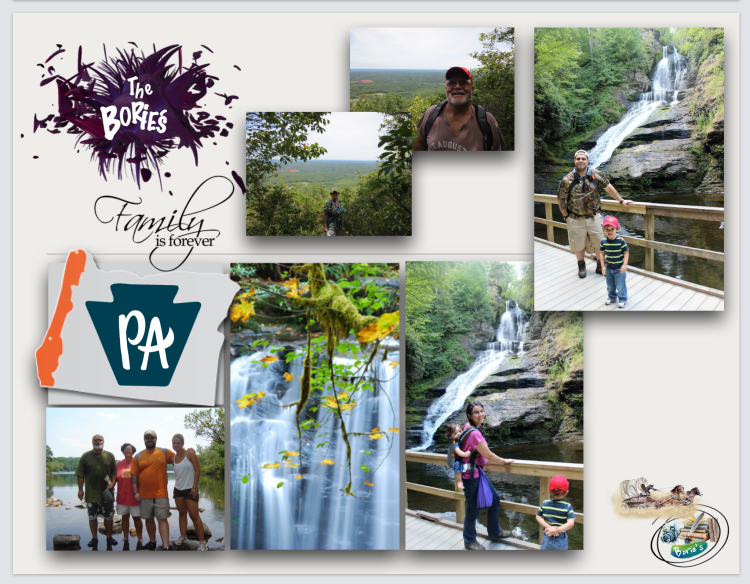
.…não!. Não queremos parecer uns verdadeiros “Indiana Jones”!. O que queremos é ir visitar a família lá no norte, nos estados de Nova Jersey e Pennsylvania, abraçar os nossos netos e os seus pais!. No passado era tão simples, são apenas mil milhas de boa estrada!.
(…not!. We don’t want to look like real “Indiana Jones”!. What we want is to go visit the family in the north, in the states of New Jersey and Pennsylvania, to hug our grandchildren and their parents!. In the past it was so simple, it is only a thousand miles of good road)!.
…já estamos vacinados, pelo menos dizem-nos que ficámos imunes a esse maldito “Coronavírus19”, sendo agora potenciais candidatos a um novo rosto da comunidade de imunização, dando assim a nossa contribuição para a saúde pública e, contra tudo e contra todos vamos de nova para a estrada!.
(…we are already vaccinated, at least they tell us that we were immune to that damn “Coronavirus19”, being now potential candidates for a new face of the immunization community, thus giving our contribution to public health and, against everything and against everyone we will back to the road)!.
…vamos tentar a tão esperada “reunião familiar”!. O pensamento agita o nosso cérebro, misturando a alegria com um toque de ansiedade e, sabemos que a palavra “ansiedade” não devia de estar lá, mas na verdade, as oportunidades de nos reunirmos em família têm sido poucas, devido à época que atravessamos como acima já explicámos por causa da presença da maldita pandemia “Coronavírus19”!.
(…let’s try the long-awaited “family reunion”!. The thought agitates our brain, mixing the joy with a touch of anxiety and, we know that the word “anxiety” should not be there, but in fact, the opportunities to get together as a family have been few, due to the time we are going through, as we explained above because of the presence of the damn pandemic “Coronavirus19”)!.
…vamos ver sobretudo os netos, porque nós quando crianças, os nossos progrenitores seguindo uma tradição de há séculos, também ficavam felizes quando nos viam, e nós como crianças, tínhamos a felicidade de não perceber coisa nenhuma e, de não ter as esperanças que os outros tinham, porque na idade de ter esperanças, infelizmente já não sabíamos ter esperanças, tudo talvez por causa de ainda quase crianças, ser-mos forçados a ir combater na maldita Guerra Colonial em África!.
(…we will see grandchildren above all, because we as children, our parents following a tradition of centuries, were also happy when they saw us, and we as children, were fortunate to not perceive anything and to not have the hopes that the others did, because at the age of hope, unfortunately we no longer knew how to hope, all perhaps because we were still almost children, we were forced to go and fight in the bloody African Colonial War)!.
…também sabemos que nesta já um pouco avançada idade, devemos estar preparados para as perguntas a questões, que eles sempre gostam de saber, como por exemplo: “quem somos, de onde viémos ou o que fizémos durante a nossa vida”, pois nestas reuniões é uma boa oportunidade para as histórias de família se desenrolarem e, acreditamos que não lhes devemos esconder nada, até as nossas aventuras!.
(…we also know that in this already a little old age, we must be prepared for questions to questions, which they always like to know, such as: “who we are, where we came from or what we did during our life”, because in these meetings it is a good opportunity for family stories to unfold and, we believe that we should not hide anything from them, even our adventures)!.
…alguns dos nossos netos já são grandotes, e claro, em parte vamos ser “aquelas pessoas da história da família” e incorporar algumas histórias onde vão surgir muitas perguntas e, quando surgir qualquer assunto que nos cause algum embaraço, eles vão dizer: “vamos conversar sobre isso”!. Mas no fundo, no fundo, ao contar-mos para eles as nossas histórias da infância ou do início da nossa vida, algumas de que já nos devíamos ter esquecido, vai ser um “reviver”, que para nós representa um dos presentes que mais valor e significado têm!.
(…some of our grandchildren are already big, and of course, in part we will be “those people from the family history” and incorporate some stories where many questions will arise and, when any issue that causes us any embarrassment comes up, they will say: “let’s talk about it”!. But deep down, deep down, when we tell them our stories from childhood or the beginning of our life, some of which we should have already forgotten, it will be a “relive”, which for us represents one of the gifts that most value and meaning have)!.
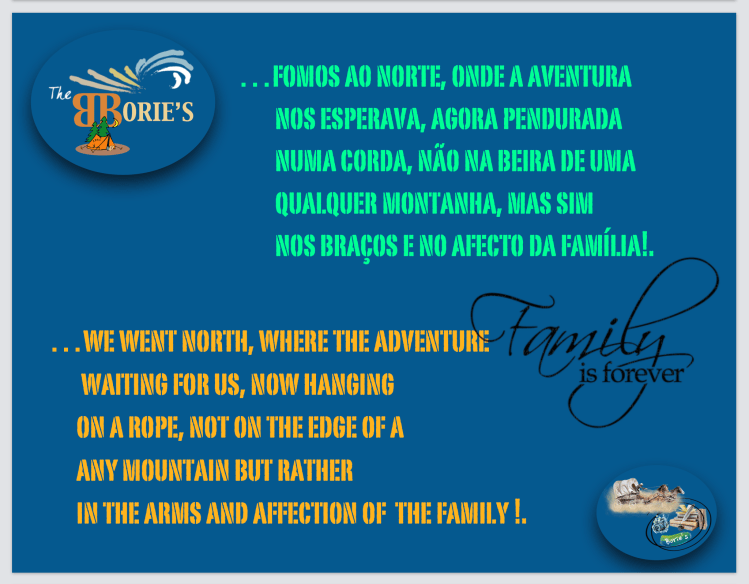
…enfim, vamos para o norte, a aventura espera-nos, talvez agora pendurada numa corda, não na beira de uma qualquer montanha, mas sim nos braços e no afecto da família!.
(…in short, we are going north, the adventure awaits us, perhaps now hanging from a rope, not on the edge of any mountain, but in the arms and affection of the family)!.
Tony Borie, Século XXI. (Tony Borie, 21st Century).
…já por diversas vezes escrevemos sobre as nossas aventuras pelo distante estado do Alaska e, sem qualquer dúvida ver um urso pardo arrebatando salmão de um qualquer riacho do Alaska, é a memória de uma vida, tal como admirar no seu próprio habitate, as águias, os ursos negros tímidos ou as baleias jubarte acrobáticas!.
(…we have already written about our adventures in the distant state of Alaska several times and, without any doubt, seeing a brown bear snatching salmon from some Alaska stream, is the memory of a life, just like admiring the eagles in their own habitat , shy black bears or acrobatic humpback whales)!.
…ou mesmo caminhar sobre a cor da neve gelada de um qualquer glaciar, agraciados e aquecidos pela maravilhosa luz do sol que, depois de passar aproximadamente pelo paralelo 43º N, nos beneficia de 16 a 20 horas por dia, às vezes mais e, nos ilumina em algumas das mais belas paisagens do mundo, onde a natureza ainda é pura!. Claro, toda esta beleza natural nos faz recordar o Alaska para sempre e, em parte continuarmos a receber notícias e seguir o que por lá se passa!.
(…or even to walk on the color of the icy snow of any glacier, graced and warmed by the wonderful sunlight that, after passing through the parallel 43º N, benefits us from 16 to 20 hours a day, sometimes more and, in illuminates in some of the most beautiful landscapes in the world, where nature is still pure !. Of course, all this natural beauty reminds us of Alaska forever and, in part, we continue to receive news and follow what is going on there)!.
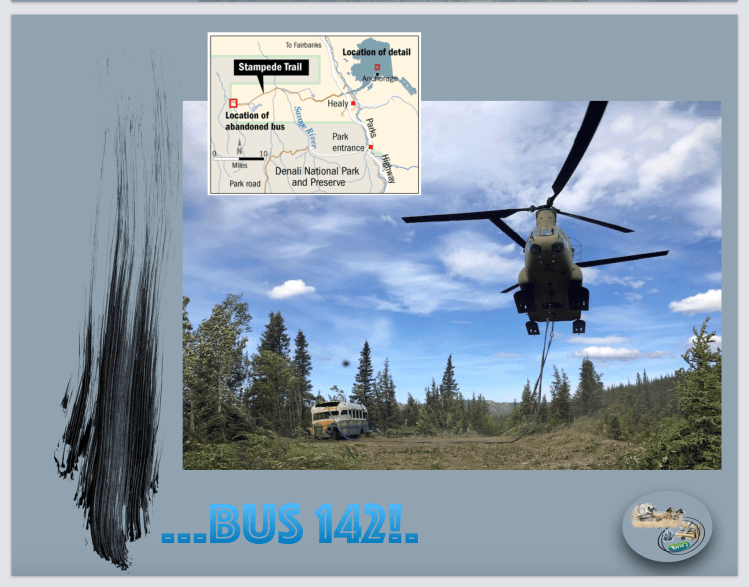
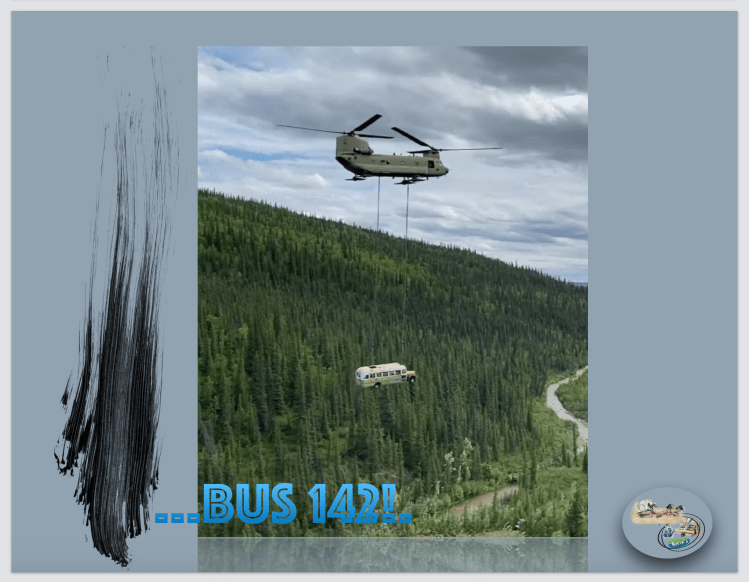
…e, chegou ao nosso conhecimento a notícia de que, “o hoje famoso autocarro 142 foi transferido em Junho de 2020 para tentar impedir as pessoas de se colocarem em perigo!. Foi retirado da trilha Stampede por um helicóptero CH-47 Chinook e levado até ao Museu do Alaska, para que todos possam ver e aproveitar o famoso autocarro com segurança!. Agora, pode ser que menos pessoas estejam tentando a caminhada por si mesmas ou que estejam mais preparadas para os perigos que se avizinham”!.
(…and the news came to our attention, “the now famous bus 142 was transferred in June 2020 to try to prevent people from putting themselves in danger!. It was removed from the Stampede trail by a CH-47 Chinook helicopter and taken to the Alaska Museum, so that everyone can safely see and enjoy the famous bus!. Now, it may be that fewer people are trying to walk on their own or are more prepared for the dangers ahead”!.
…e, parece que as palavras deste último capítulo ditas assim, não fazem muito sentido, mas fazem!. Porquê?. Porque são parte daquilo que lá se desenrolou, neste estado do norte, que muitos consideram a “última fronteira”!. É uma história que cresceu, tornando-se num fenómeno cultural, chegando mesmo a Hollywood, com o título de “Into the Wild”, fazendo-nos pensar o que leva as pessoas a fazer certas coisas e, se houvesse uma resposta para isto, parece-nos que o mundo seria muito mais fácil!.
(…and, it seems that the words of this last chapter said thus, do not make much sense, but they do!. Because?. Because they are part of what unfolded there, in this northern state, which many consider to be the “last frontier”!. It’s a story that grew, becoming a cultural phenomenon, even reaching Hollywood, with the title “Into the Wild”, making us think what makes people do certain things and, if there was an answer to that, it seems to us that the world would be much easier)!.
…porquê?. Porque ser-mos diferentes uns dos outros é o que torna o mundo tão incrível, no entanto, só porque preferimos um certo estilo de vida, não significa que todos concordem, mas empurrar o barco da nossa vida para mais longe do que qualquer outra pessoa, ao ponto de acabar com a própria vida, cremos que estamos a ir longe de mais!.
(…because?. Because being different from each other is what makes the world so amazing, however, just because we prefer a certain lifestyle does not mean that everyone agrees, but pushing the boat of our lives further than anyone else , to the point of ending our own lives, we believe that we are going too far)!.
…esta verdadeira e trágica história que envolve este hoje famoso autocarro 142 e, que se desenrolou perto da cidade de Fairbanks, onde já estivémos por diversas vezes, acampando, pernoitando, visitando parques e museus ou de simples passagem e, como tal conhecemos com algum pormenor as zonas desertas ou de floresta, das montanhas cobertas de gelo e dos rios ainda selvagens, que de pequenos se tornam gigantes consoante o gelo que se vai derretendo nas montanhas que os rodeiam!.
(…this true and tragic story that surrounds this now famous bus 142 and, which took place near the city of Fairbanks, where we have been several times, camping, staying overnight, visiting parks and museums or simply passing by, and as such we know with some detail the deserted or forested areas, the mountains covered with ice and the rivers still wild, that from small become giant according to the ice that melts in the mountains that surround them)!.
…dito isto, sabíamos que o dito famoso autocarro 142 existia!. (…having said that, we knew that the famous bus 142 existed)!.
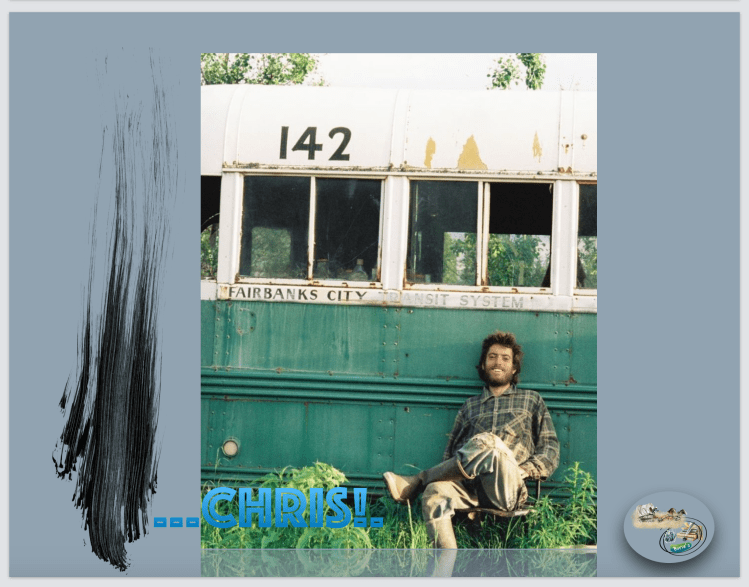
…que é parte da história de vida do jovem Chris McCandless e, chegámos a querer ir vê-lo, mas os obstáculos para essa jornada, não eram compatíveis com a nossa um pouco avançada idade, no entanto procurámos mais informação!. Encontrámo-la, agradecemos entre outras publicações, à fundação em memória do Chris pelas fotos, tomando a liberdade de as publicar no nosso blogue e, perfazemos a história de hoje!.
(…which is part of the life story of young Chris McCandless and, we even wanted to go see him, but the obstacles for that journey, were not compatible with our slightly advanced one age, however we looked for more information !. We found it, thanks, among other publications, to the foundation in memory of Chris for the photos, taking the liberty to publish them on our blog and, make up today’s story)!.
…continuando, se já assistiram ao filme biográfico de drama “Into the Wild”, há uma boa chance de que esta não seja a primeira vez que ouvem o nome de Chris, no entanto, acontece que o filme é muito mais do que uma história inventada num estúdio de Hollywood!. É a história de como Chris tentou construir uma vida para si mesmo na floresta, apenas para descobrir que a Mãe Natureza tem que ser tratada com amor e dedicação e, quando isso não acontece, é uma das amantes mais cruéis!.
(…continuing, if you’ve watched the biopic drama film “Into the Wild”, there’s a good chance that this isn’t the first time they’ve heard Chris’s name, however, it turns out that the film is much more than a story invented in a Hollywood studio!. It is the story of how Chris tried to build a life for himself in the forest, only to discover that Mother Nature has to be treated with love and dedication and, when it does not, she is one of the most cruel lovers)!
…tentando explicar quem era verdadeiramente o jovem Chris, sabemos que nasceu em El Segundo, Califórnia e cresceu nos subúrbios de Annandale, Virgínia!. Depois de se formar em Maio de 1990 com notas altas na Emory University, na Georgia, parou de se comunicar com a sua família, deu o fundo da faculdade de $24.500 para a caridade e começou a viajar pelo oeste dos USA, partindo para a aventura!.
(…trying to explain who the young Chris really was, we know he was born in El Segundo, California and grew up in the suburbs of Annandale, Virginia!. After graduating in May 1990 with high marks from Emory University in Georgia, he stopped communicating with his family, gave the $24,500 college fund to charity and started traveling the western USA, going on an adventure)!.
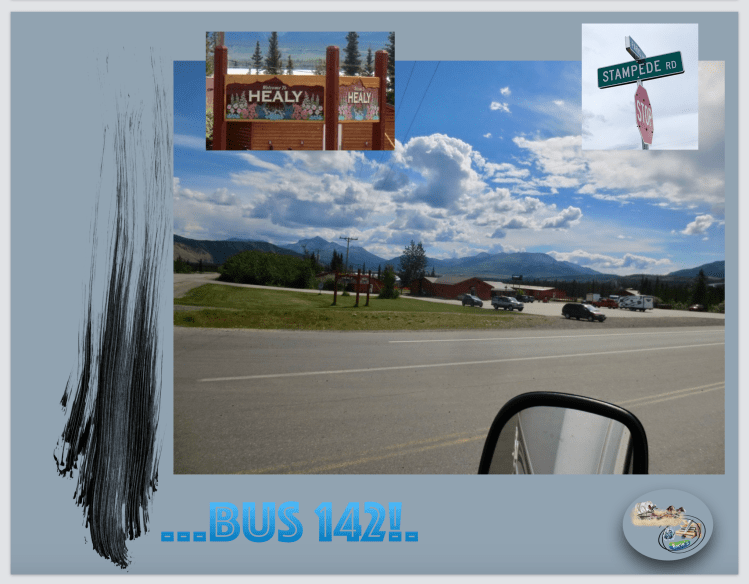
…a sua viajem para o norte começou no ano de 1992 e, para chegar ao Parque Nacional de Denali, no Alaska, pelo menos desde o estado de Dakota do Sul, ia pedindo boleia, parando aqui e ali, até que chegou à cidade de Fairbanks!. Aqui, saindo da cidade, conseguiu uma última boleia de uma pessoa gentil, até ao início da pista acidentada de Stampede Trail, nos arredores da pequena cidade de Healy, (onde também já acampámos), onde foi visto pela última vez com vida!.
(…his journey to the north began in 1992 and, to reach Denali National Park, Alaska, at least from the state of South Dakota, he hitchhiked, stopping here and there, until he arrived in the city of Fairbanks!. Here, leaving the city, he got a last ride from a kind person, until the beginning of the rugged trail of Stampede Trail, on the outskirts of the small town of Healy, (where we also camped), where he was last seen alive)!.
…essa gentil pessoa disse mais tarde que estava seriamente preocupada com a segurança do Chris, depois de notar que a sua mochila era leve, com equipamento mínimo, rações escassas e óbvia falta de experiência, dizendo ter profundas dúvidas sobre a capacidade de Chris sobreviver à selva áspera e implacável do Alaska, tentando persuadi-lo para atrasar a viagem, oferecendo-lhe até um desvio para a cidade de Anchorage e comprar-lhe equipamentos e suprimentos adequados!.
(…that kind person later said that he was seriously concerned for Chris’s safety, after noting that his backpack was light, with minimal equipment, meager rations and an obvious lack of experience, saying he had deep doubts about Chris’s ability to survive the Alaska’s rugged and relentless jungle, trying to persuade you to delay the trip, even offering you a detour to Anchorage and buying you the right equipment and supplies)!.
…infelizmente, Chris ignorou todos os avisos e recusou todas as ofertas de ajuda, apenas concordou em usar umas botas de borracha antes de partir!. Esta gentil pessoa, infelizmente foi a última a ver Chris vivo e, enquanto este jovem aspirante a explorador descia o caminho da floresta coberta de neve, com o nome de Stampede Trail, é que verificou que Chris havia deixado o seu único mapa e o relógio no seu veículo, mas já era tarde demais!. Ele já tinha desaparecido na floresta, no entanto, antes de partir, Chris pediu-lhe que tirasse uma foto dele com a sua câmera!.
(…unfortunately, Chris ignored all the warnings and refused all offers of help, just agreed to wear some rubber boots before he left!. This kind person, unfortunately, was the last to see Chris alive and, while this young aspiring explorer was walking down the snow-covered forest path, named Stampede Trail, he found that Chris had left his only map and clock in your vehicle, but it was too late!. He had already disappeared in the forest, however, before leaving, Chris asked him to take a picture of him with his camera)!.
…caminhando por esta trilha coberta de neve, Chris encontrou o hoje famoso autocarro 142 do sistema de transporte da cidade de Fairbanks, abandonado, onde montou o seu acampamento, não demorando muito para que se instalasse, pois não levava nenhum tipo de barraca ou material de acampar e, provavelmente foi um alívio para si quando encontrou este tipo de abrigo!.
(…walking along this snow-covered trail, Chris found the now famous bus 142 of the transport system of the city of Fairbanks, abandoned, where he set up his camp, and it didn’t take long for him to set up, as he didn’t carry any type of tent or material. camping and it was probably a relief for you when you found this type of shelter)!.
…e, nas anotações do seu diário, que mais tarde foi encontrado, afirmam que Chris planejava caminhar ao longo desta trilha até ao Mar de Bering, mas ficou por aqui, apenas com 20 milhas de viagem!. Porquê?. O autocarro 142 agora famoso, estava quase em ruínas, quase totalmente coberto pela neve e pela vegetação e os pneus estavam vazios, todavia isso não importava, pois era um abrigo perfeito!.
(…and, in his diary notes, which was later found, they say that Chris planned to walk along this trail to the Bering Sea, but he stayed here, with only 20 miles of travel! .Because?. Bus 142, now famous, was almost in ruins, almost completely covered by snow and vegetation and the tires were empty, however that did not matter, as it was a perfect shelter)!.
…uma das janelas do autocarro 142 já não existia, tinha sido substituída por um pedaço de madeira, onde Chris escreveu uma nota sobre como ele finalmente estava livre das correntes do resto do mundo e como “depois de dois anos errantes”, ele estava prestes a começar “a última e maior aventura”, terminando com as palavras “na selva”!.
(…one of the windows of bus 142 no longer existed, it had been replaced by a piece of wood, where Chris wrote a note about how he was finally free from the chains of the rest of the world and how “after two wandering years”, he was about to beginning “the last and greatest adventure”, ending with the words “in the jungle”)!.
…manteve o seu diário detalhado, contando a sua jornada na selva, querendo tentar sobreviver fora da civilização, o que significa que levou com ele apenas 10 libras de arroz, um pequeno rifle de caça, várias caixas de cartuchos, uma câmera e uma pequena selecção de material de leitura, incluindo um guia de plantas comestíveis da região!.
(…kept his detailed diary, telling his journey in the jungle, wanting to try to survive outside civilization, which means he took with him just 10 pounds of rice, a small hunting rifle, several boxes of cartridges, a camera and a small selection of reading material, including a guide to edible plants from the region)!.
…passando 16 semanas aprendendo como viver da terra, todavia, não conseguiu encontrar muita comida!. Conseguiu capturar alguns porcos-espinhos, esquilos e gansos canadienses, mas um grande alce que ele caçou, apodreceu antes que ele pudesse comer a sua carne!. Assim, as coisas tomaram um rumo ainda mais trágico à medida que ele continuou a documentar todas as emoções e aspectos da sua odisséia!.
(…spending 16 weeks learning how to live off the land, however, he couldn’t find much food!. He managed to catch some porcupines, squirrels and Canadian geese, but a large moose that he hunted, rotted before he could eat his meat!. Thus, things took an even more tragic turn as he continued to document all the emotions and aspects of his odyssey)!.
…apenas dois meses depois de ir para a selva já queria voltar para casa!. Infelizmente, não tinha ideia de como voltar. Tentou sair do parque nacional enquanto arrumava as suas coisas e caminhava de volta ao rio Teklanika, no entanto, havia um problema!. O rio não era mais o riacho gotejante quando ele cruzou a água pela primeira vez, mas agora, a neve derretida e o gelo descongelado significavam que tinha mais de 25 metros de largura e a água estava fora de controle!.
(…just two months after going to the jungle he already wanted to go home!. Unfortunately, he had no idea how to get back. He tried to leave the national park while packing up and walking back to the Teklanika river, however, there was a problem!. The river was no longer the trickling stream when it first crossed the water, but now, melted snow and thawed ice meant it was over 25 meters wide and the water was out of control)!.
…não teve outra escolha a não ser voltar para o autocarro 142 e esperar, porque o rio Teklanika estava no seu caminho e, enquanto tentava prosseguir na sua jornada a água turbulenta tornou impossível a sua travessia, mesmo que ele estivesse acostumado a tentar qualquer coisa, sabia que não conseguiria chegar ao outro lado!.
(…he had no choice but to return to bus 142 and wait, because the Teklanika river was in his way and, while trying to continue on his journey the turbulent water made it impossible to cross, even though he was used to trying anything, I knew I couldn’t get to the other side)!.
…escreveu que estava “Solitário, com medo”, no entanto, se ele tivesse o mapa ou se estivesse mais preparado para esta aventura, poderia ter percebido que haviam várias cabanas na área que continham alimentos, equipamentos de sobrevivência e até a existência de um teleférico abandonado, operado manualmente, a 1⁄2 milha (800 m) a jusante de onde ele havia cruzado o rio anteriormente, que talvez teriam sido suficientes para salvar a sua vida!.
(…wrote that he was “Lonely, scared”, however, if he had the map or was more prepared for this adventure, he could have realized that there were several huts in the area that contained food, survival equipment and even the existence of a abandoned cable car, operated manually, 1⁄2 mile (800 m) downstream from where he had crossed the river previously, which perhaps would have been enough to save his life)!.
…no seu diário explicava como lidava com o facto de ficar preso na neve, ficando mais fraco a cada dia e as suas muitas tentativas de sobrevivência, porque quando esqueceu o seu mapa, significava que não tinha ideia de que a ajuda estava mais perto do que ele percebia e, as últimas páginas do diário foram as que documentaram o quão desesperado ele estava por ajuda!.
(…in his diary he explained how he dealt with being trapped in the snow, getting weaker every day and his many attempts at survival, because when he forgot his map, it meant he had no idea that help was closer to him. that he noticed and, the last pages of the diary were the ones that documented how desperate he was for help)!.
…estava usando mais energia do que comia, o que significava que continuava a ficar mais fraco a cada dia que passava!. As suas anotações no diário ficavam mais curtas e trágicas e a sua última entrada escrita foi no 107º dia onde ainda conseguiu escrever “Beautiful Blueberries” (Mirtilos lindos)!. Daí até ao 113º dia, Chris não escreveu mais nada para cada dia!.
(…he was using more energy than he ate, which meant that he continued to get weaker with each passing day!. His diary entries became shorter and more tragic and his last entry was on the 107th day where he still managed to write “Beautiful Blueberries”! From then until the 113th day, Chris did not write anything else for each day)!.
…no entanto acredita-se que perto da hora da sua morte, tirou uma foto de si mesmo acenando enquanto segurava uma nota escrita, que dizia: TIVE UMA VIDA FELIZ E AGRADEÇO AO SENHOR!. ADEUS E QUE DEUS ABENÇOE A TODOS!.
(…however it is believed that near the time of his death, he took a picture of himself waving while holding a written note, which said: I HAD A HAPPY LIFE AND I THANK YOU!. GOODBYE AND GOD BLESS ALL)!.
…tudo isto até que um grupo de caçadores que procurava abrigo para passar a noite encontrou o hoje famoso autocarro 142, onde Chris estava hospedado e, ao entrarem, sentiram o cheiro do que pensaram ser comida podre e descobriram “um caroço” mum velho saco de dormir na parte de trás do autocarro, contactaram a polícia, que chegou no dia seguinte, verificando que eram os restos em decomposição do jovem Chris!. Já lá iam 132 dias após o início da jornada do Chris!.
(…all this until a group of hunters looking for shelter to spend the night found the now famous bus 142, where Chris was staying and, when they entered, they smelled what they thought was rotten food and discovered “a lump” in an old sack sleeping in the back of the bus, they contacted the police, who arrived the next day, checking that it was the decomposing remains of young Chris!. It was already 132 days after Chris journey began)!.
…muitas pessoas tentaram descobrir o que fez Chris perder a vida!. Durante anos, as pessoas presumiram que tinha ficado sem comida e simplesmente morrido de fome, no entanto, alguns acreditam que Chris comeu sementes venenosas que causariam muitos danos a uma pessoa, todavia, tragicamente Chris estava incrivelmente fraco e poderia ter comido as sementes como uma última tentativa de sobreviver!.
(…many people tried to find out what made Chris lose his life!. For years, people assumed that he had run out of food and simply starved to death, however, some believe that Chris ate poisonous seeds that would do a lot of damage to a person, however, tragically Chris was incredibly weak and could have eaten the seeds as a last attempt to survive)!.
…Chris tirou dezenas de fotos ao longo da sua aventura, tirou muitos auto-retratos e fotos de paisagens que mostram tragicamente como ficou fraco no final da sua jornada, mostrando que o seu corpo estava literalmente definhando, mas apesar de tudo o que ele estava lutando, ainda tinha um grande sorriso no rosto em cada uma das fotos!.
(…Chris took dozens of pictures throughout his adventure, took lots of self-portraits and pictures of landscapes that tragically show how weak he was at the end of his journey, showing that his body was literally withering, but despite everything he was struggling, still had a big smile on his face in each of the photos)!.
…já se passaram quase 30 anos desde que Chris embarcou na sua jornada, no entanto, o mundo nunca esquecerá o legado e o fenômeno cultural que Chris deixou no seu rastro, quando ainda um jovem decidiu viajar para o deserto do Alaska, nunca mais voltando a sua casa!. Porquê?. Porque era ambicioso e queria fazer tudo sozinho, insistindo em fazer a viagem sem ninguém ao seu lado e, a história diz-nos que, juntos, é mais fácil vencer!.
(…almost 30 years have passed since Chris embarked on his journey, however, the world will never forget the legacy and cultural phenomenon that Chris left in his wake, when still a young man decided to travel to the Alaska desert, never to return your house!. Because?. Because he was ambitious and wanted to do everything himself, insisting on making the trip without anyone by his side, and history tells us that together, it is easier to win)!
…o autocarro 142, onde o Chris viveu e morreu, tornou-se num destino conhecido para caminhantes, com o nome de “Magic Bus”!. É um 1946 International Harvester, que foi abandonado pelos trabalhadores da estrada em 1961, na hoje também famosa “Stampede Trail” e, a vida do jovem Chris, tornou-se num assunto de uma série de artigos, livros, filmes e documentários que ajudaram a elevar a sua vida ao status de um mito moderno, tornando-se numa figura romântica para alguns, talvez inspirados pelo que vêem no seu idealismo de espírito livre, mas para outros, é uma figura controversa e algo equivocada!.
(…bus 142, where Chris lived and died, has become a popular destination for walkers, with the name “Magic Bus”!. It is a 1946 International Harvester, which was abandoned by road workers in 1961, on the now also famous “Stampede Trail” and, the life of young Chris, became the subject of a series of articles, books, films and documentaries that helped to raise his life to the status of a modern myth, becoming a romantic figure for some, perhaps inspired by what they see in his free spirit idealism, but for others, he is a controversial figure and something wrong)!.
…o exemplo de toda esta aventura é que, o agora famoso autocarro 142, se tornou o centro das atenções de muitas pessoas, (incluindo nós) que desejavam recriar a jornada do Chris, mas infelizmente os perigos que ele enfrentou eram reais, e muitos deles ainda são um problema até hoje!. Os residentes locais costumam se referir às pessoas que viajam para o local onde estava o famoso autocarro 142, como “peregrinos”!.
(…the example of this whole adventure is that, the now famous bus 142, became the center of attention for many people (including us) who wanted to recreate Chris’ journey, but unfortunately the dangers he faced were real, and many of them are still a problem today!. Local residents often refer to people traveling to the place where the famous bus 142 was located, as “pilgrims”)!.
…encontrámos o exemplo de um jovem casal que, inspirados pela verdadeira história da busca implacável do Chris pela liberdade e aventura, num mês de Abril, portanto com neve, caminharam pela Stampede Trail até ao “Mágico Bus” e escreveram que:
(…we found the example of a young couple who, inspired by the true story of Chris’s relentless search for freedom and adventure, in April, therefore with snow, walked the Stampede Trail to the “Mágico Bus” and wrote that:)
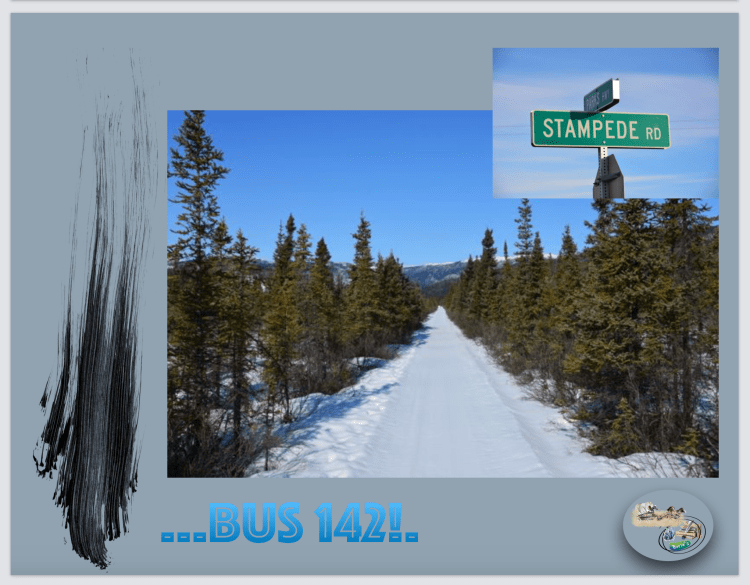
…”a trilha não era uma rota única, na verdade, havia várias trilhas passando por entre as árvores e podemos ver que algumas haviam sido usadas recentemente por condutores de cães e motos de neve!. O tempo estava claro e calmo, mas ainda tão frio que não conseguíamos ficar parados por muito tempo e a neve seca e crocante rangia sob os pés!.
(…”the trail was not a single route, in fact, there were several trails going through the trees and we can see that some had been used recently by dog and snowmobile drivers !. The weather was clear and calm, but still so cold that we couldn’t stand still for a long time and the dry, crunchy snow creaked underfoot)!.
…havia uma vasta planície aberta dentro de um vale de montanhas cobertas de neve, apenas se podendo distinguir o formidável pico do Monte McKinley ao fundo!. Cruzámos o rio Teklanika, que ainda estava totalmente congelado em ambas as direções!. Parecia que estávamos caminhando há anos, portanto o “Mágic Bus”, certamente não poderia estar muito longe, mas de acordo com o mapa, ainda ficava a uma distância mais distante, e claro, nesta área remota do Alaska, sentimos uma ansiedade nervosa enquanto fazíamos uma curva e, finalmente avistamos o “Mágic Bus”!.
(…there was a vast open plain within a snow-capped mountain valley, only the formidable peak of Mount McKinley in the background! We crossed the Teklanika River, which was still totally frozen in both directions! It felt like we had been walking for years, so the “Magic Bus” certainly couldn’t be very far away, but according to the map, it was still a farther distance away, and of course, in this remote area of Alaska, we felt nervous anxiety while we made a turn and, finally, we saw the “Magic Bus”)!.
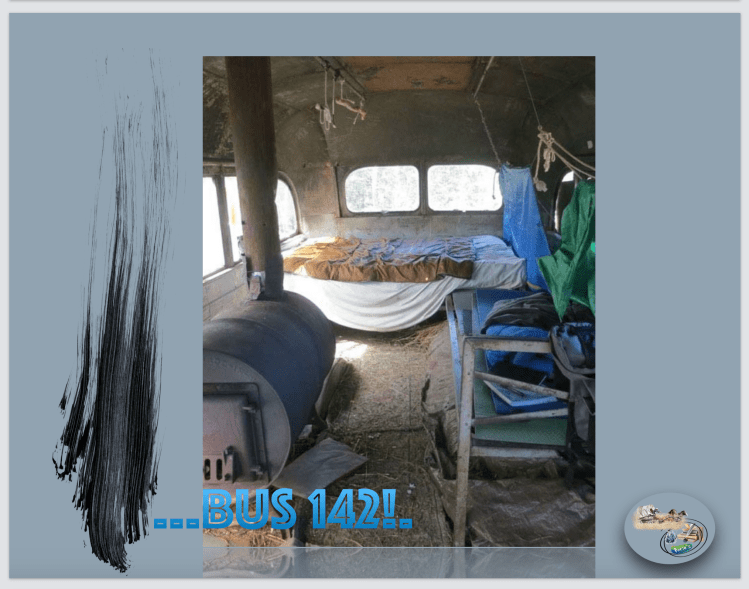
…a primeira reação foi de espanto, seguido por um pouco de tristeza com o estado do “Magic Bus”!. Estava cheio de centenas de buracos de bala e várias das janelas tinham sido destruídas!. Fizemos uma verificação rápida para nos certificarmos de que não havia ursos ou outros animais dormindo lá dentro!. Apesar do seu estado de degradação sentimos a história que nos rodeava e, também apesar de termos uma barraca, de jeito nenhum passaríamos outra noite na barraca, quando poderíamos estar dentro do “Magic Bus” com o fogo rugindo, mesmo se esta fosse a mesma cama em que o Chris havia falecido!.
(…the first reaction was astonishment, followed by a little sadness at the state of the “Magic Bus” !. It was filled with hundreds of bullet holes and several of the windows had been destroyed! We did a quick check to make sure there were no bears or other animals sleeping in there !. Despite its state of degradation, we felt the history that surrounded us and, even though we had a tent, there was no way we would spend another night in the tent, when we could be inside the “Magic Bus” with the fire roaring, even if it was the same bed in which Chris had passed away)!.
…lá, vimos sinais das pessoas que visitaram este local por toda parte, desde nomes escritos em preto em todas as paredes até a quantidade de comida que foi deixada para trás para garantir que ninguém mais passasse fome ali!. Havia vários diários de bordo onde as pessoas expressavam os seus pensamentos sobre Chris e sua história, bem como compartilharam a sua própria história de como chegaram ali!. Muitos falaram sobre seus problemas para cruzar o rio Teklanika, enquanto outros vieram em motos de neve, quadriciclos, jangadas ou até bicicletas de montanha”!.
(…there, we saw signs of people who visited this place everywhere, from names written in black on all the walls to the amount of food that was left behind to ensure that no one else went hungry there !. There were several logbooks where people expressed their thoughts about Chris and his story, as well as sharing their own story of how they got there !. Many talked about their problems crossing the Teklanika River, while others came on snowmobiles, ATVs, rafts or even mountain bikes”)!.
…tentando chegar ao local, pelo menos 15 pessoas tiveram que ser resgatadas, e pelo menos duas pessoas morreram ao tentar atravessar o Rio Teklanika e, a informação pública do parque nacional, diz que policias estaduais, o corpo de bombeiros e os guardas-florestais são chamados para tentar resgatar caminhantes presos a cada ano, e as tropas estaduais do Alaska ainda acreditam que 75% dos seus resgates ocorrem na Stampede Trail!.
(…trying to reach the site, at least 15 people had to be rescued, and at least two people died while trying to cross the Teklanika River and, the national park’s public information, says state police, the fire department and the rangers they are called on to try to rescue trapped hikers each year, and Alaska state troops still believe that 75% of their rescues occur on the Stampede Trail)!.
…e, como no princípio escrevemos, “o hoje famoso autocarro 142 foi transferido em Junho de 2020 para tentar impedir as pessoas de se colocarem em perigo!. Foi retirado da trilha Stampede por um helicóptero CH-47 Chinook e levado até ao Museu do Alaska, para que todos possam ver e aproveitar o famoso autocarro com segurança!. Agora, pode ser que menos pessoas estejam tentando a caminhada por si mesmas ou que estejam mais preparadas para os perigos que se avizinham”!.
(…and, as we wrote in the beginning, “the now famous bus 142 was transferred in June 2020 to try to prevent people from putting themselves in danger !. It was removed from the Stampede trail by a CH-47 Chinook helicopter and taken to the Alaska Museum, so that everyone can safely see and enjoy the famous bus !. Now, it may be that fewer people are trying to walk on their own or are more prepared for the dangers ahead ”)!.
…e, o Museu do Norte da Universidade do Alaska (Fairbanks) anunciou que, o que se tornou a casa permanente de Chris, com o nome de “Magic Bus 142”, será restaurado e uma exposição ao ar livre será criada!.
(…and the Museum of the North of the University of Alaska (Fairbanks) has announced that what has become Chris’s permanent home under the name “Magic Bus 142” will be restored and an outdoor exhibition will be created)!.
…isto são curiosidades do Alaska, a última fronteira!.
(…these are curiosities of Alaska, the last frontier)!.
Tony Borie, Século XXI. (Tony Borie, 21st Century).
…vamos escrevendo, porque na escrita encontramos as emoções do sentir!. Talvez como os pássaros que voam na escuridão ou mesmo aquelas flores que crescem no entulho e quase não se vêem, e também quase ninguém repara, mas ambos existem, tal como nós, que entre outras coisas, ainda nos vamos lembrando dos caminhos da vida que fomos percorrendo por alguns continentes, regiões ou lugares antes desconhecidos e, nos sentimos uns previlegiados em contar estas memórias, claro, sempre na expectativa que possam ser úteis, sobretudo para os vindouros!.
(…let’s write, because in writing we find the emotions of feeling!. Perhaps like the birds that fly in the darkness or even those flowers that grow in the rubble and hardly see each other, and almost nobody notices, but both exist, just like us, that among other things, we are still remembering the paths of life that we have traveled through some continents, regions or places previously unknown and, we feel privileged to tell these memories, of course, always in the expectation that they may be useful, especially for those to come)!.
…assim, vamos à história de hoje!. Em alguns momentos da nossa já longa existência, sentimos muitas saudades da nossa gente, da nossa aldeia quase mediaval do século passado, naquela encosta agreste da montanha do Caramulo, onde a natureza era tão simples, onde se nascia sem trazer nada, morrendo sem levar nada e, no meio ninguém brigava por algo, porque sabiam que também não levavam nada!.
(…so, let’s go to today’s story!. In some moments of our long existence, we miss our people, our almost mediaval village of the last century, on that rough slope of the Caramulo mountain, where nature was so simple, where you were born without bringing anything, dying without taking nothing and, in the middle nobody fought for something, because they knew they didn’t take anything either)!.
…era uma vida tão simples, que não se sentia a dificuldade que era andar descalço e com pouca roupa no corpo, calcando o gelo da montanha ou tomando banho nú no riacho de água pura que corria ao fundo do vale!. A maioria de nós, o povo, vivíamos do campo e do que ele nos dava!. Era uma agricultura artezanal de sobrevivência, que também ajudava à criação de algum gado, trabalhando desde muito cedo até tarde, talvez umas 15 ou 16 horas por dia!.
(…it was such a simple life, that one did not feel the difficulty of walking barefoot and with little clothes on the body, treading the mountain ice or taking a naked bath in the stream of pure water that ran at the bottom of the valley!. Most of us, the people, lived on the countryside and what he gave us!. It was an artisanal agriculture of survival, which also helped to raise some cattle, working from very early to late, maybe 15 or 16 hours a day)!.
…vivíamos em comunidade!. Se uma família tinha fartura, todas tinham fartura, se o tempo não era favorável à agricultura e havia fome, todas tinham fome!. A alimentação era pobre, consistindo naquilo que se produzia, sendo o pão de milho a sua base principal e, para além da sopa, às vezes uma sardinha ou carne de porco salgada, mas difícilmente se comia carne!. As azeitonas, pão de trigo ou centeio, tal como queijos frescos, era um petisco sazonal e raro, no entanto havia alguma fartura em legumes, mas o arroz, açucar, manteiga café ou até bacalhau, eram escassos, porque havia que os comprar e dinheiro, não havia!.
(…we lived in community!. If a family was abundant, everyone was abundant, if the weather was not favorable to agriculture and there was hunger, everyone was hungry !. The food was poor, consisting of what was produced, corn bread being its main base and, in addition to the soup, sometimes a sardine or salted pork, but it was difficult to eat meat !. Olives, wheat or rye bread, as well as fresh cheeses, were a rare and seasonal snack, however there was some abundance in vegetables, but rice, sugar, butter, coffee or even cod, were scarce, because they had to be bought and money, there was no)!.
…o vestuário variava conforme o clima e o trabalho, mas normalmente, era usado repetidas vezes, remendando-se até já não ser possível mais a sua utilização!. Tal como a habitação que era pobre, sendo a cozinha a principal divisão da casa, onde havia uma grande lareira em frente à boca do forno com uma trempe ou uma “panela de três pernas”, que cozinhava tanto para nós como para os animais!.
(…the clothing varied according to the climate and the work, but normally, it was used repeatedly, mending until it was no longer possible to use it!. Just like the poor house, the kitchen being the main room in the house, where there was a big fireplace in front of the oven with a trivet or a “three legged pan”, which cooked both for us and for the animals)!.
…claro, tudo isto na nossa classe pobre, porque naquele tempo, nas vilas ou cidades, a burguesia e a nobreza eram ricas, formando uma classe influente, alguma ligada ao comércio ou ocupando cargos no governo, vivendo em casas luxuosas ou em palácios e, normalmente faziam 4 ou 5 refeições por dia, servidas por pessoas quase escravizadas do povo, que saindo da miséria que viviam em casa dos seus pais nas aldeias, para lá iam servi-los, só pelo comer e vestir, que era os restos daquilo que lhes crescia e, no lugar de ir parar ao lixo, alimentava e vestia estas pessoas a quem a sorte não sorriu!.
(…of course, all this in our poor class, because at that time, in the towns or cities, the bourgeoisie and the nobility were wealthy, forming an influential class, some linked to commerce or occupying government positions, living in luxurious houses or in palaces and , usually ate 4 or 5 meals a day, served by people almost enslaved by the people, who, coming out of the misery that lived in their parents’ house in the villages, went there to serve them, just by eating and dressing, which was the remains of that that grew up and, instead of going to waste, fed and dressed these people whose luck did not smile)!.
…no entanto, havia alguns com alguma ambição que saiam das aldeias e, vinham para as vilas ou cidades com a intenção de melhorar o seu estilo de vida ou talvez proporcionar melhor educação aos seus filhos!. Esses, desempenhavam a maior parte das actividades rudes mas necessárias, que quase ninguém queria fazer, como aguadeiros, operários, lavadeiras, limpa chaminés, jardineiros ou vendedores ambulantes!. A sua vida, apesar de algumas melhorias, continuava a ser dura, vivendo em casas ou casebres pequenas nos arrabaldes, velhas e húmidas, sem iluminação, esgotos ou água canalizada, com uma alimentação também pobre, pouco variada e comida quase sempre fora de horas!.
(…however, there were some with some ambition who left the villages and came to the towns or cities with the intention of improving their lifestyle or perhaps providing a better education for their children !. These, performed most of the rude but necessary activities, which almost nobody wanted to do, such as watermongers, workers, washerwomen, chimney sweeps, gardeners or street vendors !. Her life, despite some improvements, continued to be harsh, living in small houses or huts on the outskirts, old and humid, without lighting, sewers or running water, with a poor diet, little variety and food almost always out of hours.)!.
…alguns destes, sendo tarefeiros no porto naval da capital Lisboa, refugiando-se em navios que saíam para o Brazil, embora sendo do povo, sabe-se lá como, fizeram fortuna, regressando a Portugal tentando imitar o estilo de vida da classe burguesa, construindo palácios, vivendo e trajando “à grande e à francesa”, porque era norma também, o seu vestuário reflectir a sua riqueza!. Era frequente, quando se passava por uma casa nova, grande e com aspecto mais bonito, dizer-se: “é de algum Brazileiro”!.
(…some of these, being laborers in the naval port of the capital Lisbon, taking refuge in ships leaving for Brazil, although belonging to the people, who knows how, they made a fortune, returning to Portugal trying to imitate the lifestyle of the bourgeois class , building palaces, living and dressing “to the great and the French”, because it was also the norm, their clothing to reflect their wealth !. It was frequent, when passing by a new house, large and with a more beautiful aspect, to say: “it belongs to some Braziler”)!.
…tudo isto foram bocados das nossas raízes, da nossa juventude, que nos fizeram compreender o bem sobre o mal, tempos de alguma repressão aos pobres e, quando havia crises, eram enormes que, tal como já o escrevemos por diversas vezes, aliadas ao recrutamente obrigatório para integrar contingentes para a guerra colonial em África, quando apareciam doenças, a taxa de mortalidade era grande, pois no seio das famílias, num mundo rural empobrecido, o acesso a roupa nova e limpa ou medicinas de manutenção, era muito difícil, tal como a higiene corporal tornava-se num ritual ocasional e não uma prática regular!.
(…all these were pieces of our roots, of our youth, that made us understand the good about the evil, times of some repression to the poor and, when there were crises, they were enormous that, as we have written it several times, allied recruiting mandatory to integrate contingents for the colonial war in Africa, when diseases appeared, the mortality rate was high, because within families, in an impoverished rural world, access to new and clean clothes or maintenance medicines was very difficult, just as body hygiene became an occasional ritual and not a regular practice)!.
Tony Borie, Século XXI. (Tony Borie, 21st Century).
…consideramo-nos uns previlégiados!. Porquê?. Porque entre outras peripécias, somos sobreviventes de uma mortífera guerra de guerrilha nas savanas e pântanos de África, quase atingimos as oito dezenas de anos de vida e, quase sempre rodeados de uma dedicada família, assim como amigos, considerados também quase como família, vivendo como sendo uma pessoa que nunca andou em busca do que é supérfluo e também nunca ambicionou acumular coisas e bens!.
(…we consider ourselves to be privileged!. Because?. Because among other adventures, we are survivors of a deadly guerrilla war in the savannas and swamps of Africa, we have almost reached the eight dozen years of life and, almost always surrounded by a dedicated family, as well as friends, also considered almost as family, living as being a person who has never been in search of what is superfluous and also never aspired to accumulate things and goods)!.
…somos assim, nascemos assim!. Valorizamos o nosso espaço, apreciamos o contexto de vida e sabemos que ela está entrelaçada com o tempo, desde quando nascemos até aos dias em que se vive!. Como tal, achamos que a vida deve ser vivida sem ilusões do absurdo, que é quando uma pessoa começa a ser consumida pelo suicídio, entre outras, pelo consumismo desenfreado que por aí existe, não valorizando e respeitando, sobretudo a natureza e as pessoas, talvez em busca de uma vida desarraigada, sem valorizar verdadeiramente, tudo que se conseguiu com trabalho e honestidade!.
(…we are like this, we were born like this!. We value our space, appreciate the context of life and know that it is intertwined with time, from when we were born until the days we live!. As such, we think that life should be lived without illusions of the absurd, which is when a person begins to be consumed by suicide, among others, by the rampant consumerism that exists there, not valuing and respecting, especially nature and people, perhaps in search of an uprooted life, without truly valuing, everything that was achieved with work and honesty)!.
…já chega de blá, blá, blá, vamos à história de hoje, onde falamos da Flórida e das suas praias, porque por aqui não é só “Hurricanes” e Disney”!.
(…enough blah, blah, blah, let’s go to today’s story, where we talk about Florida and its beaches, because here it is not just “Hurricanes” and “Disney”)!.
…empoleiradas no Golfo do México, as praias de Clearwater e Sandy Key, são o lar de algumas das praias mais pitorescas da Flórida, com uma costa de areia macia e branca, que as classifica como um destino ideal não só para nós pessoas idosas, como para quem procura um dia tranquilo de banhos em águas rasas, límpidas e azuis com ondas suaves, onde se podem observar os golfinhos saltando da água, mesmo ali na nossa frente!.
(…perched on the Gulf of Mexico, the beaches of Clearwater and Sandy Key are home to some of Florida’s most picturesque beaches, with a soft white sand coastline, which makes them an ideal destination not only for us people elderly, as for those looking for a quiet day of bathing in shallow, clear, blue waters with gentle waves, where dolphins can be seen jumping from the water, right there in front of us)!.
…acima escrevemos que somos uns previlégiados!. Pois umas das razões dessa frase é que dentro dos nossos amigos mais chegados, está o casal Natércia e o Jorge, que aqui têm residência de verão, e que periódicamente nos estendem convite para visitas de convívio, tornando-nos a nós, simples e comuns sobreviventes deste mundo, viver por alguns períodos com o rótulo de “cinco estrelas”!.
(…above we write that we are privileged!. Because one of the reasons for this phrase is that within our closest friends, there are the couple Natércia and Jorge, who have a summer residence here, and who periodically extend us an invitation to socializing visits, making us simple and common. survivors of this world, live for some periods with the label of “five stars”)!.
…fazendo-nos ser uns previlegiados caçadores de emoções que, caminhando por aqui ao longo da praia, entrando na água aqui e ali, ou quando nos levam um pouco para o norte, até dois refúgios num litoral quase intocado, que são a Ilha Caladesi e Ilha Lua de Mel, designados como parques estaduais, tornando-os num local perfeito para explorar florestas antigas de pinheiros, caminhando pela costa arenosa imaculada ou encontrar pássaros, répteis e mamíferos nativos da costa da Flórida, passando por labirintos selvagens de manguezais!.
(…making us a privileged thrill seekers who, walking here along the beach, entering the water here and there, or when they take us a little north, up to two refuges on an almost untouched coastline, which are the Caladesi Island and Honeymoon Island, designated as state parks, making them a perfect place to explore ancient pine forests, walk along the pristine sandy coast or encounter birds, reptiles and mammals native to the Florida coast, through wild mangrove mazes)!.
…às vezes, estes queridos amigos, também nos levam para uma experiência verdadeiramente única, até Tarpon Springs, a capital mundial da esponja, onde existe a maior concentração de greco-americanos do país, apreciando os laços históricos da cidade com a indústria de esponjas que é a sua principal atração, e claro, visitar os diversos restaurantes que por aqui existem, para saborear “saganaki” flamejante, e uma grande variedade de outros pratos mediterrâneos!.
(…sometimes, these dear friends, also take us for a truly unique experience, to Tarpon Springs, the sponge capital of the world, where there is the largest concentration of Greek Americans in the country, enjoying the city’s historic ties with the sponge industry which is its main attraction, and of course, visit the various restaurants that exist here, to taste flaming “saganaki”, and a wide variety of other Mediterranean dishes)!.
…e, em Sandy Key, que além de ser um paraíso imaculado e tranquilo fora da agitação de Clearwater, com uma bela praia de areia branca, e é onde as tartarugas marinhas ameaçadas de extinção frequentemente põem ovos e onde nós visitantes observamos pássaros exóticos, alguns também ameaçados de extinção, fazendo ninhos ou se alimentando num raro pântano de sal!.
(…and on Sandy Key, which in addition to being an immaculate and peaceful haven outside of the hustle and bustle of Clearwater, with a beautiful white sand beach, is where endangered sea turtles often lay eggs and where we visitors watch exotic birds some also threatened with extinction, making nests or feeding in a rare salt marsh)!.
…e claro, o Trolley (veículo de transporte público), passa todos os trinta minutos, mas como adoramos caminhadas, por vezes atravessamos a ponte de Sandy Key, que se eleva a cerca de 65 pés de altura, mostrando-nos uma linda vista do Golfo do México, bem como o horizonte do centro de Clearwater e da sua praia, onde as nossas escolhas não terminam quando o sol se põe, que só por si é um espectáculo!.
(…and of course, the Trolley (public transport vehicle), passes every thirty minutes, but as we love hiking, we sometimes cross the Sandy Key bridge, which rises to about 65 feet in height, showing us a beautiful view the Gulf of Mexico, as well as the skyline of downtown Clearwater and its beach, where our choices do not end when the sun goes down, which in itself is a spectacle)!.
…porque ao fim da tarde, podemos assistir à chegada do “folclore” dos barcos de pesca à doca com a respectiva descarga do peixe e, à noite abre um pequeno festival na Pier 60 e nas passadeiras que dão ascesso à praia, com pequenas lojas de artesões e artistas de rua, que nos divertem com as suas habilidades e acrobacias, assim como filmes ao ar livre!.
(…because at the end of the afternoon, we can watch the “folklore” of the fishing boats arrive at the dock with the respective fish unloading, and in the evening a small festival opens on Pier 60 and on the walkways leading to the beach, with small shops of artisans and street artists, who amuse us with their skills and acrobatics, as well as outdoor films)!.
…sempre que visitamos a Natércia e o Jorge, estes queridos amigos de longa data, trazemos recordações e experiências que são difíceis de esquecer!. A maneira gentil com nos recebem, e claro, da paragem quase sempre obrigatória, que é o restaurante de praia, Frenchy’s Saltwater Café, onde às vezes é difícil conseguir uma mesa antes do pôr do sol, para apreciar uma vista incrível e pedir uma sopa She Crab, Rocktapus, Grouper Nuggets ou uma sanduíche de garoupa do golfo, (a garoupa é um alimento básico local), onde servem 6 tipos diferentes, e às vezes até podemos desfrutar de música ao vivo por artistas locais saboreando a “cerveja da semana”!.
(…whenever we visit Natércia and Jorge, these dear longtime friends, we bring memories and experiences that are hard to forget!. The kind way they receive us, and of course, from the almost always mandatory stop, which is the beach restaurant, Frenchy’s Saltwater Café, where it is sometimes difficult to get a table before sunset, to enjoy an incredible view and order a soup She Crab, Rocktapus, Grouper Nuggets or a gulf grouper sandwich, (the grouper is a local staple), where they serve 6 different types, and sometimes we can even enjoy live music by local artists enjoying the “beer of the week”)!.
…bem hajam Natércia e Jorge, entre outros motivos, pelos bons momentos que sempre nos proporcionam!.
(…well there are Natércia and Jorge, among other reasons, for the good times they always provide us)!.
Tony Borie, Século XXI. (Tony Borie, 21st Century).
…continuamos a viver no meio de uma pandemia onde todos os dias o anjo da morte passa por cima de nós!. Não temos que o temer, porque conscientes de que não existe a vida eterna, continuamos a adorar estar vivos e, talvez seja o momento para pensar-mos no verdadeiro valor da vida!.
(…we continue to live in the middle of a pandemic where the angel of death passes over us every day!. We do not have to fear it, because aware that there is no eternal life, we continue to love being alive and, perhaps it is the time to think about the true value of life)!.
…conscientes, vamos desfrutando e agradecendo por tudo o que temos e que de bom ainda nos vai rodeando!. Em outras palavras, vamos vivendo, tentando ignorar o medo, porque esse maldito medo, faz-nos imaginar o que ainda não aconteceu, e claro, vamos sofrer o dobro!. É preciso relaxar um pouco, apreciar o que temos e sobretudo, viver no presente!.
(…aware, we are enjoying and thanking you for all that we have and that the good is still surrounding us!. In other words, we are living, trying to ignore the fear, because this damn fear, makes us imagine what has not yet happened, and of course, we will suffer twice as much!. We need to relax a little, appreciate what we have and, above all, live in the present)!.
…por exemplo!. Nas nossas normais caminhadas à volta do local onde vivemos, a nossa esposa Isaura, dedicada companheira por mais de cinco décadas, chamou-nos à atenção para um casal de pequeninos e lindos pássaros, que voando em zigue-zagues, vieram pousar num ramo de uma árvore ali mesmo ao nosso lado!.
(…for example!. In our normal walks around the place where we live, our wife Isaura, dedicated companion for more than five decades, drew our attention to a couple of small and beautiful birds, that flying in zigzags, came to land on a branch of a tree right there beside us)!.
…descarados, começaram a dança do acasalamento!. Chegaram mais pássaros, com diferentes cores, num chilriado estridente!. Nunca tínhamos visto pássaros tão lindos!. Porquê?. Porque o céu estava azul, as flores silvestres despontavam aqui e ali, cheirava-se a Primavera!. Era a Primavera que chegava!.
(…brazen, they started the mating dance!. More birds arrived, with different colors, in a high-pitched chirp!. We have never seen birds so beautiful!. Because?. Because the sky was blue, the wild flowers were emerging here and there, we smelled of Spring!. It was spring that was coming)!.
…parámos por momentos, reparando no cenário à nossa volta!. Começámos a ver o que não tínhamos visto antes!. Porquê?. Porque de outras vezes era rotina, os nossos olhos e o nosso pensamento estavam em outro lugar, e agora não!. O pintassilgo, o pardal, o pássaro azul, o vermelho e o amarelado começaram a cantar no ramo daquela pequena árvore, o riacho começou a murmurar e a fragrância de flores que se abriam vieram suavemente com a brisa!.
(…we stopped for a moment, noticing the scenery around us!. We started to see what we hadn’t seen before!. Because?. Because at other times it was routine, our eyes and our thoughts were elsewhere, and not now!. The goldfinch, the sparrow, the blue, the red and the yellowish bird started to sing on the branch of that little tree, the stream started to murmur and the fragrance of flowers that opened came softly with the breeze)!.
…e, as flores levantávam-se do chão, a erva começava a ficar espessa e verde, os pássaros vinham voando com alegria do sul, o calor da nossa respiração recebia o aroma da frescura dos pequenos riachos por onde passávamos, ouvindo a música da natureza que enche os bosques, e claro, parecia-nos que toda a natureza se regozijava!.
(…and, the flowers rose from the ground, the grass started to get thick and green, the birds came flying with joy from the south, the warmth of our breath received the aroma of the freshness of the small streams where we passed, listening to the music of the nature that fills the woods, and of course, it seemed to us that all nature was rejoicing)!.
…era a modesta beleza primaveril, todavia, o vento ainda soprava um pouco frio, pois o sol ainda não estava pronto para lançar os seus raios mais quentes, no entanto, alguns pássaros já tinham vindo e talvez mais estavam a caminho, assim como muitas flores para nós bonitas, (porque não existem flores feias), já se mostravam de modo que, da floresta e daquela árvore, da pequena baía, do campo e das flores, já nos parecia que vinha um grito de alegria, dizendo-nos, ”A primavera está aqui!.
(…it was the modest spring beauty, however, the wind was still blowing a little cold, as the sun was not yet ready to release its hottest rays, however, some birds had already come and perhaps more were on the way, as well as many flowers for us beautiful, (because there are no ugly flowers), already showed themselves so that, from the forest and that tree, the small bay, the field and the flowers, it seemed to us that a cry of joy was coming, telling us, ”Spring is here)!.
Tony Borie, século XXI. (Tony Borie, 21st century).
…vivemos no estado da Flórida mas era simples, mesmo muito simples, porque não era a primeira vez e cremos mesmo que não será a última, que fizémos uma das nossas mais longas viajens!. Viajámos em direcção ao oeste, um pouco antes de começar uma curva para norte, depois outra vez para oeste, mas sempre no sentido norte!.
(…we live in the state of Florida but it was simple, even very simple, because it was not the first time and we really believe it will not be the last, that we made one of our longest trips!. We traveled west, just before starting a north turn, then west again, but always north)!.
…numa aventura, quase como uma “expedição”, de aproximadamente 16.500 milhas, completa com tempestades de chuva, neve, granizo, nevoeiro ou vento forte, viajando em estradas rápidas ou pequenas, com pedras, poeira ou lama, acidentes no seu percurso ou em reparação, desertas ou com um tráfico intenso, inundações, pontes improvisadas em madeira, atravessando rios e riachos, alguns em jangadas!.
(…on an adventure, almost like an “expedition”, of approximately 16,500 miles, complete with rainstorms, snow, hail, fog or strong wind, traveling on fast or small roads, with stones, dust or mud, accidents on your route or under repair, deserted or with heavy traffic, floods, improvised wooden bridges, crossing rivers and streams, some on rafts)!.
…ou às vezes agraciados e aquecidos pela maravilhosa luz do sol que, depois de passar aproximadamente pelo paralelo 43º N, nos beneficia de 16 a 20 horas por dia, às vezes mais e, nos iluminava em algumas das mais belas paisagens do mundo, onde a natureza ainda é pura!. Porque tanto nós como a nossa dedicada esposa Isaura, queremos ser bem-vindos ao mundo!.
(…or sometimes graced and warmed by the wonderful sunlight that, after passing through the parallel 43º N, benefits us from 16 to 20 hours a day, sometimes more and, illuminated us in some of the most beautiful landscapes in the world, where nature is still pure!. Because both we and our dedicated wife Isaura, we want to be welcome to the world)!.
…tudo isto foi passado, dormindo e cozinhando, ou frequentando alguns restaurantes económicos em localidades rurais, usufruindo do conforto limitado da nossa “White Fox” (caravana), enquanto víamos coisas novas, conhecíamos novas pessoas, e claro, também nos divertiamos, porque se fôssemos ficar em casa, teríamos raízes, em vez de pés!.
(…all this was spent, sleeping and cooking, or going to some cheap restaurants in rural locations, enjoying the limited comfort of our “White Fox” (caravan), while we saw new things, we met new people, and of course, we also had fun, because if we were to stay at home, we would have roots instead of feet)!.
…aqui e ali, encontrávamos a aventura pendurada numa corda ao lado duma montanha, dum rio selvagem, numa estrada deserta, dentro de uma tempestade, onde 574.156,74… galões de chuva constante, ou 732.489,24… pés quadrados de neve branca e gelada, nos causavam algumas dificuldades mas, se na verdade queremos saber verdadeiramente quem somos, teremos que viajar até que ninguém saiba o nosso nome!.
(…here and there, we found the adventure hanging on a rope next to a mountain, a wild river, on a deserted road, inside a storm, where 574,156.74 … gallons of constant rain, or 732,489.24 … square feet of icy white snow caused us some difficulties, but if we really want to know who we really are, we will have to travel until no one knows our name)!.
…assim, chegámos ao distante estado do Alaska!. E, sem qualquer dúvida, ver um urso marrom majestoso arrebatando salmão de um qualquer riacho do Alaska, é a memória de uma vida!. Mas, por mais icónicos que sejam esses animais predadores, são apenas o começo das surpresas para nós vindos do sul, que o Alaska tem para nos oferecer, como por exemplo manter os olhos abertos para admirar as águias, ursos negros tímidos, baleias jubarte acrobáticas, e claro, o majestoso alce, o maior membro da família dos cervos!.
(…so, we arrived in the distant state of Alaska!. And without a doubt, seeing a majestic brown bear snatching salmon from some Alaska stream is the memory of a lifetime!. But, as iconic as these predatory animals are, they are only the beginning of the surprises for us coming from the south, that Alaska has to offer us, such as keeping our eyes open to admire the eagles, shy black bears, acrobatic humpback whales , and of course, the majestic moose, the largest member of the deer family)!.
…ou o silêncio da Cordilheira Chugach, ou outras montanhas, numa área ainda selvagem, que são o paraíso de alguns garimpeiros de ouro, (ao qual nos juntámos por algum tempo, encontrando mesmo uns pequenos flocos), que insistem na sua procura, metidos nos ribeiros, com uma pá, um balde e uma bacia, com persistência e um pouco de paciência, tentando a sua chance de encontrar flocos de ouro do Alaska!.
(…or the silence of the Cordillera Chugach, or other mountains, in an area still wild, which are the paradise of some gold miners, (to which we joined for some time, even finding small flakes), who insist on their search, engaged in the streams, with a shovel, a bucket and a bowl, with persistence and a little patience, trying your chance to find Alaska gold flakes)!.
…tudo isto, às vezes observados por ursos pretos, marrons ou polares, também metidos num qualquer riacho cheio de salmão, ou pelas águias empoleiradas numa qualquer árvore, que nos observam a todos, sem perturbar os ursos, nem os garimpeiros, ou mesmo caminhar sobre a cor da neve gelada de um qualquer glaciar, ou rodeados das folhas duma árvore que nasceu ao lado de um rio com água limpa e brilhante, que corre revoltoso em direção ao oceano, como que querendo fugir da terra firme, onde os homens com a desculpa do “progresso, que lhes proporciona a riqueza fácil”, poluiem e destroiem constantemente!.
(…all of this, sometimes observed by black, brown or polar bears, also in a brook full of salmon, or by eagles perched in any tree, who watch us all, without disturbing the bears or the miners, or even walking about the color of the icy snow of any glacier, or surrounded by the leaves of a tree that was born next to a river with clean and shiny water, which runs revolt towards the ocean, as if wanting to escape from the mainland, where men with the excuse of “progress, which provides them with easy wealth”, constantly pollute and destroy)!.
…toda esta beleza natural, nos faz recordar o Alaska para sempre, e claro, em parte continuarmos a receber notícias e seguir o que por lá se passa e, ao consultar-mos a página do Anchorage Daily News, surge a notícia de que o “musher” (condutor de um trenó puxado por cães), Dallas Seavey, oriundo da povoação de Talkeetna (onde também já estivémos), na manhã da passada segunda-feira, fez história ao vencer a corrida “Iditarod” com recorde de tempo, capturando assim o seu quinto campeonato na célebre “Iditarod Trail Sled Dog Race”!.
(…all this natural beauty, reminds us of Alaska forever, and of course, in part we continue to receive news and follow what is going on there, and when we look at the Anchorage Daily News page, the news comes that the “Musher” (dog sled driver), Dallas Seavey, from the village of Talkeetna (where we’ve also been), last Monday morning, made history by winning the “Iditarod” race with record time, thus capturing its fifth championship in the famous “Iditarod Trail Sled Dog Race”)!.
…mais à frente explicam que Dallas Seavey, dirigindo uma equipe de cães de trenó, alcançou a linha de chegada em Deshka Landing, às 5h08, completando a corrida em 7 dias, 14 horas, 8 minutos e 57 segundos e, que a sua família estava entre uma pequena multidão reunida na linha de chegada e ele, sorrindo, talvez escondendo algum sofrimento, percorreu a linha dos seus dedicados cães, acariciando cada um!.
(…further explain that Dallas Seavey, driving a team of sled dogs, reached the finish line at Deshka Landing at 5h08, completing the race in 7 days, 14 hours, 8 minutes and 57 seconds and that his family he was among a small crowd gathered at the finish line and he, smiling, perhaps hiding some suffering, walked the line of his dedicated dogs, petting each one)!.
…depois começou a falar a sério e disse: “desde que ganhei o meu primeiro “Iditarod”, e fui o mais jovem a vencer, as pessoas têm perguntado, oh, você vai conseguir cinco, você vai conseguir cinco”, fazendo em seguida um pequeno resumo do que foram as suas vinte participações nesta corrida, relembrando que é um “musher” de terceira geração que cresceu em Seward, o antigo lar do clã Seavey, pois seu avô Dan chegou lá como professor em 1963 e foi um pioneiro do “Iditarod”, e o seu pai, Mitch, é três vezes campeão do Iditarod!.
(…then he started to be serious and said: “since I won my first “Iditarod”, and I was the youngest to win, people have been asking, oh, are you going to get five, are you going to get five”, doing next a short summary of his twenty appearances in this race, recalling that he is a third generation musher who grew up in Seward, the former home of the Seavey clan, as his grandfather Dan arrived there as a teacher in 1963 and was a pioneer of “Iditarod”, and his father, Mitch, is a three-time Iditarod Champion)!.
…finalmente vamos à história de hoje, contando o que é o “Iditarod Trail Sled Dog Race!.
(…finally we go to today’s story, telling what is the “Iditarod Trail Sled Dog Race”)!.
…a exemplo do que foram a “Santa Fé Trail”, a “Oregon Trail”, a “Califórnia Trail”, a “Appalachian Trail” ou a “Mormon Trail”, (trilhas antigas dos pioneiros)!.
(…like the “Santa Fé Trail”, the “Oregon Trail”, the “California Trail”, the “Appalachian Trail” or the “Mormon Trail”, (old trails of the pioneers!).
…das quais já tivémos o previlégio de percorrer alguns pequeninos troços do seus percursos, também já estivémos em alguns lugares, embora sendo época de verão, portanto sem neve, caminhando por pequeninos troços do percurso da “Iditarod Trail Sled Dog Race”, que fazem parte do que foi a história de pioneiros, que no século XIX, atravessaram não só planícies na procura da sua terra prometida, como também a “tundra” (região ártica, plana e sem árvores com o subsolo permanentemente congelado), próximo do Mar de Bearing, à luz do “sol da meia-noite”!.
(…of which we already had the privilege to go through some small sections of its routes, we have also been in some places, although it is summer time, so without snow, walking through small sections of the route of the “Iditarod Trail Sled Dog Race”, which are part of what was the history of pioneers, who in the 19th century, crossed not only plains in search of their promised land, but also the “tundra” (arctic, flat and tree-free region with the subsoil permanently frozen), close to the Bearing Sea, in the light of the “sun midnight”)!.
…a “Iditarod Trail Sled Dog Race” (Uma corrida de Cães de Trenó), é uma corrida anual de cães de trenó de longa distância disputada no início de Março e, que vai desde a cidade de Anchorage até à cidade de Nome, inteiramente dentro do estado americano do Alaska, onde “mushers”, que é o nome dado aos condutores de um trenó puxado por cães, e uma equipe que pode ir de 12 a 16 cães, (nenhum pode ser adicionado durante a corrida) e, dos quais pelo menos 5 devem estar no trenó na linha de chegada, cobrindo a distância em 8-15 dias ou tavez até mais!.
(…the “Iditarod Trail Sled Dog Race” is an annual long-distance sled dog race held in early March and runs from the city of Anchorage to the city of Nome, entirely within the American state of Alaska, where “mushers”, which is the name given to the drivers of a sled pulled by dogs, and a team that can go from 12 to 16 dogs, (none can be added during the race) and, of the which at least 5 must be on the sled at the finish line, covering the distance in 8-15 days or maybe even more)!
…este evento começou no ano de 1973, como sendo um evento para testar os melhores “mushers” com as suas equipes de cães de trenó, mas evoluiu para a corrida altamente competitiva de hoje, onde este pomposo nome de “Iditarod Trail Sled Dog Race”, não é mais do que uma homenagem ao que faziam os pioneiros pesquisadores de ouro do século dezoito ou dezanove, que se aventuravam para leste, quando desembarcavam na cidade de Nome, no Mar de Bearing!.
(…this event started in 1973, as an event to test the best “mushers” with their sled dog teams, but it has evolved into today’s highly competitive race, where this pompous name of “Iditarod Trail Sled Dog Race”, Is nothing more than a tribute to what the pioneering gold researchers of the eighteenth or nineteenth century did, who ventured to the east, when they landed in the city of Nome, in the Bearing Sea)!.
…que em seguida deslizavam com os seus trenós puxados por cães ao longo da costa do Mar de Bering, através de nevascas que causavam condições de apagão, temperaturas abaixo de zero e ventos fortes que podiam fazer com que a sensação térmica, que chega aos 100 ° F (−73 ° C), em passagens por vezes até chuvosas das cordilheiras do Alaska, até ao seu interior pouco povoado por uma paisagem agreste de florestas de tundra e abetos, por colinas e desfiladeiros de montanha e por rios!.
(…which then slid with their dog sleds along the coast of the Bering Sea, through blizzards that caused blackout conditions, sub-zero temperatures and strong winds that could cause the thermal sensation, which reaches 100 ° F (−73 ° C), sometimes even rainy passages in the Alaska mountain ranges, to its inland sparsely populated by a rugged landscape of tundra and fir forests, mountain hills and canyons and rivers)!.
…hoje é considerado um elo simbólico, para o início da história deste estado e está conectado a muitas tradições que comemoram o legado dos “mushing”, passando por pequenos assentamentos Athabaskan e Iñupiat, onde ainda hoje existem os melhores condutores e as suas equipes de cães, que são as principais celebridades locais!.
(…today it is considered a symbolic link, for the beginning of the history of this state and is connected to many traditions that celebrate the legacy of the “mushing”, passing through small settlements Athabaskan and Iñupiat, where even today the best drivers and their teams of dogs, who are the main local celebrities)!.
…hoje, embora o campo anual de mais de cinquenta “mushers” e cerca de mil cães ainda seja em grande parte do Alaska, competidores de quatorze países completaram este evento, que recebeu a atenção de jornalistas da imprensa escrita e da televisão e multidões de espectadores que assistiram ao início do cerimonial no cruzamento da Quarta Avenida com a D Street na cidade de Anchorage e em menor número nos postos de controle ao longo da trilha!.
(…today, although the annual field of more than fifty mushers and about a thousand dogs is still largely in Alaska, competitors from fourteen countries completed this event, which received the attention of print and television journalists and crowds of spectators who watched the ceremony begin at the intersection of Fourth Avenue and D Street in the city of Anchorage and fewer at checkpoints along the trail)!.
…voltando à história, o nome da corrida é a “Trilha Iditarod”, que foi designada como uma das primeiras quatro trilhas históricas nacionais dos Estados Unidos em 1978, e por sua vez, leva o nome da cidade de Iditarod, que era uma vila do povo Athabaskan antes de se tornar o centro do interior e o distrito de mineração de Iditarod, no ano de 1910 e, que tal como outras, se tornou uma cidade fantasma no final da corrida do ouro local!.
(…back to history, the name of the race is the “Iditarod Trail”, which was designated as one of the first four national historic trails in the United States in 1978, and in turn, takes its name from the town of Iditarod, which was a village of the Athabaskan people before it became the center of the interior and the mining district of Iditarod in 1910 and, like others, became a ghost town at the end of the local gold rush)!.
…partes da “Trilha Iditarod” foram usadas pelos povos Inupiaq e Athabascan nativos do Alaska, centenas de anos antes da chegada dos comerciantes de peles russos no ano de 1800, mas a trilha atingiu o seu pico entre o final da década de 1880 e meados da década de 1920, quando os mineiros chegaram para cavar carvão e mais tarde ouro, especialmente após as corridas do ouro do Alaska na cidade de Nome no ano de1898 e no “Império Interior” ao longo das montanhas Kuskokwim entre os rios Yukon e Kuskokwim,!.
(…parts of the “Iditarod Trail” were used by Inupiaq and Athabascan people native to Alaska, hundreds of years before the arrival of Russian fur traders in the year 1800, but the trail peaked between the late 1880s and the mid of the 1920s, when miners arrived to dig coal and later gold, especially after the Alaska gold races in the city of Nome in 1898 and in the “Inner Empire” along the Kuskokwim Mountains between the Yukon and Kuskokwim rivers)!.
…naquela época, a principal comunicação e ligação de transporte para o resto do mundo durante o verão era o navio a vapor, mas entre Outubro e Junho, os portos do norte, como Nome, ficaram congelados, então os trenós puxados por cães entregavam correspondência, lenha, equipamento de mineração, minério de ouro, alimentos, peles e outros suprimentos necessários entre os postos comerciais e assentamentos em todo o Interior e ao longo da costa oeste!.
(…at that time, the main communication and transport link to the rest of the world during the summer was the steamship, but between October and June, northern ports, like Nome, were frozen, so the dog sleds delivered mail , firewood, mining equipment, gold ore, food, skins and other necessary supplies between trading posts and settlements across the interior and along the west coast)!.
…claro, com toda esta corrida ao ouro, “roadhouses”, (casas de comer e dormir), onde os viajantes podiam passar a noite, surgiram a cada 14 a 30 milhas (23 a 48 km) até o final da década de 1920, quando os cargueiros foram substituídos por pilotos de bush (da floresta, da neve, de partes desertas), voando em aeronaves pequenas e, as “roadhouses” desapareceram, no entanto os trenós puxados por cães persistiram nas partes rurais do Alaska, mas quase foram extintos com a disseminação de motos de neve na década de 1960!.
(…of course, with all this gold rush, “roadhouses” (eating and sleeping houses), where travelers could spend the night, appeared every 14 to 30 miles (23 to 48 km) until the end of the 1920s , when the freighters were replaced by bush pilots (from the forest, from the snow, from deserted parts), flying in small aircraft, and the roadhouses disappeared, however the dog sleds persisted in rural parts of Alaska, but almost were extinguished with the spread of snowmobiles in the 1960s)!.
…à parte, mas ainda relacionado com o “Iditarod Trail Sled Dog Race” e que vale a pena contar, foi o evento mais famoso na história do “mushing” do Alaska, que foi a corrida de soro do ano de 1925 para Nome, também conhecida como a “Grande Corrida da Misericórdia”, que ocorreu quando uma grande epidemia de difteria ameaçou a cidade de Nome e, como o suprimento de antitoxina de Nome havia expirado, o médico responsável pela saúde local recusou-se a usá-lo e, em vez disso, enviou telegramas solicitando um novo suprimento de antitoxina!.
(…aside, but still related to the “Iditarod Trail Sled Dog Race” and worth counting, it was the most famous event in the history of Alaska’s “mushing”, which was the serum race of the year 1925 for Nome, also known as the “Great Race of Mercy”, which occurred when a major diphtheria epidemic threatened the city of Nome and, as Nome’s supply of antitoxin had expired, the local health officer refused to use it and instead, it sent telegrams requesting a new supply of antitoxin)!.
…a antitoxina mais próxima foi encontrada em Anchorage, a quase mil milhas de distância!. Para levar a antitoxina a Nome, cães de trenó tiveram que ser usados em parte da viagem, já que os aviões não podiam ser usados e os navios seriam muito lentos!. O governador Scott Bone aprovou uma rota segura e o cilindro de soro de 20 libras (9,1 kg) foi enviado de trem a 480 km do porto de Seward para Nenana, onde pouco antes da meia-noite de 27 de Janeiro, foi passado para o primeiro de vinte “mushers” e mais de 100 cães que retransmitiram o pacote 674 milhas (1.085 km) de Nenana até Nome!.
(…the nearest antitoxin was found in Anchorage, almost a thousand miles away!. In order to take the antitoxin to Nome, sled dogs had to be used for part of the trip, as airplanes could not be used and ships would be very slow!. Governor Scott Bone approved a safe route and the 20-pound (9.1 kg) serum cylinder was sent by train 480 km from Seward port to Nenana, where just before midnight on 27 January, it was passed for the first of twenty “mushers” and more than 100 dogs that relayed the 674-mile (1,085 km) package from Nenana to Nome)!.
…voltanto à “Trilha Iditarod”, é composta por duas rotas!. A rota norte, é executada em anos pares e a rota sul, é executada em anos ímpares e, ambas seguem a mesma trilha de 352 milhas (566 km), de Anchorage a Ophir, onde se reúnem em Kaltag, 346 milhas (557 km) de Nome!. Como resultado, a distância exata medida da corrida varia de ano para ano, mas oficialmente a rota do norte tem 975 milhas (1.569 km) de comprimento, e a rota do sul tem 998 milhas (1.606 km) de comprimento!. A extensão da corrida também é frequentemente arredondada para 1.000 mi (1.609,34 km), mas é oficialmente definida como 1.049 mi (1.688,20 km), o que homenageia o status do Alaska como o 49º estado dos EUA!.
(…back to the “Iditarod Trail”, it consists of two routes!. The northern route runs in even years and the southern route runs in odd years and both follow the same 352-mile (566 km) trail, from Anchorage to Ophir, where they meet at Kaltag, 346 miles (557 km) ) of Nome!. As a result, the exact measured distance of the race varies from year to year, but officially the northern route is 975 miles (1,569 km) long, and the southern route is 998 miles (1,606 km) long!. The length of the race is also frequently rounded to 1,000 mi (1,609.34 km), but is officially defined as 1,049 mi (1,688.20 km), which pays homage to Alaska’s status as the 49th state of the USA)!.
…durante o seu percurso existem quase trinta postos de control onde os condutores se devem registrar, todavia alguns preferem acampar na trilha e seguir em frente imediatamente, mas outros permanecem e descansam!. Os “sacos descartáveis” de suprimentos são transportados à frente de cada posto de controle pela Força Aérea de Iditarod e, o equipamento inclui comida para o ‘musher” e os cães, botas extras para os cães, faróis para viagens noturnas, baterias (para as lâmpadas, música ou rádios), ferramentas e peças de trenó para reparos e até mesmo trenós leves para a corrida final para Nome!.
(…during your journey there are almost thirty checkpoints where drivers must register, however some prefer to camp on the trail and move on immediately, but others remain and rest!. The “disposable bags” of supplies are carried in front of each checkpoint by the Iditarod Air Force, and the equipment includes food for the musher and dogs, extra boots for dogs, headlights for night trips, batteries (for lamps, music or radios), tools and sled parts for repairs and even light sleds for the final run to Nome)!.
…existem três descansos obrigatórios que cada equipe deve realizar durante o Iditarod, sendo uma parada de 24 horas, a ser realizada em qualquer posto de controle, outra uma parada de oito horas, feita em qualquer posto de controle no rio Yukon, e uma outra parada de oito horas em White Mountain!.
(…there are three mandatory rests that each team must perform during the Iditarod, one 24-hour stop, to be done at any checkpoint, another an eight-hour stop, made at any checkpoint on the Yukon River, and another eight-hour stop at White Mountain)!.
…este texto já vai um pouco longo, todavia entendemos que não o devemos terminar sem mencionar algumas curiosidades relacionadas com a “Trilha Iditarod”!. Por exemplo: os primeiros Huskies Siberianos do Alaska, tornaram-se os cães de corrida favoritos, criados para velocidade, pés fortes, resistência, boa atitude e, o mais importante, o desejo de correr!. Tal como o prémio do vencedor em cada ano varia e, o maior distribuido até ao momento foi de US $69.000.00, no entanto, depois ganham algum dinheiro com seus patrocínios, taxas de palestras, contratos de publicidade e ofertas de livros!.
(…this text is a little long, however we understand that we should not finish it without mentioning some curiosities related to the “Iditarod Trail” !. For example: Alaska’s first Siberian Huskies became favorite running dogs, bred for speed, strong feet, endurance, good attitude and, most importantly, the desire to run !. As the winner’s prize in each year varies and the biggest one distributed so far was US $ 69,000.00, however, afterwards they earn some money with their sponsorships, lecture fees, advertising contracts and book offers)!.
…enfim, isto são curiosidades do Alaska, a última fronteira!.
(…anyway, these are curiosities of Alaska, the last frontier)!.
Tony Borie, Século XXI.(Tony Borie, 21st Century).
…sempre soubemos a importância da vacinação!. Além de qualquer outra coisa esta nossa opção sempre foi proteger a nós e às pessoas que nos rodeiam!. Embora a dor da injeção real possa durar um ou dois minutos, a paz de espírito fica para toda a vida, fazendo com que tudo valeu a pena!.
(…we have always known the importance of vaccination!. In addition to everything else, our option has always been to protect ourselves and the people around us!. Although the pain of the actual injection can last for a minute or two, peace of mind remains for life, making it all worth it)!.
…quando a maldita pandemia nos atingiu em 2020, tivemos que fazer muitas mudanças na maneira como fazíamos a nossa normal vida de pessoas idosas, especialmente nos procedimentos de controle de infecção, na limpeza à nossa volta e sempre usando máscara em lugares públicos onde existissem pessoas estranhas!.
(…when the damn pandemic hit us in 2020, we had to make a lot of changes in the way we made our normal lives for older people, especially in infection control procedures, cleaning around us and always wearing a mask in public places where there were people Weird)!.
…além de tudo isto, restringimos as nossas visitas, mesmo a amigos de longa data, até a membros de família, tentando protegê-los!. A imagem de alguém num hospital, infectado por esta maldita pandemia estava sempre no nosso pensamento, às vezes até parece que ouviamos esse alguém gritar com aflição: “isto é só tubos, eu não preciso de ser entubado, não quero morrer, quero voltar para casa”!.
(…in addition to all this, we restrict our visits, even to longtime friends, even family members, trying to protect them!. The image of someone in a hospital, infected by this damn pandemic was always on our mind, sometimes it even seems that we heard that someone scream with distress: “this is just tubes, I don’t need to be intubated, I don’t want to die, I want to go back to House”)!.
…felizmente, nunca acordámos cansados, com calafrios, dores no corpo, sobretudo no peito, tosse, febre, ou não sentir o paladar da comida, tal como o nível do oxigénio baixo, que são os primeiros sintomas desta maldita pandemia!.
(…luckily, we never woke up tired, with chills, body aches, especially in the chest, cough, fever, or not feeling the taste of food, such as the low oxygen level, which are the first symptoms of this damn pandemic)!.
…fomos resistindo até ao dia de ontem, quando finalmente recebemos a segunda dose de vacina, sabendo que possívelmente vamos sentir, além da pequena dor no braço, talvez alguns calafrios ou dores na cabeça, mas sabemos que é apenas o nosso sistema imunológico a fazer o que deve fazer, dando uma boa e forte resposta à vacina!.
(…we were resisting until yesterday, when we finally received the second dose of vaccine, knowing that we will possibly feel, in addition to the small pain in the arm, maybe some chills or headaches, but we know that it is only our immune system to do what to do, giving a good and strong response to the vaccine)!.
…agora que temos a vacina COVID-19, esperamos que todos sejam vacinados assim que ela estiver disponível, porque graças a ela o mundo vai voltar a ter um novo rosto, o rosto da comunidade de imunização!.
(…now that we have the COVID-19 vaccine, we hope that everyone will be vaccinated as soon as it becomes available, because thanks to it the world will once again have a new face, the face of the immunization community)!.
…nós e a nossa esposa Isaura, companheira na aventura da vida por mais de cinco décadas, fizémos o que devíamos fazer, já tomámos a segunda vacina contra o Coronavírus19!. Como tal, demos a nossa contribuição para a saúde pública!.
(…we and our wife Isaura, companion in the adventure of life for more than five decades, we did what we should do, we already had the second vaccine against Coronavirus19!. As such, we have made our contribution to public health)!.
Tony Borie, Século XXI. (Tony Borie, 21st Century).