…so this is where God put the West!.

…so this is where God put the West!.

…então é aqui que Deus colocou o Oeste!. (So this is where God put the West)!.

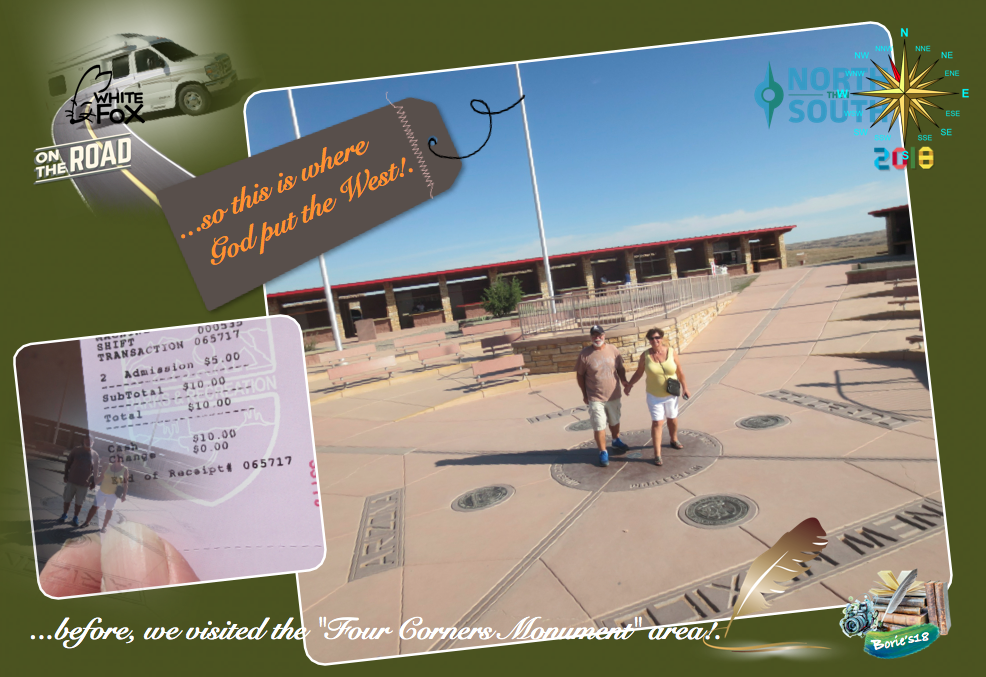
…sim, andávamos pelo Oeste!. Antes, visitámos a área do “Four Corners Monument” (Monumento das Quatro Esquinas), que marca o quadriponto no sudoeste dos Estados Unidos, onde os estados do Arizona, Colorado, Novo México e Utah se encontram e é o único ponto nos Estados Unidos compartilhado por quatro estados, levando a área a ser nomeada a região “Four Corners” (Quatro Esquinas)!. (Yes, we were walking in the West!. Before, we visited the “Four Corners Monument” area, which marks the quadriponto in the southwest United States, where the states of Arizona, Colorado, New Mexico and Utah meet and is the only point in the United States shared by four states, leading the area to be named the “Four Corners” region)!.

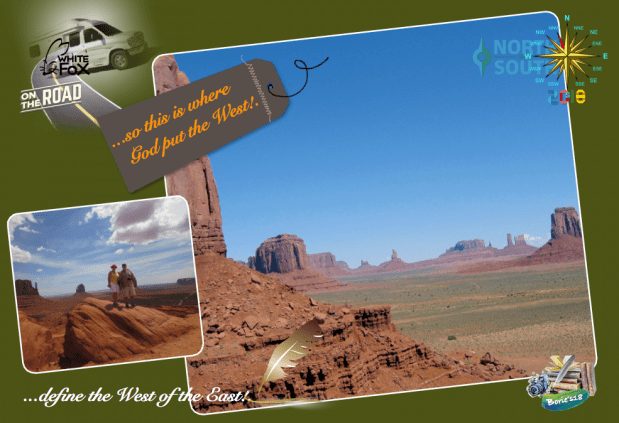
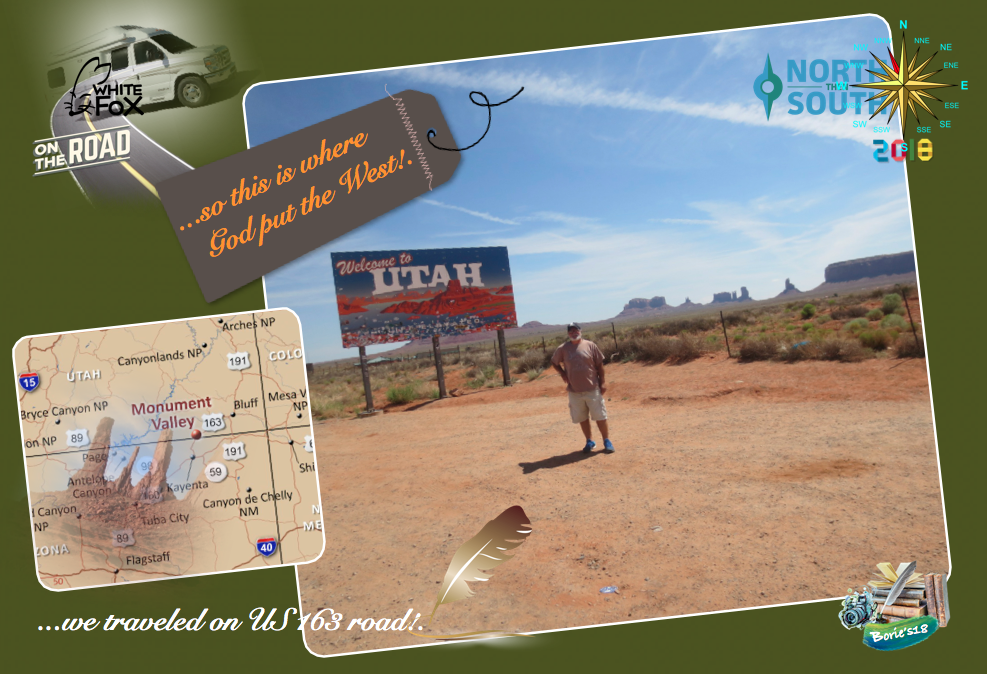
…viajávamos pela estrada US 163, aproximando-nos da fronteira entre os estados de Utah e Arizona, entrando num extenso vale onde o seu piso é em grande parte siltstone do Grupo Cutler, ou areia derivada dele, depositado pelos rios sinuosos que esculpiram este maravilhoso vale!. A sua cor vermelha viva, vem do óxido de ferro exposto no siltstone desgastado pelo tempo, onde também as suas rochas mais escuras e azul-acinzentadas, obtêm a sua cor do óxido de manganês!. (We traveled on US 163 road, approaching the border between the states of Utah and Arizona, entering an extensive valley where its floor is largely siltstone of Cutler Group, or sand derived from it, deposited by the sinuous rivers that sculpted this wonderful valley!. Its bright red color comes from the exposed iron oxide in the weather-worn siltstone, where also its darker and blue-gray rocks get their color from manganese oxide)!.

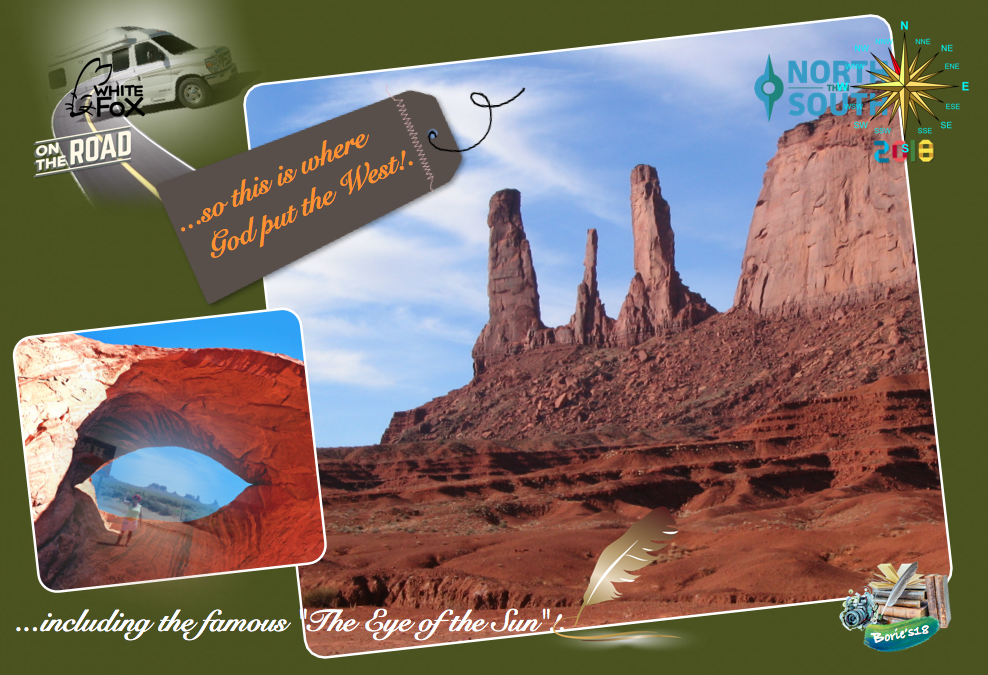
…é uma região que faz parte do Planalto do Colorado, que inclui grandes estruturas de pedra, incluindo o famoso “The Eye of the Sun” (O Olho do Sol), que é uma formação natural que assume a aparência de um olho, onde os sobreviventes da Nação Navajo têm encontros e festivais, com cantos e tambores!. (Is a region that forms part of the Colorado Plateau, which includes large stone structures, including the famous “The Eye of the Sun”, which is a natural formation that takes on the appearance of an eye , where the survivors of the Navajo Nation have encounters and festivals, with songs and drums)!.

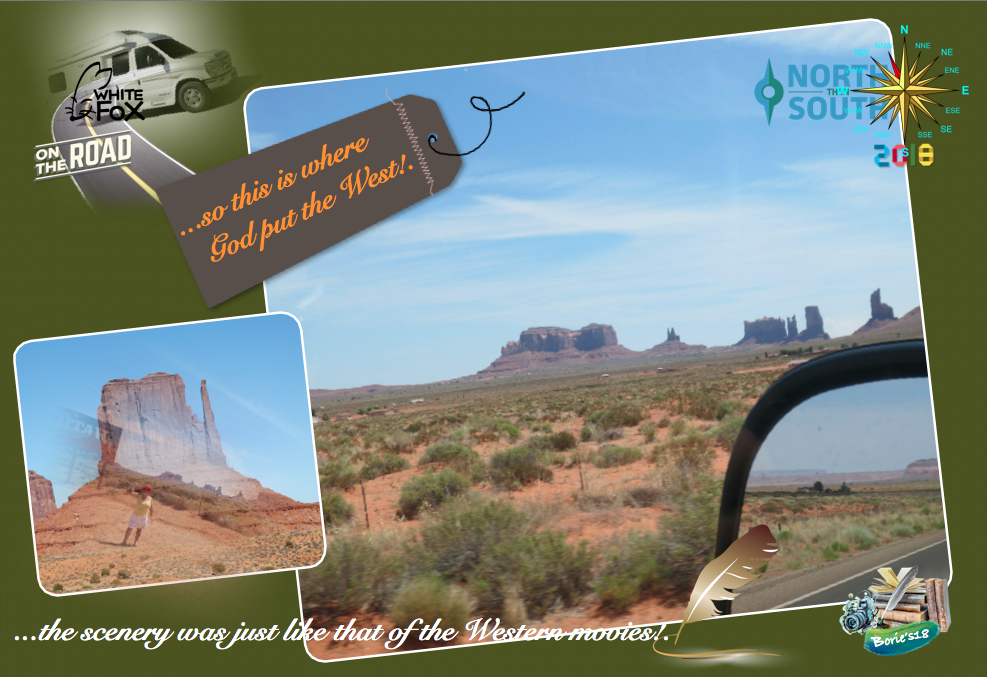
…apesar da elevação do fundo deste maravilhoso vale, poder variar entre 1.500 a 1.800 metros acima do nível do mar, a nossa “White Fox”, deslizava suavemente!. O cenário era tal qual o dos filmes do Oeste, já avistávamos ao longe uma parte do vale, que logo nos fez lembrar a célebre frase do actor John Wayne, quando exclamava, “So this is where God put the west” (então é aqui que Deus colocou o oeste)!. (Despite the elevation of the bottom of this wonderful valley, to be able to vary between 1,500 and 1,800 meters above sea level, our “White Fox” slid smoothly!. The scenery was just like that of the Western movies, we could already see in the distance a part of the valley, which immediately reminded us of the famous phrase of the actor John Wayne, when he exclaimed, “So this is where God put the west”)!.

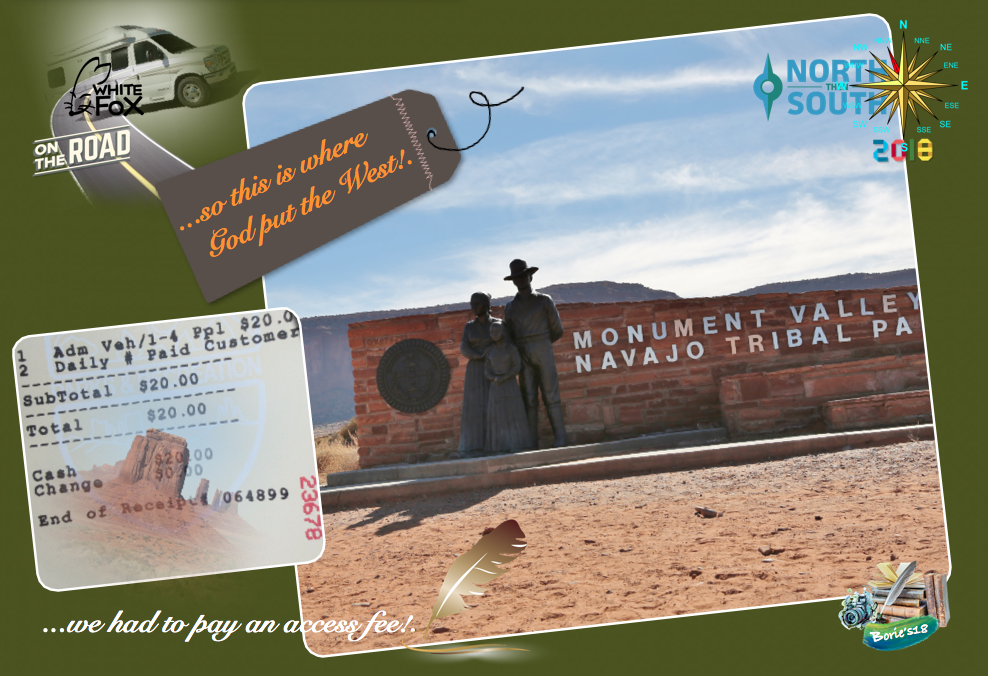
…o vale fica dentro do território da Reserva da Nação Navajo, a entrada era já ali, tivémos que pagar uma taxa de acesso, onde nos informaram que era possível viajar na nossa “White Fox”, por uma certa área do parque numa estrada de terra com aproximadamente 27 quilómetros (uma viagem de duas a três horas), visitando algumas partes do Monument Valley!. (Vale do Monumento)!. (The valley is within the territory of the Navajo Nation Reserve, the entrance was already there, we had to pay an access fee, where we were informed that it was possible to travel in our “White Fox”, for a certain area of the park in a dirt road with approximately 27 kilometers (a trip of two to three hours), visiting some parts of Monument Valley)!.

….havia algum sol, mas este vale, como já mencionámos anteriormente, oficialmente é uma grande área que inclui o território da Reserva da Nação Navajo, equivalente a um parque nacional, que experimenta um clima desértico com invernos frios e verões quentes, onde existe sempre, principalmente no verão alguma chuva ocasional, que foi o que nos aconteceu!. (There was some sun, but this valley, as we have already mentioned, officially is a large area that includes the territory of the Navajo Nation Reserve, equivalent to a national park, which experiences a desert climate with cold winters and hot summers, where there is always, especially in the summer some occasional rain, that’s what happened to us)!.

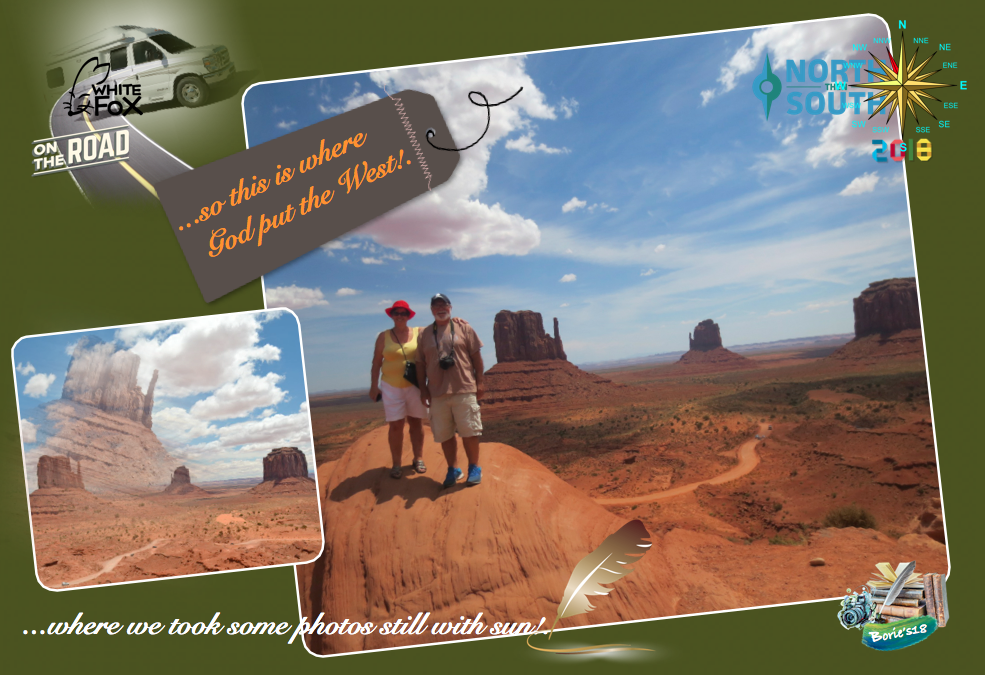
…depois de percocorrermos alguma área junto do Centro de Informação, onde tirámos algumas fotos ainda com sol!. (After crossing some area next to the Information Center, where we took some photos still with sun)!.

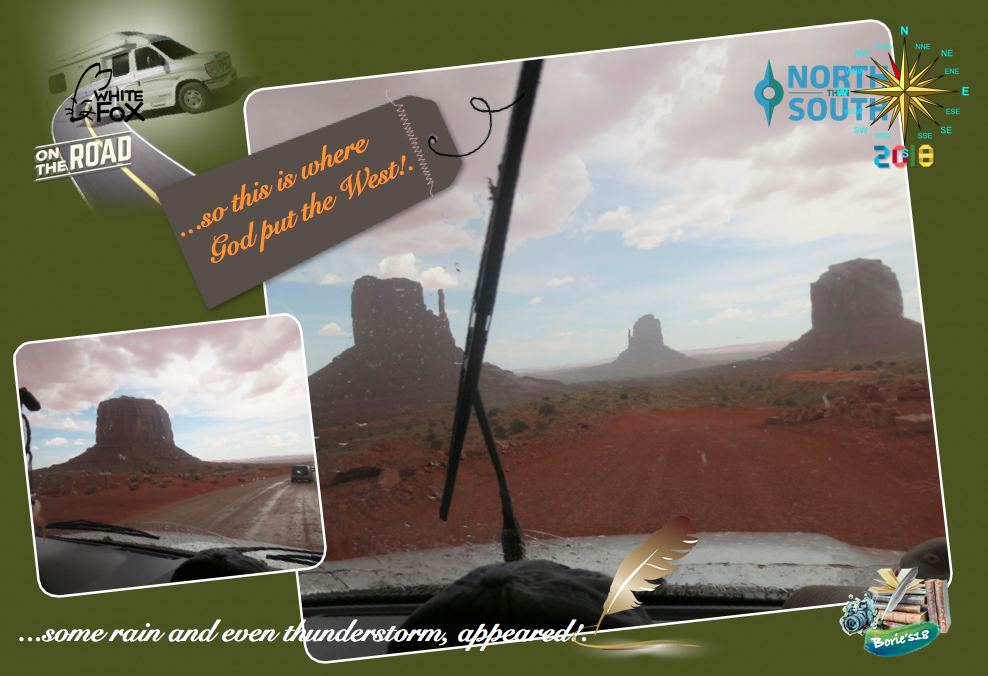
…pois quando entrámos no parque, tentando fazer o “Loop Drive” (designação do circuito do parque), alguma chuva e mesmo trovoada, apareceu, no entanto seguimos e, o sol também regressou de novo, pelo menos em algumas áreas do percurso!. (Because when we entered in the park, trying to do “Loop Drive” (designation of the circuit of the park), some rain and even thunderstorm, appeared, however we continued and, the sun also returned again, at least in some areas of the route)!.

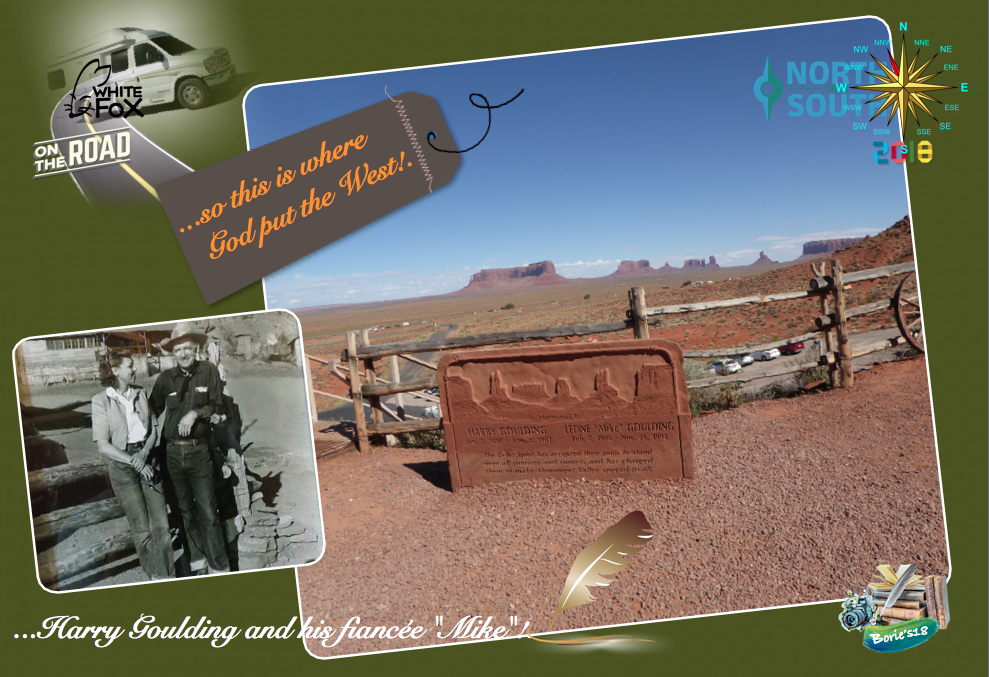
…conforme íamos avançando, o cenário era incrível!. Viajando pelo seu interior, o Monument Valley (Vale do Monumento), a cada momento nos surgia pela frente uma paisagem natural, oculta entre pequenos monumentos de pedra vermelha que, entre outros viajantes que se aventuram nesta região selvagem, uns dos pioneiros, e que muito contribuiram para que o resto do mundo conhecesse melhor esta maravilha da natureza, foram Harry Goulding e sua noiva “Mike” (supostamente ele não podia pronunciar o seu primeiro nome, que era Leone)!. Talvez sem o saberem, transformaram este cenário em um ícone do oeste americano, hoje conhecido em todo o mundo!. (As we were advancing, the scenery was incredible!. Traveling inland, the Monument Valley, every now and then a natural landscape, hidden among small red stone monuments that, among other travelers who venture in this wilderness, one of the pioneers, much contributed to make the rest of the world better acquainted with this wonder of nature, were Harry Goulding and his fiancée “Mike” (supposedly he could not pronounce his first name, which was Leone)!. Perhaps without knowing it, they turned this scenery into an icon of the American West, now known throughout the world)!.

…eles acabaram por se casar e decidiram abrir o caminho de Durango, no sul do Colorado, e que ele, Harry Goulding, antes era um negociante de ovelhas que juntamente com sua noiva, vieram ao Monument Valley (Vale do Monumento), em busca de uma oportunidade de negócio!. Ninguém sabe se já tinham conhecimento, ou se foi simplesmente alguma sorte, comprando um lote substancial de terra, quando a Reserva Indígena Paiute foi realocada e, muitos acres se tornaram disponíveis para venda, numa área que só pode ser descrita como uma terra seca ao lado de algumas rochas incrivelmente altas!. (They eventually married and decided to open the road to Durango in southern Colorado, and that he, Harry Goulding, was once a sheep dealer who, along with his fiancée, came to Monument Valley, in search of a business opportunity!. No one knows if they were aware of, or was simply lucky enough to purchase, a substantial plot of land when the Paiute Indigenous Reservation was relocated and many acres became available for sale in an area that can only be described as a side of some incredibly high rocks)!.

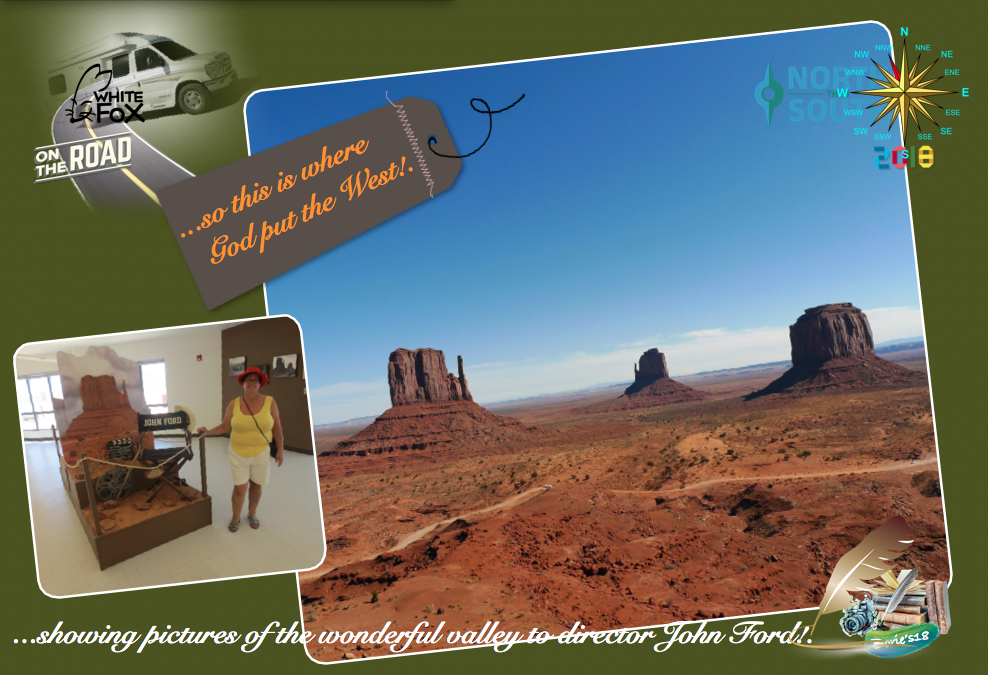
…claro, pouco tempo depois, Harry e sua esposa carregaram um “saco de dormir, a cafeteira, alguma comida”, como Harry mais tarde explicou, e dirigiram-se para Hollywood, mostrando fotos do maravilhoso vale ao diretor John Ford, convencendo-o de que o Monument Valley (Vale do Monumento), era o cenário perfeito para o seu próximo filme!. (Of course, shortly afterwards, Harry and his wife carried a “sleeping bag, coffeepot, some food”, as Harry later explained, and they headed to Hollywood, showing pictures of the wonderful valley to director John Ford, convincing him that the Monument Valley was the perfect setting for his next movie)!.

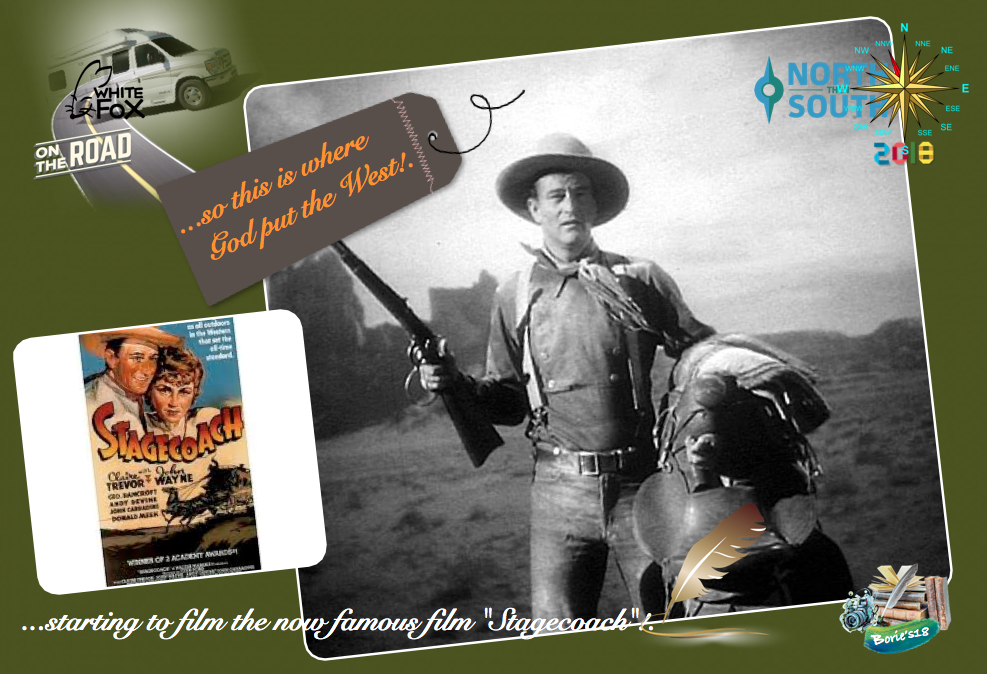
…o director John Ford ficou deslumbrado e, em menos de um mês, mudou-se com todo o equipamento necessário para lá, começando a filmar a hoje célebre película “Stagecoach”, onde segundo relatos, contratou um actor da classe “B”, que dava pelo nome de John Wayne, para estrela principal, para mostrar uma odisseia sobre o espírito da fronteira americana!. (Director John Ford was dazzled and, in less than a month, moved with all the necessary equipment there, starting to film the now famous film “Stagecoach”, where he reportedly hired an actor from class “B”, that gave by the name of John Wayne, for main star, to show an odyssey on the spirit of the American border)!.

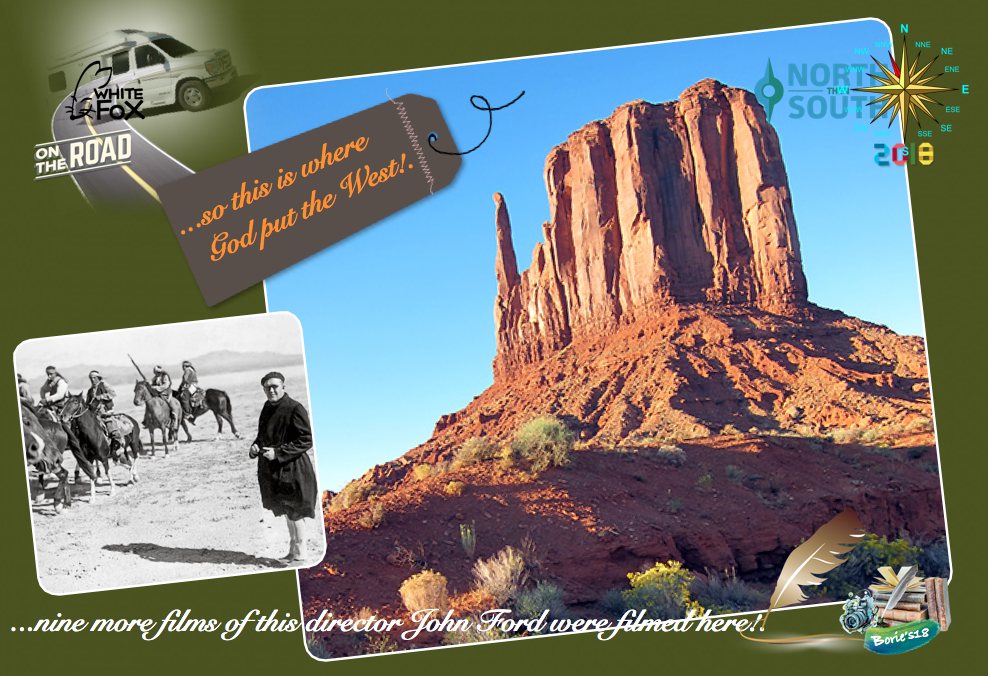
…nove mais filmes deste director John Ford foram filmados aqui, onde se destacam “My Darling Clementine” (1946), “Fort Apache” (1948) mesmo “She Wore a Yellow Ribbon” (1949) ou mais tarde, pelo ano de 1956 “The Searchers”, com Jeffrey Hunter, John Wayne e Harry Carey Jr., dirigindo actores além do já mencionado John Wayne, Will Rogers, Henry Fonda, Maureen O’Hara, Vera Miles, James Stewart ou Richard Widmark, que não só ajudou a Nação Navajo com o dinheiro necessário, mas também serviu para que o resto do mundo podesse admirar as impressionantes formações rochosas vermelhas, no meio deste deserto!. (Nine more films of this director John Ford were filmed here, where they highlight “My Darling Clementine” (1946), “Fort Apache” (1948) same “She Wore a Yellow Ribbon” (1949) or later, for the year 1956 “The Searchers” starring Jeffrey Hunter, John Wayne and Harry Carey Jr., directing actors beyond John Wayne, Will Rogers, Henry Fonda, Maureen O’Hara, Vera Miles, James Stewart, or Richard Widmark, only helped the Navajo Nation with the necessary money, but also served so that the rest of the world could admire the impressive red rock formations in the middle of this desert)!.

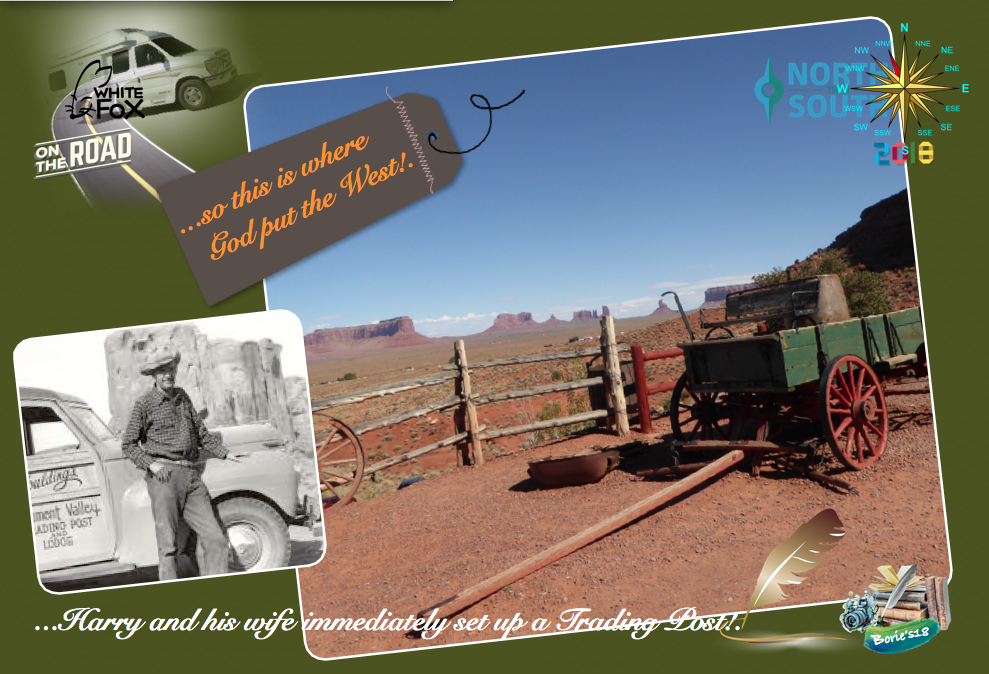
…acompanhando todo esta evolução, Harry e sua esposa, imediatamente montaram um Posto de Negociação, na base da Big Rock Door Mesa, enquanto faziam amizade e conduziam negócios com os Navajos locais, que viam com bons olhos a sua presença, onde muitas décadas depois, este Posto de Negociação Goulding, se transformou num chalé, com cabines, museu, restaurante e uma área de acampamento para casas ambulantes, sendo colocado no Registro Nacional de Lugares Históricos em 1980, pela sua importância para a área local!. (Following all this evolution, Harry and his wife immediately set up a Trading Post at the base of the Big Rock Door Table, while making friends and conducting business with the local Navajos, who welcomed their presence, where many decades later, this Goulding Trading Post turned into a cottage, with cabins, museum, restaurant and a camping area for mobile homes, and was placed on the National Register of Historic Places in 1980 for its importance to the local area)!.

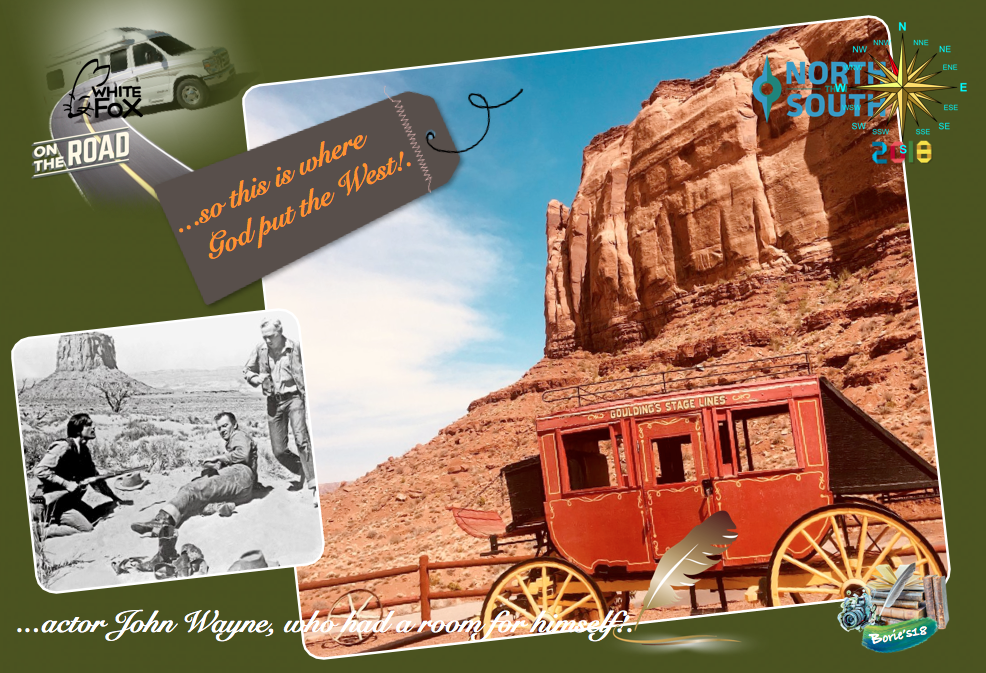
…os negócios da Goulding cresceram, mudando de mãos ao longo dos anos, enquanto Monument Valley (Vale do Monumento), continuou a ser cenário para muitos filmes, programas de televisão e anúncios, bem como um destino turístico muito popular, onde principalmente trabalhadores e estrelas de Hollywood, que por aqui viviam temporadas, como por exemplo o actor John Wayne, que tinha um quarto para si mesmo, nas trazeiras deste Posto de Negociação, com um dos mais bonitos cenários do vale!. Assim como outras pessoas, pelo menos durante o tempo em que eram protagonistas nas diferentes películas que por aqui se filmavam, ou que simplesmente passavam e, dada a publicidade, tinham curiosidade em verem o cenário ao vivo!. (Goulding’s business grew, changing hands over the years, while Monument Valley continued to be the setting for many movies, television shows and commercials, as well as a very popular tourist destination, where mainly workers and Hollywood stars, who lived here for years, such as actor John Wayne, who had a room for himself, in the back of this Trading Post, with one of the most beautiful scenery in the valley! Like other people, at least during the time that they were protagonists in the different films that were filmed here, or that they simply passed and, given the publicity, they were curious to see the scene live)!.


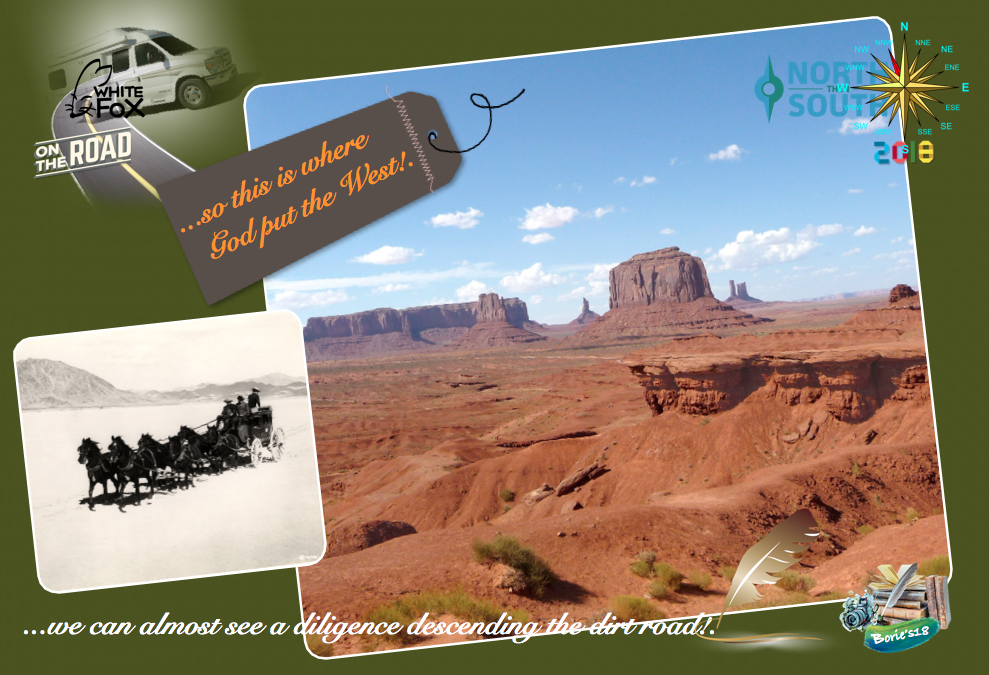
…ainda hoje, em alguns pontos estratégicos, podemos olhar o deserto onde sobressaiem altos monumentos e, depois de admirar o cenário, fechando os olhos por momentos, no pensamento, quase podemos ver uma diligência descendo a estrada de terra, pedra e areia!. Segundo relatos, mais de 400.000 pessoas visitam Monument Valley todos os anos e, provávelmente este Vale não seria o que é hoje, sem o apoio de Harry Golding e sua esposa Mike!. (Even today, in some strategic points, we can look at the desert where high monuments stand out and, after admiring the scenery, closing our eyes for moments, in the thought, we can almost see a diligence descending the dirt road, stone and sand!. According to reports, more than 400,000 people visit Monument Valley every year and probably this Valley would not be what it is today without the support of Harry Golding and his wife Mike)!.

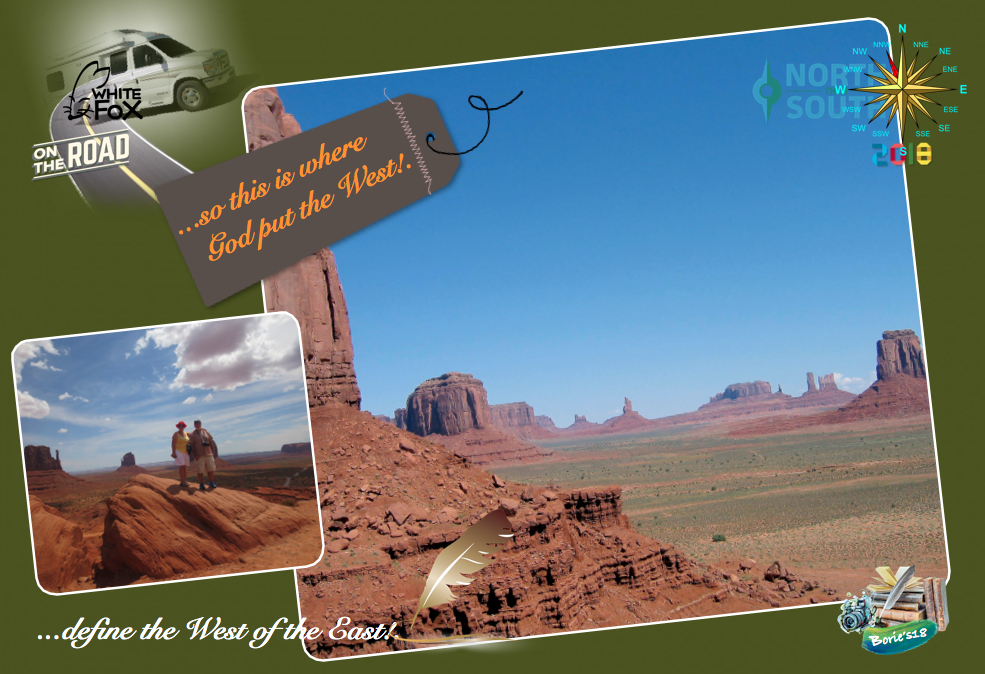
…talvez dada a publicidade, no entanto o cenário maravilhoso da paisagem em parte comprovam estas palvras mas, talvez seja exagero, no entanto dizem que esta área do Monument Valley (Vale do Monumento), “definem o Oeste do Leste”!. (Perhaps given the publicity, however the wonderful scenery of the landscape in part prove these words but, perhaps it is exaggeration, nevertheless they say that this area of the Monument Valley, “define the West of the East”)!.

…nós, assim como a nossa “White Fox”, quando regressámos ao local do início do parque, estávamos cobertos de areia vermelha, depois de atravessar um cenário irregular, a princípio com alguma água e lama e, poeirento depois, mas contentes, não só pela paisagem, mas pelo que aprendemos sobre os índios da Nação Navajo!. (We, like our “White Fox”, returned to the site of the beginning of the park, we were covered with red sand, after crossing an irregular scenery, at first with some water and mud and then dusty, but glad not only by the landscape, but from what we learned about the natives of the Navajo Nation)!.

Tony Borie, September 2018.

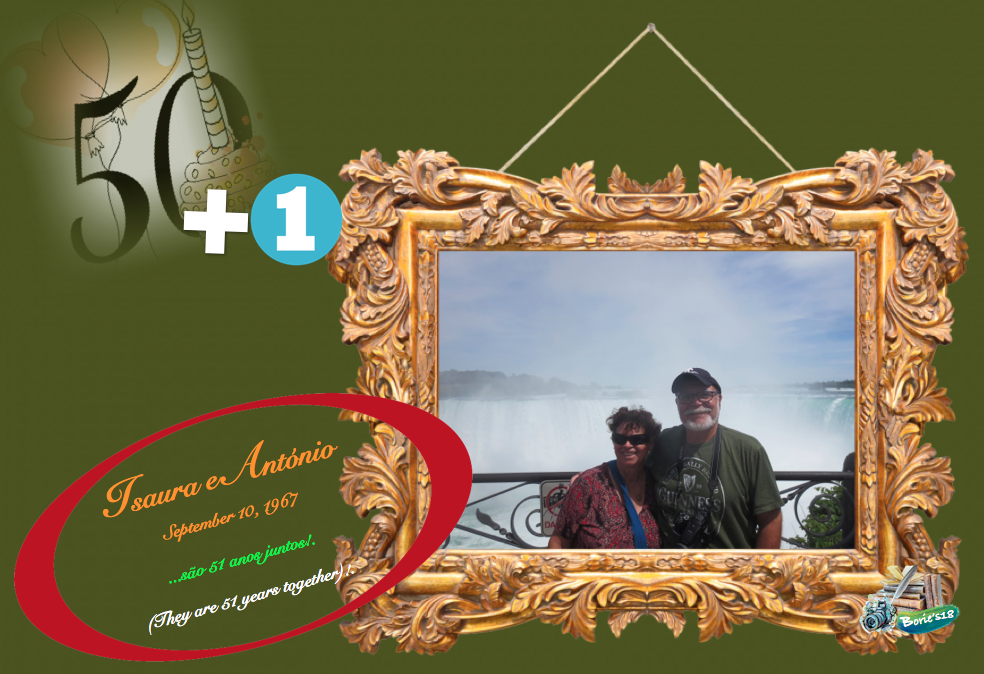
…51 years together!.

…51 years together!.

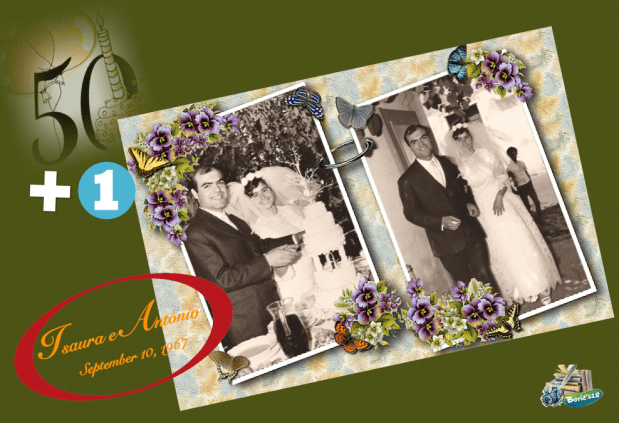
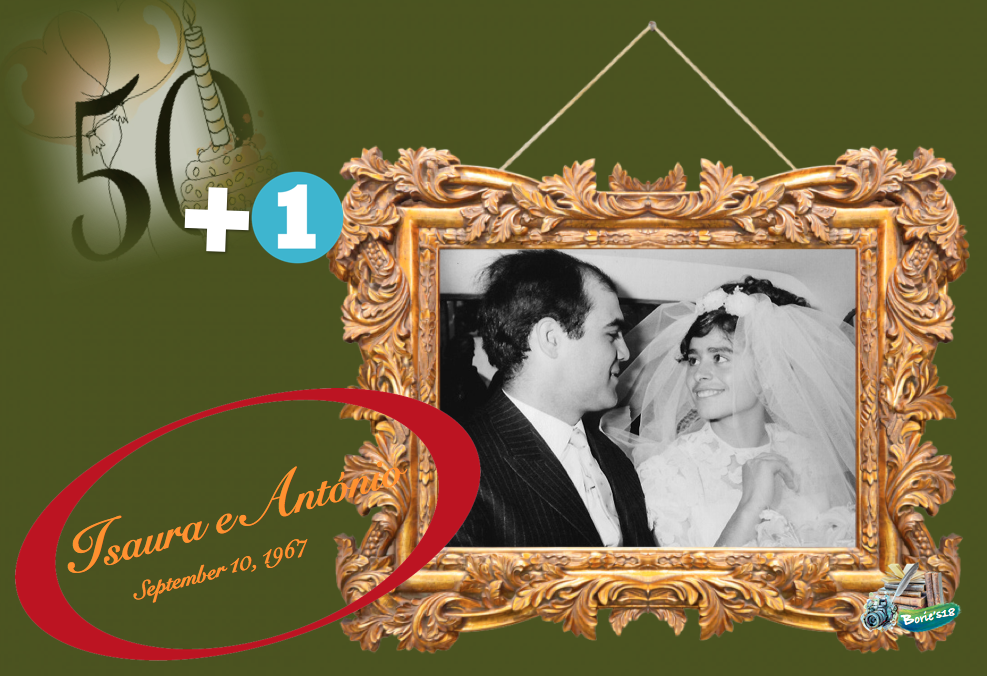
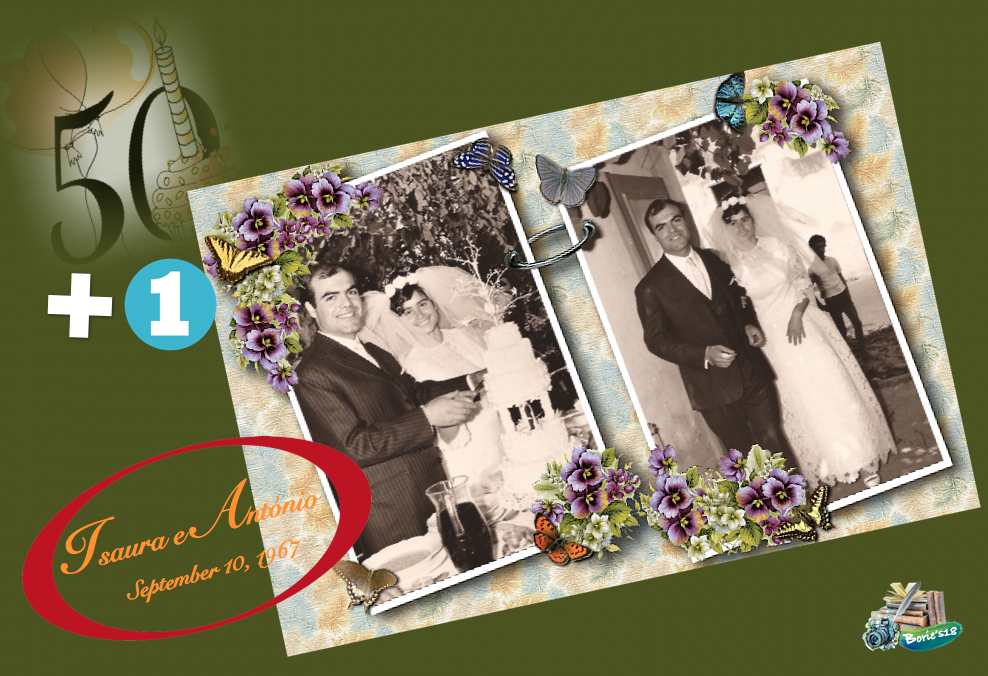
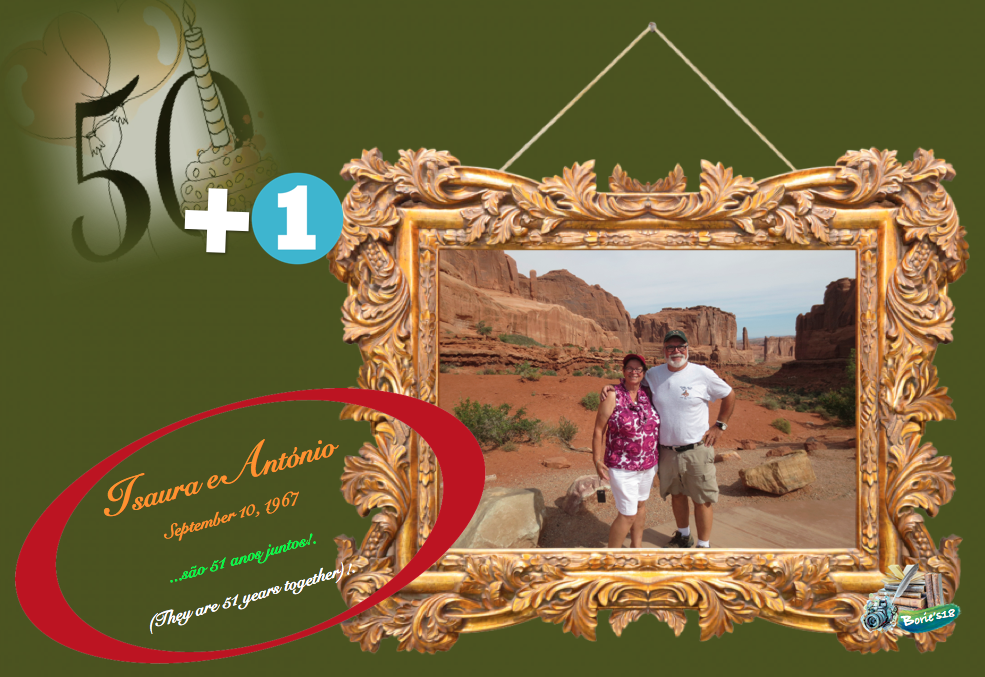
…dia 10 de Setembro de 1967!. (On September 10, 1967)!.

…já lá vão 51 anos!. (It’s been 51 years)!.

…levantámo-nos ainda era madrugada, tal como todos os dias o fazemos, mas hoje é um dia especial, antes de nos sentar em frente ao computador, tirámos a aliança dos dedos e verificámos, pois está lá gravado, “ISAURA 10/9/1967”!. (We got up it was still dawn, just as we do every day, but today is a special day, before we sit in front of the computer, we took the ring of fingers and we noticed, because it is recorded there, “ISAURA 10/9/1967”)!.

…são 51 anos juntos!. Sim juntos, porque um homem sózinho não é nada, mas duas pessoas, já podem continuar a formar o mundo!. (They are 51 years together!. Yes together, because a man alone is nothing, but two people can already continue to form the world)!.

…e dizem que, casamentos felizes começam quando nos casamos com quem amamos e, eles florescem quando amamos aquele com quem nos casamos, esta é a verdade!. (And they say, happy marriages begin when we marry who we love, and they bloom when we love the one we marry, this is the truth)!.

…e mais, casais que se amam dizem mil coisas sem falar, sem dizer uma só palavra, no entanto continuam juntos, vivendo num espaço que dividem em 50%, com a possível exceção do espaço da cozinha!. (And more, couples who love each other say a thousand things without speaking, without saying a word, yet they continue together, living in a space that divides by 50%, with the possible exception of kitchen space)!.

…e se aprofundar-mos ainda mais, as correntes não mantêm um casamento junto!. São pequenos fios, centenas de pequenos e minúsculos fios que se podem quebrar ao longo dos anos, mas o sentimento do amor, normalmente mantêm as pessoas juntas!. (And if we delve deeper, the chains do not keep a marriage together!. They are tiny threads, hundreds of tiny, tiny threads that can break through the years, but the feeling of love usually holds people together)!.

…estes 51 anos de vida juntos, dizem-nos que o sucesso no casamento não vem apenas por encontrar o parceiro certo, mas que felizmente vivemos com o parceiro certo, tal como o casamento pode sobreviver, se os parceiros perceberam que às vezes o melhor, vem depois do pior!. (These 51 years of life together, tell us that success in marriage does not come only by finding the right partner, but that we happily live with the right partner, just as marriage can survive, if the partners realized that sometimes the best, comes after the worst)!.

… a Isaura e nós, temos o maior acordo pré-nupcial do mundo, chama-se amor e compreenção, com a particularidade de às vezes manter-mos uma qualquer discussão, sobre um qualquer assunto sem qualquer importância, mas com a particularidade também de nos apaixonar-mos muitas vezes mas, sempre com a mesma pessoa, mantendo depois uma longa conversa, que sempre nos parece pequena, onde a nossa união continua feliz e duradoura, porque no fundo, no fundo, quando discutimos, acabamos por ser dois bons perdedores!. (To Isaura and we, we have the biggest prenuptial agreement in the world, it is called love and understanding, with the peculiarity of sometimes maintaining any discussion, about any matter without any importance, but with the particularity also to fall in love many times but always with the same person, after a long conversation, which always seems small, where our union remains happy and lasting, because deep down, when we discuss, we end up being two good losers).

…e para finalizar, porque logo mais pela tardinha vamos para os “copos”, com alguns amigos de longa data, o Adão e a Eva tiveram um casamento ideal!. Ele não teve que ouvir sobre todos os homens com quem ela poderia se ter casado, e ela não teve que ouvir, sobre o herói que ele diz ter sido, as namoradas que consquistou, ou sobre o tão bem a sua mãe cozinhava!. (And to finish, because soon in the afternoon we go to the “glasses”, with some long-time friends, Adam and Eva had an ideal marriage!. He did not have to hear about all the men she could have married with, and she did not have to listen, about the hero he says he was, the girlfriends he got, or about how well his mother cooked)!.

…obrigado Isaura, por me teres aturado todos estes anos e, continuo aqui, fazendo todos os possíveis e impossíveis, por ti!. (Thank you, Isaura, for you kept me up all these years and I’m still here, doing everything possible and impossible for you)!.

Tony Borie, September 2018!.

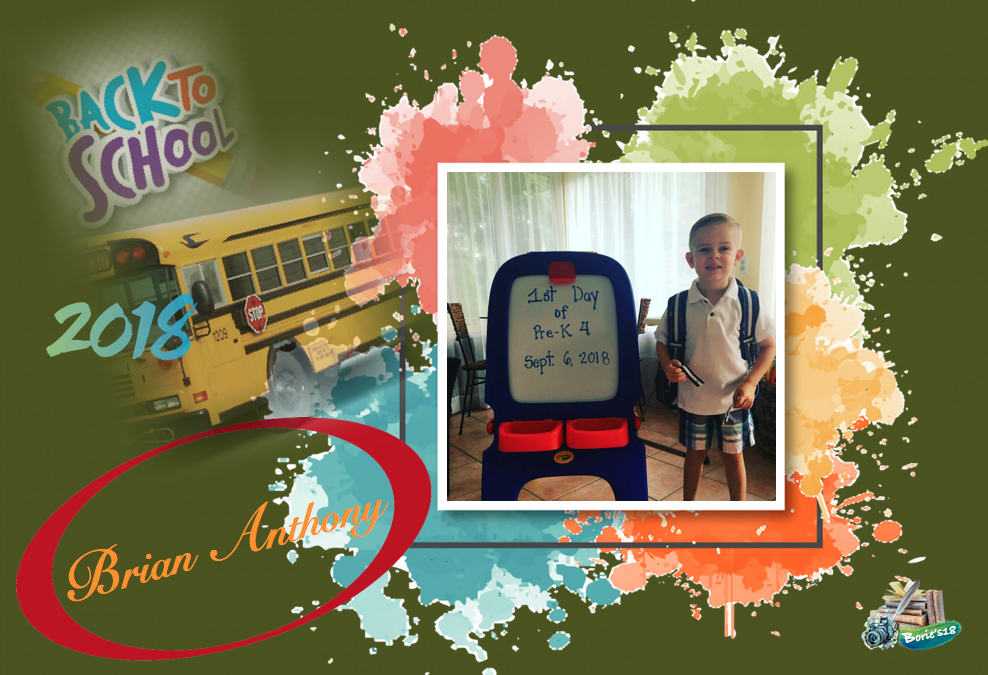
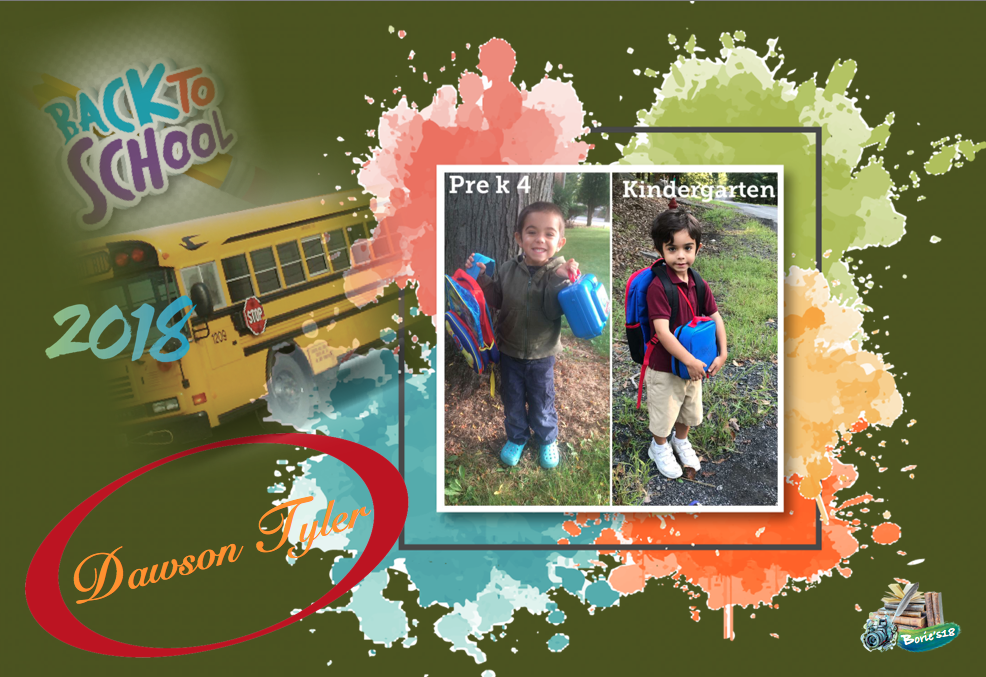
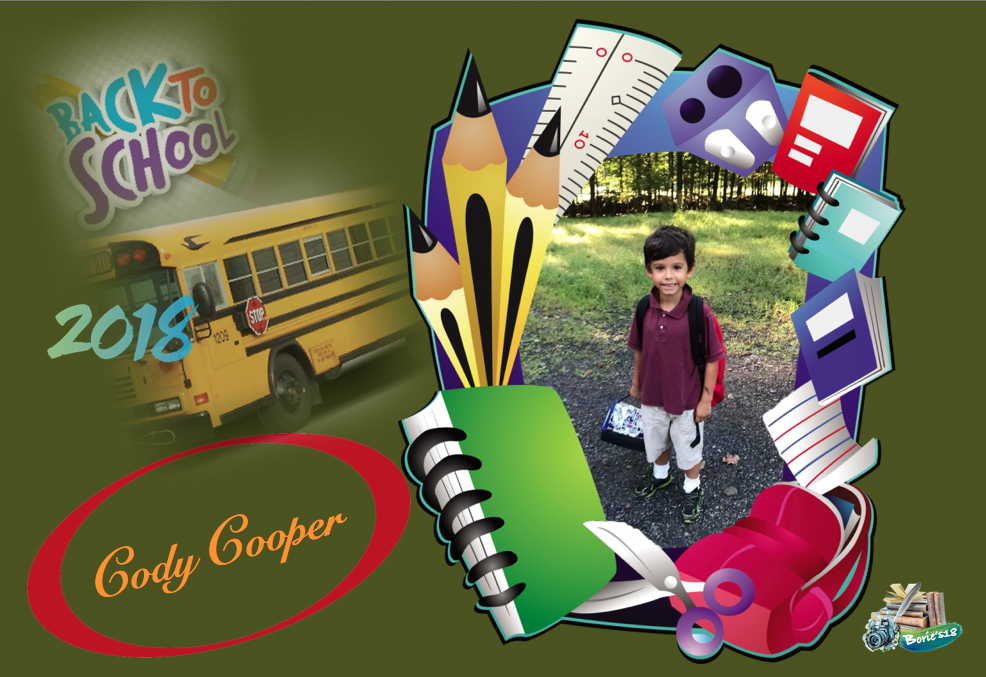
…the grandchildren go to school!.

…os netos vão para a escola!. (the grandchildren go to school)!.

…quase todas as crianças adoram o primeiro dia de escola!. Certo?. (almost all children love the first day of school!. Right?).

…nos dias de conforto de hoje, a resposta é sim!. (on today’s comfort days, the answer is yes)!.

…nos dias de desconforto de há setenta ou mais anos atrás, a resposta era não!. (in the days of discomfort of seventy or more years ago, the answer was no)!.

…porquê?. Simples!. Era o desconforto das salas de aula, com muito calor nos dias verão e muito frias nos dias de inverno!. O trajecto para a escola era feito caminhando por caminhos nem sempre livres e planos, pois quando chovia ou nevava, havia frio, água e lama, alguns professores eram rudes, pois o método de ensino era, “tens que aprender” gostes ou não gostes da disciplina e, se não aprendias, por vezes até te espancavam!.

…felizmente hoje, isso já não existe!.

(Because?. Simple!. It was the discomfort of the classrooms, very hot in the summer days and very cold in the winter days!. The route to the school was made by walking along paths not always free and flat, because when it rained or snowed, there was cold, water and mud, some teachers were rude, because the teaching method was, “you have to learn” likes or dislikes of discipline and, if you did not learn, sometimes even beat you up)!.

Fortunately today, this no longer exists)!.

…hoje, o primeiro dia de escola é carregado de potencial de esperança, as crianças viajam de suas casas numa linda, típica e apropriada camioneta, a maioria deles vão alegres, vão encontrar novos amigos, fazer novas amizades, as salas de aula são confortáveis, os professores explicam-se com métodos pedagógicos modernos, onde as crianças sem o notarem vão aprendendo, têm a hora do lanche e, sobretudo divertem-se!. (Today, the first day of school is loaded with hope potential, children travel from their homes in a beautiful, typical and appropriate van, most of them go cheerful, meet new friends, make new friends, classrooms are comfortable, the teachers explain themselves with modern pedagogical methods, where children without noticing it they learn, they have the hour of the snack and, mainly they have fun)!.

…nos próximos dias vão encontrar-se de novo, já se conhecem melhor, já têm uma certa confiança com alguns que, na sua mente já foram seleccionados!. (In the next few days they will meet again, they know each other better, they already have a certain confidence with some that in their minds have already been selected)!.

…se alguma criança usa uma roupa diferente, de cores alegres e variadas, é muito possível que logo outro companheiro use expressões, como por exemplo, “hoje, pareces um sinal de trânsito ambulante”, ou mesmo, “tenho que usar óculos de sol, quando te vejo”, fazendo com que sejam mais moderados com a roupa que usam!. (If some child wears a different outfit with bright and varied colors, it is very possible that another companion will soon use expressions, such as “today, you look like a walking traffic sign”, or even, “I have to wear glasses when I see you”, making them more moderate in their clothes)!.

…começam a conhecer-se, vão existir os mais inteligentes e os menos inteligentes, os mais agressivos e os menos agressivos, os amigos e os quase inimigos, enfim vão começar a conhecer o que é viver em comunidade, em outras palavras, vão “sair da casca”!. (Begin to know each other, there will be the most intelligent and the least intelligent, the most aggressive and the less aggressive, friends and almost enemies, finally they will begin to know what it is to live in community, in other words, they will “come out of the shell”)!.

…vão começar a saber que existe um quarto de banho para rapazes e outro para raparigas!. Se o companheiro ao lado é amigo, ele também passa a ser seu amigo, se o companheiro não é amigo, ele também não vai ser seu amigo, é quase o iníco da sua formação com pessoa!. (They will begin to know that there is a bathroom for boys and another one for girls!. If the companion next to him is a friend, he also becomes his friend, if the companion is not a friend, he is not going to be his friend, it is almost the beginning of his formation with person)!.

…vai ver que existem diferentes expressões emocionais, em cada companheiro, onde existem os nervosos, os amistosos, os tímidos, os brincalhões e, aqueles especiais, que sem o notarem vão ser populares por isto ou por aquilo, arranjando amigos e seguidores em cada companheiro da sua aula!. (Will see that there are different emotional expressions in each companion, where there are the nervous, the friendly, the timid, the pranksters, and those special, who without noticing will be popular for this or that, arranging friends and followers in every roommate of your class)!.

…uma das verdades é que, ao fim de algum tempo, já sabem, ou pelo menos têm uma ideia o que é viver em comunidade, onde uns colocam a roupa sobre a cadeira, outros falam muito, outros são reservados, outros usam sapatos de lona, outros têm o cabelo quase rapado, outros não gostam que toquem nos seus objectos, enfim, vão saber que existem diferentes pessoas com diferentes identidades!. (One of the truths is that, after a while, they already know, or at least have an idea what it is to live in community, where some put their clothes on the chair, others talk a lot, others are reserved, others use canvas shoes, others have hair almost shaved, others do not like touching their objects, in short, they will know that there are different people with different identities)!.

…mas no fundo, no fundo, quase todas as crianças adoram o primeiro dia de escola!. Certo?. (But deep down, in the background, almost all children love the first day of school!. Right?.

Tony Borie, September 2018.

…remembering the Typical Group “The Cancioneiro of Agueda”!.

…remembering the Typical Group “The Cancioneiro of Agueda”!.

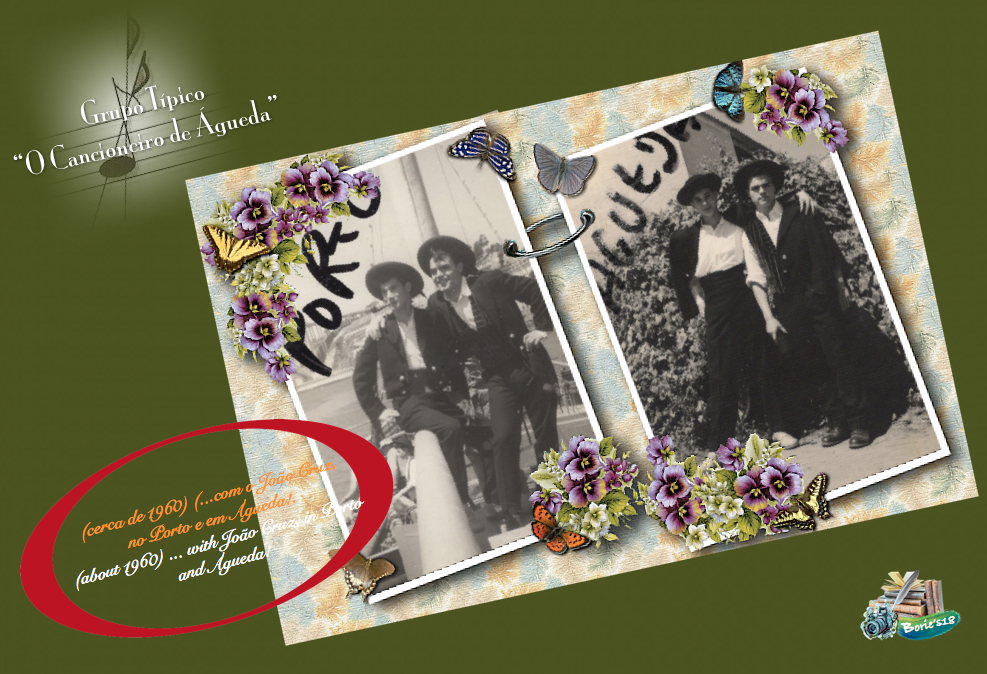
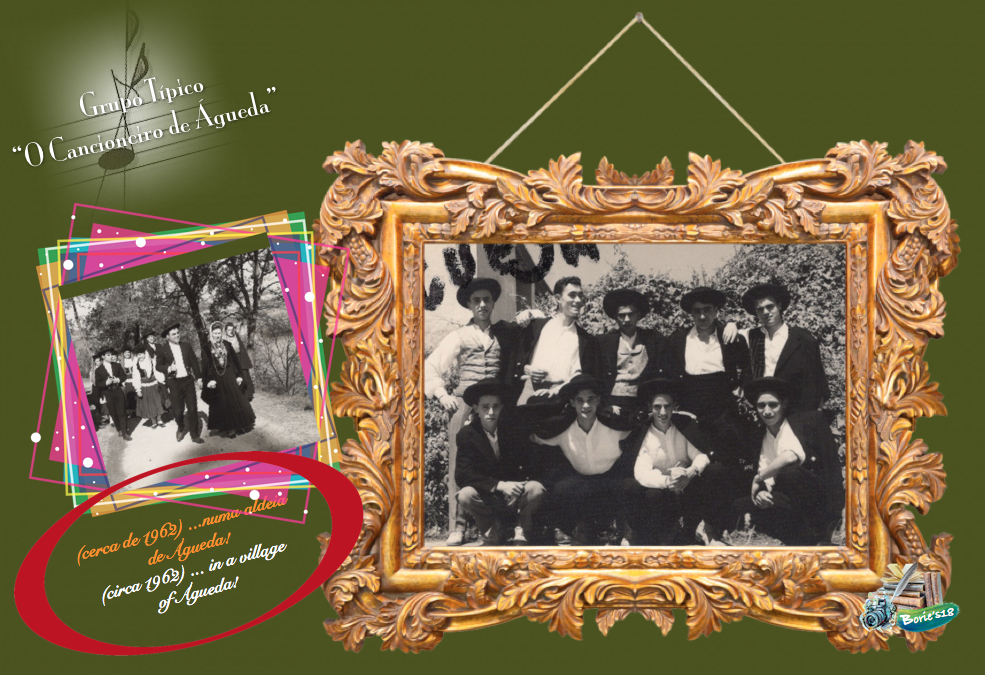
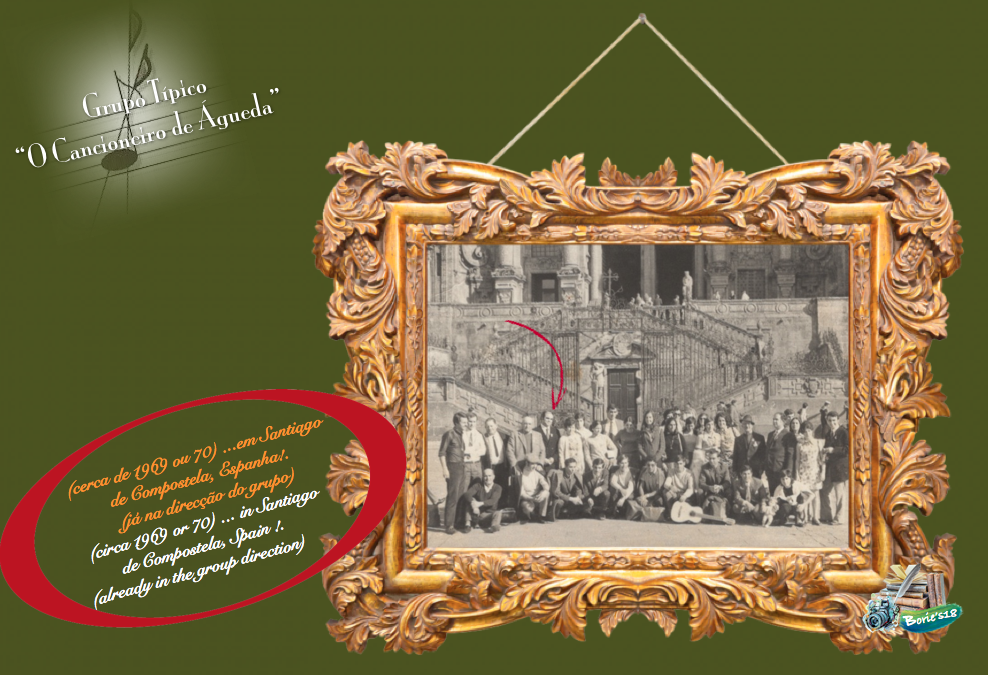
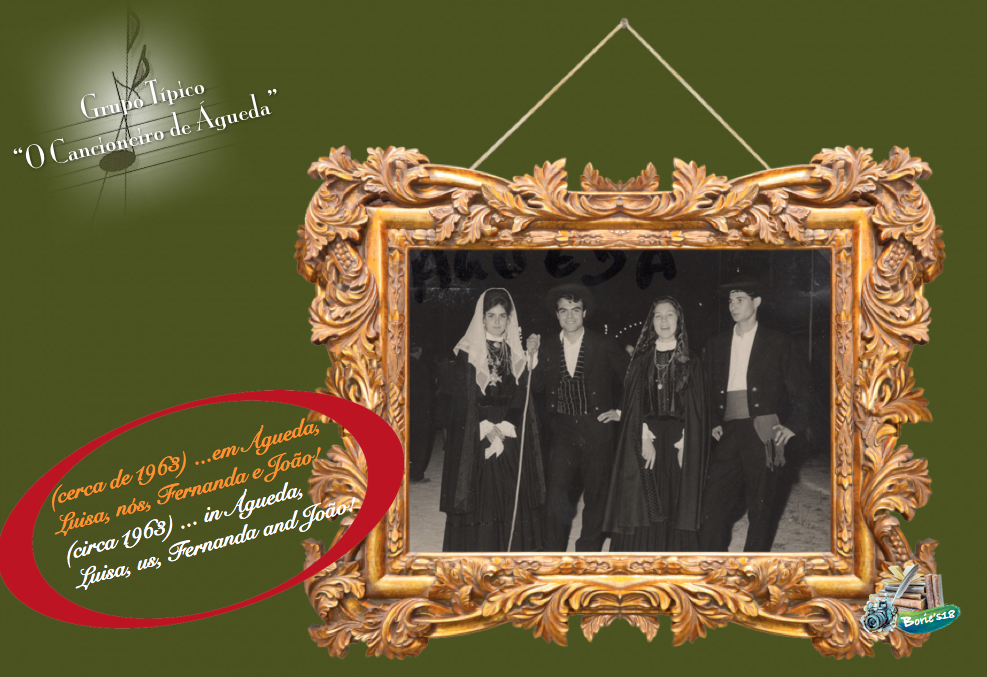
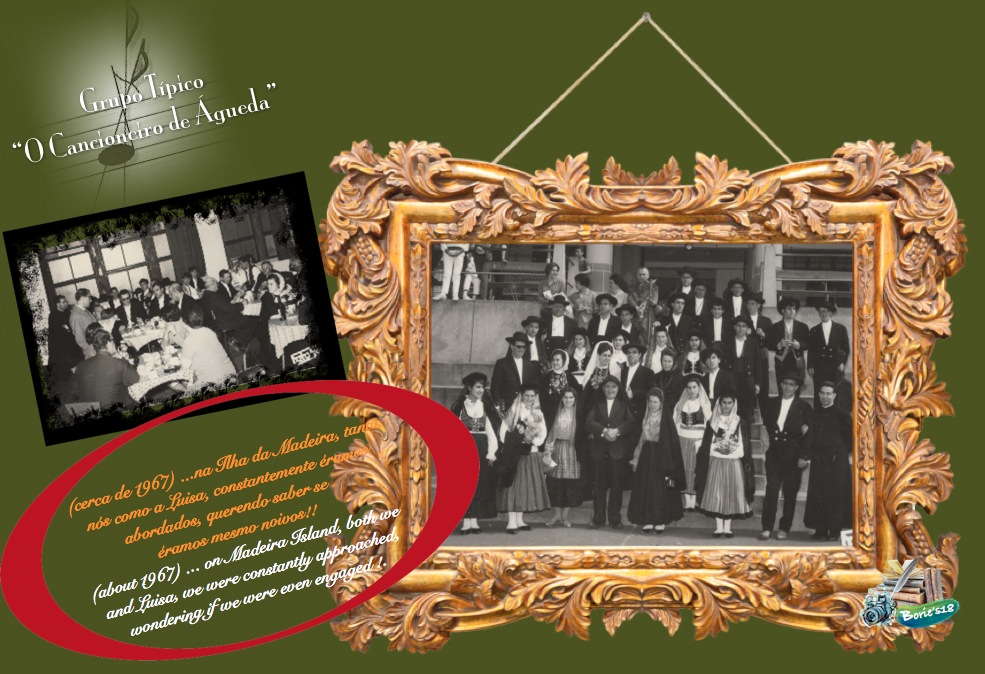
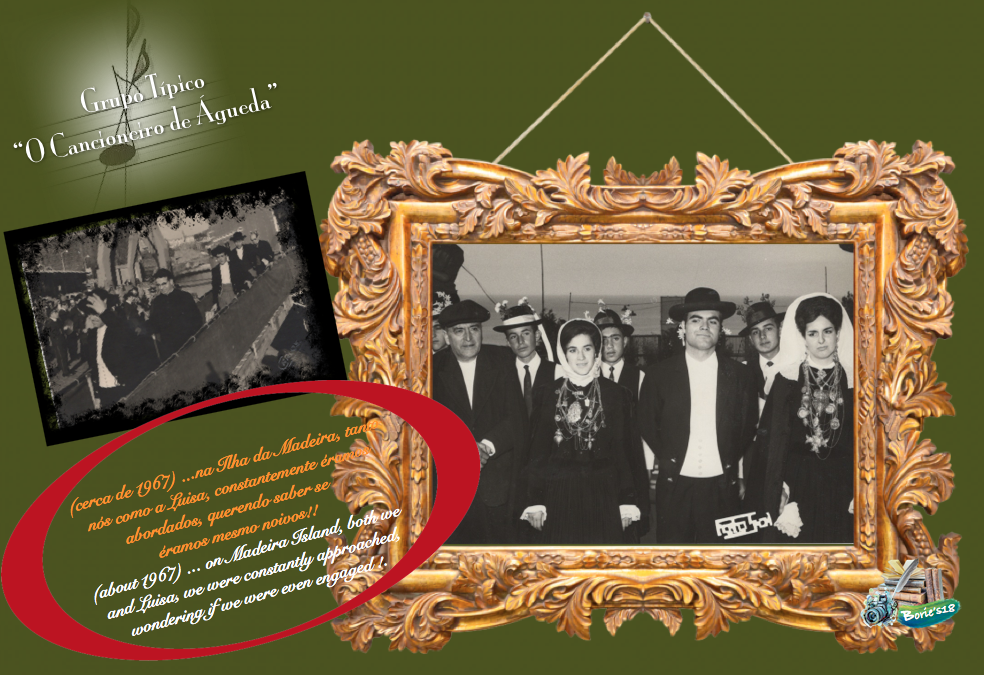
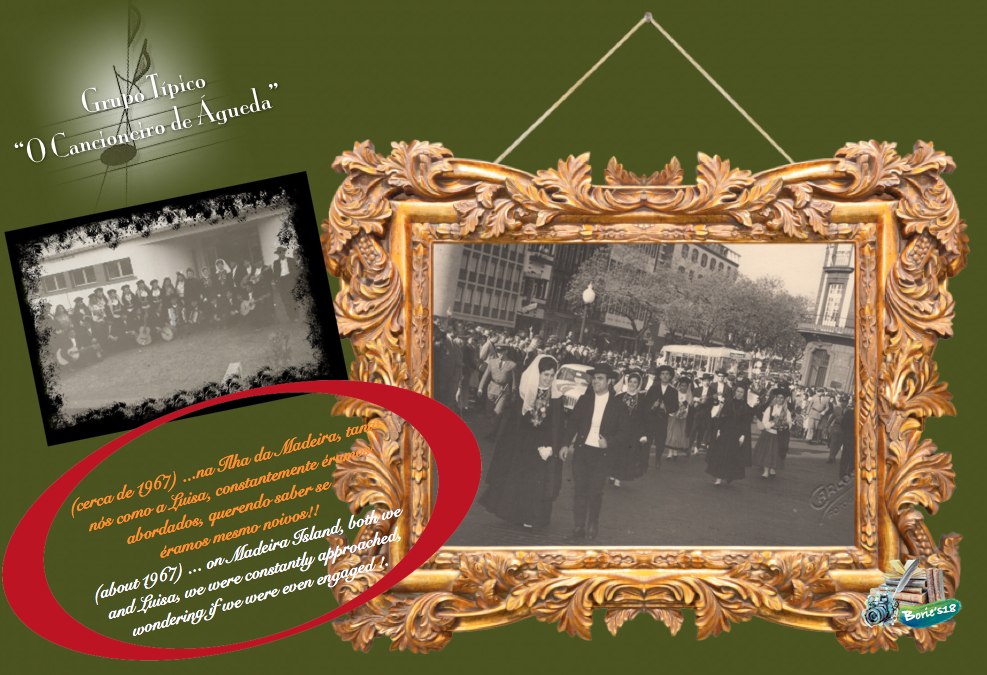
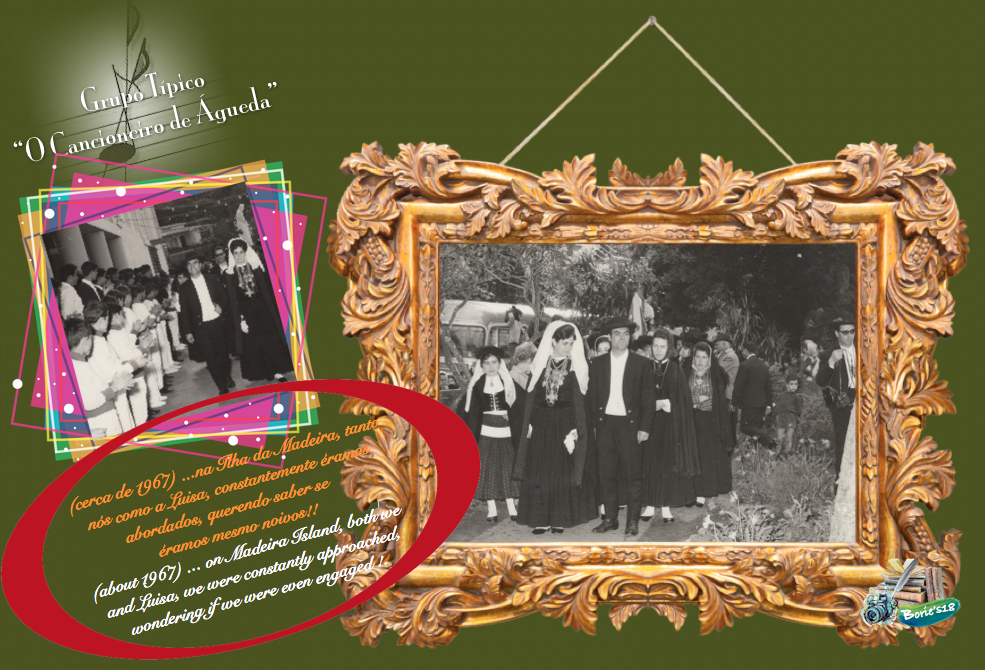
…lembrando o Grupo Típico “O Cancioneiro de Águeda”!. (remembering the Typical Group “The Cancioneiro of Águeda”)!.

…foi na aldeia do Vale do Ninho D’Águia, lá na vertente agreste da Montanha do Caramulo, que a Dona Maria Aguiar Guerra e Cruz, personalidade com algum relevo na sociedade da então vila de Águeda, situada na também então região da Província da Beira Litoral, nos descobriu para o “Folclore”!. (It was in the village of Vale do Ninho D’Águia, on the rugged slope of Caramulo Mountain, that Dona Maria Aguiar Guerra and Cruz, a personality with some relief in the society of the then village of Águeda, Province of Beira Litoral, discovered us for the “Folklore”)!.

…folclore, que era uma disciplina autónoma, que incluía histórias, ditos e canções das populações rurais camponesas, que eram consideradas como resíduo e sobrevivência do passado, que continuavam a existir nas camadas mais baixas da sociedade, pelo menos durante o período do nacionalismo romântico na Europa, que apresentavam tradições como processos orgânicos, baseados na tradição de qualquer vila ou aldeia!. (Folklore, which was an autonomous discipline, which included stories, sayings, and songs of rural peasant populations, which were regarded as residues and survivals of the past, which continued to exist in the lower strata of society, at least during the Romantic nationalism in Europe, which presented traditions as organic processes, based on the tradition of any village or village)!.

…crendo nós que esta palavra “Folclore”, começou a ser usada principalmente depois de que os estados alemães foram invadidos pela França napoleónica, onde a população usou as suas tradições, para o processo de reconstrução do seu país e que, talvez sem o saberem, foram seguidos por outras nações, que buscavam independência política dos seus vizinhos, que também foram atacadas por aquelas forças dominantes!. (Believing us that this word “Folklore”, began to be used mainly after the German states were invaded by Napoleonic France, where the population used their traditions, for the process of reconstruction of their country and that, perhaps without they were followed by other nations, who sought political independence from their neighbors, who were also attacked by those ruling forces)!.

…continuando!. Nós, ainda pouco mais que crianças, no momento em que a Dona Maria Aguiar Guerra e Cruz, reparou em nós, estávamos metidos numa represa, que existia ao fundo do vale, baldeando água para que os nossos progrenitores regassem um pequeno campo de milho!. Ela, a Dona Maria Aguiar, andava por ali, pois vinha visitar uma sua protegida que tinha acabado de “dar á luz’, pois era assim que se dizia de alguém que tinha acabado de ser mãe!. (Continuing!. We, little more than children, at the moment when Dona Maria Aguiar Guerra and Cruz noticed us, we were in a dam that existed at the bottom of the valley, pouring water for our progrenadores to water a small field of corn!. She, Dona Maria Aguiar, was walking around, because she came to visit her protégé who had just “given birth,” because that was how someone said she had just been a mother)!.

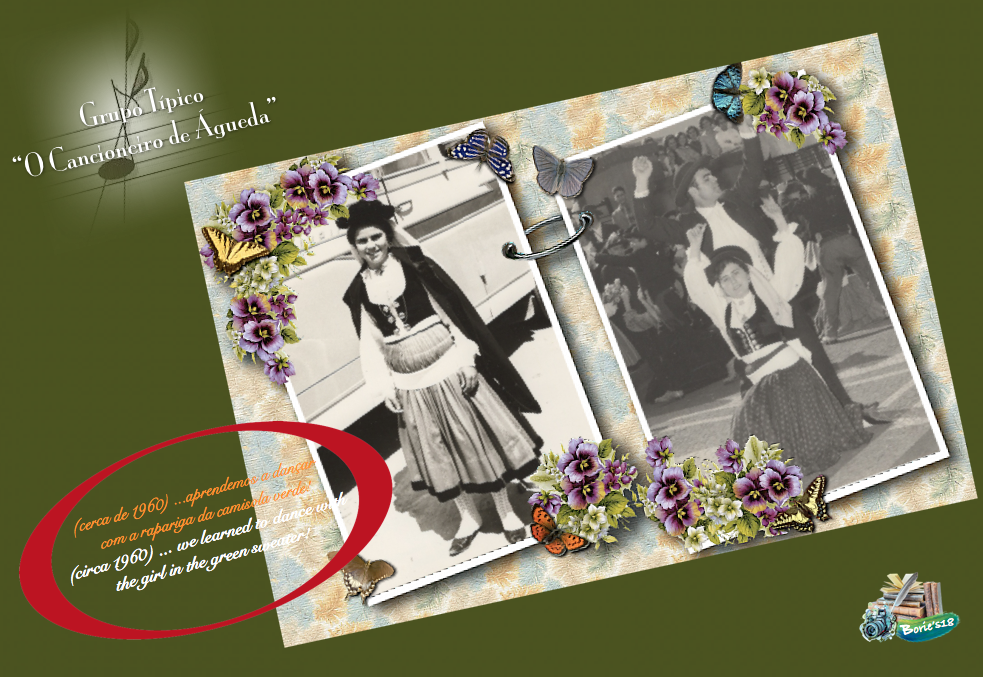
…pediu aos nossos progrenitores, se consentiam que fizéssemos parte do futuro Grupo de Folclore que se estava a organizar na vila!. Lá fomos, usando alguma roupa dos nossos irmãos mais velhos e, de alguns companheiros da escola primária, que assim que souberam da notícia, nos proporcionaram sapatos, calças e uma linda camisa!. Não havia a menor ideia do que era dançar em grupo mas, com a ajuda daquela rapariga da camisola verde, que era ainda mais linda com as mangas arregaçadas, aprendemos!. (Asked our progrenitors, if they allowed us to become part of the future Group of Folklore that was being organized in the village!. There we went, wearing some clothes from our older brothers and some of our classmates from the elementary school who, as soon as they heard the news, provided us with shoes, pants and a nice shirt!. I had no idea what it was to dance in a group, but with the help of that girl in the green sweater, who was even more beautiful with her sleeves rolled up, we learned)!.

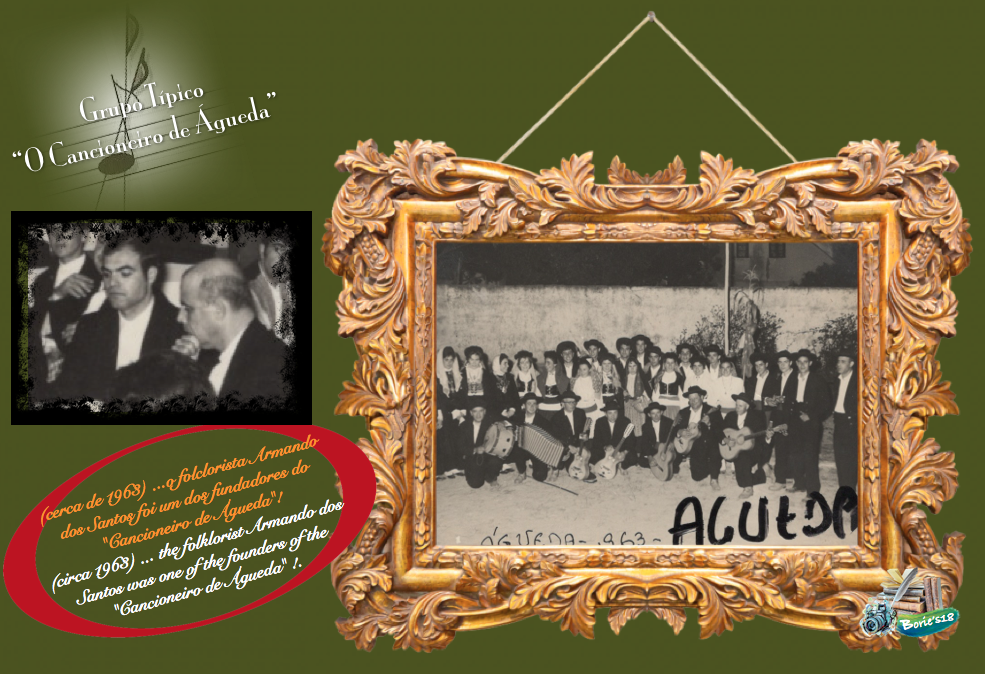
…falando um pouco de como se começou a organizar o Grupo Típico ”O Cancioneiro de Águeda”, havia naquela ocasião um grupo de pessoas, que se podia chamar de “dedicadas às tradições”, onde se destacava além da já referida Dona Maria Aguiar Guerra e Cruz, a sua irmã Maria Luciana Aguiar Guerra, o folclorista Armando dos Santos e o maestro José Soares da Costa, este acompanhado quase sempre de sua dedicada filha Maria, entre mais umas tantas personalidades, que não nos recordamos mas que de um modo ou de outro, também contribuíam para que esta organização tivesse algum sucesso!. (Talking about a bit of how the Typical Group “The Cancioneiro of Águeda” began to organize, there was a group of people on that occasion, one that could be called “dedicated to the traditions”, where it stood out beyond the aforementioned Dona Maria Aguiar Guerra and Cruz, his sister Maria Luciana Aguiar Guerra, the folklorist Armando dos Santos and the conductor José Soares da Costa, this accompanied almost always of his dedicated daughter Maria, among a few more personalities, that we remembered but of a way or another, also contributed to this organization to have some success)!.

…todavia, um pouco mais tarde, o Rui Aguiar Guerra assim com a sua irmã Estela, a Dona Orquídia Flores Lobão e mesmo nós, pois nessa ocasião também já fazíamos parte dos quadros técnicos e directivos do Grupo, dando continuação a este maravilhoso trabalho, prestigiando não só a vila de Águeda, como toda a região!. (But a little later, Rui Aguiar Guerra, along with his sister Estela, Dona Orquídea Flores Lobão and even us, since we were already part of the technical and managerial staff of the Group, continuing this wonderful work, prestigious not only the village of Águeda, as the whole region)!.

…a realização do interesse por histórias, ditos e canções, foi muito difícil de realizar naquele tempo, pois as ferramentas de pesquisa, ou os métodos de recolha eram quase primitivos!. Por exemplo, lembramo-nos de sair pela manhã, numa camionteta pequena, com uma saca do farnel, cedida com a interferência do Armando dos Santos, que no momento era funcionário da empresa de camionagem “Oliveiras”, para a região oeste/sul da Montanha do Caramulo, onde nos esperava um grupo de pessoas, exemplificando uma determinada dança, onde o Armando dos Santos, escrevinhava um desenhos num papel e o maestro José Soares da Costa ouvindo, escrevia a música!. (The realization of interest in stories, sayings and songs, was very difficult to perform at that time, because the tools of research, or the methods of collection were almost primitive!. For example, we remember going out in the morning, in a small truck, with a sack of farnel, ceded with the interference of Armando dos Santos, who was at the moment an employee of the “Oliveiras” trucking company, to the west / south region of Caramulo Mountain, where a group of people were waiting for us, exemplifying a certain dance, where Armando dos Santos wrote a drawing on a piece of paper and Jose Soares da Costa, listening to it, wrote the song)!.

…por tradição é inicialmente lembrado o comportamento das pessoas, uma vez que ele perde o seu propósito prático, não havendo razão para mais transmissão a menos que tenha sido imbuído de significado além da praticidade inicial da acção!. Este significado está no centro da folclorística, ou seja, o estudo do folclore!. Por exemplo, numa dessas deslocações, para aprender-mos os usos e costumes dos nossos antepassados, ao verem-nos chegar a determinada aldeia, as pessoas fugiam para suas casas, pois tinha começado a Guerra do Ultramar Português, pensando essas pessoas que a nossa ida àquela aldeia era para recolha de sangue, para os soldados que lutavam na África em defesa da bandeira do seu país, então com um governo com tendências coloniais!. (By tradition is initially remembered the behavior of people, since it loses its practical purpose, there being no reason for further transmission unless it has been imbued with meaning beyond the initial practicality of action!. This meaning is at the heart of folklore, that is, the study of folklore!. For example, in one of these trips, to learn the customs and customs of our ancestors, when they saw us coming to a certain village, people fled to their homes, since the Portuguese Overseas War had begun, thinking these people that ours to that village was for blood collection, for the soldiers who fought in Africa in defense of the flag of their country, then with a government with colonial tendencies)!.

…lembramo-nos de o Armando dos Santos, que sempre demonstrou uma certa simpatia por nós, creio que as nossas famílias foram cruzadas algumas décadas atrás, nos dizer:

– vamos ser um Grupo de Folclore que, com a minha experiência neste campo, vai mostrar ao País a beleza de toda a região da Beira Litoral!. Os senhores de Lisboa reprovaram-nos quando lá levámos o Rancho Tricanas da Rua D’ Além, da aldeia de Assequins, que na verdade usava roupas brilhantes, mas este Grupo Típico é demonstrativo dos usos e costumes desta bonita região!.

…como tinha razão o grande folclorista Armando dos Santos!.

(we remember Armando dos Santos, who has always shown a certain sympathy for us, I believe our families were crossed a few decades ago, to tell us:

– we will be a Folklore Group that, with my experience in this field, will show the Country the beauty of the entire region of Beira Litoral!. The lords of Lisbon reproached us when we took the Tricanas Ranch from Rua D ‘Além, from the village of Assequins, which actually wore bright clothes, but this Typical Group is a demonstration of the customs and customs of this beautiful region!.

As the great folklorist Armando dos Santos was right)!.

…a palavra folclore, também podemos dizer que representa a voz do povo, também inclui o conhecimento costumeiro, as formas e rituais de celebrações como a Páscoa ou o Natal, ou até uma celebração de casamento, assim como danças, canções ou ritos de iniciação!. Cada um deles, individualmente ou em combinação, pode ser considerado um artefacto folclórico!. (The word folklore, we can also say that it represents the voice of the people, it also includes customary knowledge, forms and rituals of celebrations such as Easter or Christmas, or even a wedding celebration, as well as dances, songs or rites of initiation!. Each of them, individually or in combination, can be considered a folk artifact)!.

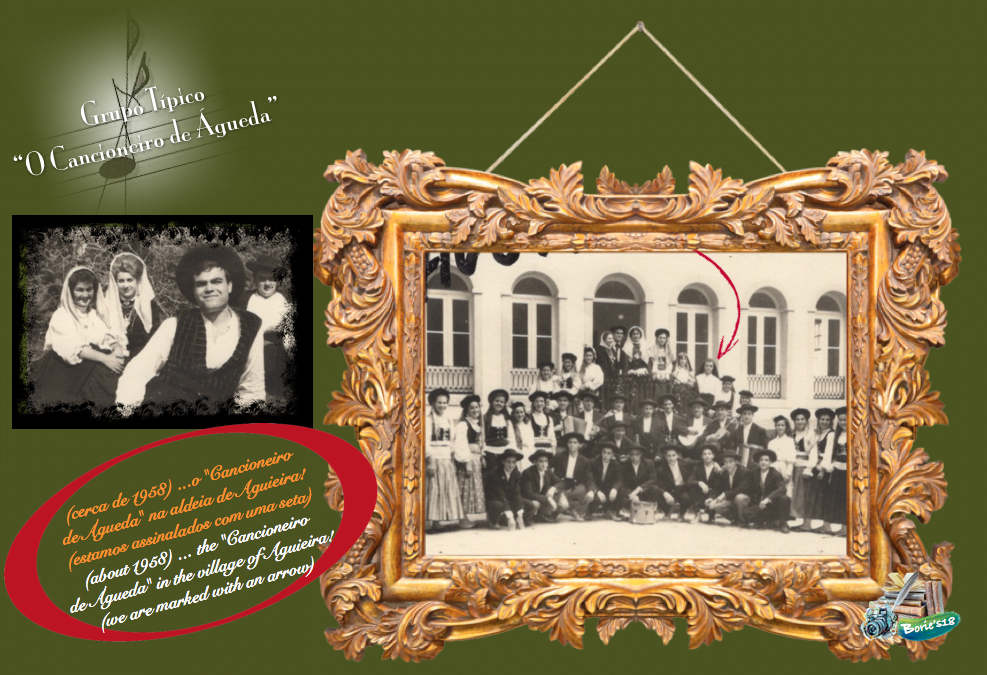
…foi por volta do ano de 1957, que fizémos a primeira apresentação!. Ainda estávamos em formação, portanto o Grupo não dançou, só desfilou, sendo muito aplaudido!. Foi nas festas da cidade de Braga e a convite, cremos nós, da cidade, mas com a interferência do “Grupo de Folclore Gonçalo Sampaio” da cidade de Braga!. (It was around the year 1957, that we did the first presentation!. We were still in training, so the group did not dance, just paraded, being very applauded!. It was at the festivals of the city of Braga and the invitation, we believe, of the city, but with the interference of the “Group of Folklore Gonçalo Sampaio” of the city of Braga)!.

…tão essencial quanto a sua forma, o folclore também abrange a transmissão desses artefatos de uma região para outra ou de uma geração para a seguinte!. Pois o folclore não é ensinado em um currículo escolar formal ou estudado nas artes plásticas!. Em vez disso, essas tradições são transmitidas informalmente de um indivíduo para outro, seja por meio de instrução verbal ou demonstração, como tal foram alguns elementos do Rancho das Tricanas da Rua D’Além, da aldeia de Assequins, que transitaram para o Grupo Típico, já experientes em palco, que ensinaram os mais novos, tal como nós, que nos iniciávamos!. (As essential as its form, folklore also covers the transmission of these artifacts from one region to another or from one generation to the next!. For folklore is not taught in a formal school curriculum or studied in the plastic arts!. Instead, these traditions are transmitted informally from one individual to another, either through verbal instruction or demonstration, as such were some elements of the Rancho das Tricanas from Rua D’Além, from the village of Assequins, who transited to the Typical Group , already experienced on stage, who taught the younger, just like us, that we started)!.

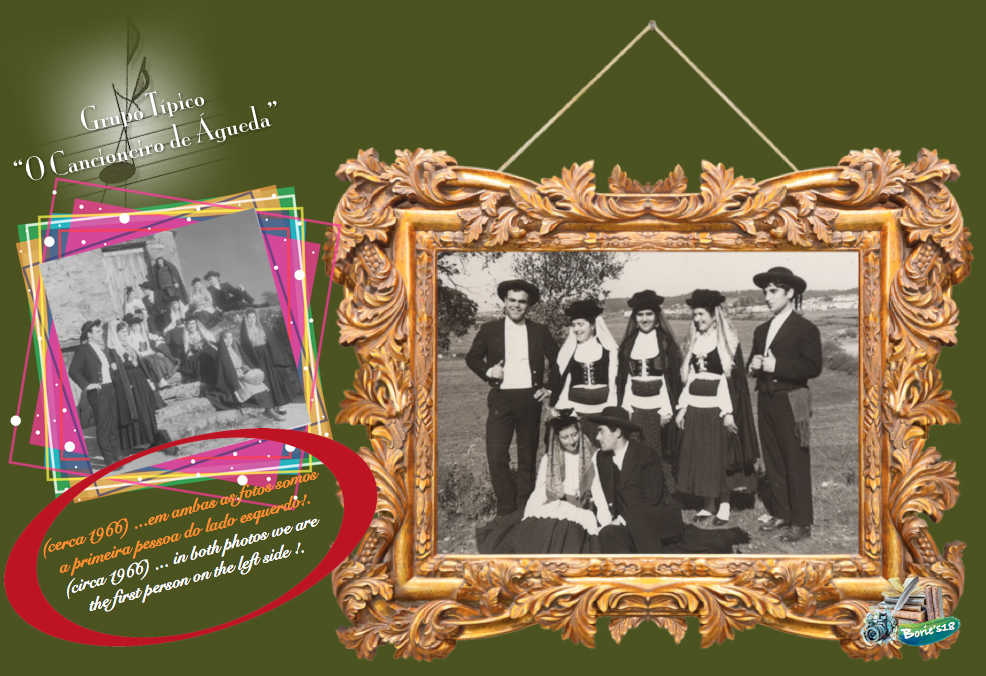
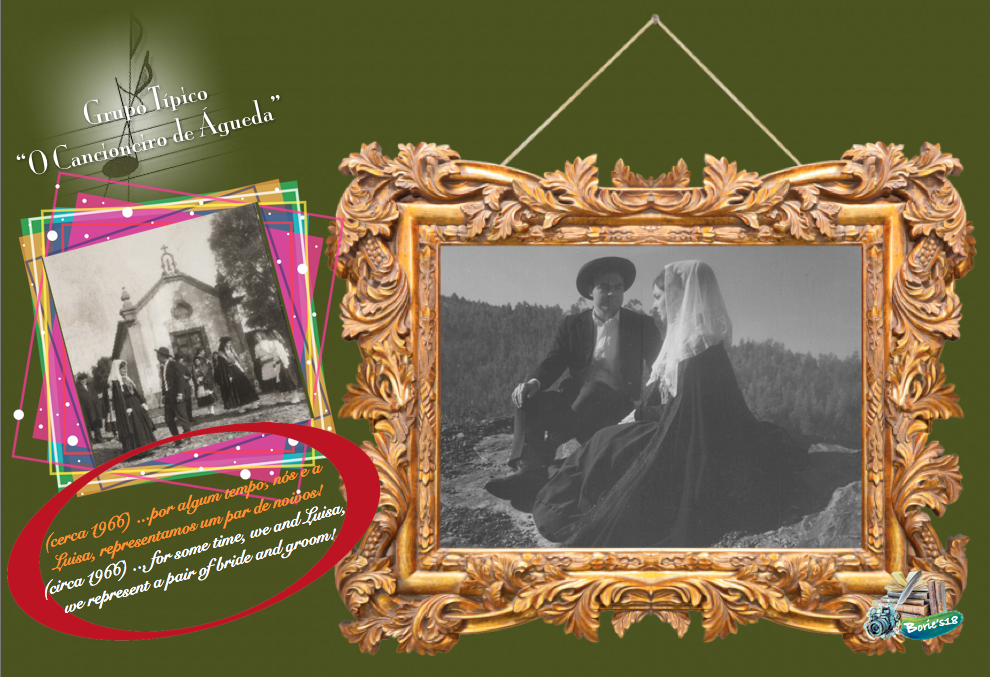
…quando começámos a percorrer o País, as pessoas paravam, admiravam a beleza dos trajes, principalmente os representativos de “Noivos”, ou da “Lavradeira Rica”, ou do de “Ver a Deus”, ou mesmo as danças, que mostravam uma coreografia lenta e bonita, tal como as pessoas que habitavam aquela vertente agreste da Montanha do Caramulo, que viam o tempo passar, pastoreando os seus rebanhos, com as nuvens bem perto de si!. (When we began to walk the country, people stopped, they admired the beauty of the dress, especially the representatives of “Noivos” (Bridegrooms), or “Lavradeira Rica” (Rich Farmer), or of “Vêr a Deus” (See God), or even the dances, which showed a slow and beautiful choreography, just like the people who lived on that rugged mountain slope of Caramulo Mountain, who saw the time passing, shepherding their flocks, with the clouds very close to themselves)!.

…alguma fama chegou, a Rádio Televisão Portuguesa, a preto branco, requisitava a presença do Grupo, tanto nos estúdios do Monte da Virgem, no Norte do País como nos estúdios da capital Lisboa!. Os folcloristas europeus, tal como o poeta escritor Pedro Homem de Melo, permaneciam focados no folclore oral das populações camponesas homogéneas em suas regiões, sendo este poeta escritor oriundo da então vila de Águeda, (padrinho de baptismo da nossa mãe Ilda), teve alguma influência nestas frequentes exibições na Televisão Portuguesa!. (Some fame arrived, the Portuguese Radio Televisión, in black white, requested the presence of the Group, both in the studios of Monte da Virgem, in the North of the Country and in the studios of the capital Lisbon!. European folklorists, like the poet writer Pedro Homem de Melo, remained focused on the oral folklore of homogeneous peasant populations in their regions, being this poet writer from the village of Águeda, (godfather of our mother Ilda’s baptism), had some influence on these frequent exhibitions on Portuguese Television)!.

…havia uma particularidade do poeta escritor Pedro Homem de Melo, que sempre que apresentava o nosso Grupo Típico “O Cancioneiro de Águeda” na televisão, começava, enfrentando as câmaras, concentrando a sua voz naquele poema que deixava logo a perceber que era o seu grupo de folclore preferido que ia actuar a seguir, recitando sempre:

Com as crianças da vila,
Fui outrora à Comunhão.
Com elas, em procissão.
Também dei a volta à vila.
As rãs cantavam no campo!.
Os campos eram jardins.
Com os rapazes da vila
Também fui a alumiar
Pela estrada de Assequins…
Vinha o domingo de Páscoa!
E quando o Senhor entrava
No átrio da nossa casa,
Pegando na Cruz, bendita,
O meu pai, então rezava,
Minha mãe ajoelhava…
Toda a família ajoelhava!
E eu sonhava,
E a Cruz, bendita,
Pelos meus lábios passava…

(There was a peculiarity of the poet writer Pedro Homem de Melo, that whenever he presented our Typical Group “The Cancioneiro of Águeda” on television, he began, facing the chambers, concentrating his voice on that poem that he soon realized that it was his favorite group of folklore that would act next, always reciting:

With the children of the village,
I was once in Communion.
With them, in procession.
I also went back to the village.
The frogs sang in the field!
The fields were gardens.
With the boys from the village
I also went to light
Along the Assequins road …
Easter Sunday was coming!
And when the Lord entered
In the atrium of our house,
Taking the Cross, blessed,
My father then prayed,
My mother was kneeling …
The whole family was kneeling!
And I dreamed,
And the Cross, blessed,
Through my lips I passed …

…e depois de uma pequena pausa, dando mostra de alguma emoção, terminava, falando um pouco mais alto, abrindo os braços ao céu:

Anjos! Rosmaninho! Andores!
Incenso do meu País!
Igreja de Santa Eulália!.
Onde está a nossa raíz!

(And after a little pause, showing some emotion, he would finish, speaking a little louder, opening his arms to the sky:

Angels! Rosemary! Saints and andores!
Incense of my Country!
Church of Santa Eulalia !.
Where is our root)!.

…o Grupo Típico, tinha uma carteira de convites, que nos fazia seleccionar onde era mais conveniente para o nosso solista Armindo dos Santos, ser ouvido, pois entre outras, o Malhão de Águeda, já era quase um hino nacional, onde alguns profissionais da música, com fama internacional o imitavam!. O Armindo dos Santos, tinha o previlégio de possuir uma voz única e, quando cantava, dizendo que, “Moreninha do Convento, não hei-de casar contigo, nem hei-de de te deixar casar”, fazia as pessoas rirem, chorar, emocionarem-se, entusiasmarem-se, gritarem, algumas querendo mesmo subir ao palco e abraçarem-no!. (The Typical Group, had a portfolio of invitations, which made us select where it was more convenient for our soloist Armindo dos Santos, to be heard, since among others, Malhão de Águeda, was almost a national anthem, where some music professionals with international fame imitated it!. Armindo dos Santos had the privilege of having a unique voice and when he sang, saying that “Moreninha do Convento, I will not marry you, nor will I let you marry”, it made people laugh, cry, to get excited, to get excited, to shout, some even wanting to take the stage and hug him)!.

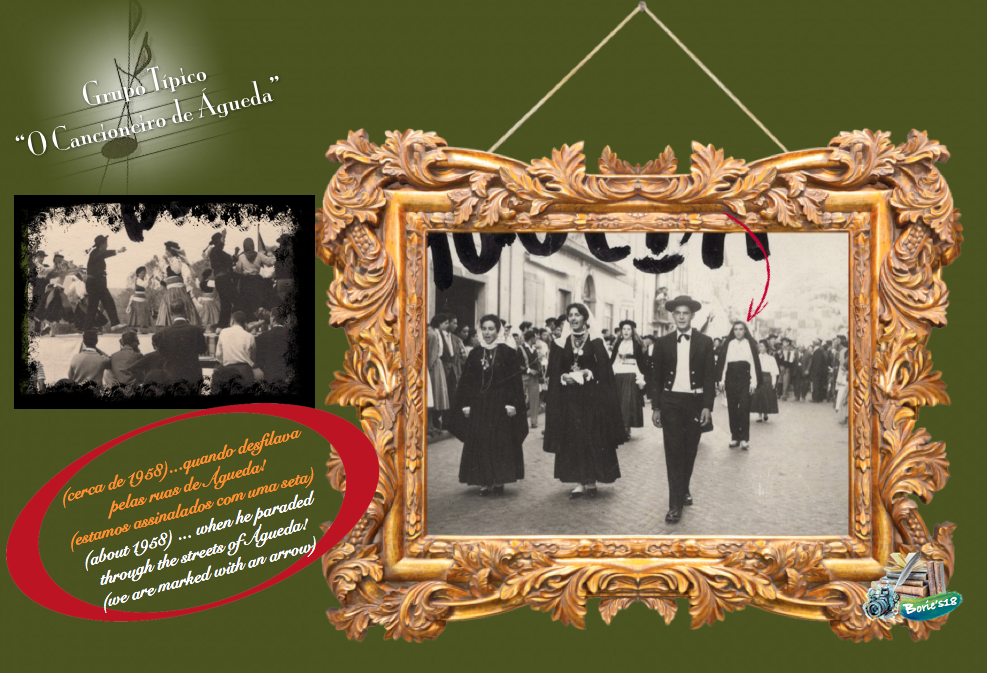
…o Grupo Típico “O Cancioneiro de Águeda”, foi sempre acarinhado pela população da vila, principalmente quando desfilava nas suas ruas, onde muitas famílias colocavam bonitas e coloridas colchas nas janelas de suas casas, assim como estava sempre presente, não o Grupo completo, mas alguns elementos vestidos a rigor, quando havia qualquer cerimónia nos Paços do Conselho, recebendo qualquer entidade governativa!. (The Typical Group “The Cancioneiro of Águeda”, was always cherished by the population of the village, especially when it paraded in its streets, where many families put beautiful and colorful quilts in the windows of their houses, just as it was always present, not the complete Group, but some elements dressed up, when there was any ceremony in the Council Pairs, receiving any government entity)!.

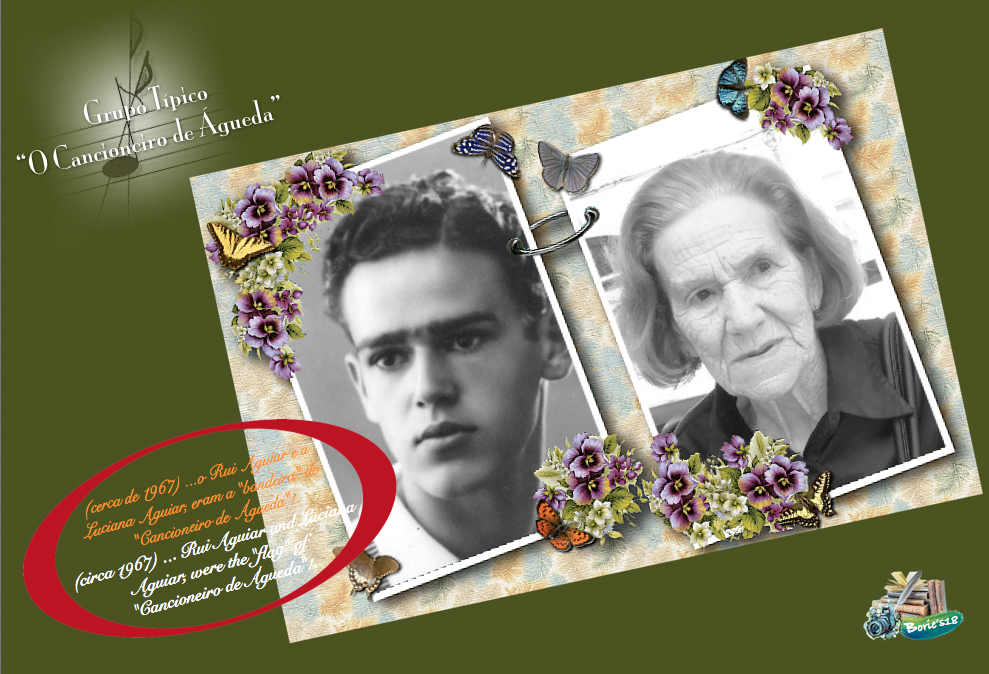
…a sua bandeira, foi ideia de Dona Maria Aguiar Guerra e Cruz, com o consentimento imediato de Armando Santos, que não queria nada com cores brilhantes, depois do Rui Aguiar ler umas frazes do livro “Águeda” de Adolfo Portela!. (His banner was the idea of Dona Maria Aguiar Guerra and Cruz, with the immediate consent of Armando Santos, who wanted nothing with bright colors, after Rui Aguiar read some frazes from the book “Águeda” by Adolfo Portela)!.

…o Rui Aguiar, era uma pessoa culta, sabia ouvir e gostava que também que o ouvissem, principalmente, quando privávamos, pois éramos amigos, algumas pessoas até nos interrogavam se éramos irmãos!. Alguns dias, íamos ao fim do dia até à aldeia de Castrovães, onde se iniciava um grupo de folclore e onde colaborávamos, ensinando algumas danças!. Na viajem, o Rui dizia-nos que o livro Águeda de Adolfo Portela, exemplificava o que era Águeda perfeitamente e a razão da bandeira do “Cancioneiro de Águeda”!. Sabia de cor algumas frazes lá escritas, como por exemplo, quando declamava:

…e logo as sachadeiras se despojam dos seus aventais mais garridos, para armar a bandeira, em cujo cimo o patrão dependura o saquinho do queijo e do pão, o lenço dos temoços e das azeitonas, a cabacinha da água pé…!.

(Rui Aguiar, was a cultured person, knew how to listen and liked that they also heard it, especially when we deprived, because we were friends, some people even questioned us if we were brothers!. Some days, we would go to the end of the day to the village of Castrovães, where we started a folklore group and where we collaborated, teaching some dances!. On the journey, Rui told us that the book Águeda by Adolfo Portela, exemplified what Águeda was perfectly and the reason for the “Cancioneiro of Águeda” flag!. He knew by heart some of the frazes written there, for example, when he declaimed:

… and soon the scaffolders strip off their gaudier aprons to arm the flag, on whose top the boss hangs the cheese and bread sachet, the scarf and the olives, the foot of the water standing…)!.

…e continuava declamando até que chegávamos ao nosso destino!.

…também nos dizia que lá no livro se explicava que, “se houvesse de fazer-se algum dia a caricatura de Águeda, bastaria figurá-la com uma nota de música e com foguetes na cauda”!.

(And kept on declaiming until we reached our destination!

… also told us that in the book it was explained that “if the caricature of Águeda were ever to be made, it would suffice to picture it with a note of music and with rockets on the tail”)!.

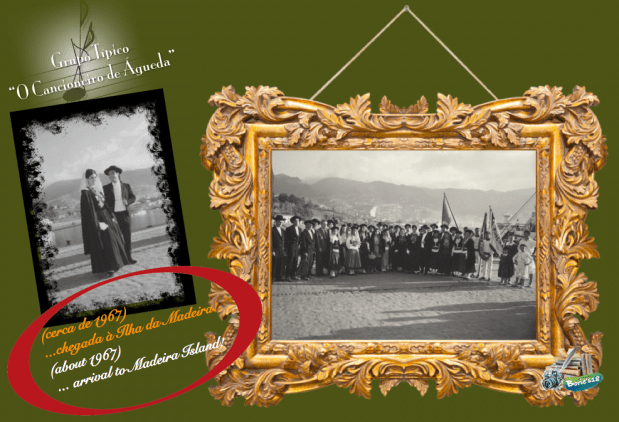
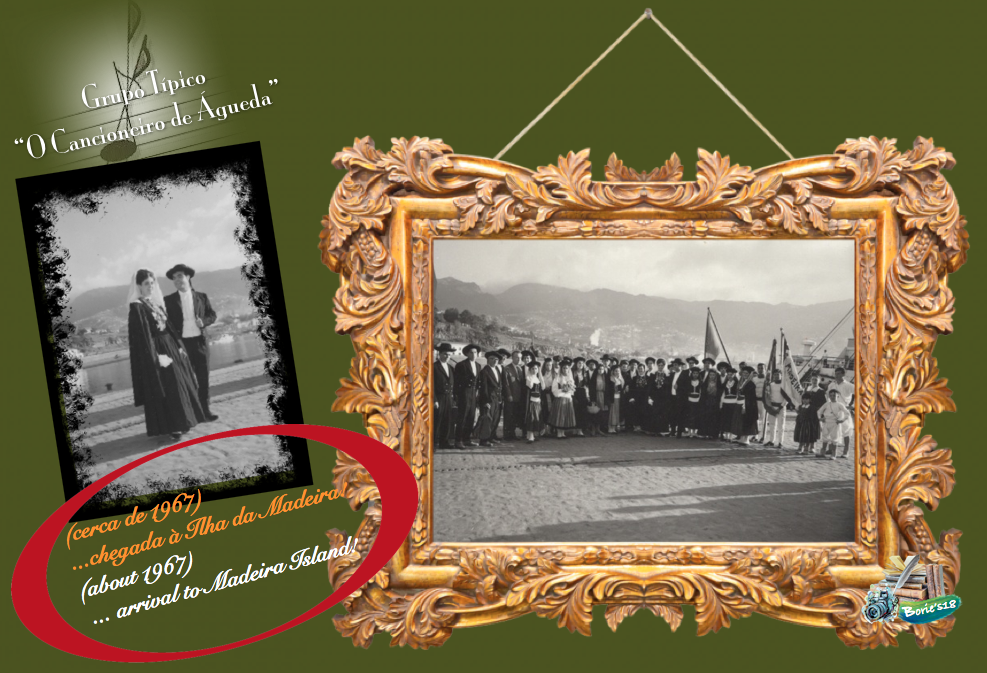
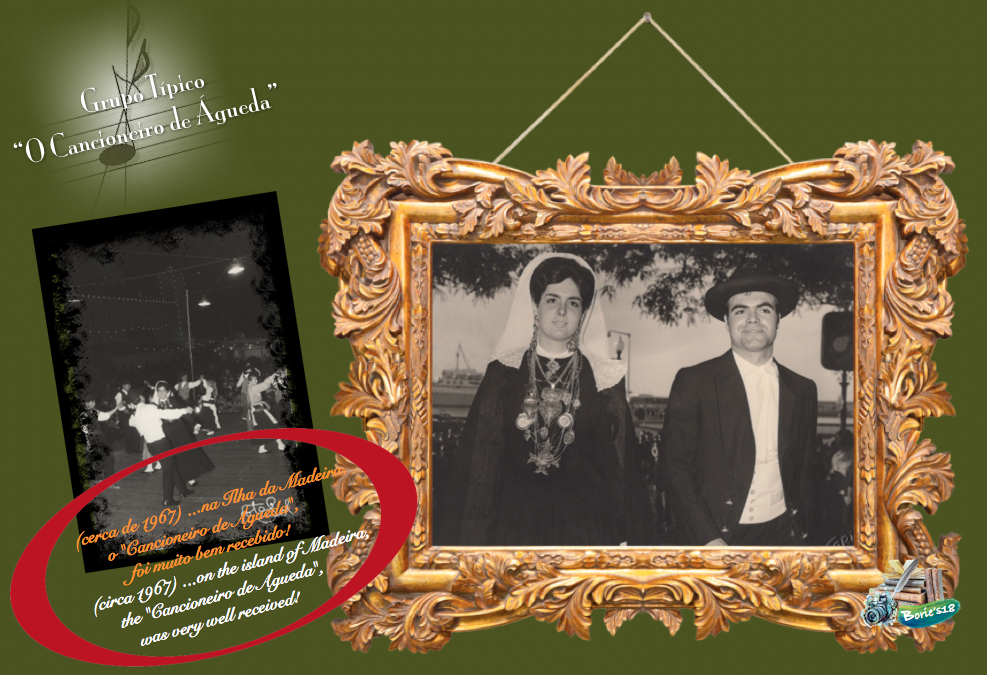
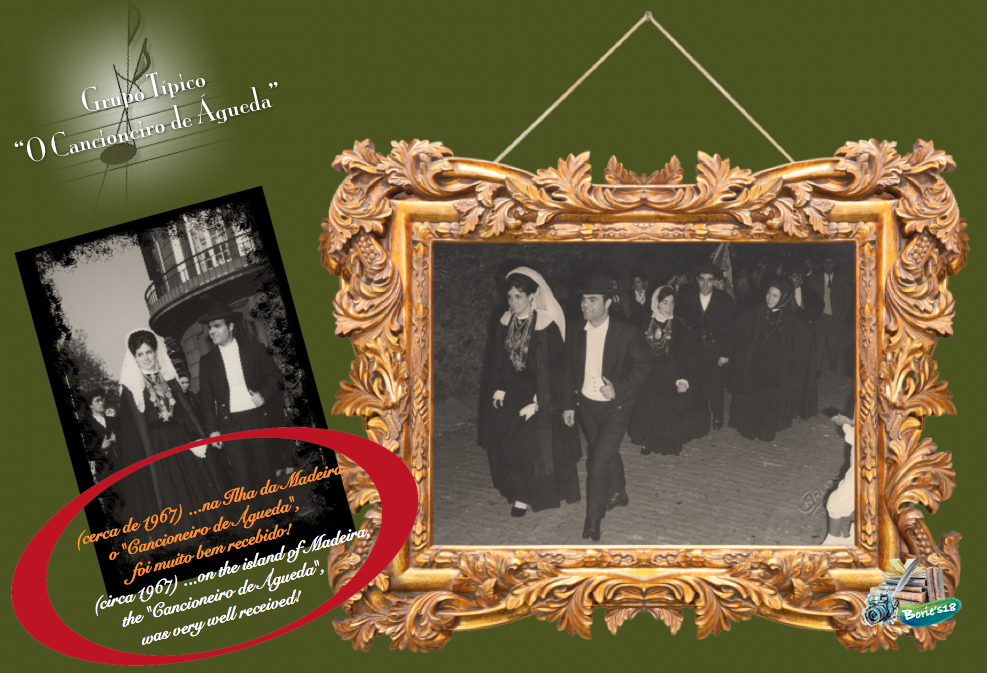
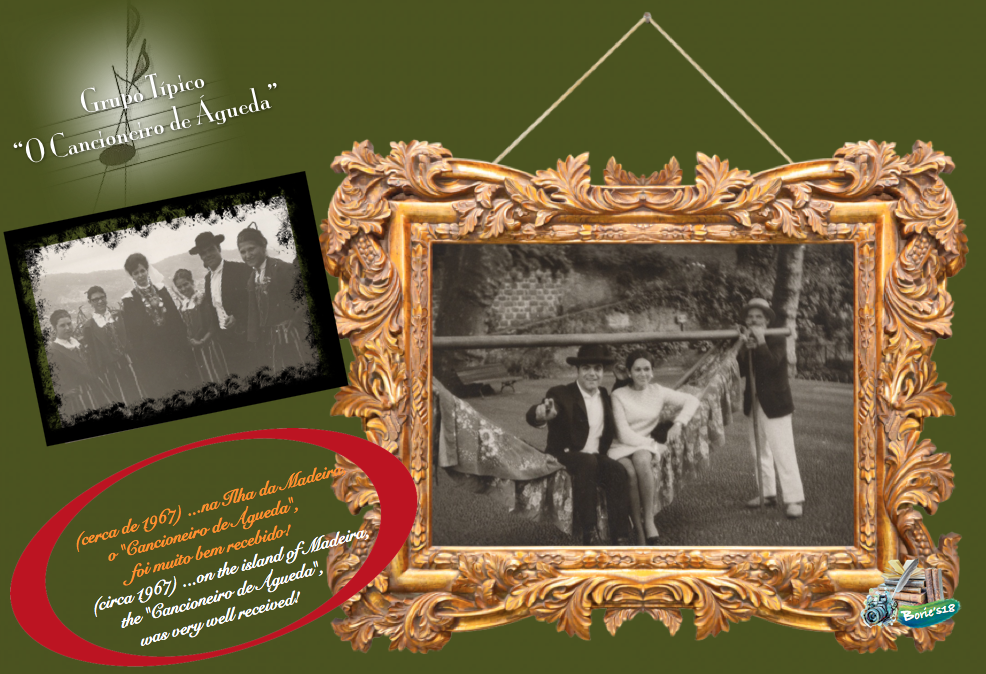
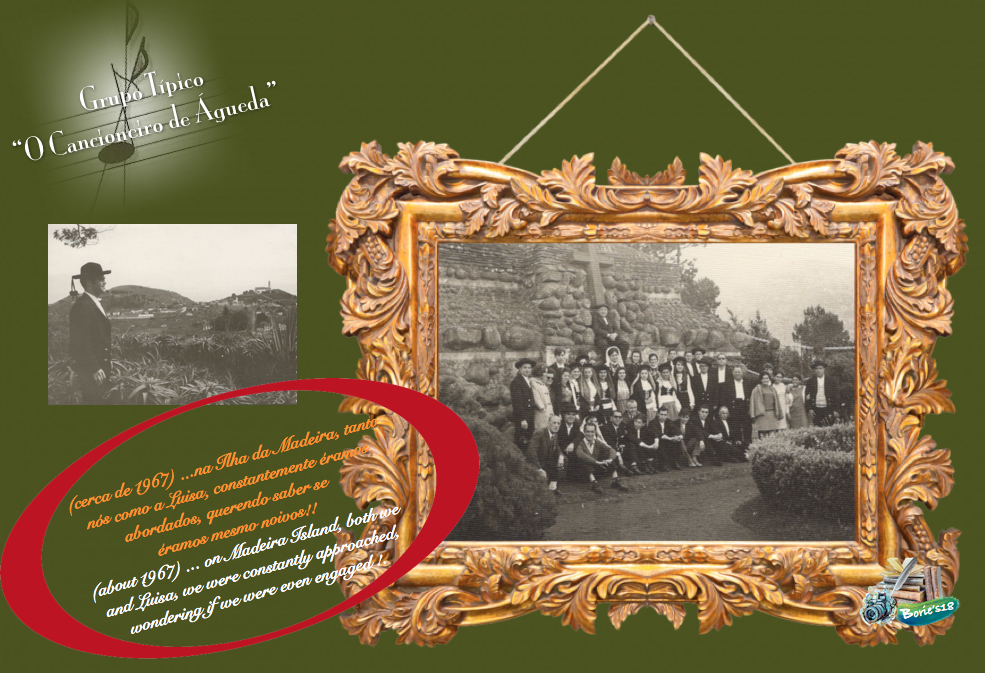
…tivémos convites do estrangeiro, principalmente de França e da Espanha, todavia era por um período de tempo excessivo para a vida de um vulgar agricultor, empregado de uma oficina metalúrgica ou de um professor escolar, portanto alguns desses convites foram declinados, com a indicação de outros grupos de folclore, com os quais mantínhamos as melhores relações, no entanto houve dois convites que não recusámos!. Foi no ano de 1967, para a Ilha da Madeira, do qual fomos nós, como responsáveis por parte orientação directiva, um dos elementos do grupo mais activos, assim como também numa ida a Espanha, mais propriamente a Santigo de Compostela, uns anos depois, realizando a primeira internacionalização do grupo!. (We had invitations from abroad, mainly from France and Spain, but it was too long for the life of a vulgar farmer, a metalworker or a schoolteacher, so some of these invitations were declined with other groups of folklore, with which we had the best relations, however there were two invitations that we did not refuse!. In 1967, we went to the island of Madeira, of the most active members of the group, as well as a trip to Spain, more precisely to Santigo de Compostela, a few years later, performing the first internationalization of the group)!.

…na Ilha da Madeira, durante o tempo que lá estivémos, recebemos toda a atenção, mesmo fora do vulgar a que estávamos acostumados!. As pessoas eram amáveis, recebíamos convites para casa de algumas jovens que nos seguiam durante o dia, não lhes interessando o lugar para onde nos deslocávamos!. Éramos abordados na rua, com perguntas que por vezes nos deixavam um pouco embaraçados, mas inocentes, só querendo saber coisas que lhes pareciam, mas que na verdade não eram! Nunca mais esquecemos o povo da Ilha da Madeira!. (On the Island of Madeira, during the time we were there, we received all the attention, even outside the vulgar one to which we were accustomed!. The people were kind, we received invitations to the home of some young people who followed us during the day, not caring about where we were moving!. We were approached on the street with questions that sometimes left us a bit embarrassed, but innocent, only wanting to know things that seemed to them, but that they really were not!. We have never forgotten the people of Madeira)!.

…isto é a razão porque os povos se amam e se compreendem e, para se entender completamente o “folclore”, é útil esclarecer as suas partes componentes, como por exemplo os termos “folk” e “lore”!. Numa pequena busca, encontramos documentado que o termo foi cunhado em 1846 pelo inglês William Thoms!. Ele o inventou para substituir a terminologia contemporânea de “antiguidades populares” ou “literatura popular”!. A segunda metade da palavra composta, “lore”, mostra-se mais fácil de definir, já que seu significado permaneceu relativamente estável nos últimos dois séculos, vindo da antiga instrução “lar”, da língua inglesa, que nos mostra o conhecimento e as tradições de um grupo particular, frequentemente transmitido de boca em boca!. (This is the reason why people love and understand each other and, in order to fully understand “folklore”, it is useful to clarify their component parts, such as the terms “folk” and “lore”!. In a small quest, we find documented that the term was coined in 1846 by Englishman William Thoms!. He invented it to replace the contemporary terminology of “popular antiquities” or “popular literature”! .The second half of the compound word, “lore”, is easier to define, since its meaning remained relatively stable in the last two centuries, coming from the old “home” instruction of the English language, which shows us knowledge and traditions of a particular group, often transmitted by word of mouth)!.

…as tradições folclóricas, cresceram tanto na Europa, quanto na América do Norte, onde ainda hoje existem pesquisas de culturas nativas americanas, tentando compreender a totalidade dos seus costumes e crenças!. (Folklore traditions have grown both in Europe and in North America, where even today there are surveys of Native American cultures, trying to understand the totality of their customs and beliefs)!.

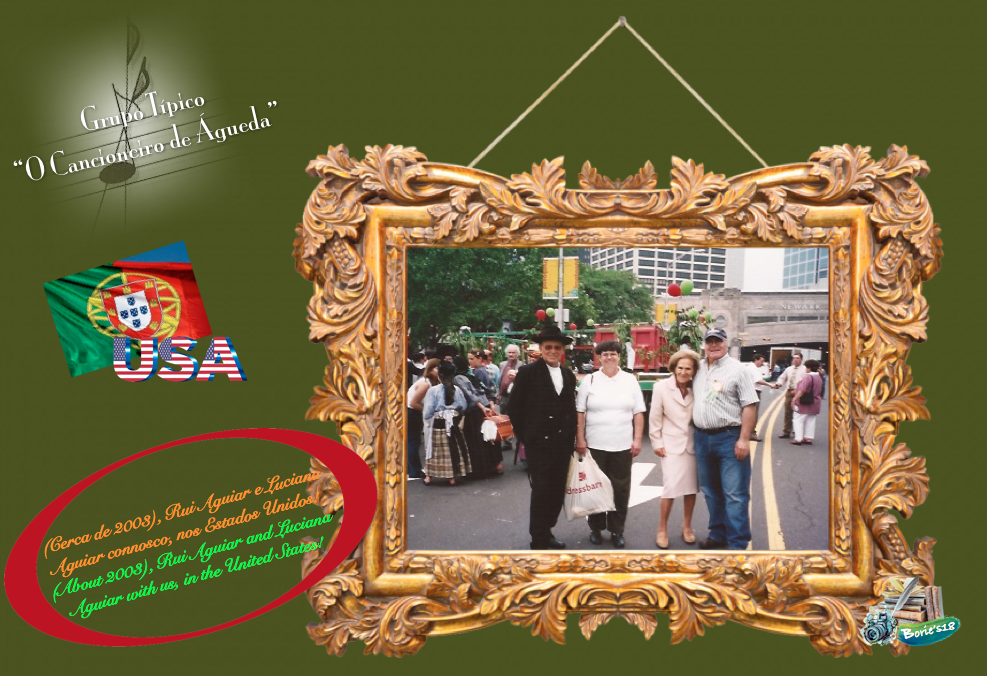
…como tal, quando vivíamos no norte, trabalhámos para que o Grupo Típico “O Cancioneiro de Águeda”, visitasse os Estados Unidos!. Depois de algumas reuniões de trabalho, formámos um grupo coeso, ciente das suas responsabilidades, para que o Grupo Típico “O Cancioneiro de Águeda”, nos visitasse, transmitindo uma parte vital das crenças e costumes dentro de um grupo no espaço e no tempo, mostrando às pessoas americanas os fragmentos culturais e os artefactos folclóricos transmitidos informalmente, como regra de forma anónima e sempre em múltiplas variantes!. (As such, when we lived in the north, we worked so that the Typical Group “The Cancioneiro of Águeda”, visited the United States!. After some work meetings, we formed a cohesive group, aware of their responsibilities, so that the Typical Group “The Cancioneiro of Águeda” visited us, transmitting a vital part of the beliefs and customs within a group in space and time, showing American people the cultural fragments and folk artifacts transmitted informally, as a rule anonymously and always in multiple variants)!.

…esta foi a nossa última contribuição, para dar a conhecer a origem, no seu próprio conjunto de lendas urbanas, daquilo a que chamamos de folclore oral do campesinato europeu da época que, hoje com uma sofisticação cada vez mais teórica das ciências sociais, tornou-se evidente que o folclore é uma componente natural e necessário de qualquer grupo social e, na verdade não precisamos de ser antigos nem antiquados, pois continua a ser criado, transmitido e em qualquer grupo é usado para diferenciar entre “nós” agora, e “eles” no passado!. (This was our last contribution, to make known the origin, in its own set of urban legends, of what we call oral folklore of the European peasantry of the time, which, today, with an increasingly theoretical sophistication of the social sciences , it has become evident that folklore is a natural and necessary component of any social group and in fact we do not need to be old or outdated as it continues to be created, transmitted and in any group is used to differentiate between “we” now , and “them” in the past)!.

…hoje, do lado de cá do oceano Atlântico, lembramos a vila de Águeda, principalmente a nossa aldeia, lá na vertente agreste da Montanha do Caramulo, onde a crosta terrestre, lentamente começava a ser plana, flutuando por perto as zonas ribeirinhas do Rio Águeda, onde pela noite, não havendo luz eléctrica, se a terra tremesse, nascendo dos céus uma pequena luz, que seria uma qualquer estrela, talvez uma estrela nova, daquelas que fazem oscilar um continente, ninguém dava por nada!. (Today, on the Atlantic side of the Atlantic, we remember the village of Águeda, especially our village, there on the rugged slope of Caramulo Mountain, where the earth’s crust slowly began to be flat, floating near the riverine areas of the Águeda River, where at night, there being no electric light, if the earth trembled, a small light rising from the sky, which would be any star, perhaps a new star, those that make a continent flutter, no one gave a damn)!.

…todavia, passado mais de seis décadas, lembramos com ternura o Grupo Típico “O Cancioneiro de Águeda”, sentindo que foi uma benção do destino contribuir para a sua fundação e, para o seu contributo na divulgação dos usos e costumes da região onde nascemos, estando gratos a esta instituição pelos benefícios que nos ofereceu enquanto pessoa jovem, preparando-nos como ser humano, para enfrentar o mundo com aqueles princípios de dignidade que todos devemos ter, se queremos que este mundo se torne num lugar mais agradável para se viver e que, de outra maneira jamais conseguiríamos, dado ao local e ambiente de aldeia do interior, onde nascemos, onde não tivémos nunca oportunidade de continuar a frequentar a escola, só mais tarde e em outro país o conseguimos fazer!. (Nevertheless, after more than six decades, we remember with tenderness the Typical Group “The Cancioneiro of Águeda”, feeling that it was a blessing of the destiny to contribute to its foundation and, for its contribution in spreading the customs and customs of the region where we were born, being grateful to this institution for the benefits it offered us as a young person, preparing ourselves as a human being, to confront the world with those principles of dignity that we should all have if we want this world to become a more pleasant place to if we live and that we would never otherwise, given the place and environment of the village in the interior, where we were born, where we never had the opportunity to continue to attend school, only later and in another country we can do it)!.

Tony Borie, September 2018.

…we returned to the south!.

…we returned to the south!.


…voltamos ao sul!. (we returned to the south)!.

…não rumo ao Polo Sul, onde as temperaturas de inverno podem chegar aos 130 graus Fahrenheit, onde num normal dia, existem ocasionais rajadas de vento que têm a força de um furacão ou, onde naquele lugar remoto, em caso de necessidade, entre outras coisas, não é lá muito fácilmente acessível a qualquer equita médica ou qualquer outro tipo de ajuda!. (Not towards the South Pole, where winter temperatures can reach 130 degrees Fahrenheit, where on a normal day, there are occasional gusts of wind that have the force of a hurricane or, where in that remote place, in case of need, among other things, is not very easily accessible to any medical doctor or any other type of help)!.

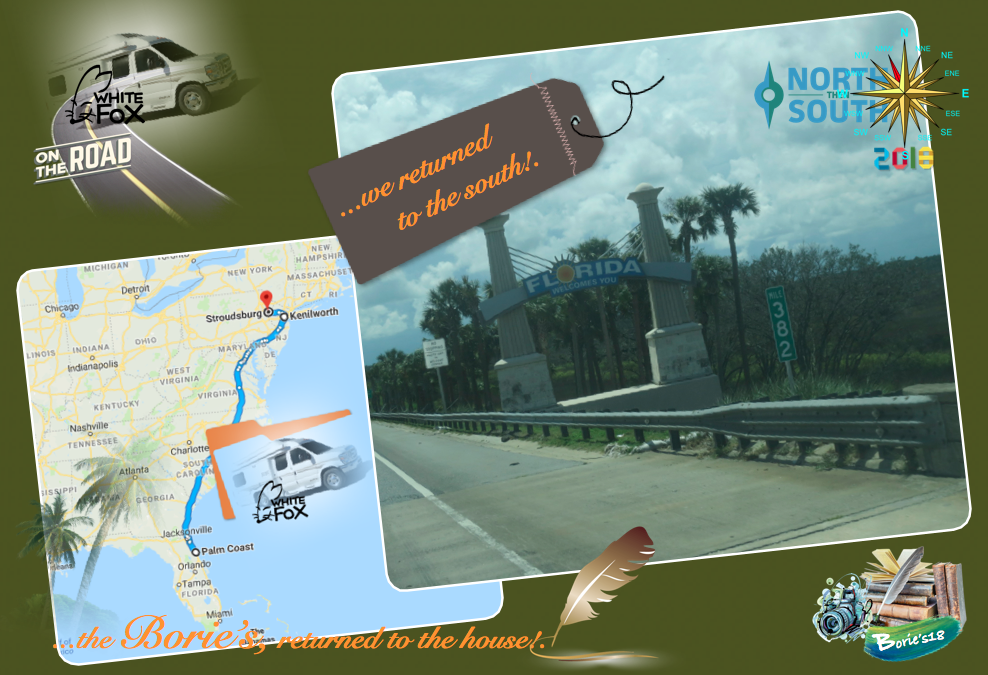
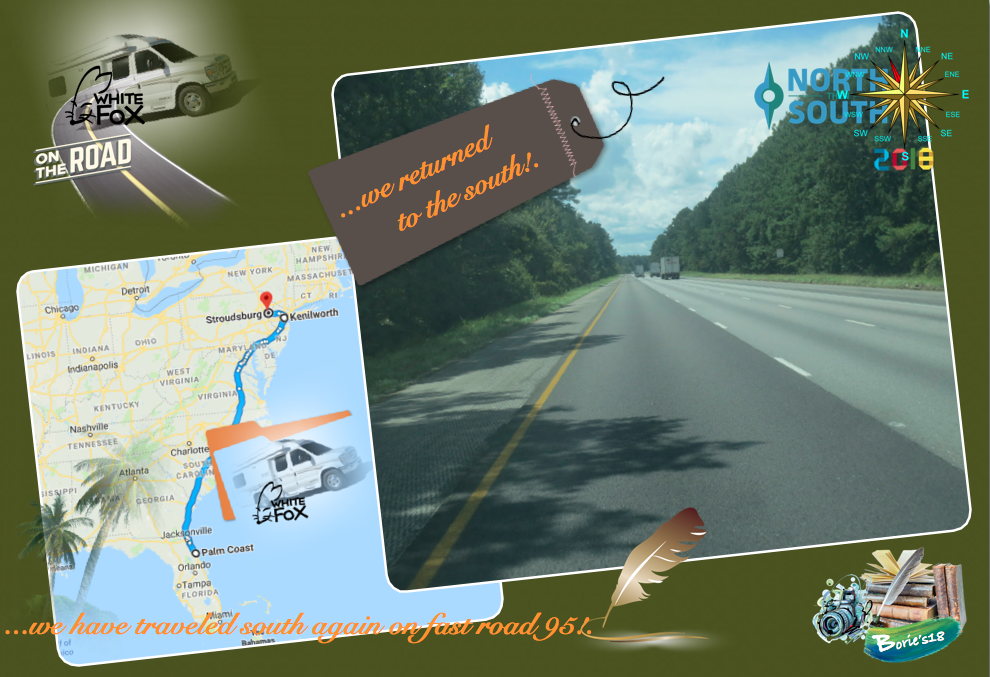
…viajámos para sul, de novo na estrada rápida 95, sempre cumprindo as normas da velocidade imposta, no conforto da nossa “White Fox”, onde existe quase todo o tipo de ajuda, como locais de descanso, estações de abastecimento, restaurantes, ou em caso de necessidade, até mesmo hospitais!. (We have traveled south again on fast road 95, always meeting the standards of speed imposed, in the comfort of our “White Fox”, where there is almost every kind of help, such as resting places, filling stations, restaurants, or in case of need, even hospitals !.

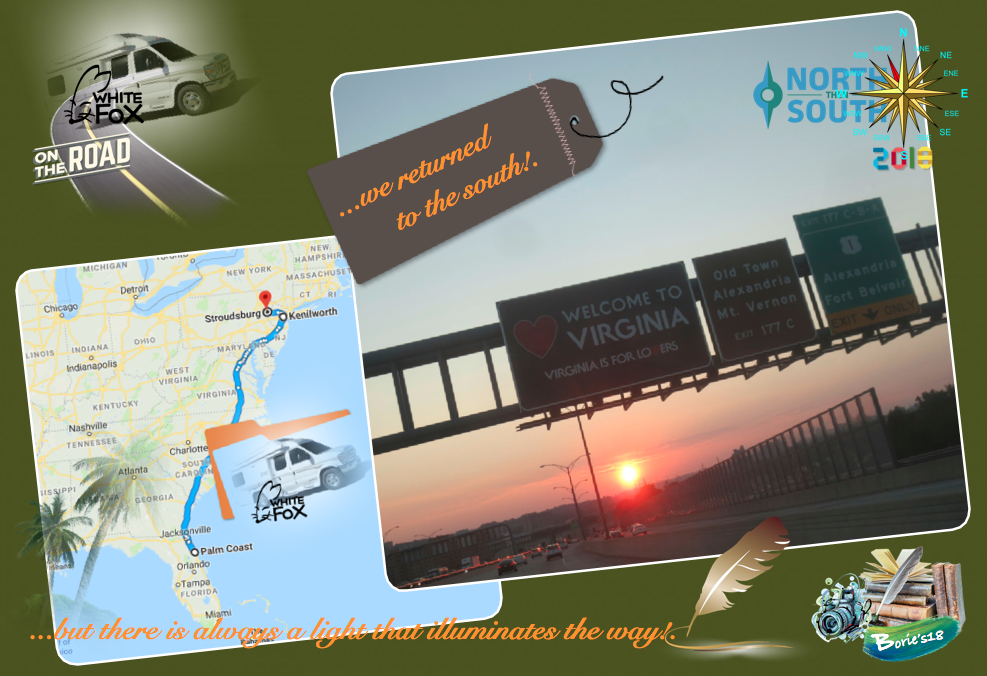
…era o returno a casa, ao nosso lar, sabendo que ninguém pode voltar e fazer um novo começo, todavia qualquer um nós pode começar a partir de agora e, fazer um novo final, assim como não há promessa de dias sem dor, riso sem tristeza ou sol sem chuva, mas existe sempre uma luz que nos ilumina o caminho, pois desapontamentos são como as colisões de estradas, atrapalham-nos um pouco, mas lá para diante, a estrada fica suave e, pelo menos na nossa já um pouco avançada idade, não é lá muito aconselhável ficar nas colisões da vida por muito tempo!. (It was the returno the house, to our home, knowing that no one can come back and make a new beginning, however anyone we can start from now and, make a new end, just as there is no promise of days without pain, laughter without sadness or sun without rain, but there is always a light that illuminates the way, for disappointments are like road collisions, they disturb us a little, but then forward, the road becomes soft and, at least in our already a little advanced age, it is not very advisable to stay in the collisions of life for long)!.

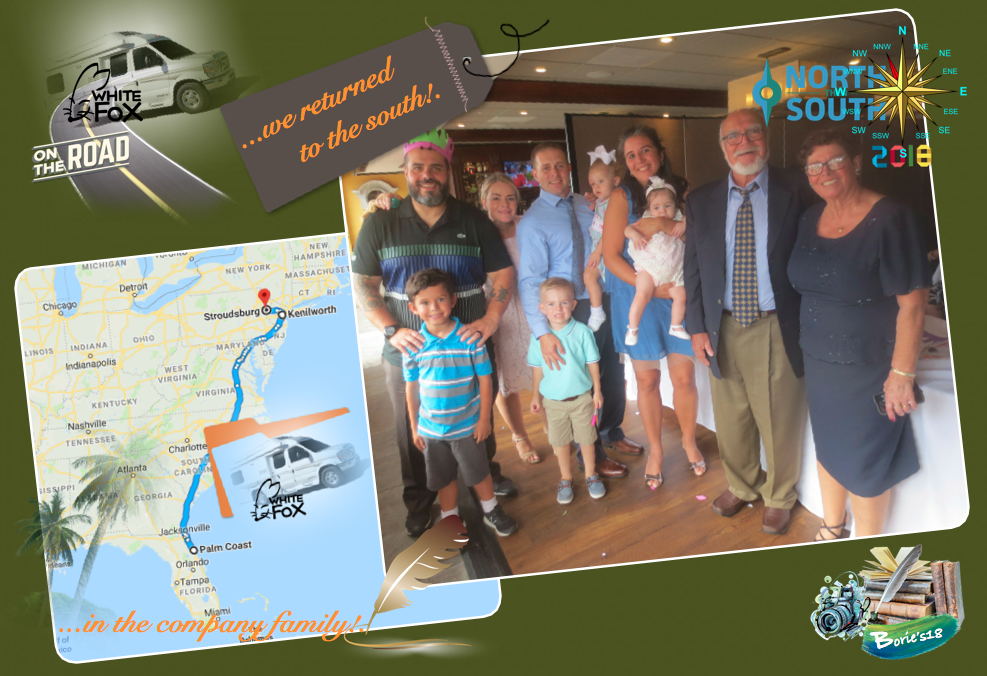
…cada dia é um presente e, enquanto os nossos olhos se abrirem, concentramo-nos num novo dia, que é o presente e, em todas as lembranças felizes que vamos guardando, como por exemplo o tempo passado no norte, na companhia da família ou dos amigos de longa data, a Natércia e o Jorge!. (Every day is a gift, and as long as our eyes open, we focus on a new day, which is the present, and on all the happy memories we keep, such as the time spent in the north in the company family or long-time friends, Natércia and Jorge)!.

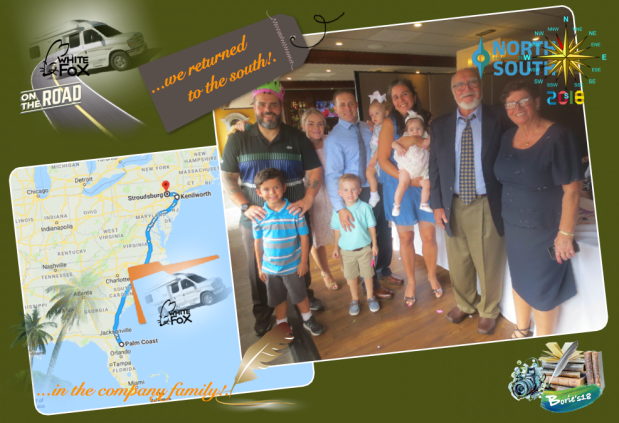
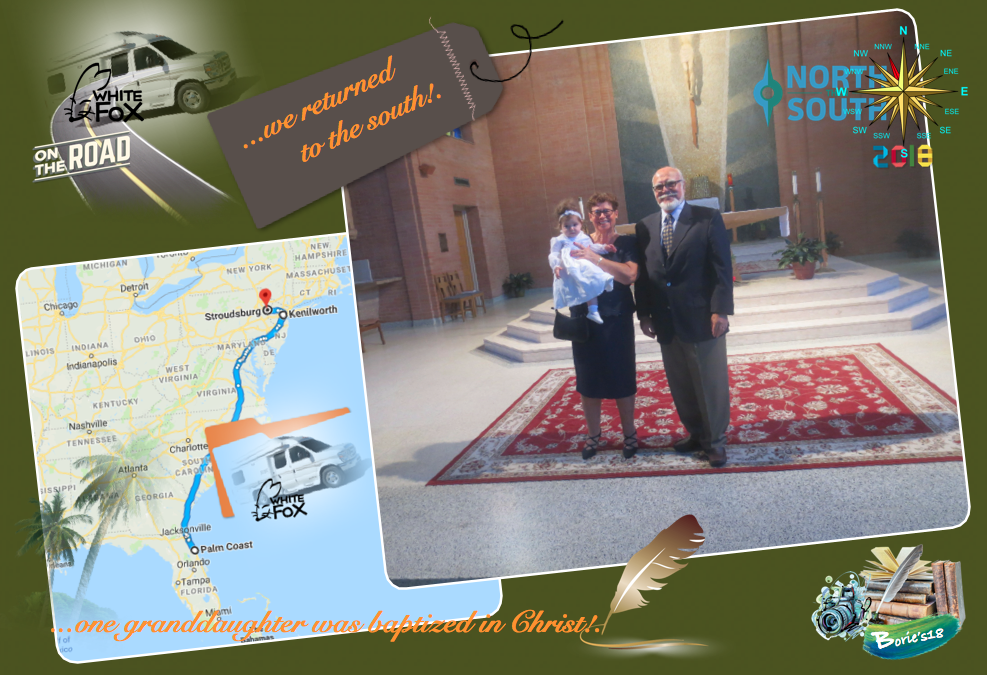
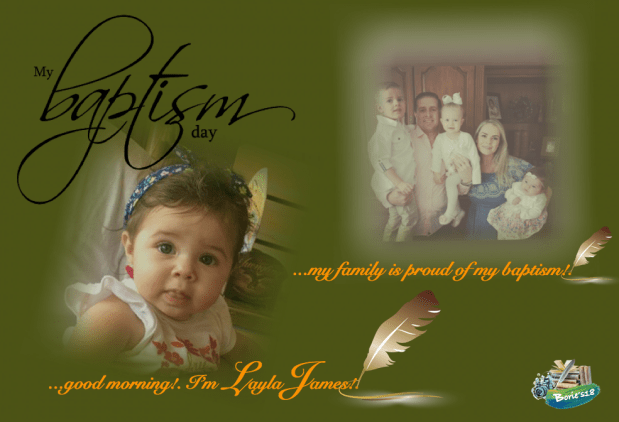
…houve alegria, juntámo-nos, convivemos, uma neta foi baptizada em Cristo!. (There was joy, we joined, we lived together, one granddaughter was baptized in Christ)!.

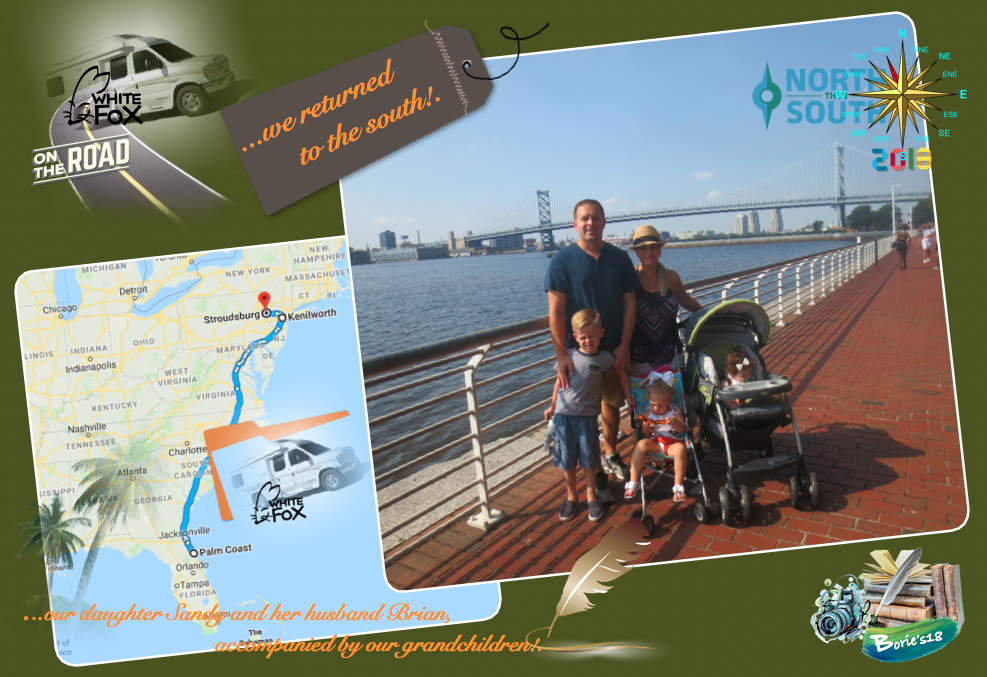
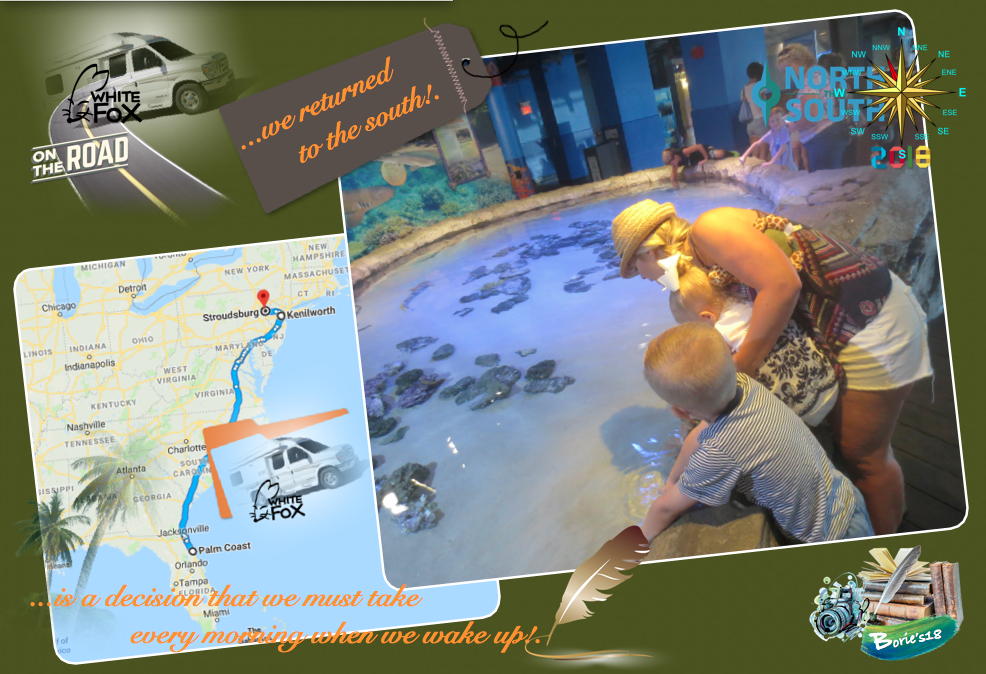
…outra teve uma pequena festa de aniversário, que se prolongou com uma visita ao oceanário da cidade de Candem, no estado de Nova Jersey, onde a nossa filha Sandy e o seu marido Brian, na companhia dos nossos netos, nos presentearam com uma visita guiada ao pormenor, a todo o complexo do oceanário, visitando o lugar onde os hipopótamos, os tubarões, os pinguins e outras espécies vivem e se reproduzem, contribuindo para a continuação da vida selvagem, neste mundo, que a nós nos parece cada vez mais difícil, quando pensamos em sensibilidade de uns para com os outros!. (Another had a small birthday party, which lasted with a visit to the oceanarium of the city of Candem, in the state of New Jersey, where our daughter Sandy and her husband Brian, accompanied by our grandchildren, presented us with a detailed tour of the whole complex of the oceanarium, visiting the place where hippos, sharks, penguins and other species live and reproduce, contributing for the continuation of wildlife in this world, which seems to us increasingly difficult when we think of sensitivity to each other)!.


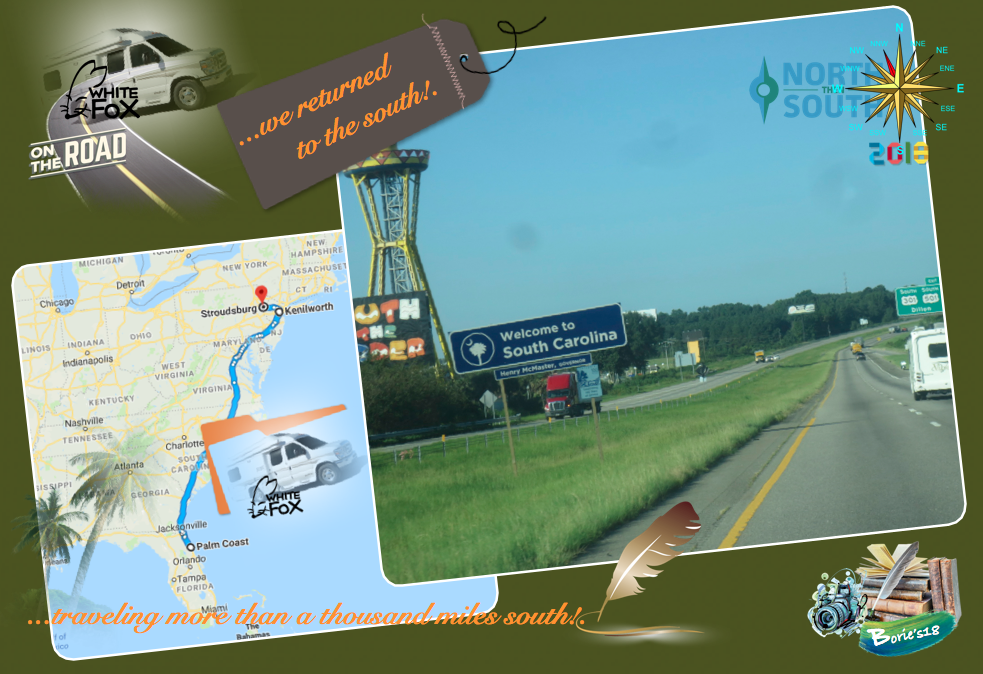
…depois, depois despedimo-nos, viajando mais de mil milhas em direcção ao sul, ouvindo alguma música, pensando entre outras coisas que, a felicidade é algo que podemos decidir com alguma antecedência e, se gostamos da vida que levamos ou não, não depende do conforto ou das facilidades que hoje existem, ou até mesmo como este mundo está organizado, depende sim, é como nós organizamos a nossa mente!. (Then we say goodbye, traveling more than a thousand miles south, listening to some music, thinking among other things that happiness is something we can decide with some advance and if we like the life we take or not, it does not depend on the comfort or facilities that exist today, or even how this world is organized, it depends on yes, it’s how we organize our mind)!.

…é uma decisão que devemos tomar todas as manhãs quando acordamos, pois a velhice é como uma conta bancária, com a diferença que nesta idade, não depositamos dinheiro, devemos depositar muita felicidade e só as boas memórias, na conta bancária das lembranças! (Is a decision that we must take every morning when we wake up, because old age is like a bank account, with the difference that at this age, we do not deposit money, we must deposit much happiness and only the good memories, in the bank account of memories)!.

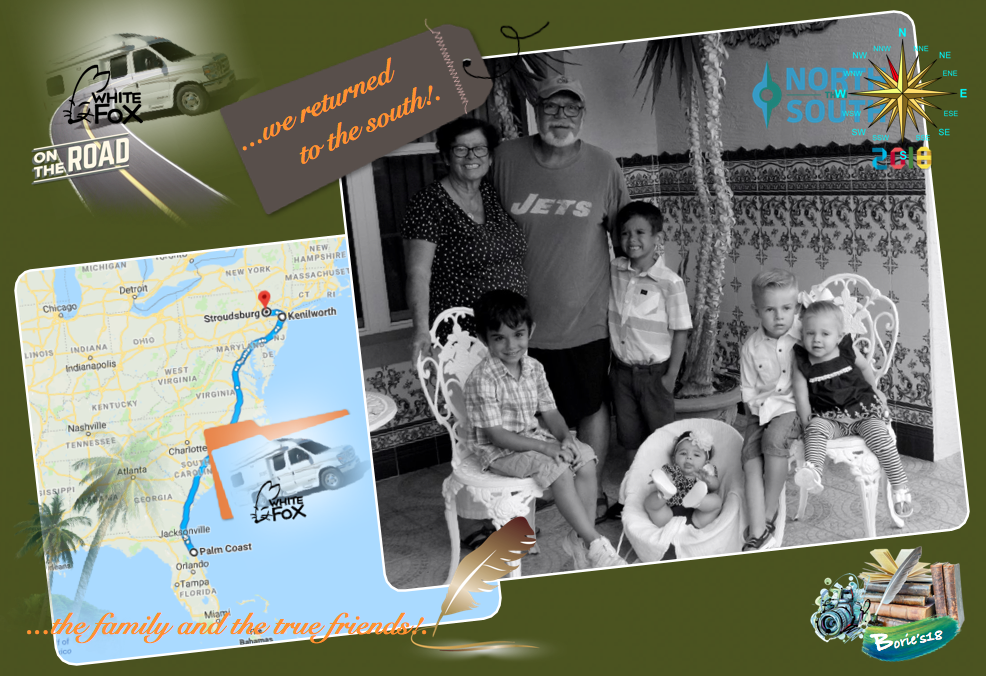
…a família e os verdadeiros amigos, são uma boa parte para preencher o nosso banco de memórias, onde felizmente ainda vamos depositando e, sobretudo concentramo-nos nestas cinco regras muito simples que, nos fazem um pouco mais felizes, como por exemplo, vamos libertando o nosso coração do ódio, assim como a nossa mente das preocupações, vivemos simplesmente, na esperança de dar-mos mais e esperando sempre menos!. (The family and the true friends, are a good part to fill our memory bank, where we are fortunately still depositing and, above all, we focus on these five very simple rules that make us a little happier, for example, let us free our hearts from hatred, as well as our mind from worries, we live simply, hoping to give ourselves more and waiting ever less)!.

Tony Borie, September 2018.

…I’m Layla James!.

…I’m Layla James!.

…olá, bom dia!. Eu sou a Layla James!. (…hello good day!. I’m Layla James)!.

…o meu pai Brian, a minha mãe Sandy, o meu irmão Brian Anthony e a minha irmã Ava Monroe, convidaram os meus avós, os meus primos, os meus tios e tias, assim como a família e, também alguns amigos da família, para assistirem à cerimónia do meu baptismo!. (My father Brian, my mother Sandy, my brother Brian Anthony and my sister Ava Monroe, invited my grandparents, my cousins, my uncles and aunts, as well as the family and some friends of the family, to attend the ceremony of my baptism)!.

…que alegria eu sinto neste dia, em vos ver aqui todos juntos!. (What a joy I feel in this day, in seeing you here together)!.

…vou ser baptizada!. Dizem-me que, vou nascer de novo, vai ser um novo começo de vida, que as coisas velhas já passaram, que tudo se vai tornar novo em minha vida!. (I’m going to be baptized!. They tell me that, I will be born again, it will be a new beginning of life, that old things have passed, that everything will become new in my life)!.

…embora ainda não saiba andar, mas já “engatinho”, portanto estou pronta a começar essa nova caminhada na novidade da vida, que me dizem que começa, depois de ser baptizada em Cristo!. (Although I still do not know how to walk, but already “crawling”, so I am ready to begin this new journey in the novelty of life, which tell me that begins, after being baptized in Christ)!.

…penso que ainda não tenho “pecados”, pois sou tão nova!. Mas às vezes choro e faço algumas “birras”, é natural, pois é a única maneira que conheço para comunicar com os adultos, principalmente quando tenho sede ou fome, alguma dor ou quero que me mudem a “fralda”, que quando está molhada, me faz sentir sem aquele conforto que todos os bebés devem ter!. (I think I still do not have “sins”, because I’m so young!. But sometimes I cry and make some “tantrums”, it’s natural because it’s the only way I know to communicate with adults, especially when I’m thirsty or hungry, some pain or I want to change my “diaper” when wet, makes me feel without that comfort that all babies should have)!.


…alguns de vocês vieram de longe, como os meus avós da Flórida, todavia espero que passem um bom dia, porque os meus pais, querem a vossa presença, depois desta cerimónia do meu baptismo na Igreja, num restaurante local!. (Some of you have come from afar, like my grandparents from Florida, but I hope you have a good day, because my parents want your presence, after this ceremony of my baptism in the Church, in a local restaurant)!.

…divirtam-se, regressem a vossas casas com segurança e, qualquer dia quero ver-vos de novo, por ocasião da minha primeira comunhão!. (Have fun, come back to your homes safely and I want to see you again sometime on my first communion)!.

…abraços e beijinhos, agora quero que a minha mãe (às vezes é o meu pai, o meu irmão ou a minha irmã), me dê a “chucha”!. (Hugs and kisses, now I want my mother (sometimes it’s my father, my brother or my sister), give me the “chucha” (baby pacifier)!.

…desculpem quando às vezes choro, mas como já antes expliquei, é a única maneira que conheço de me comunicar com vocês!. (Sorry when I sometimes cry, but as I explained before, it’s the only way I know to communicate with you)!.

Tony Borie, August 26, 2016.

…we woke up at five!.

…we woke up at five!.

…acordámos às cinco!. (we woke up at five)!.

…acordámos às cinco da madrugada!. Fizémos um chá, que bebemos bem quente, na nossa caneca preferida, que está quebrada na asa, portanto é segurada entre as mãos, que nos aqueceu, sobretudo o corpo e, talvez a alma, se é que ela existe!. (We woke up at five in the morning!. We made tea, which we drank very hot, in our favorite mug, which is broken in the wing, so it is held between our hands, which has warmed us, especially the body and, perhaps the soul, if it exists)!.

…não podemos resmungar sobre a nossa saúde, pelo contrário, alegramo-nos por ainda estar vivos e, também não nos vamos sentir tristes por o dinheiro não chegar até ao final do mês, pelo contrário, ficamos felizes por ainda termos memória para controlar as nossas finanças, encorajando-nos a planear as nossas compras com sabedoria, para nos guiarem para longe da catástrofe que era, não haver dinheiro para a medicina de manutenção, ou o fogão lá na cozinha, não trabalhar mais, por falta de arroz, massa, vegetais ou outros géneros alimentícios!. (We can not grumble about our health, on the contrary, we rejoice that we are still alive and we will not feel sad because the money does not arrive until the end of the month, on the contrary, we are happy that we still have memory for control our finances by encouraging us to plan our purchases wisely, to guide us away from the catastrophe that was, to have no money for maintenance medicine, or the stove in the kitchen, not to work anymore, for lack of rice, pasta, vegetables or other foodstuffs)!.

…saímos de casa, ainda é noite que tenta clarear, vamos lá fora ao pequeno jardim, tocamos numa rosa que tenta florescer, picamo-nos, não ficamos tristes porque aquela flor tem espinhos, pelo contrário, ficamos contentes porque aquela pequena árvore com muitos espinhos, é onde nascem aquelas bonitas rosas!. (We leave the house, it is still night that tries to clear, we go outside to the small garden, we touch a rose that tries to flourish, we sting, we are not sad because that flower has thorns, on the contrary, we are happy because that small tree with many thorns, is where those beautiful roses are born)!.

…entrámos em casa de novo, procuramos qualquer livro para ler, porque, pela manhã, aqueles noticiários da TV, é só desgraças!. Se for uma boa notícia, não transmitem, não tem interesse, não faz audiências, não entusiasma as pessoas, não as faz ficarem “excitadas”, portanto, quanto maior for a catástrofe, mais audiências existem e, para a competição entre as diversas estações de TV, isso é muito importante!. (We went home again, we look for any book to read, because, in the morning, those TV news, it’s only misfortunes!. If this is good news, they do not transmit, have no interest, do not audiences, do not enthuse people, do not make them “excited”, therefore, the greater the catastrophe, the more audiences there are, and, for competition between the various TV stations, this is very important)!.

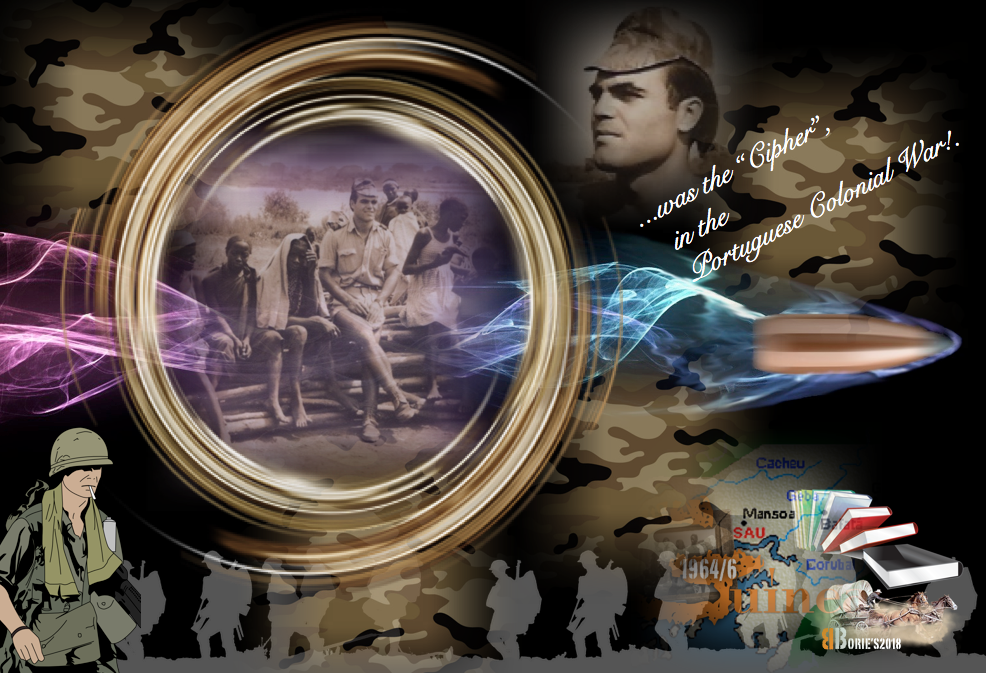
…continuando, abrimos o nosso diário de guerra, sentamo-nos numa cadeira na parte de trás da nossa casa, onde sentimos alguma paz e onde algumas aves pela manhã sobrevoam, visitando-nos na procura de alguma água e comida!. Naquele diário, que continuamos a guardar quase religiosamente, vem lá escrito, não importa a página que abrimos, aqueles ataques ao aquartelamento, emboscadas, fornilhos que rebentaram, mortos, feridos e, todo aquele, blá, blá, blá, que os queridos leitores já conhecem, principalmente os antigos combatentes, onde alguns, infelizmente ainda sentem no seu próprio corpo!. (Continuing, we open our war diary, sit in a chair in the back of our house, where we feel some peace and where some birds fly in the morning, visiting us in search of some water and food!. In that diary, which we continue to keep almost religiously, it comes written, no matter the page we open, those attacks on the barracks, ambushes, fodder that burst, dead, wounded and, everyone, blah, blah, blah, that dear readers already know, especially the former combatants, where some unfortunately still feel in their own body)!.

…em determinada página, está escrito um texto, embora seja um pouco difícil de explicar, pois muitas palavras são ilegíveis e não encaixam, talvez fosse o desespero naquele dia menos feliz, tentámos colocar algumas palavras no seu verdadeiro lugar, assim como algumas vírgulas e pontos finais, cá vai:

“Hoje, dia 29 de Abril de 1965 – Estou triste, não vou escrever nada, mesmo nada, acordei com o mosquiteiro e a cama toda molhada!. Quando é que esta “porcaria” vai secar, estou triste e angustiado, estou aqui, junto destes jovens, é a mesma coisa que estivesse preso, pois estou rodeado de arame farpado e, para cúmulo, aquele janelo ainda não está acabado!. A chuva entra cá dentro, a culpa é do “Marafado”, (companheiro, militar de combate), que costuma lá pôr o casaco do camuflado, cheio de lama a secar e, esta noite não o fez, não sei porquê”!.

(On a certain page, a text is written, although it is a little difficult to explain, since many words are illegible and do not fit, perhaps it was despair on that less happy day, we tried to put some words in their true place, as some commas and endpoints, here goes:

“Today, April 29, 1965 – I’m sad, I’m not going to write anything, nothing at all, I woke up with the mosquito net and the bed all wet!. When this “crap” is going to dry up, I’m sad and distressed, I’m here, with these young people, it’s the same thing that was stuck, because I’m surrounded by barbed wire, still to the point, that window is not finished yet!. Rain enters inside, the fault is of the “Marafado”, (companion, combat military), who usually puts there the coat of the camouflaged, full of mud to dry and, tonight did not do it, do not know why”)!.

“Olha a minha sorte, sem o querer já estou a escrever, mas para quê, só vai sair “porcaria”, pois estou muito triste, passei a noite a sonhar que estava na minha aldeia, no Vale do Ninho d’Águia, naquela encosta agreste da montanha do Caramulo, onde próximo passava a estrada de Lisboa ao Porto”!. (“Look at my luck, without wanting to write, but for what, it’s going to be “crap”, because I’m very sad, I spent the night dreaming that I was in my village, in the Valley of the Eagle’s Nest, on that slope rugged mountain of Caramulo, where near passed the road from Lisbon to Porto”)!.

“A estrada estava renovada, o senhor Francisco, que era o cantoneiro, que os visinhos diziam que pela manhã colocava o carro de mão, a pá e a enxada, na beira da estrada, com a placa uns metros à frente, a dizer “obras”, só para marcar presença, indo de seguida cultivar umas leiras de terra seca, que também diziam que não eram dele, era da “JAE”, ou seja, da Junta Autómona das Estradas, que lhe pagava o ordenado, onde ele plantava, quase sempre fora do tempo, umas favas e às vezes tremoço, que os coelhos e as lebres selvagens comiam tudo, mesmo antes de nascer”!. (“The road was renewed, Mr. Francisco, who was the “cantoneiro” (person repairing the road), that the neighbors said that in the morning he would put the hand cart, the shovel and the hoe on the side of the road, with the sign a few meters ahead, say “man works”, just to make a presence, and then to cultivate some dry land, which also said that they were not his, was the “JAE”, that is, of the Autonomous Board of Roads, which paid him the wages, where he planted, almost always out of season, some fava beans and sometimes lupine, which rabbits and wild hares ate everything even before they were born”)!.

“No meu sonho, via o senhor Francisco, a tapar os buracos da estrada com areia e alcatrão, a que ele chamava “pixe”, depois começou a marcar a estrada, com tinta branca ou amarela, pois assim podia evitar acidentes, quando o carro dos bois do senhor Manuel Lagareiro, passasse pela camionete da carreira, que era mais larga, afrouxando naquela curva, onde havia uma árvore, que estava sempre com o tronco pintado de branco, mas onde o “pessoal do contra” (pessoas que não concordavam com o regime de governação colonial), lá iam colocar panfletos, às vezes até pinturas, com letras a dizer coisas que o senhor Francisco, que também todos diziam que era “Bufo”, palavra que na linguagem do povo, designava os informadores da polícia do estado e, às vezes alterado, dizia:

– Se sei, ou agarro o filho da puta, que escreve estas coisas, vou denunciá-lo à polícia e, não vê mais a luz do sol, vai para o “Tarrafal” (estabelecimento prisional de políticos, nas ilhas de Cabo Verde, em pleno Oceano Atlântico), com toda a certeza”!.

(“In my dream, I saw Mr. Francisco, covering the holes in the road with sand and tar, which he called “pixe”, then started marking the road with white or yellow paint, so that he could avoid accidents when the car of the oxen of Mr. Manuel Lagareiro, passed by the bus of the career, which was wider, loosening in that curve, where there was a tree, that always was with the trunk painted white, but where the “personnel of the against” (people who did not agree with the regime of colonial rule), there would be pamphlets, sometimes even paintings, with letters to say things that Mr. Francisco, who also all said was “Bufo”, a word that in the language of the people, designated police informers of the state and, sometimes altered, said:

– If I know, or I catch the son of a bitch who writes these things, I’m going to report him to the police and he does not see the sun, he goes to the “Tarrafal” (prison establishment of politicians, in the islands of Cape Verde, in the middle of the Atlantic Ocean), with all certainty”)!.

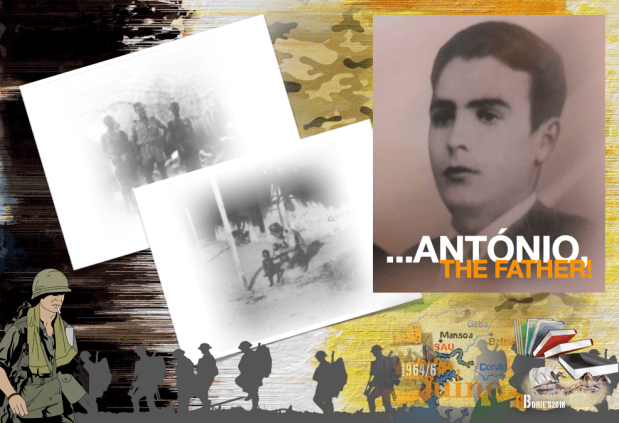
“Neste meu sonho, o pai António, lá ia pela estrada abaixo, descalço, levantava o braço a dizer “olá”, a toda a gente por quem passava, às vezes até tirava o chapéu roto e encurrilhado!. De repente, vem um carro preto e parou, dois homens grandes e feios, levaram-no à força, pois o pai António, apesar de analfabeto, também tinha fama de ser do “contra”!. Foi preso para uma prisão onde estavam muitos companheiros, cercada de arame farpado, onde a água da chuva entrava por um janelo roto e aberto, que naquela altura, não estava encoberto por um farrapo, que um companheiro lá punha todas as noites”!. (“In this dream of mine, my father, Antonio, was walking down the road, barefoot, raising his arm to say hello to everyone he passed by, sometimes he even took off his broken and curled hat!. Suddenly, a black car came and stopped, two big and ugly men, took him by force, because the father Antonio, although illiterate, was also reputed to be the “against”!. He was arrested for a prison where many companions were surrounded by barbed wire, where rainwater entered through a broken and open window, which at that time was not covered by a rag, which a companion put there every night”)!.

“Quando acordei, estava todo molhado, e era EU!. Felizmente não era o pai António, que tinha fama de ser do “contra”!. (When I woke up, it was all wet, and it was ME!. Luckily it was not the father Antonio, who was reputed to be the “against”)!

…hoje, lendo tudo isto, não ficamos tristes porque o pai António e a mãe Ilda, não nos deram mais quando estávamos crescendo, pelo contrário, sentimo-nos gratos, por terem permitido que viéssemos a este mundo!. (Today, reading all this, we were not sad because father António and his mother Ilda did not give us more when we were growing up, on the contrary, we felt grateful for allowing us to come to this world)!.

…neste momento, levantamos a cabeça, olhamos o céu, o que o dia de hoje será, depende só de nós!. Nós é escolhemos o tipo de dia que vamos ter e, a menos que existam outros planos, lembramo-nos sempre que, um “sorriso” fará com que os dias melhorem, nesta já avançada idade, no entanto, não ficamos nunca tristes porque temos que fazer alguns trabalhos domésticos, pelo contrário, compreendemos e ficamos felizes, por termos um lugar, a que ainda podemos chamar de “lar”!. (At this moment, we lift our heads, look at the sky, what today will be, it’s up to us! We are choosing the type of day we are going to have, and unless there are other plans, we always remember that a “smile” will make the days improve in this already advanced age, however, we are never sad because we have to do some housework, on the contrary, we understand and are happy, because we have a place, which we can still call home)!.

…tenham um óptimo dia, queridos leitores!. (Have a great day, dear readers)!.

Tony Borie, August 2018.

…Borie’s Five, it’s cool!.

…Borie’s Five, it’s cool!.

…Borie’s Cinco, é fixe!. (Borie’s Five, it’s cool!

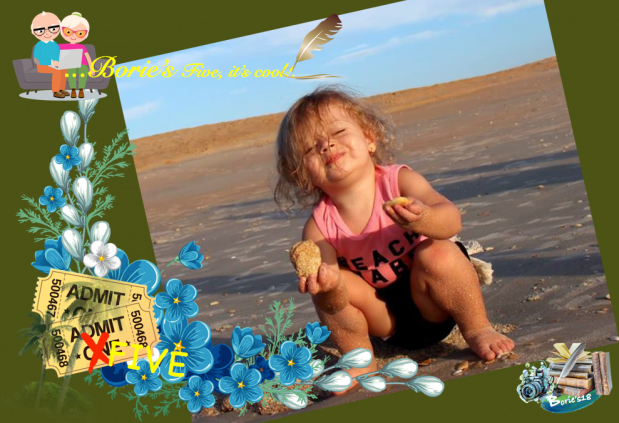
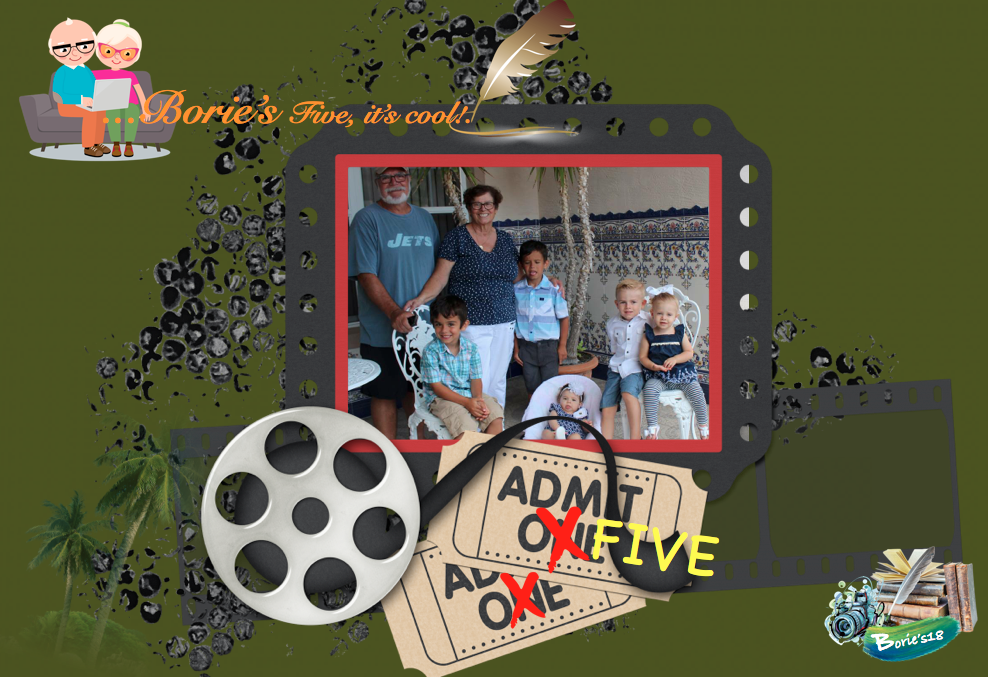
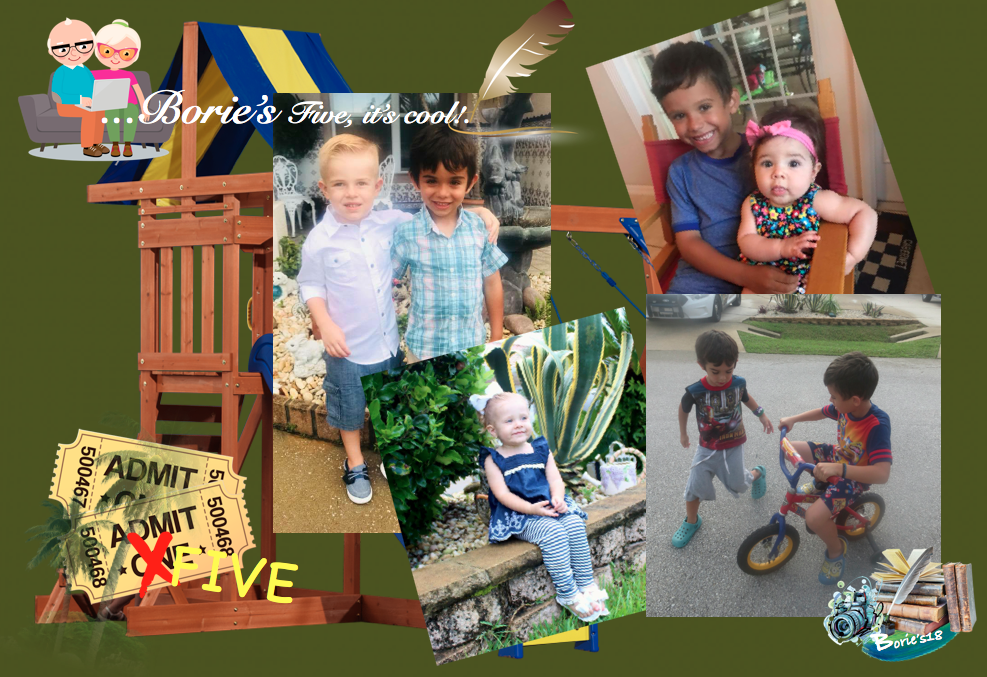
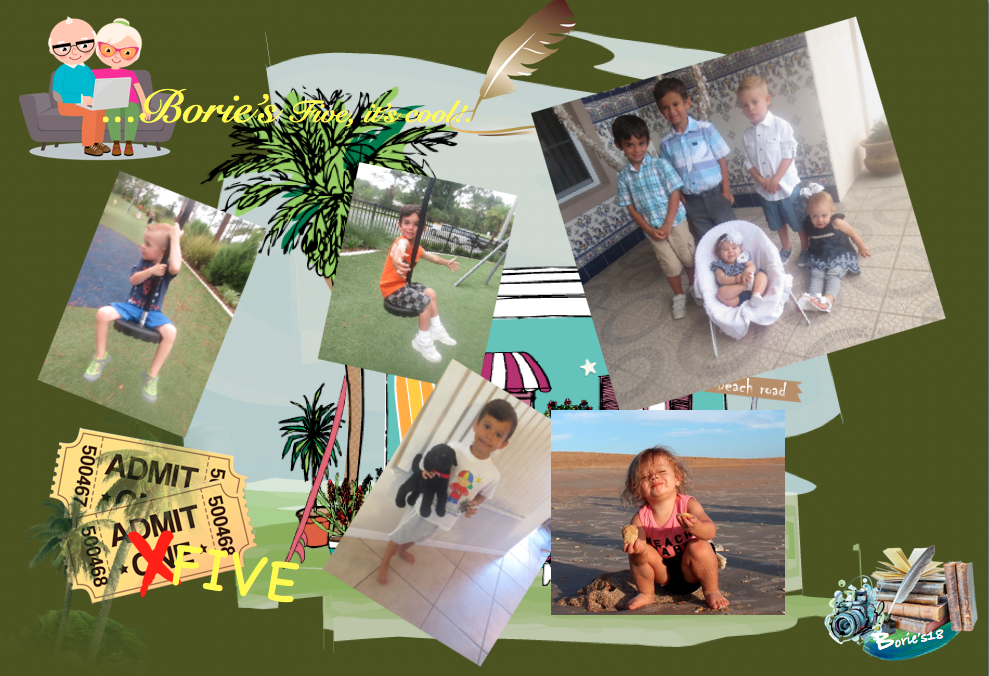
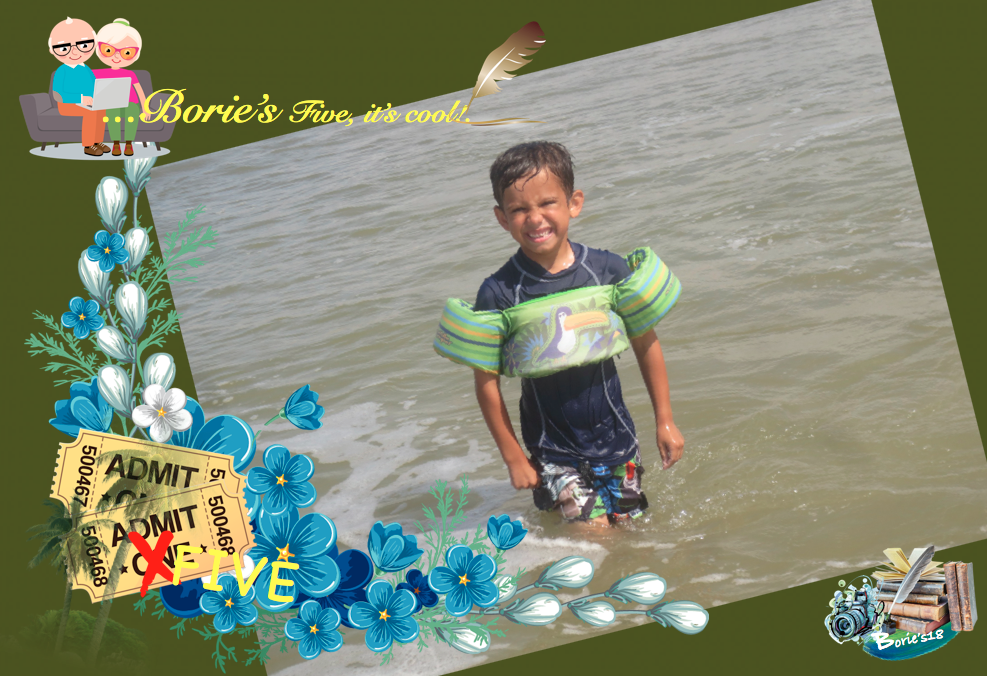
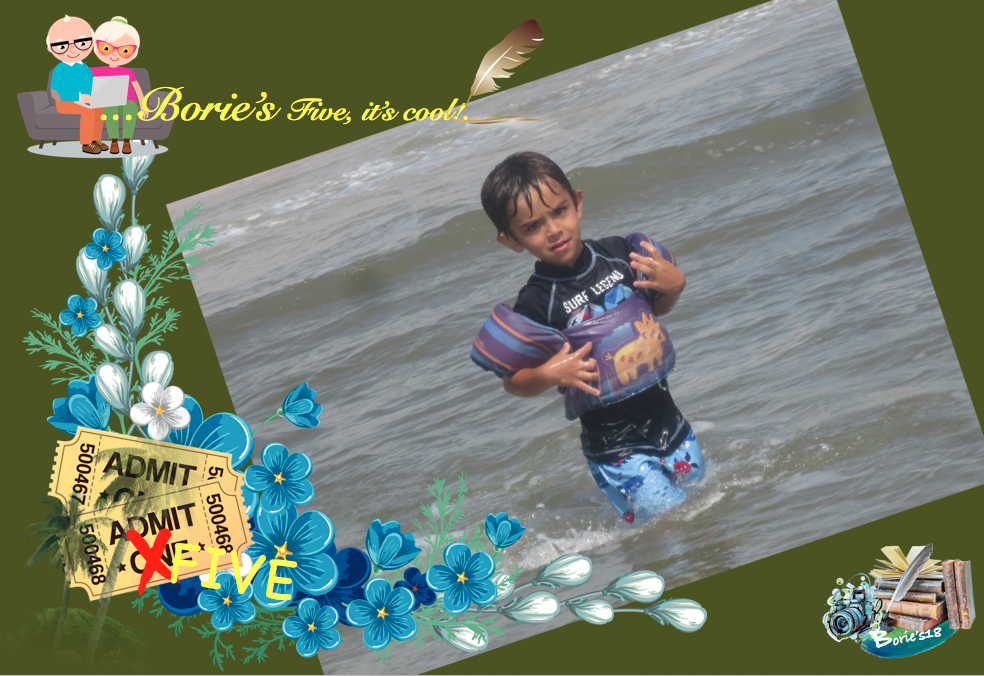
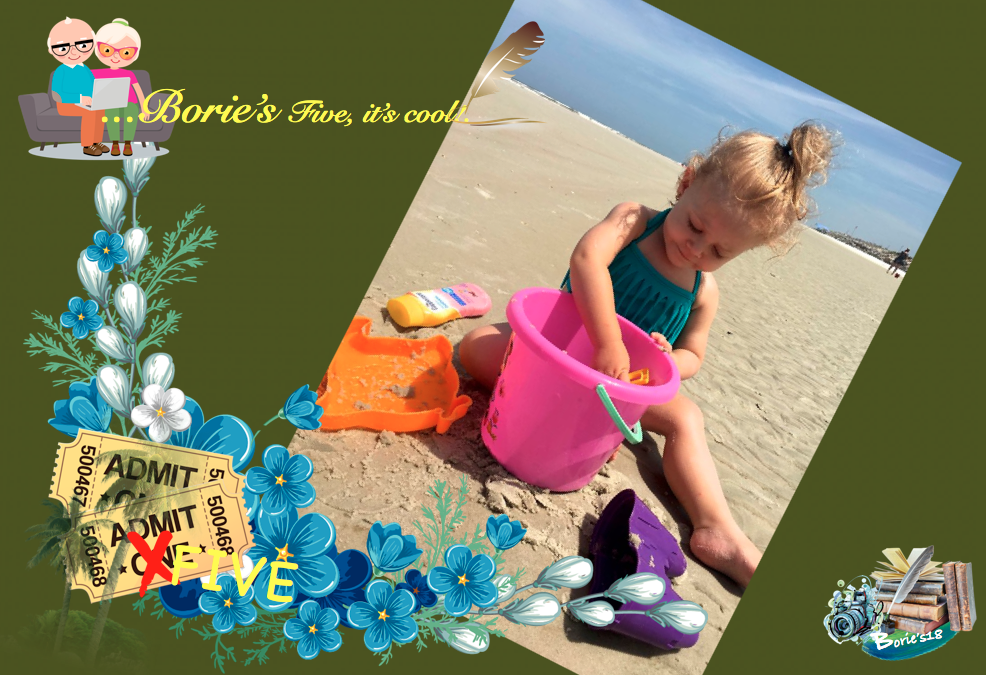
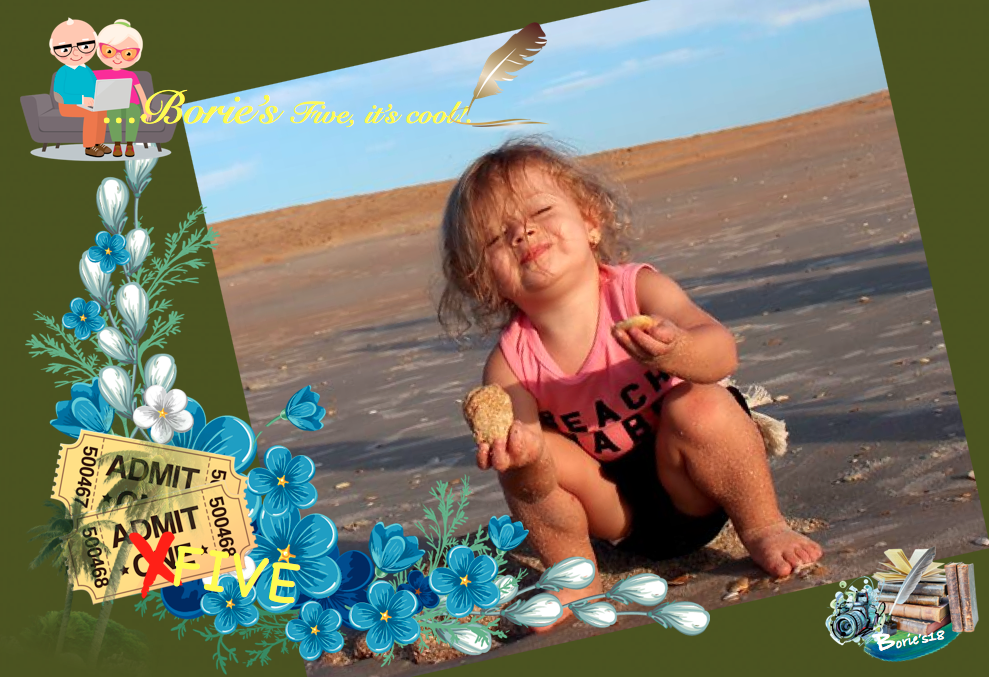
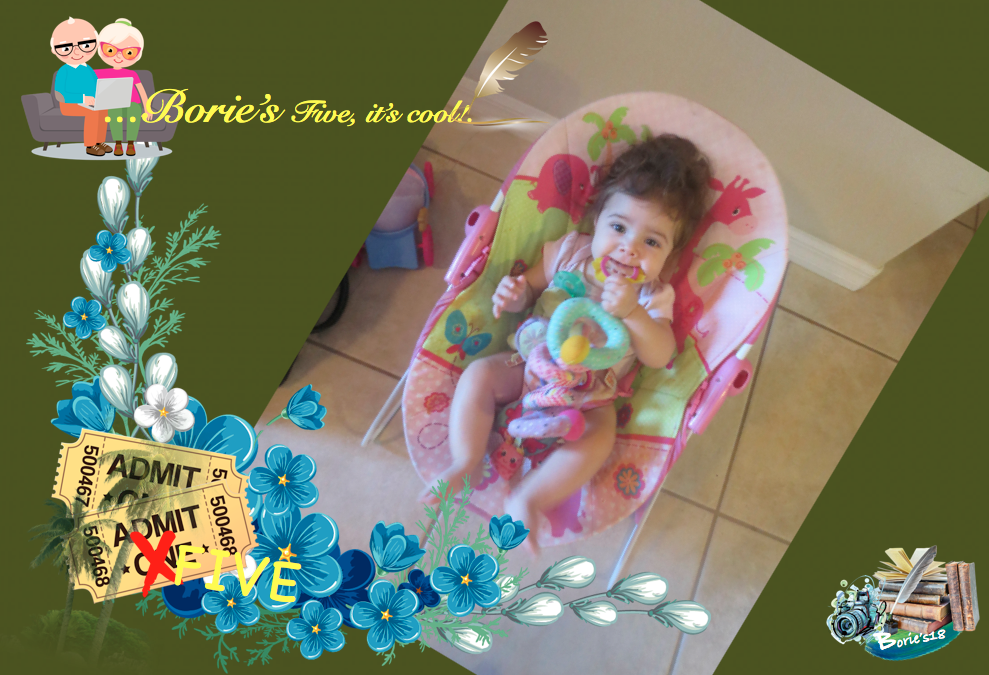
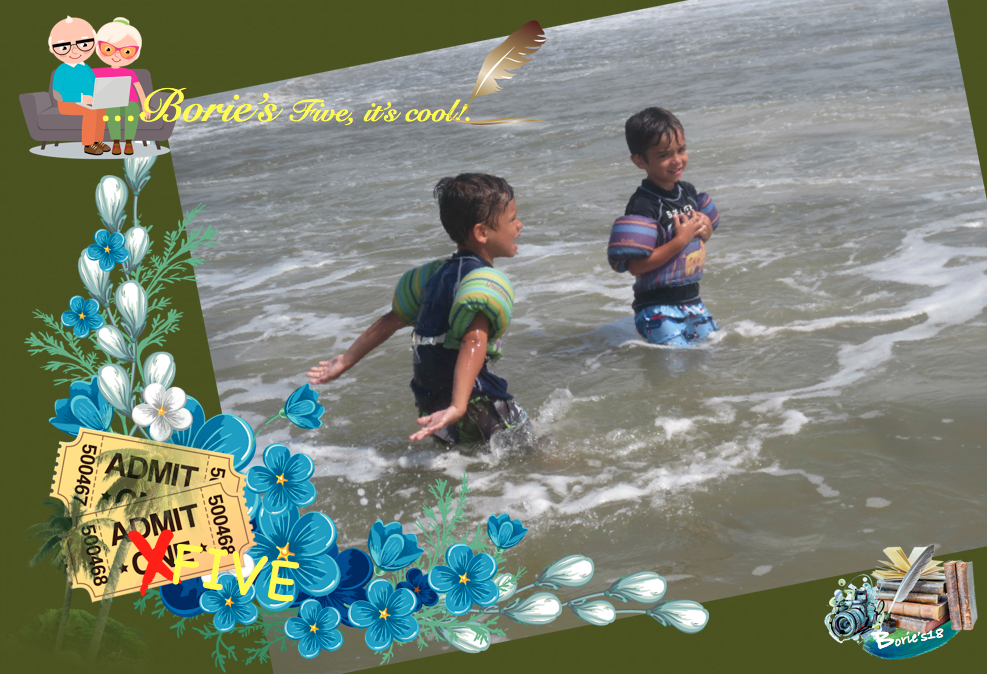
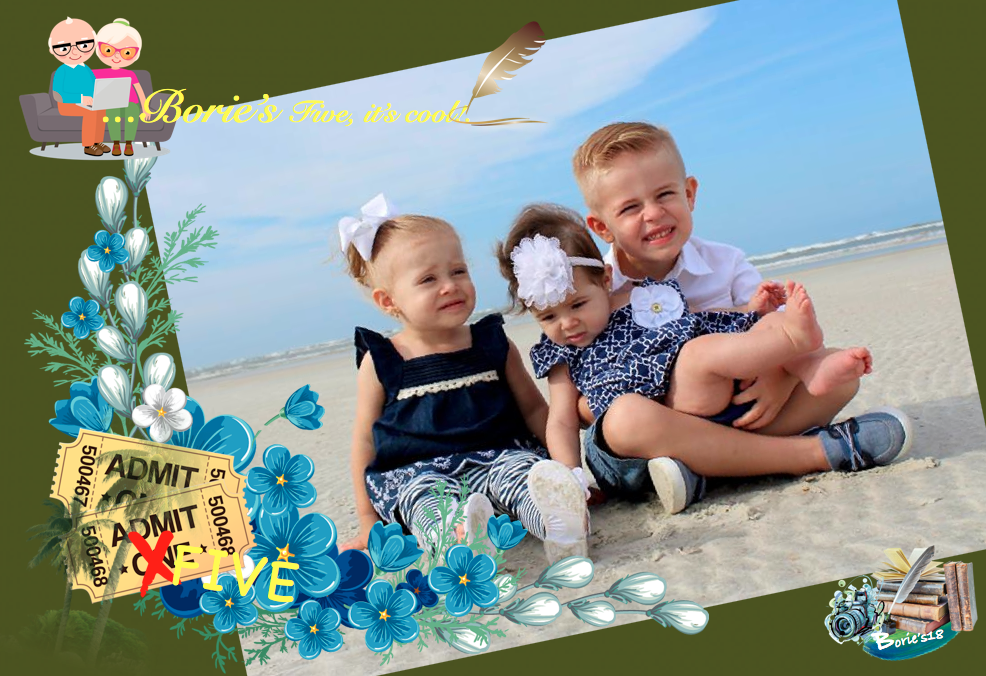
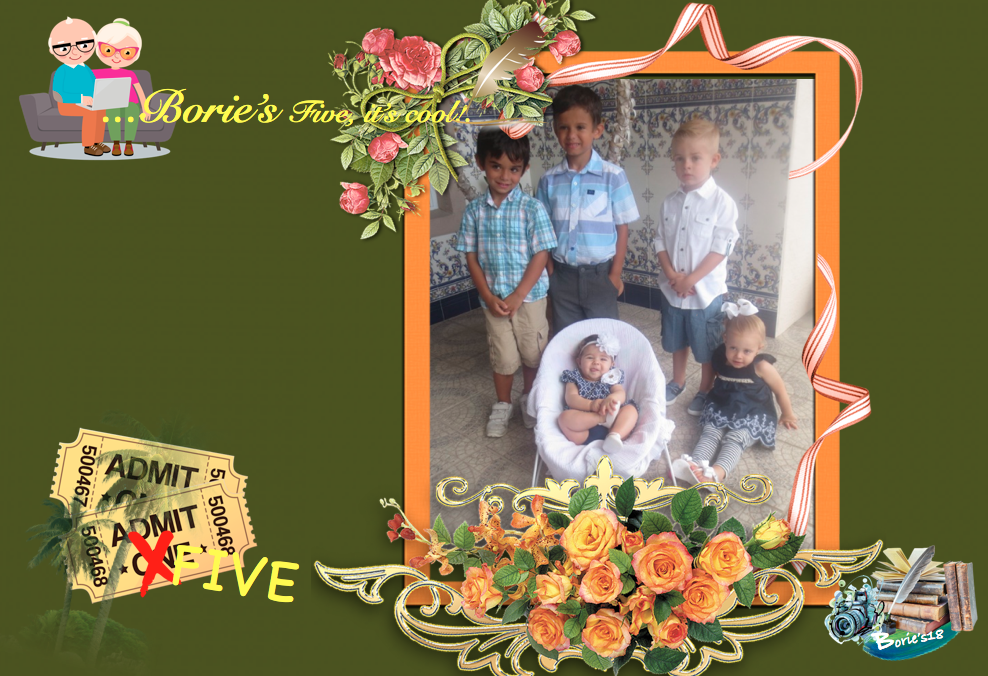
…com cinco, faz-se um número mágico!. Com cinco, é divertido!. Com cinco, é uma alegria!. Com cinco, é “fixe”!. (With five, make yourself a magic number!. With five, it’s fun!. With five, it’s a joy!. With five, it’s “cool”)!.

…antes a nossa casa estava demasiado limpa mas, com cinco netos em casa, não podemos manter muitas regras!. Porquê!. Porque ficamos sempre em desvantagem!. (Before our house was too clean but, with five grandchildren at home, we can not keep too many rules!. Because!. Because we are always at a disadvantage)!.

…não é que esteja a defender a anarquia!. Mas não se pode dizer a um neto ou neta que não se pode pendurar no sofá!. Que não se pode atirar para cima da cama, enrolando-se no lençol!. Que não pode correr pela casa segurando um gelado, que se vai derretendo nas mãos, deixando um rasto de diversas cores no chão, que antes estava limpo!. Que nos esconde o remoto control da TV, porque queremos mudar o canal que nesse momento está transmitindo “desenhos animados”!. Que sobe a uma cadeira da mesa, para espreitar o que os adultos estão a comer ou beber nesse momento e, não compartilham com eles!. (It is not that you are defending anarchy!. But you can not tell a grandson or granddaughter that you can not hang on the couch!. That you can not throw yourself on the bed, curling up in the sheet!. That he can not run around the house holding an ice cream, which melts in his hands, leaving a trail of several colors on the floor, which was clean before!. That hides the remote control of the TV, because we want to change the channel that is transmitting “cartoons”!. It climbs a table chair, to peek into what the adults are eating or drinking at that time and, do not share with them)!.

…que fogem para a garagem, para descobrirem algo escondido nas diversas caixas armazenadas, que guardam anos de história da vida dos avós!. Que a todo o momento querem subir para os braços dos avós, para ficarem em posição mais alta e olharem-nos nos olhos!. Para nos puxarem para a rua, tirando-nos do sofá, querendo analizar a área onde residem agora!. Que ficam admirados se chove, porque no seu pensamento, na Flórida é só sol e bom tempo!. Que na praia, nos puxam para as ondas do mar, pensando que com a nossa presença têm mais protecção!. (Who flee to the garage, to discover something hidden in the various boxes stored, that keep years of history of the life of the grandparents!. That at all times they want to climb into the arms of the grandparents, to stand in a higher position and look us in the eyes!. To pull us into the street, getting us off the couch, wanting to analyze the area where they now reside!. Who are amazed if it rains, because in his thought, Florida is only sun and good weather!. That on the beach, they pull us into the waves of the sea, thinking that with our presence they have more protection)!.

…temos notado que os nossos netos gostam muito de vir a nossa casa, porque também para eles, “é uma alegria” e, logo percebemos que a casa, com as crianças por aqui, produz uma atmosfera festiva!. Sobretudo os mais velhos, claro, tiram alguma vantagem sobre os mais novos e, às vezes dizem-nos que a casa está “demasiado limpa” e, não aceitam um fluxo de regras que, nós adultos de outra geração lhes queremos impor, como por exemplo, tentar repreendê-los de saltar ou correr pela casa enquanto seguram um copo de plástico com água na mão, que quando a água cai, “é uma alegria”!. (We have noticed that our grandchildren are very fond of coming to our house, because for them too “it is a joy” and soon we realize that the house, with the children around here, produces a festive atmosphere!. Especially the older ones, of course, take some advantage over the younger ones and sometimes tell us that the house is “too clean” and they do not accept a flow of rules that we adults of another generation want to impose on them, such as for example, try to scold them from jumping or running around the house while holding a plastic cup with water in hand, which when the water falls, “it is a joy”)!.

…viagens casuais ao parque ou à praia, tornaram-se excitantes para eles, porque as crianças precisam é mais tempo para descontrair e relaxar com a liberdade de não fazer nada e, isso foi uma opção a que demos alguma prioridade, embora na nossa idade, para nós, nos roubasse alguma energia!. (Casual trips to the park or the beach have become exciting for them because children need is more time to chill and relax with the freedom to do nothing and that was an option to which we gave some priority, although in the our age, for us, steal some energy)!.

…com cinco netos em casa, não temos lá muito tempo para gastar analisando cada movimento ou humor de cada um, e claro, também existe menos controle nas suas vidas, o que significa que as crianças têm mais controle nelas, concentrando-se mais sobre o que fazem, o que lhes agrada!. (With five grandchildren at home, we do not have much time to spend analyzing each movement or mood of each, and of course, there is also less control in their lives, which means that children have more control in them, concentrating more about what they do, what they like)!.

…mesmo quando vamos a algum lugar especial, esquecemo-nos que somos adultos, deixamos de ser orgulhosos e, escolhemos os locais, acreditando que lhes estamos a proporcionar uma oferta especial, onde eles se podem sentir o mais felizes possível!. (Even when we go somewhere special, we forget that we are adults, we stop being proud, and we choose the places, believing that we are providing them with a special offer, where they can feel as happy as possible)!.

…convivemos com eles por algum tempo, provávelmente vão esquecer o que lhes dissémos ou o que lhes fizémos mas, nunca esquecerão a alegria que lhes fizémos sentir!. Tal como a nós avós, uma palavra deles, boa ou má, ficará em nós por algum tempo, mas o que nos fizeram sentir, vai ficar para sempre em nossas memórias!. (We live with them for some time, they will probably forget what we said or what we did to them, but they will never forget the joy we made them feel!. Like grandmothers, one word of them, good or bad, will stay in us for a while, but what they have made us feel will forever remain in our memories)!.

…mas cinco netos é “fixe”!. Cremos mesmo que estes cinco netos, não vão ser um problema de superpopulação do mundo e, do seu esgotamento nos recursos para a sobrevivência do Planeta Terra!. Na realidade, o grande problema que o nosso Planeta enfrenta, é mesmo a falta de crianças!. (But five grandchildren is “cool”!. We even believe that these five grandchildren will not be a problem of overpopulation of the world and of their depletion in the resources for the survival of Planet Earth!. In fact, the big problem facing our Planet is the lack of children)!.

…ter cinco netos “é fixe”!. Os avós, esperam por vocês outra, outra e outra vez e, as vossas imagens ficam para sempre nos nossos já um pouco velhos corações, assim como aos vossos pais, que nos proporcionaram momentos únicos com a vossa visita!. (Having five grandchildren “is cool”!. Grandparents, wait for you again, again and again and again, and your images remain forever in our already old hearts, as well as your parents, who have given us unique moments with your visit!.

Tony Borie, August 2018.

…american with portuguese heart!.

…american with portuguese heart!.

…americano com coração português!. (…american with Portuguese heart)!.

…antes do ano de 1907, muitas crianças fizeram a viagem para os Estados Unidos sózinhas, onde algumas viajaram milhares de quilómetros sem a companhia de um pai, mãe ou outro qualquer guardião!. Mas, depois do ano de 1907, era proibido para qualquer pessoa que tivesse menos de 16 anos, passar pela Estação de Imigração, situada na Ellis Island (Ilha de Ellis), sem a companhia de um adulto!. (Before the year 1907, many children made the trip to the United States alone, where some traveled thousands of miles without the company of a parent, or any other guardian! But after 1907, it was forbidden for anyone under the age of 16 to pass through the Immigration Station, located on Ellis Island (Ellis Island), without the company of an adult)!.

…esta ilha está situada no estado de New Jersey, na Upper Bay (Baía Superior), quase onde o rio Hudson termina e as suas águas entram no Oceano Atlântico, a que os colonos holandeses chamavam a Ilha Oyster Island (Ilha das Ostras), por causa da abundância de ostras nas proximidades e, as ostras eram uma valiosa fonte de alimento, primeiro para as tribos nativas americanas, depois para aqueles que iam chegando ao Novo Mundo!. (This island is located in the state of New Jersey in the Upper Bay, almost where the Hudson River ends and its waters enter the Atlantic Ocean, which the Dutch settlers called Oyster Island, because of the abundance of oysters nearby, and oysters were a valuable source of food, first for the Native American tribes, then for those who were coming to the New World)!.

…bem, vamos começar com a história de hoje!. (Well, let’s start with today’s story)!.
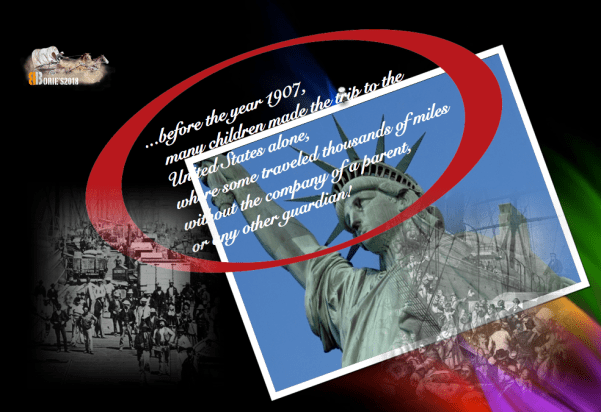
…o António e a Ermelinda, foram emigrados nos Estados Unidos!. Aqui nasceu o seu único filho, o António Manuel, todavia, uns anos depois decidiram regressar a Portugal, quando este, ainda era uma criança!. Com algumas economias, construiram a sua casa e, cultivando algumas terras que herdaram, viviam razoávelmente, no conforto de uma aldeia na encosta da Serra da Estrela, próximo da cidade de Viseu!. (Antonio and Ermelinda were emigrated to the United States!. Here was born his only son, António Manuel, however, a few years later they decided to return to Portugal, when he was still a child!. With some savings, they built their home and, cultivating some land they inherited, lived reasonably, in the comfort of a village on the slope of Mountain of the Estrela (Star), near the city of Viseu)!.

…o António Manuel, a que todos chamavam o Tó Manel, foi crescendo, era um rapaz popular, podiam fazer-lhe as maiores brincadeiras, que ele não levava nada a mal, só às vezes é que ficava um pouco irritado quando lhe chamavam “Americano”, mas em certos momentos até achava graça!. Era um estudante um pouco melhor que o normal, era inteligente, mas não levava os estudos muito a sério!. Quando no intervalo das aulas, os colegas formavam um grupo de futebol, todos o queriam no seu time, pois ele, com habilidade ou com força, levava tudo à frente até à baliza adversária!. (Antonio Manuel, whom everyone called Tó Manel, grew up, he was a popular boy, they could make the biggest jokes to him, that he did not take anything to bad, only sometimes it was that he was a little annoyed when called “American”, but at times it even found grace!. He was a slightly better student than usual, he was smart, but he did not take his studies too seriously!. When, at the interval of classes, his colleagues formed a football group, everyone wanted him on his team, because he skillfully or forcefully took everything ahead to the opposing goal)!.

…quando iam tomar banho no rio, que passava ao fundo da aldeia, sabia as partes mais fundas do rio, onde existia a maior concentração de água, atirando-se lá de cima, de alguma árvore próxima, perante o desespero dos colegas, julgando que se ia matar!.

…nesse momento sim, alguns diziam:

  – O “Americano”, é “atravessado”!.

…mas outros, logo respondiam:

– Ele não é “atravessado”, ele é “maluco”!.

…esta, era a opinião dos colegas da escola!.

   (When they went to bathe in the river, that went to the bottom of the village, he knew the deepest parts of the river, where there was the greatest concentration of water, throwing himself up there, from some nearby tree, before the despair of his colleagues, thinking that he was going to kill himself!

    At that moment, yes, some said:

    – The “American” is “crossed”!.

    But others answered:

    – He is not “crossed”, he is “crazy”!.

   This was the opinion of school colleagues)!.

…mesmo no rio, a nadar, com habilidade ou com força, passava à frente de todos!. Não podia estar em casa, andava sempre na rua!. Os pais, faziam tudo para que o Tó Manel, tivesse algum tempo de descanso, mas não adiantava nada, nasceu assim, era traquino!. Os vizinhos gostavam dele e, muitas das traquinices que ele fazia, não diziam nada aos pais, pois era uma criança de quem gostavam!. Foi crescendo, acabou a escola primária, os pais matricularam-no na escola industrial, numa vila próxima, onde o levavam todos os dias, completou o curso de indústria, indo trabalhar numa empresa francesa, que se tinha instalado nessa vila próxima da sua aldeia!. (Even in the river, swimming, skillfully or forcefully, passed in front of everyone!. She could not be at home, she was always on the street!. The parents, they did everything so that the Tó Manel, had some time of rest, but it was no use, it was born like this, it was naughty!. The neighbors liked him, and many of the tricks he did did not say anything to his parents, because he was a child they liked!. He grew up, finished elementary school, parents enrolled him in industrial school, in a nearby village, where they took him every day, completed the industry course, going to work in a French company that had settled in that village near his village)!.

…as raparigas vizinhas, andavam quase todas, apaixonadas pelo Tó Manel!. Ele não prestava nenhuma atenção a elas!. O que ele queria era jogar futebol, andar nos bailes, corridas de motorizadas, pois ele alterava os motores para darem mais velocidade e ninguém sabia, assim, ganhava sempre!. Enfim, tudo o que de mal ou de bem se passasse na aldeia, o nome do Tó Manel, era sempre mencionado!. (The neighboring girls, almost all of them, in love with the Tó Manel!. He paid no attention to them!. What he wanted was to play football, to ride the balls, motorcycle races, because he changed the engines to give more speed and nobody knew, thus, he always won!. Anyway, all that bad or good happened in the village, the name of the Tó Manel, was always mentioned)!.

…fazendo um pequeno intervalo e voltando à Estação de Imigração situada na Ellis Island (Ilha de Ellis), nunca é demais lembrar que, por apenas 30 centavos, um imigrante com fome, poderia comprar pão, queijo, linguiça e limonada na tenda de comida que ali existia!. Os tempos eram outros e, depois da Primeira Guerra Mundial e da Revolução Russa, havia um medo generalizado do comunismo!. Foi chamada a era de “Red Scare”, ( vermelho de medo), onde as autoridades de imigração tentaram impedir a entrada de comunistas, também conhecidos como “radicais” e “indesejáveis”!. Todavia, também havia benefícios para os passageiros de primeira e segunda classe, que não eram obrigados a ir à Estação de Imigração de Ellis Island, (Ilha de Ellis), para processamento de imigração, pois as autoridades pensavam que, se um imigrante pudesse comprar uma passagem de primeira ou segunda classe, provávelmente não estava doente ou com problemas financeiros, condições que poderiam torná-los um fardo para a sociedade americana!. (Taking a short break and returning to the Immigration Station on Ellis Island, it’s never too easy to remember that for just 30 cents a hungry immigrant could buy bread, cheese, sausage and lemonade in the tent of food that existed there!. The times were different, and after World War I and the Russian Revolution, there was a widespread fear of communism!. It was called the “Red Scare” era, where immigration officials tried to block the entry of communists, also known as “radicals” and “undesirable”!. However, there were also benefits for first and second class passengers who were not required to go to Ellis Island Immigration Station for immigration processing, as authorities believed that if an immigrant could afford to buy a first or second class pass, was probably not sick or in financial trouble, conditions that could make them a burden to American society)!.

…regressamos agora à personagem do nosso Tó Manel que, embora tivesse nascido nos Estados Unidos, adorava Portugal, considerando Portugal a sua Pátria e, aproximando-se a idade do serviço militar obrigatório, mesmo sabendo que a Guerra Colonial o levaria a África, vai à inspecção, fica apurado para todo o serviço militar, completa a instrução militar, vai defender Portugal, para a então Província Colonial da Guiné Portuguesa, junto de nós, no mesmo barco, mas em diferente unidade militar, recebendo o nome de guerra de “Furriel Miliciano”, pois era esse o seu posto, mas era tal e qual um vulgar soldado, pois convivia com todos, tal como quando era criança, com os seus colegas de escola!. (We now return to the character of our Tó Manel who, although he was born in the United States, loved Portugal, considering Portugal his Homeland, and approaching the age of compulsory military service, even though he knew that the Colonial War would take him to Africa, goes to the inspection, is apprehended for all military service, completes the military training, will defend Portugal, for the then Colonial Province of Portuguese Guinea, next to us, in the same boat, but in different military unit, receiving the name of war of “Furriel Militiano”, for this was his post, but he was just as vulgar a soldier, for he lived with everyone, just as when he was a child, with his schoolmates)!.

…sobrevive dois anos naquela zona de combate, estacionado no aquartelamento da vila de Mansoa, combatendo e ajudando a construir este posto avançado, tal como nós, onde já mencionámos o seu nome por diversas vezes, em que a sua personagem era o principal protagonista, e claro, entre outros factores, com muita sorte, regressa a Portugal!. (Survives for two years in that combat zone, stationed in the quarter of the village of Mansoa, fighting and helping to build this outpost, just like us, where we have mentioned his name several times, where his character was the main protagonist, and of course, among other factors, with great luck, returns to Portugal)!.

…o Tó Manel, como tinha nascido nos Estados Unidos, regressa ao seu país de origem, aterrando no aeroporto de Nova Iorque, onde nos serviços de Imigração, lhe deram as boas vindas a casa, talvez lhe dizendo em seguida, “continue andando”, pois o lema não oficial dos trabalhadores da Estação de Imigração de Ellis Island, (Ilha de Ellis), era “continue andando”, assim, os trabalhadores estavam a tentar manter a linha em movimento, porque a estação estava superlotada!. Naquela época, a Estação de Imigração de Ellis Island, (Ilha de Ellis), tinha sido projectada para processar 5.000 pessoas por dia, todavia durante o pico do período de imigração, mais de 11.000 imigrantes chegavam todos os dias!. (The Tó Manel, as he was born in the United States, returns to his country of origin, landing at New York airport, where he was welcomed by Immigration Services, perhaps telling him “continue walking”, because the unofficial motto of workers at Ellis Island Immigration Station was” keep walking”, so the workers were trying to keep the line moving because the station was overcrowded!. At that time, the Ellis Island Immigration Station had been designed to process 5,000 people per day, but during the peak of the immigration period, more than 11,000 immigrants arrived every day)!.

…continuando, o Tó Manel, regressou aos Estados Unidos, para a companhia de uns tios, que viviam na mesma cidade onde nós naquela época também vivíamos, aliás, onde vivia quase toda a comunidade portuguesa oriunda da zona de Aveiro e Viseu, lá em em Portugal!. (And continued, Tó Manel, returned to the United States, to the company of some uncles, who lived in the same city where we also lived in that time, in fact, where almost all the Portuguese community came from the zone of Aveiro and Viseu, there in Portugal)!.

…com a mais pura das coincidências, o Criador põe-nos de novo frente a frente, num arraial do Clube Português, naquela cidade, pois normalmente era o local onde as pessoas emigradas das diversas regiões de Portugal, aproveitavam as festas socias que se realizavam no clube para se encontrar!. Abraçámo-nos, rimos, chorámos, fumámos um cigarro feito à mão e, lembrámos os momentos passados na Guerra Colonial!. (With the purest coincidence, the Creator puts us face to face again, in a camp of the Portuguese Club, in that city, since it was usually the place where people emigrated from different regions of Portugal took advantage of the social parties that they performed at the club to meet!. We hugged, laughed, cried, smoked a handmade cigarette, and remembered the moments spent in the Colonial War)!.

…na multinacional onde exercíamos a nossa profissão, precisavam de novos empregados!. Por essa razão foi que, no já longínquo ano de 1907, chegaram à Estação de Imigração de Ellis Island, (Ilha de Ellis), 1.007.765 imigrantes, onde milhares de telhas foram usadas na construção do Grande Salão, a maior e principal sala do edifício desta Estação de Imigração, onde depois do ano de 1917, o governo dos EUA exigiu que os imigrantes fossem alfabetizados!. Isso significava que eles deveriam ser capazes de ler e escrever na sua língua nativa, onde a alfabetização era determinada no Grande Salão, durante o processo de inspeção!. (In the multinational where we carried out our profession, they needed new employees!. That is why, in the distant year 1907, 1,007,765 immigrants arrived at the Ellis Island Immigration Station, where thousands of shingles were used in the construction of the Great Hall, the largest and largest room of the building of this Immigration Station, where after the year 1917, the US government demanded that the immigrants be literate!. This meant that they should be able to read and write in their native language, where literacy was determined in the Great Hall during the inspection process)!.

…felizmente, não foi o caso do Tó Manel, que além de nascer neste país, sabia ler e escrever, não só em Português, como era fluente na língua francesa ou inglesa!. Com o nosso auxílio, foi trabalhar para a multinacional, sendo nosso companheiro de trabalho, tal como já tinha sido em cenário de guerra!. (Fortunately, it was not the case of Tó Manel, who not only was born in this country, but could read and write, not only in Portuguese, but also fluent in French or English!. With our help, it was to work for the multinational, being our workmate, as it had already been in a scenario of war)!.

…tal como quando era criança em Portugal, ou quando estava em zona de combate na então Província Colonial da Guiné Portuguesa, passado um tempo, já era popular!. Todos conheciam o Tó Manel!. Nos primeiros dois anos, conheceu diversas posições no seu trabalho!. Foi ajudante, operador de um forno onde se derretia alumínio, condutor de empilhador, operador de um moinho de misturar diversos produtos metálicos, empacotador, enfim, aplicava para todos os trabalhos que estavam disponíveis!.

…na sala do lanche, os portugueses, diziam:

   – Porra, o Tó Manel não pára em “ramo verde”!.

   (Just as when I was a child in Portugal, or when I was in combat zone in the then Colonial Province of Portuguese Guinea, after a while, it was already popular!. Everyone knew Tó Manel!. In the first two years, you have met different positions in your work!. It was helper, operator of a furnace where aluminum melted, driver of forklift, operator of a mill to mix various metal products, packer, in short, applied for all the jobs that were available!.

    In the snack room, the Portuguese said:

    – Damn, Tó Manel does not stop at “green branch”)!.

…nos intervalos do trabalho, quando os portugueses se juntavam, qualquer conversação era motivo para o Tó Manel finalizar, com uma destas expressões:

  – Hó, mas em Portugal é melhor!. Hó, mas em Portugal é que é bom!. Hó, mas em Portugal é assim!. Hó, mas em Portugal é diferente!.

   (In the intervals of work, when the Portuguese joined, any conversation was cause for the Tó Manel to finish, with one of these expressions:

    – Hó, but in Portugal is better!. Hó, but in Portugal it is good!. Hó, but in Portugal it is so!. Hó, but in Portugal it is different)!.

…voltando um pouco à Ellis Island (Ilha de Ellis), o Tó Manel, tinha nascido nos Estados Unidos, já muito depois do tamanho original da Ellis Island (Ilha de Ellis), que era de 3,3 acres, mas cresceu ao longo dos anos, chegando ao tamanho actual de 27,5 acres, isto é, oito vezes maior!. Como isso aconteceu? Pedra e terra extraídas de projetos de construção maciços, como a construção dos túneis do metropolitano de Nova York, que foram adicionados como aterros, ao redor da ilha original!. Mas, apesar de ter nascido nos Estados Unidos, o Tó Manel, gostava, adorava mesmo Portugal, aliás, tinha dado a sua vida, tinha dado o corpo às balas, na Guerra Colonial em África, defendendo a bandeira de Portugal!. (Returning to Ellis Island, the Tó Manel, had been born in the United States long after the original size of Ellis Island, which was 3.3 acres, but grew over the years, reaching the current size of 27.5 acres, that is, eight times greater!. How did this happen?. Stone and land extracted from massive construction projects, such as the construction of the tunnels of the New York metropolitan, which were added as landfills, around the original island!. But despite being born in the United States, Tó Manel liked it, he really loved Portugal!. In fact, he had given his life, had given his body to the bullets, in the Colonial War in Africa, defending the Portuguese flag)!.

…a Rosa, a quem os pais chamavam “Bezuga”, (rapariga bonita, neste caso filha bonita, na linguagem das ilhas), e o Tó Manel, depois de a conhecer, lhe passou a chamar única e simplesmente Zita, que era o diminuitivo de Rosita, uma rapariga de dezoito anos, filha de um casal, em que o pai era das ilhas, mais propriamente da Ribeira Grande, na ilha de São Miguel, e a mãe do continente, mais propriamente de Moncorvo e, tinha um irmão mais novo, de apenas oito anos, que completava esta família a que os vizinhos chamavam os “Açoreanos”!. (Rosa, whom her parents called “Bezuga” (beautiful girl, in this case beautiful daughter, in the language of the islands), and the Tó Manel, after knowing her, called him simply and simply Zita, who was the diminutive of Rosita, an eighteen-year-old girl, the daughter of a couple, whose father was from the islands, more specifically Ribeira Grande, on the island of São Miguel, and the mother of the continent, more specifically Moncorvo, a younger brother, just eight, who completed this family the neighbors called the “Azoreans”)!.

…num sábado à tarde, a Rosa foi com a família, ao arraial à portuguesa, que se realizou no Clube Português, da cidade onde vivíamos!. Havia sardinhas assadas, febras, frango de churrasco, cerveja, vinho e música de Portugal, como tal, era aí que o Tó Manel, se sentia feliz!. Estava no meio de Portugal!. (On a Saturday afternoon, Rosa went with her family, to the Portuguese village, which took place in the Portuguese Club, the city where we lived!. There were roasted sardines, fries, barbecue chicken, beer, wine and music from Portugal, as such, that’s when Tó Manel felt happy!. I was in the middle of Portugal)!.

…a Rosa, viu o Tó Manel no meio de um grupo de rapazes, que logo lhe despertou a atenção, pois era um pouco mais velho que os outros, mas convivia, falava, ria-se e brincava com todos!. Simpatizou com ele e, quando teve oportunidade de o encarar, pisca-lhe o olho!. (Rosa, saw Tó Manel in the middle of a group of boys, who soon aroused his attention, because he was a little older than the others, but he lived, talked, laughed and played with everyone!. He sympathized with him, and when he had a chance to face him, his eye blinked)!.

…o Tó Manel, habituado a todo o tipo de provocações, não ligou!. Passado algum tempo, já depois de ter bebido umas cervejas, quando a música começou a tocar e, como a Rosa andava por perto, o Tó Manel convida a Rosa para dançar!. Ninguém sabe o que a Rosa lhe disse ou lhe fez, a verdade é que não mais a largou!. (Tó Manel, accustomed to all kinds of provocations, did not call!. After some time, after drinking a few beers, when the music began to play and, as Rosa was around, Tó Manel invites Rosa to dance!. No one knows what Rosa told or did to him, the truth is that he did not leave her)!.

…começaram a namorar!. O local de namoro era num parque, que havia em frente à casa da Rosa!. Num dia de chuva, namoravam dentro do carro do Tó Manel, a mãe, de vez em quando vinha à janela, para ver se via algo de anormal!. Pareceu-lhe que viu o carro a balançar e, diz ao filho de oito anos, na linguagem que se usava em casa e que só eles compreendiam, que era um português americanizado, com sotaque e algumas palavras originalmente faladas nos Açores:

   – Hó “nisca de gente”, (rapazinho), veste a jaqueta (casaco), “vá larê” (vai dar uma volta), lá fora, ver se a “bezuga”, (filha bonita), tua irmã, que está no carro do Tó Manel, “parqueado” (estacionado), ali no parque, e “take a look”, (dá uma olhada), se a “bezuga” está bem?.

…e continuando, enquanto levava uma cerveja “Korisca” (marca de cerveja original dos Açores, que só bebiam ao domingo, e que compravam num estabelecimento de importação de bebidas, numa cidade ao norte do estado de Nova Jersey) ao marido, que estava sentado em frente à televisão:

   – Que tempo, não “escampar” (parar de chover), se vêm para “outside” (cá para fora), ficam todos “enlameirados” (molhados e sujos), anda, “pega drêt” (desaparece)!.

   (Started dating!. The place of dating was in a park, that was in front of the house of the Rose!. On a rainy day, they would get into Tó Manel car, his mother would occasionally come to the window to see if he saw anything abnormal!. It seemed to him that he saw the car swaying, and told the eight-year-old son in the language used at home that only they understood that he was an Americanized Portuguese with an accent and a few words originally spoken in the Azores:

   – Ho “nisca de gente”, (little boy), wear the “jacket” (coat), “go larê” (go for a walk), outside, see if “bezuga” (beautiful daughter), your sister, who is in the car of Tó Manel, “parked”, there in the park, and “take a look”, if the “bezuga” is well?.

   And continuing, while carrying a “Korisca” beer (the original Azores beer brand, which they only drank on Sunday, and which they bought at a liquor import establishment in a town in northern New Jersey) who was sitting in front of the television:

    – What time, do not “escampar” (stop raining), if they come out side, are all “enlameirados” (wet and dirty), “anda” (walks), “pega drêt” (disappears)!.

…o irmão da Rosa, veio cá fora, aproximou-se do carro, encostou-se à janela, colocou a mão sobre os olhos, servindo de protecção por causa da chuva e, viu o que não devia ver!. Regressa a correr para casa, gritando para a mãe:

  – Mãe, mãe, a “bezuga”, está debaixo do Tó Manel, com a saia levantada!.

   (Rosa’s brother came outside, approached the car, leaned against the window, put his hand over his eyes, served as protection because of the rain and saw what he should not see!. He runs back home, shouting at his mother:

     – Mother, mother, the “bezuga”, is under the Tó Manel, with the skirt raised)!.

…o pai, honrado homem das ilhas, ao ouvir isto, salta do sofá, pois como já mencionámos, estava a ver um jogo do Benfica-Sporting, em frente à televisão, onde o seu Sporting, clube do seu coração estava a perder, larga a garrafa de cerveja “Korisca”, que tinha entre as mãos, pega na faca da cozinha e, querendo salvar a honra da sua querida “bezuga”, (filha bonita), não se importando se estava a chover, vem a correr direito ao carro, abre a porta, agarra o Tó Manel pela camisa, encosta-lhe a faca ao pescoço, dizendo-lhe na sua linguagem, que como já mencionámos entravam muitas palavras que só as pessoas oriundas dos Açores compreendiam e, com cara de um guerreiro combatente, que se encontrava debaixo de fogo, numa emboscada nos pântanos da então Guiné Portuguesa:

   – Houve lá, meu “corisco mal amanhado” (meu safado), vais fazer a “bezuga”, (filha bonita), tua esposa, ou “vais apanhar nas ventas”, (vais levar na cara), ou no “ilhó” (no cú), que vais ficar com os “olhos arregalados” (olhos em bico), talvez te arranque essas “gadelhas” (cabelos), ou talvez queiras que te agarre com os “gadanhos” (dedos), no “rabixel” (rabo), ou te arranque essa “picanca” (nariz), e te ensine, as boas maneiras de respeitar um “householder” (chefe de família)!. Se és “Petxeno” (rapazola), e pensas o contrário, “tás bem amanhado” (estás lixado)!. “pelo’ê” (ai de ti), “asno” (burro), “tás vesgueta” (estás cego), a minha “bezuga” (filha bonita), não é nenhum “podão” (mulher feia)!.

   (The father, an honorable man from the islands, on hearing this, jumps off the couch, because as we have already mentioned, he was watching a game of Benfica-Sporting, (soccer), in front of the television, where his Sporting club of his heart was to lose, drop the bottle of “Korisca” beer, which he had in his hands, he took the kitchen knife and, wanting to save the honor of his beloved “bezuga” (beautiful daughter), did not care if it was raining, run right into the car, open the door, grab Tó Manel by the shirt, lean his knife around his neck, telling him in his language that as we mentioned, many words entered that only people from the Azores understood and, with a face of a fighting warrior, who was under fire, in an ambush in the swamps of the then Portuguese Guinea:

   – There was there, my “corisco mal amanhado” (my naughty), you will be “bezuga” (beautiful daughter), your wife, or “vais apanhar nas ventas”, (you will take in the face), or the “ilhó” (on your ass), that you’re going to have the “olhos em bico” (eyes in the beak), maybe you’ll tear out those “gadelhas” (hair), or maybe you want to catch you with the “gadanhos” (fingers), on “rabixel” (tear) off that “picanca” (nose), and teach you, the good manners of respecting a householder!. If you are “Petxeno” (young man), and you think the opposite, “tás bem amanhado” (you are sanded)!. “Pelo’ê” (woe to you), “asno” (donkey), “tás vesgueta” (you’re blind), my “bezuga” (beautiful daughter), is not a “podão” (ugly woman)!.

…ninguém sabe se foi pela faca encostada ao pescoço, ou pela linguagem do pai da Rosa, pois já estava habituado a ver isto, quando foi combatente e, esteve em zona de combate na então Província Colonial da Guiné Portuguesa, mas a verdade é que passado três meses, foram à presença do senhor padre da Igreja Portuguesa de Nossa Senhora de Fátima, que lhe leu a epístola, fazendo deles, marido e mulher!. (No one knows if it was the knife leaning on his neck, or the language of Rosa’s father, since he was already used to seeing it when he was a combatant and was in a combat zone in the then Colonial Province of Portuguese Guinea, but the truth is that after three months, they went to the presence of the Lord Father of the Portuguese Church of Our Lady of Fatima, who read the epistle, making them husband and wife)!.

…seguiu-se um banquete, no Clube Português, onde lá para o final houve alguma diferença de opiniões entre o continente e as ilhas, que ia acabando em zaragata, mas com um discurso lento, intervalado com alguns soluços, o senhor padre, fez ver a todos, que era um dia de alegria, acabando finalmente por todos irem para suas casas, embora alguns não se cumprimentassem no momento da despedida!. (A banquet followed in the Portuguese Club, where towards the end there was some difference of opinion between the mainland and the islands, which ended in a ruckus, but with a slow speech, interrupted with some sobs, the priest , made everyone see that it was a day of joy, finally ending by everyone going to their homes, although some did not greet each other at the moment of farewell)!.

…o Tó Manel, na multinacional, agora era uma pessoa mais calma!. No entanto aplicou para nova ocupação, agora operava uma máquina de cortar arame!. Era um trabalho que necessitava de alguma habilidade, mas o Tó Manel, aos poucos, foi aperfeiçoando a máquina à sua maneira, e passado algum tempo, fazia mais produção num dia que os restantes operadores em três!.

…na sala do lanche, os portugueses, diziam:

   – Porra, parece que o Tó Manel, agora “acentou”!.

   (The Tó Manel, in the multinational, was now a calmer person!. However applied for new occupation, now operated a wire cutting machine!. It was a job that needed some skill, but the Tó Manel, little by little, perfected the machine in its own way, and after some time, it did more production one day than the remaining operators in three !.

    In the snack room, the Portuguese said:

    – Damn, it seems that Tó Manel has now “accentuated”)!.

…trabalhava algumas horas extras!. A Rosa, que agora era a sua Zita, também trabalhava, sendo secretária numa companhia de seguros!. O sogro, honrado homem das ilhas, cossando a “cramalheira” (queixo), como ele sempre fazia, um dia disse-lhe:

   – Hó Tó Manel, tenho uma “apoquentação” (inquietação)!. Para criar a “bezuga”, (filha bonita), eu e a mãe, passámos “fominha negra” (muita fome), creio que és um marido “binsuade” (abençoado), “mêm de veras” (a sério), é o momento de comprarem uma casita, estão a trabalhar os dois, podem “agantar” (aguentar) essa responsabilidade!.

   (Worked some overtime!. Rosa, who was now her Zita, also worked as a secretary at an insurance company!. His father-in-law, an honorable man of the islands, sewing the “cramalheira” (chin), as he always did, one day said to him:

    – Ho Tó Manel, I have a “apoquentação” (uneasiness)!. To create the “bezuga”, (beautiful daughter), me and the mother, we passed “fominha negra” (very hungry), I believe that you are a husband “binsuade” (blessed), “mêm de veras” (seriously), it’s time to buy a house, they’re both working, they can “agantar” (to endure) that responsibility)!.

…o Tó Manel e a sua Zita, um pouco contrariados, compraram uma casa, mas nunca esquecendo, que o seu pensamento era Portugal, pois lá é que era bom!. Tudo corria com normalidade, só que o seu pensamento, era em Portugal!. Vinham, uma ou duas vezes por ano a Portugal!. Eram umas saudades terríveis, era mais forte do que ele. A Zita, também já adorava Portugal, aquela aldeia, aquela gente simples e, como vinham de férias, claro, temporáriamente, tudo eram simpatias, não existia qualquer problema no dia a dia, regressavam sempre com vontade de voltar!. (Tó Manel and his Zita, a little annoyed, bought a house, but never forgetting, that his thought was Portugal, because there it was good!. Everything ran normally, only his thought was in Portugal!. They came once or twice a year to Portugal! They were terribly longing, stronger than him. Zita, also loved Portugal, that village, those simple people and, since they were on vacation, of course, temporarily, everything was sympathy, there was no problem on a day-to-day basis, they always returned with a desire to return)!.

…a desculpa na multinacional, para tirar o tempo fora do seu trabalho, e sempre que ia ao departamento do pessoal, era:

   – Preciso de duas semanas de férias, tenho que ir pintar a casa aos meus pais, em Portugal, que já estão velhos!. 

   (The excuse in the multinational to take time out of his job, and whenever he went to the staff department, it was:

     – I need two weeks of vacations, I have to paint the house to my parents, in Portugal, who are already old)!.

…na multinacional, gostavam dele e, concediam-lhe o tempo fora!. Um dia, quando chegou de Portugal, numa dessas muitas visitas, disse, na sala do lanche, para os companheiros portugueses:

   – Vou comprar um carro novo desta marca, pois é o que se usa agora em Portugal!. E vou levá-lo para lá!.

   (In the multinational, they liked him and, granted him time out!. One day when he arrived from Portugal on one of these many visits, he said to the Portuguese companions in the snack room:

    – I am going to buy a new car of this brand, because it is what is used now in Portugal!. And I’ll take you there)!.

…assim fez, comprou o carro, ficou na garagem da casa, coberto com um grande pano, esperando o envio para Portugal, continuando a usar o carro que tinha antes!. Os anos passaram, continuou com as viagens a Portugal!. A sua Zita, entretanto fica grávida, nasce uma linda menina!.

…sempre que lhe perguntavam se já mandou o carro para Portugal, respondia:

   – Ainda não, vou levá-lo, quando for de vez!. É mais fácil de legalizar lá!.

   (So he did, bought the car, stayed in the garage of the house, covered with a large cloth, waiting for the shipment to Portugal, continuing to use the car he had before!. The years passed, continued with the trips to Portugal!. Your Zita, meanwhile gets pregnant, is born a beautiful girl)!.

     Whenever he was asked if he had already sent the car to Portugal, he would answer:

    – Not yet, I’ll take when it’s time!. It’s easier to legalize there)!.

…passaram nove anos, ainda não tinha ido de vez!. O carro continuava na garagem coberto com um pano, em alguns locais já com ferrugem, os pneus, com a borracha ressequida e perdendo o ar!. Era um carro novo, já velho!. (It had been nine years, I still had not gone!. The car remained in the garage covered with cloth, in some places already with rust, the tires, with the rubber parched and losing the air!. It was a new car, already old)!.

…ainda não tinha completado doze anos de estadia nos Estados Unidos e, já tinha feito vinte e sete viagens a Portugal!.

…na sala do lanche, os companheiros portugueses, diziam:

   – Porra, o Tó Manel, já deve saber pilotar um avião e, ir de olhos fechados a Portugal!.

   (Had not yet completed a twelve-year stay in the United States, and had already made twenty-seven trips to Portugal!.

     In the snack room, the Portuguese companions, said:

     – Damn, Tó Manel, you must know how to fly a plane, and go with your eyes closed to Portugal)!.

…trabalhou, mais oito anos na multinacional!. Acabou por vender o carro novo, já velho, a um companheiro de trabalho, que por sua vez, acabou por vendê-lo para a sucata, para tirarem algumas partes!.

…na sala do lanche, os companheiros portugueses, diziam:

– Então o Tó Manel, não vai de vez para Portugal!. Esse carro, para mim, nem dado o queria!.

   (Worked, eight more years in the multinational!. He ended up selling the new, old car to a fellow worker, who in turn eventually sold it to the junk to get some parts!.

    In the snack room, the Portuguese companions, said:

    – Then the Tó Manel, does not go to Portugal!. This car, for me, not even given it wanted !.

…o sogro, o honrado homem das ilhas, era encarregado de uma “gang” (grupo de trabalhadores), numa companhia de construção de estradas, andava sempre todo “enlameirado” (enlameado)!. Considerava o Tó Manel como um filho “brassad” (amigo), fazendo com que largasse o trabalho na multinacional, levando-o para trabalhar a seu lado, com a intenção de que, quando se reformasse, passar o lugar de encarregado ao Tó Manel!. (His father-in-law, the honored man of the islands, was in charge of a “gang” (a group of workers), in a company of road construction, he was always “enlameirado” (muddy)!. He considered Tó Manel as a son “brassad” (friend), causing him to leave the work in the multinational, taking him to work with him, with the intention that, when he retires, to change the position of person in charge to Tó Manel)!.

…algum tempo depois, encontrámos o Tó Manel, num desses arraiais, no Clube Português, e perguntámos:

   – Então, como estás, sempre vais de vez para Portugal?.

…ao que ele respondeu, como uma certa amargura no olhar:

   – Ainda não!. A minha filha está a completar a escola!. O meu pai já morreu, a minha mãe está sózinha, não quer vir para aqui, isso ainda me faz sofrer mais!. Como sabes, nasci aqui, mas adoro Portugal!. Quero vêr se faço mais três anos de trabalho na construção, para ter direito à reforma, depois sim, irei, dôa a quem doer!.

  (Some time later, we found Tó Manel, in one of these camps, in the Portuguese Club, and we asked:

    – So, how are you, you always go to Portugal?.

    To which he replied, as a certain bitterness in the gaze:

     – Not yet!. My daughter is completing school!. My father is dead, my mother is alone, does not want to come here, it still makes me suffer more!. As you know, I was born here, but I love Portugal!. I want to see if I do three more years of construction work, to have the right to retirement, then yes, I will, whoever hurts)!.

…passaram mais alguns anos, viemos viver aqui no estado da Florida e, um certo dia, também por pura casualidade, encontrámo-nos de novo, desta vez na praia, onde em alguns dias é costume ir-mos pescar!. Chega alguém, com um balde na mão e uma cana de pesca, cremos mesmo que nos conheceu e sabia que era costume nos encontrar-mos por ali, toca-nos no ombro, e pergunta:

   – Então, como vai a pesca?.

   (A few years passed, we came to live here in the state of Florida and, one day, also by pure chance, we met again, this time on the beach, where in a few days it is customary to go fishing!. Someone arrives, with a bucket in hand and a fishing rod, we believe that he met us and knew that it was customary to meet us there, touch us on the shoulder, and ask:

     – So, how’s the fishing?.

…imediatamente reconhecemos a voz!. Era ele, o Tó Manel!. Conta-nos que, foi para Portugal de vez, a sua mãe já tinha morrido, mas não se dava mais com o ambiente, agora com aquela coisa dos euros, ninguém se entende, não se sentia bem, tanto ele como a sua Zita, pois a filha, já casada e com dois filhos, ficou nos Estados Unidos!. Os sogros, infelizmente também já tinham morrido!. (We immediately recognize the voice!. It was him, Tó Manel!. He tells us that he went to Portugal from time to time, his mother had already died, but he did not care about the environment, now with that euros thing, nobody understands, he did not feel well, he and his Zita, because the daughter, already married and with two children, stayed in the United States!. The in-laws, unfortunately, had already died)!.

…resolveu vender tudo lá em Portugal e, vir de novo para cá!. Comprou uma casa aqui, na mesma cidade onde vivemos e vivem mais Portugueses, com grande destaque para a comunidade oriunda dos Açores, mas estava a pensar em ir viver para as montanhas do estado da Geórgia, aí sim, aí é que era bom, aí é que era melhor, aí é que era diferente!. A verdade, é que foi mesmo. Por quanto tempo, ninguém sabe, só Deus!. (Decided to sell everything there in Portugal and, come again here!. Bought a house here, in the same city where we live and live more Portuguese, with great emphasis on the community from the Azores, but it was thinking of going to live in the mountains of the state of Georgia, there, that was good, there it was better, that’s where it was different!. The truth is that it was!. For how long, no one knows, God alone!.

…o Tó Manel, o “Furriel Miliciano, que andava sempre com um cigarro feito à mão na boca, não parava em “ramo verde”!. (The Tó Manel, the “Furriel Miliciano, who always walked with a handmade cigarette in his mouth, did not stop at “green branch”)!.

…no entanto, não queremos terminar sem lembrar que, no ano de 1965, o presidente Lyndon B. Johnson, assinou uma proclamação para tornar Ellis Island (Ilha de Ellis), num Monumento Nacional!. Antes de Ellis Island (Ilha de Ellis) abrir como a primeira estação de imigração federal, os imigrantes que chegavam à cidade de Nova York, eram processados no Castle Garden (Jardim do Castelo), localizado na ponta da ilha de Manhattan!. Mais de 11 milhões de imigrantes passaram pelo Jardim do Castelo, desde 1820 a 1892!. (However, we do not want to end without remembering that in the year 1965, President Lyndon B. Johnson signed a proclamation to make Ellis Island, a National Monument!. Before Ellis Island opened as the first federal immigration station, immigrants arriving in New York City were sublet at Castle Garden, located on the tip of Manhattan Island!. More than 11 million immigrants passed through the Garden of the Castle, from 1820 to 1892)!.

Tony Borie, August 2018.

…we were almost soldiers without a country!

…we were almost soldiers without a country!


…éramos quase uns soldados sem um país!. (we were almost soldiers without a country)!.
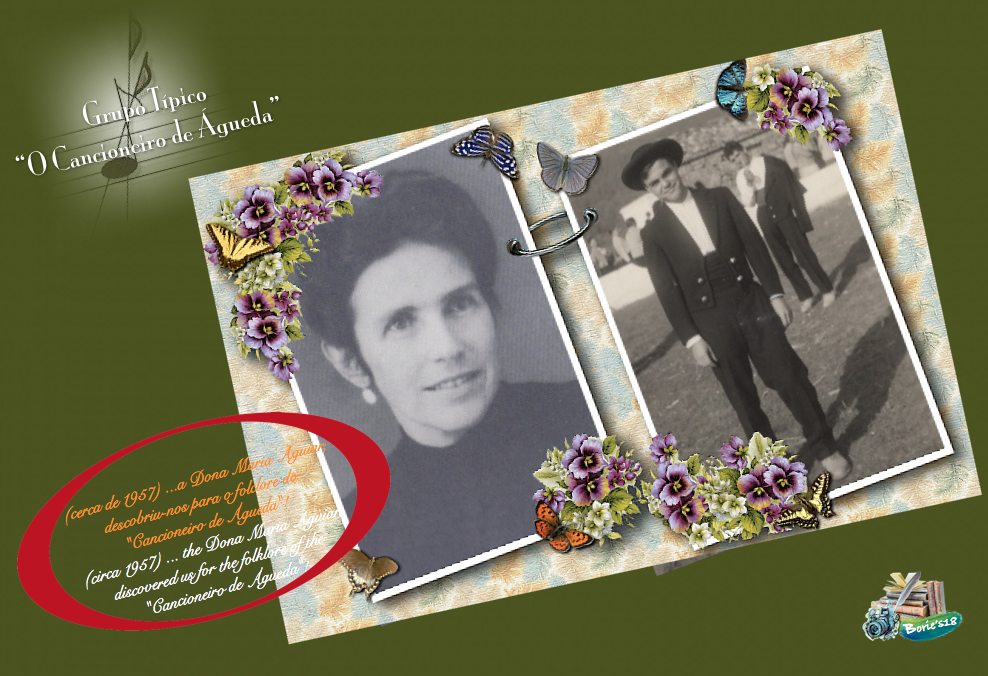
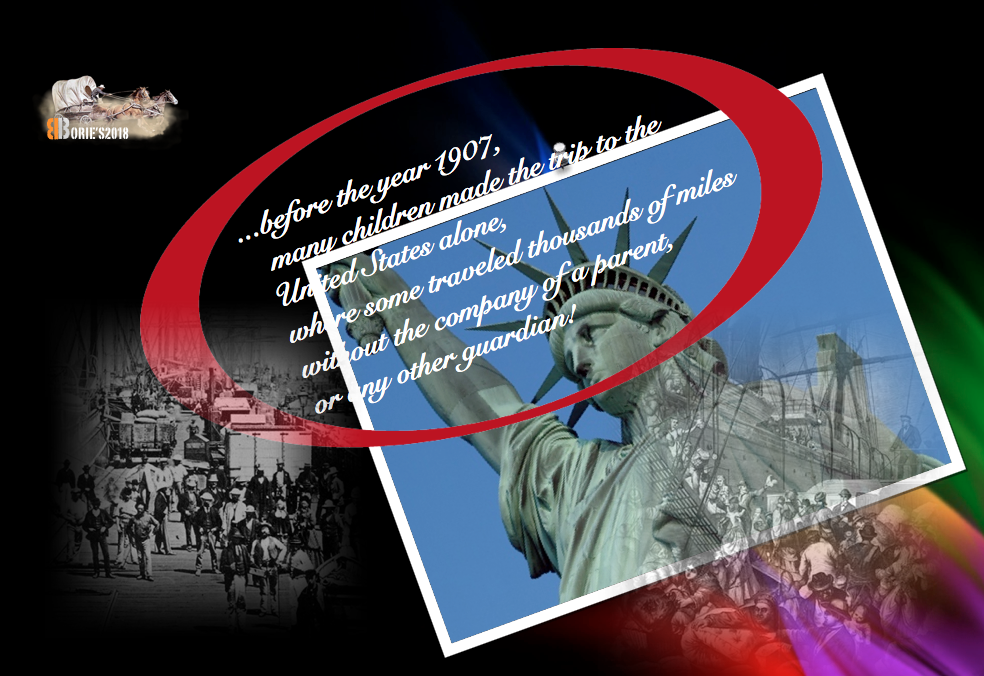
…naquela época, as forças militares que faziam parte do Exército de Portugal, pelo menos aquelas que estavam estacionadas na frente de combate da então Província Colonial da Guiné Portuguesa, começavam a ver a guerra de guerrilha agressiva e violenta, com que os guerrilheiros que lutavam pela independência do seu território usavam, como uma séria ameaça!. (At that time, the military forces that were part of the Portuguese Army, at least those that were stationed on the battlefront of the then Colonial Province of Portuguese Guinea, began to see the aggressive and violent guerrilla warfare with which the guerrillas who fought for the independence of their territory used, as a serious threat)!.

…eles, os guerrilheiros, entre outras vantagens, havia a de lutarem pelo seu ideal, pela sua terra prometida, pelo seu imaginável, pelo seu fantástico sonho de correr de vez com as pessoas (que a história universal lhes ensinou), que entre outras coisas lhe tinham escravizado os seus avós!. (The guerrillas, among other advantages, had to fight for their ideal, for their promised land, for their imaginable, for their fantastic dream of running with people (which universal history taught them), which among other things his grandparents had enslaved him)!.

…além de eles, os guerrilheiros, conhecerem e se sentirem confortáveis naquele terreno de terra vermelha, onde naquela região de África, era plano, coberto de pântanos, com corredores entre densa floresta ou terras alagadas, (onde se calcava lama, ou uma água morna, parada e coberta de mosquitos, que exalava um mau cheiro muito intenso, que a nós Europeus, nos causava tonturas, desmoralização e mau estar)!. (Besides them, the guerrillas, knew and felt comfortable in that red earth terrain, where in that region of Africa, it was flat, covered with marshes, with corridors between dense forest or wetlands, (where mud was soaked, or a warm, still water covered with mosquitoes, which exuded a very intense stench, which to us Europeans caused us dizziness, demoralization and malaise)!.

…eles, os guerrilheiros, já tinham armas sotisficadas para a época, tinham planos de ataque, conheciam o terreno em que se movimentavam, atacavam os diversos aquartelamentos das tropas Portuguesas, que existiam em lugares considerados estratégicos na então Província Colonial!. Entre outras armas, usavam o morteiro de calibre 90 mm, metralhadoras ligeiras, colocavam minas e fornilhos nos corredores de ascesso às suas bases, que às vezes eram a única via que existia, por entre os pântanos, para qualquer ser humano se deslocar de uma aldeia para outra!. (They had already had weapons for the time, had plans of attack, knew the terrain in which they moved, attacked the various barracks of Portuguese troops, which existed in places considered strategic in the then Colonial Province!. Among other weapons, they used the 90 mm caliber mortar, light machine guns, mines and fornillos in the corridors of their base, which were sometimes the only way out of the marshes for any human being to move from one village to another)!.

…muitas vezes, as tropas Portuguesas encontravam-se na pior posição, para avançar e identificar com precisão a sua localização no terreno, onde ou existia selva cerrada, pântanos ou canais, com água, lama e tarrafo, e frequentemente, quando atravessavam os rios ou canais, havia os “macaréus”, (grande vaga impetuosa que, em certos rios, se forma quando as águas desse mesmo rio se encontram com as água do mar), algumas vezes até animais perigosos, como por exemplo crocodilos, onde em algumas situações o inimigo, tirando alguma vantagem, surgia de todos os lados, atacando, disparando, sem dar qualquer oportunidade para que se recuperasse os nossos mortos ou feridos!. (Portuguese troops were often in the worst position to advance and accurately identify their location on the ground, where there were either closed jungle, swamps, or canals, with water, mud, and tarrafo, and often when they crossed the rivers or canals, there were the “macaréus”, (great impetuous wave that, in certain rivers, is formed when the waters of that same river meet with the water of the sea), sometimes even dangerous animals, as for example crocodiles, where in some situations the enemy, taking some advantage, appeared from all sides, attacking, firing, without giving any opportunity for our dead or wounded to recover)!.

…naquele cenário, não existiam condições, para se tentar recuperar qualquer morto ou ferido, pois as vítimas, deviam ser puxados para algum tipo de posição onde houvesse alguma segurança, para serem tratados e, levar um homem ferido ou morto, requer até quatro homens como portadores, o que também enfraquecia uma unidade militar num momento crítico, portanto esses infelizes militares, quando eram atingidos, alguns deles, por lá ficavam para sempre!. (In that scenario, there were no conditions, to try to recover any dead or injured, since the victims were to be pulled into some sort of position where there was some security, to be treated and to take a wounded or dead man, requires until four men as carriers, which also weakened a military unit at a critical moment, so these unhappy soldiers, some of them, when they were hit, stayed there forever)!.

…o inimigo estava bem treinado, agressivo e estava equipado com uma preponderância de armas automáticas com muitas munições, e nós, “éramos quase uns soldados sem um país”, para ali mandados, para longe das aldeias, vilas ou cidades onde nascemos, para longe do nosso continente, treinados à pressa e mal, com equipamento de combate quase absoleto, mal alimentados ou sem assistência médica, desmoralizados, vendo morrer os nossos companheiros, que ficaram ali enterrados na lama dos pântanos para sempre!. Alguns comandantes diziam, “que as tropas em cenário de guerra, não deviam ficar tão preocupadas com as baixas, para que esqueçam o inimigo, pois podiam naquele momento crítico, sofrer mais baixas na tentativa de recuperar ou ajudar os seus feridos”!. (The enemy was well trained, aggressive and equipped with a preponderance of automatic weapons with lots of ammunition, and we, “we were almost soldiers without a country”, sent there, away from the villages, towns or cities where we were born, away from our continent, trained in haste and evil, with combat equipment almost absolete, malnourished or without medical assistance, demoralized, watching our companions die, who were buried there in the mud of the marshes forever!. Some commanders said, “that the troops in a war scenario should not be so preoccupied with casualties as to forget the enemy, for they could at that critical moment suffer more casualties in an attempt to recover or help their wounded”)!.

…nós, que naquele cenário de uma guerra terrestre de guerrilha, éramos o “Cifra”, um soldado desarmado, onde a disciplina de um campo de batalha não era lá muito eficaz para a nossa sobrevivência, onde um pequeno descuido ou desleixo, onde as emboscadas, minas ou fornilhos, podiam a qualquer momento fazer com que a nossa alma nos abandonasse, na procura de uma qualquer galáxia distante, onde uma tijela de arroz ou um naco de pão era mais importante do que uma ração de combate, às vezes até mesmo do que a espingarda G-3, onde os campos abandonados da plantação de arroz, se transformaram em pântanos perigosos, onde o volume e o ruído do fogo inimigo nos trazia estarrecidos, onde só talvez, o escesso de álcool, nos dava algum miserável conforto!. (We, who in that scenario of guerrilla warfare, were the “Cipher,” an unarmed soldier, where the discipline of a battlefield was not very effective there for our survival, where a little carelessness or sloth, where ambushes, mines, or fodder, could at any moment cause our soul to abandon us, in search of any distant galaxy, where a bowl of rice or a loaf of bread was more important than a ration of combat, at sometimes even than the G-3 shotgun, where the abandoned fields of the rice plantation turned into dangerous marshes, where the volume and the noise of the enemy’s fire brought us terrified, where only perhaps the excess of alcohol gave us some miserable comfort)!.

…sim, o escesso de álcool ou alguma comida roubada no aquartelamento, como naquele dia em que tinha sido de um calor tórrido e abafado, jà noite, tavez por volta das nove e meia, dez horas da noite, mais próximo das dez do que das nove e meia, saímos do Centro de Cripto, onde executávamos as nossas tarefas, passando pela cozinha do aquartelamento, para roubar um naco de pão, aliás, como fazíamos quase todos os dias, para comer com um bocado de chouriça de conserva, que ao meio dia, nos deu o sargento da messe, a quem ajudávamos a acertar as contas no final de cada mês, pois as contas tinham que terminar em zero, não podia haver lucros nem perdas e, esse acerto por vezes era complicado!. Tinham que arranjar produtos, que quase sempre eram cigarros, às vezes até chegavam ao descaramento de incluir garrafas de “Vat 69”, que vinham da Escócia, com uma legenda no rótulo que dizia mais ou menos, “to the Portuguese Armed Forces with love” (para as Forças Armadas Portuguesas com amor), para que no final, acabasse tudo em zero!. (Yes, the amount of alcohol or some food stolen in the barracks, as on that day when it had been a hot and steamy heat, late at night, about nine-thirty, ten o’clock at night, nearer ten than nine-thirty, we left the Cripto Center, where we performed our tasks, passing by the kitchen of the quarter, to steal a loaf of bread, incidentally, as we did almost every day, to eat with a mouthful of preserved chorizo, who at noon gave us the sergeant of the harvest, whom we helped to settle the accounts at the end of each month, because the accounts had to end at zero, there could be no profits and no losses, and that was sometimes a tricky hit!. They had to find products, which were almost always cigarettes, sometimes even cheating to include bottles of “Vat 69,” which came from Scotland with a caption on the label that read, “to the Portuguese Armed Forces with love”, so that in the end, everything would end in zero)!.

…quando passávamos pela cozinha fora das horas habituais, o responsável pela precária alimentação a que estávamos sujeitos, que fazia o possível e o impossível, para que pelo menos uma vez ao dia nos fosse fornecida alguma comida quente, e que nós carinhosamente o chamávamos de “Arroz com Pão”, pois era este o seu nome de guerra, derivado a sempre que alguém dizia que não gostava da comida, ele logo se aproximava do espaço de onde tinha vindo a reclamação e, com um farrapo amarrado à cinta servindo de avental, que todos sabiam que esse farrapo, alguns meses atrás, tinha sido uma camisa, dizia:

    – Qual é a reclamação?. A comida está limpa e muito bem confeccionada!. Se não gostam, façam sandes de arroz com pão!.

(When we passed by the kitchen outside the usual hours, the person responsible for the poor food we were subjected to, who did the possible and the impossible, so that at least once a day we were provided with some hot food, and that we affectionately we called it “Rice with Bread,” since this was his name of war, derived from whenever someone said he did not like the food, he soon approached the space where the complaint had come from, and with a rag tied to the serving belt in an apron, that everyone knew that this rag, a few months ago, had been a shirt, said:

   – What is the complaint?. The food is clean and very well made!. If you do not like it, make rice sandwiches with bread)!.

…como era possível fazer sandes de arroz com pão!. Ainda bem que o companheiro Curvas, alto e refilão, andava sempre com fome e comia de tudo, porque de contrário havia conflito, e do grande!. (How it was possible to make rice sandwiches with bread!. Thank goodness that Curvas, tall and complicative, was always hungry and ate everything, because otherwise there was conflict, and the great)!.

…normalmente, quando nos aproximávamos da cozinha, fora das horas habituais e, o “Arroz com Pão”, andava por perto, logo nos dizia:

   – Hó “Cifra”, se vens aqui outra vez, depois da cozinha fechar, dou-te um tiro!. Se eu não posso entrar no Centro de Cripto, tu também não podes entrar aqui!. Caralho, que gente mais gulosa e descarada!.

…ao que nós, normalmente respondíamos:

   – Parece que isto é teu!. Hó “Arroz com Pão”!.

…nesse momento ficava mau e barafustava, mas de repente lhe passava, indo buscar uma caneca que normalmente servia o café, cheia de vinho para os dois!.

(Usually, as we approached the kitchen, outside the usual hours, and “Rice with Bread,” walked around, it would soon tell us:

    – Cipher, if you come here again, after the kitchen closes, I’ll shoot you!. If I can not enter the Crypto Center, you can not enter here either!. Fuck, people who are greedy and brazen!.

To which we would normally respond:

    – Looks like this is yours!. Hó “Rice with Bread”!.

At that moment it would get bad and it would get wet, but suddenly it would happen, going to get a mug that usually served the coffee, full of wine for both)!.

…nessa fatídica noite, que não mais esquecemos, ao entrar na cozinha, o “Arroz com Pão”, estava a fazer as suas últimas tarefas, preparando as coisas para o café da manhã, quase pronto para fechar!. O argumento foi o mesmo de sempre, a nossa resposta foi a mesma e, no final a mesma caneca do café cheia de vinho, para os dois!. (On that fateful night, which we no longer forget, as he entered the kitchen, “Rice with Bread”, was doing his last tasks, preparing things for breakfast, almost ready to close!. The argument was the same as always, our response was the same, and in the end the same coffee mug full of wine for both)!.

…já fora da cozinha, a caminho das barracas onde dormíamos, ouvimos uma forte rebentação numa área próximo da cozinha, seguida do som de tiros de metralhadora, também nos pareceu ouvir alguns gritos de aflição!. Era o fogo inimigo, era o som de armas automáticas que penetravam nos nossos ouvidos!. Ainda não havia arame farpado em redor do aquartelamento, o inimigo tentava entrar no nosso espaço, as rajadas das suas armas automáticas eram terríveis, o calor tórrido e abafado que se tinha feito sentir durante o dia, transformou-se naquele momento numa chuva que, de miudinha se foi aumentando, encharcando aquele campo de batalha onde num cenário de medo e angústia, já se ouviam gritos de aflição e militares a correr em direcção aos abrigos ainda improvisados!. (Already out of the kitchen, on the way to the tents where we slept, we heard a strong surf in an area near the kitchen, followed by the sound of machine gun shots, we also seemed to hear some cries of distress!. It was the enemy fire, it was the sound of automatic weapons that penetrated our ears!. There was still no barbed wire around the barracks, the enemy tried to enter our space, the gusts of their automatic weapons were terrible, the torrid, muffled heat that had been felt during the day, it became in that moment a rain that, of little one was increasing, flooding that field of battle where in a scene of fear and anguish, there were already cries of distress and military to run towards the shelters still improvised)!.

…lembramo-nos de que durante os rebentamentos, olhando para fora da área do aquartelamento, apenas o pequeno crepúsculo misterioso penetrava no chão da selva, rodeada de pântanos, que era a área onde estávamos situados!. O inimigo tentava empurrar-nos mais para dentro do nosso espaço!. Estávamos em pânico, escorregando na lama, também fugimos para um abrigo ainda improvisado, que por ali existia, onde já não havia lugar, mas antes parámos, ficando como que paralizados e, nesse momento lembramo-nos de dizer, quase gritando:

  – Hó meu Deus, é o “Arroz com Pão”!..

(we remember that during the bursts, looking out of the barracks area, only the small mysterious twilight penetrated the jungle floor, surrounded by marshes, which was the area where we were situated!. The enemy tried to push us further into our space!. We were in a panic, slipping in the mud, we also fled to a still improvised shelter that existed there, where there was no place, but before we stopped, being paralyzed and at that moment we remember saying, almost shouting:

    – Oh my God, it’s the “Rice with Bread”)!.

…nós éramos era um militar razoável, mas um fraco guerreiro, dessa componente, nós já sabíamos, mas com uma coragem que ainda hoje, já com esta idade, nunca soubémos onde a fomos buscar, voltámo-nos, invertendo a nosso rumo, indo de novo em direcção ao lugar onde estava situada a cozinha, onde o “Arroz com Pão”, já vinha ao nosso encontro, quase arrastando-se, com um lado do seu corpo com algum sangue, mas com a nossa ajuda e com alguma sorte, nos fomos arrastando para um outro abrigo também improvisado, já coberto de água e lama!. (We were a reasonable soldier, but a weak warrior, of that component, we already knew, but with a courage that even today, at this age, we never knew where we went to seek it, we turned, reversing our course, heading back to the place where the kitchen was located, where “Rice with Bread” was already coming to us, almost dragging itself, with one side of his body in some blood, but with our help and with some luck, we were dragging ourselves to another shelter also improvised, already covered with water and mud)!.

…o nosso pelotão de morteiros, que sempre esteve estacionado neste aquartelamento, ajudando tal como nós, na construção deste posto avançado, onde começava a zona de guerra, era composto por militares com experiência em combate, eram guerreiros!. Depressa se organizaram, tomando uma posição defensiva, no entanto os guerrilheiros inimigos, continuaram a atacar pelos flancos, onde eram repelidos pelas agora rajadas das nossas armas e pelas granadas de morteiro, embora de calibre 60 mm, eram disparadas por militares experientes, que de pouco a pouco foram dissuadindo os guerrilheiros, diminuindo a força e intensidade dos seus ataques, que talvez derivado às inúmeras baixas, ou notando que estavam a enfrentar um inimigo com uma força maior, acabaram por se retirar para a selva rodeada de pântanos, que nos circundava!. (Our mortar platoon, which was always stationed in this barracks, helping us, as we were, in the construction of this outpost, where the war zone began, was composed of soldiers with experience in combat, they were warriors! They quickly organized, taking a defensive position, yet the enemy guerrillas continued to attack by the flanks, where they were repulsed by the now bursts of our weapons and by the mortar grenades, although of caliber 60 mm, were fired by experienced military, that of little by little they were dissuading the guerrillas, diminishing the force and intensity of their attacks, that perhaps derived to the countless casualties, or noticing that they were facing an enemy with a greater force, they ended up to retire to the jungle surrounded by marshes, that in us it circled)!.

…a chuva continuava, havia muitos destroços no aquartelamento, a cozinha ficou práticamente destruída, nós voltámos ao Centro de Cripto, que assim como outras instalações de comando, sofreram menos destruição, formando-se lá um posto de enfermagem de emergência, onde no meio de uma intensa confusão, se ouviam constantemente os “Alfas”, “Bravos” e “Charlies”, que eram o códigos das letras do alfabeto e, o “Pastilhas” (enfermeiro), prestava ajuda a uns e outros, esperando pela primeira luz da manhã, onde chegaria o helicóptero para a evacuação de alguns para o hospital miltar, em Bissau!. (The rain continued, there was a lot of wreckage in the barracks, the kitchen was practically destroyed, we returned to the Cripto Center, which, like other command facilities, suffered less destruction, forming an emergency nursing station, where in the midst of intense confusion, “Alphas”, “Bravos” and “Charlies”, which were the codes of the letters of the alphabet, were constantly being heard, and “Pastilhas” (nurse) was helping some and others, waiting for the first light of morning, where the helicopter would arrive for the evacuation of some to the hospital miltar in Bissau)!.

…o resultado deste violento ataque foi, um militar morto, atingido pela explosão de uma granada de morteiro 90 mm, destruindo parte do seu corpo, um civil e natural da província, também morto, que era habitante da tal aldeia, com casas cobertas de colmo, que ficava perto do aquartelamento, pois uma dessas granadas de morteiro foi cair à aldeia!. Houve também ferimentos com balas em dois militares das forças de intervenção, que já depois do ataque, saíram a patrulhar a zona, disparando as suas armas aqui e ali, no intuito de repelir de vez os guerrilheiros, um foi de raspão, numa perna, outro, tinha uma bala alojada num braço, perto da clavícula!. (The result of this violent attack was, a dead soldier, struck by the explosion of a mortar shell 90 mm, destroying part of his body, a civilian and natural of the province, also dead, that was inhabitant of such village, with houses covered with stalk, which was near the quarter, for one of those mortar grenades was to fall into the village!. There were also gunshot wounds in two of the intervention forces, who, after the attack, went out to patrol the area, firing their weapons here and there, in order to repel the guerrillas once and for all, one was a scrape, one leg, another had a bullet lodged in one arm near the collarbone)!.

…dos outros quatro militares feridos, o mais mal tratado era o “Arroz com Pão”, que tinha estilhaços de granada de morteiro de um lado corpo, num braço e nas pernas, felizmente não foi atingido na zona da cara, os restantes militares ficaram feridos, com escoriações ligeiras, nos quais nos incluíamos, também com estilhaços de granada de morteiro, na parte superior da perna direita, que só nos apercebemos da situação, ao deitarmo-nos, quando descalçámos as botas, vendo uma húmida e a meia suja de sangue, reparámos no rasto do sangue, que vinha da parte superior da perna!. Recebemos os estilhaços de granada, no momento em que fugíamos pela primeira vez, sobre pânico e angustiados, para o tal abrigo improvisado, onde já não havia espaço!. (Of the other four wounded soldiers, the most ill-treated was “Rice with Bread,” which had mortar shell fragments on one side of the body, on one arm and on the legs, fortunately was not hit in the face area, the remaining the soldiers were wounded, with slight excoriations, in which we also included mortar shell fragments in the upper part of the right leg, which we only noticed when we went to bed, when we took off our boots, seeing a damp and half dirty of blood, we noticed the trace of blood, which came from the upper part of the leg!. We received the splinters of grenade, the moment we fled for the first time, panic and distressed, to such an improvised shelter, where there was no space)!.

…pela manhã, foram detectadas diversas marcas na lama, nos flancos do aquartelamento, de sangue e corpos arrastados dos guerrilheiros inimigos, assim como um boné de caqui amarelo, uma metralhadora e algumas munições de origem chinesa, deixadas pelo inimigo, que deviam de ter sofrido algumas baixas, recolhendo os corpos em seguida, como era seu costume!. (In the morning, several marks were detected in the mud, on the flanks of the barracks, blood and dragged bodies of the enemy guerrillas, as well as a cap of yellow persimmon, a machine gun and some ammunition of Chinese origin, left by the enemy, which of having suffered some casualties, collecting the bodies then, as was his custom)!.

…o Curvas, o tal soldado atirador, alto e refilão, gritando dizia:

     – Filhos da puta!. Eu penso que matei dois ou três!. Já não tinha mais carregadores cheios!. Eu creio que alguns tiros vinham do lado aldeia, que fica perto do aquartelamento!.

…todos diziam, que era só basófia, não tinha matado ninguém, mas o Curvas, alto e refilão, continuava a afirmar que alguns tiros tinham vindo da aldeia, próximo do aquartelamento!.

(The Curvas, that soldier, sniper, high and complicative, shouting said:

     – Sons of bitches!. I think I killed two or three!. There were no more full loaders!. I believe some shots came from the village side, which is near the quartering!.

Everyone said, that it was just a bassoon, had not killed anyone, but the Curvas, high and complicative, continued to claim that some shots had come from the village, near the barracks)!.

…nós não fomos evacuados para o hospital militar em Bissau, curámos o ferimento e, uns tempos antes de regressar a Portugal, viémos então ao hospital militar em Bissau, tirar o fragmento da granada, que felizmente cicratizou, sem mais complicações, mas que ainda hoje é visível!. (We were not evacuated to the military hospital in Bissau, we healed the wound and, some time before returning to Portugal, we then came to the military hospital in Bissau, to remove the fragment of the grenade, which happily healed, without further complications, but which is still visible today)!.

…pela manhã, o café foi feito mais tarde que o habitual, numa cozinha que se improvisou, pois a original ficou com uma parte inutilizável, pelas granadas inimigas, que lá caíram!. Ninguém mais disse que não gostava da comida e, o “Arroz com Pão”, recebeu uma grande salva de palmas, no dia em que se apresentou de novo no aquartelamento, já restabelecido dos ferimentos, com o seu habitual avental, que tempos atrás, tinha sido uma camisa!. E nós, continuámos a roubar pão na nova cozinha!. (In the morning, the coffee was made later than usual, in a kitchen that improvised, because the original was left unusable, by the enemy grenades, that fell there!. No one else said that he did not like the food, and “Rice with Bread” received a great deal of applause on the day he returned to the barracks, already recovered from the wounds in his usual apron, it had been a shirt!. And we, we continued to steal bread in the new kitchen)!.

…naquela época, “éramos quase uns soldados sem um país”!. E hoje, mais de cinquenta anos depois, continuamos a ser, pois o país que para lá nos mandou, para aquela maldita guerra de guerrilha, tirando-nos, ainda jovens das nossas aldeias, vilas ou cidades, oferecendo-nos naquele tempo um bilhete de lotaria, onde podíamos ser contemplados com uma morte violenta, num cenário de combate, onde a qualquer momento o nosso jovem corpo podia ser destruído por balas ou estillaços de uma qualquer granada, mina ou fornilho, que com alguma sorte seria recolhido, embrulhado no seu camuflado sujo com o seu próprio sangue, para não ser abandonado naqueles pântanos cobertos de água suja de lama, como aconteceu a muitos companheiros, ou os traumas daquela maldita guerra, que nos têm acompanhado durante a nossa já longa existência e, como dizíamos, esse nosso país, continua a ignorar-nos, contemplando-nos com uma ‘fortuna’, equivalente a 41 centavos por dia!. (At that time, “we were almost soldiers without a country”!. And today, more than fifty years later, we continue to be, for the country that sent us there, for that damn guerrilla war, taking us still young from our villages, towns or cities, offering us at that time a ticket where we could be contemplated with a violent death, in a scene of combat, where at any moment our young body could be destroyed by bullets or stings of any grenade, mine or fornillo, that with some luck would be collected, wrapped in the his dirty camouflage with his own blood, so as not to be abandoned in those marshes covered with muddy water, as happened to many companions, or the traumas of that damn war that have accompanied us during our long existence and, as we said, our country, continues to ignore us, contemplating us with a ‘fortune’, equivalent to 41 cents a day)!.

…talvez por tudo isto, agora, com mais frequência, vamos morrendo, vamos desaparecendo, vamos libertando-nos deste mundo onde muitas injustiças ainda existem!. (Perhaps because of all this, now, more often, we die, we are disappearing, let’s free ourselves from this world where many injustices still exist)!.

…nós combatentes da Guerra Colonial Portuguesa, já somos poucos, cada vez menos, talvez para “alívio” de alguns políticos governantes que, vivendo com conforto em cidades, recebendo mensalmente ordenados e mordomias relevantes, vêm em nós pessoas que, embora defendendo a bandeira de Portugal, dando o corpo às balas, defendendo o então país Colonial Portugal, agora os “atrapalham”, para não dizer outra palavra que normalmente se junta ao substantivo para o qualificar, que pode ser o adjectivo qualificativo “envergonham”, que também pode ser considerado um verbo pronominal!. (We fighters of the Portuguese Colonial War, there are already few, less and less, perhaps for the “relief” of some ruling politicians who, living with comfort in cities, receiving monthly ordained and relevant stewards, come in us people who, while defending the Portuguese flag, giving the body to the bullets, defending the then Colonial Portugal country, now “hinder” them, not to say another word that normally joins the noun to qualify it, which may be the adjective qualifier “ashamed”, which can also be considered a pronominal verb)!.

…apetece-nos gritar!. Hó linda língua portuguesa, língua de Camões, que aprendemos na escola rudimentar do Adro, na então vila de Águeda, que hoje, já lá vão tantos anos, vivendo tão longe, ainda adoramos, tentando ensiná-la aos nossos netos e, tão complicada que é, nunca nos “atrapalhou” e, nunca nos há-de “envergonhar”! (Feel like screaming!. There is a beautiful Portuguese language, the language of Camões, which we learned in the rudimentary school of the Adro, in the village of Águeda, which today, so many years of existence, living so far away, we still love it, trying to teach it to our grandchildren, that is, it never “got in the way” and will never “embarrass us”)!.

Tony Borie, August 2018.